A restaurant owner checks Google reviews between deliveries, answers a Facebook complaint during lunch service, and discovers an industry-site review days after it was posted. The replies are polite, but rushed. Some customers receive a response within hours, while others receive silence. At the same time, the owner is expected to protect the business's reputation, learn from recurring complaints, and keep every location's voice consistent.
That's the problem AI review management addresses. It isn't a faster way to write “Thanks for your feedback.” Used well, it's a trust and governance system that helps a local business find reviews, understand what customers mean, choose the right response path, and keep a person accountable for sensitive decisions.
Why Reviews Now Demand More Than Manual Management
Reviews influence whether customers discover a local business and whether they feel comfortable choosing it. A 2016 Pew Research survey found that 82% of U.S. adults at least sometimes read online customer ratings or reviews before buying something for the first time, while 40% said they always or almost always do so. More recent consumer research reports that 97% of consumers read online reviews before making a purchase, and 89% expect businesses to respond. These figures come from consumer research on online reviews and purchasing behavior.
Consider a neighborhood dental practice with several dentists and a steady flow of appointments. A patient praises a receptionist on Google. Another complains about waiting time on Facebook. A third posts a detailed comment on a healthcare directory. Each review contains useful information, but the office manager has to notice the review, identify the issue, decide whether it needs escalation, write a suitable reply, and record any operational follow-up.
Manual checking breaks down because customers don't research in one place. One 2026 report says consumers now use an average of 6 review sites during research, while the same source estimates that Google hosts around 73% of all online reviews. Those figures support a practical conclusion: Google deserves close attention, but a business that only checks Google can still miss important customer conversations.
The hidden cost of falling behind
A delayed response does more than leave one customer waiting. It can signal that the business doesn't monitor feedback, doesn't take complaints seriously, or has no clear owner for customer experience. A copied reply creates a different problem. It may technically satisfy a response expectation while making the business sound inattentive.
Review management also has an operational purpose. A cluster of comments about cold food, confusing invoices, parking, or missed appointment reminders can reveal a process problem that a star rating alone won't explain. Employees need a way to separate routine praise from issues requiring a manager, service recovery, or fraud review.
Practical rule: Treat every review as both a public reputation signal and a private piece of operating feedback.
AI has entered this workflow because review consumption is widespread, research happens across multiple platforms, and response expectations are high. The sensible goal isn't to remove people from the process. It's to give a small team the same kind of sorting and prioritization support that a larger operation can build internally.
What AI Review Management Really Means
Think of AI review management as a capable front-desk assistant. The assistant watches the incoming channels, reads each message, identifies the topic and emotional tone, suggests what deserves attention first, and prepares a response for a staff member to approve. It doesn't own the business, decide whether a refund is appropriate, or invent facts about a customer's experience.
The system usually performs three connected jobs:
- Monitoring finds new reviews across connected platforms.
- Understanding classifies sentiment, topics, language, urgency, and possible risk.
- Acting routes the review, drafts a reply, records the outcome, and surfaces patterns for the team.
That distinction matters because a simple template tool and an AI system aren't the same. A template might insert a customer's name into a fixed sentence. AI can interpret whether “the room was spotless, but check-in took forever” contains both praise and a service complaint, then recommend a response that addresses the actual issue.
The difference between assistance and replacement
AI works from patterns in language and from the information supplied to it. It can recognize that “rude cashier,” “slow checkout,” and “friendly staff” relate to service experience, but it may not know whether the cashier was following a new policy or whether the customer's account has already been resolved.
That's why the strongest setup combines automation with human accountability. Staff members define the brand voice, approved policies, escalation rules, and factual knowledge base. AI handles repetitive reading and drafting. A person checks the response when the review involves allegations, personal information, compensation, safety, discrimination, legal threats, or an unclear situation.
Businesses that want to understand the analysis layer can also explore this guide to customer feedback analysis with AI. The important concept is simple: AI should help the team make a better decision, not hide who made it.
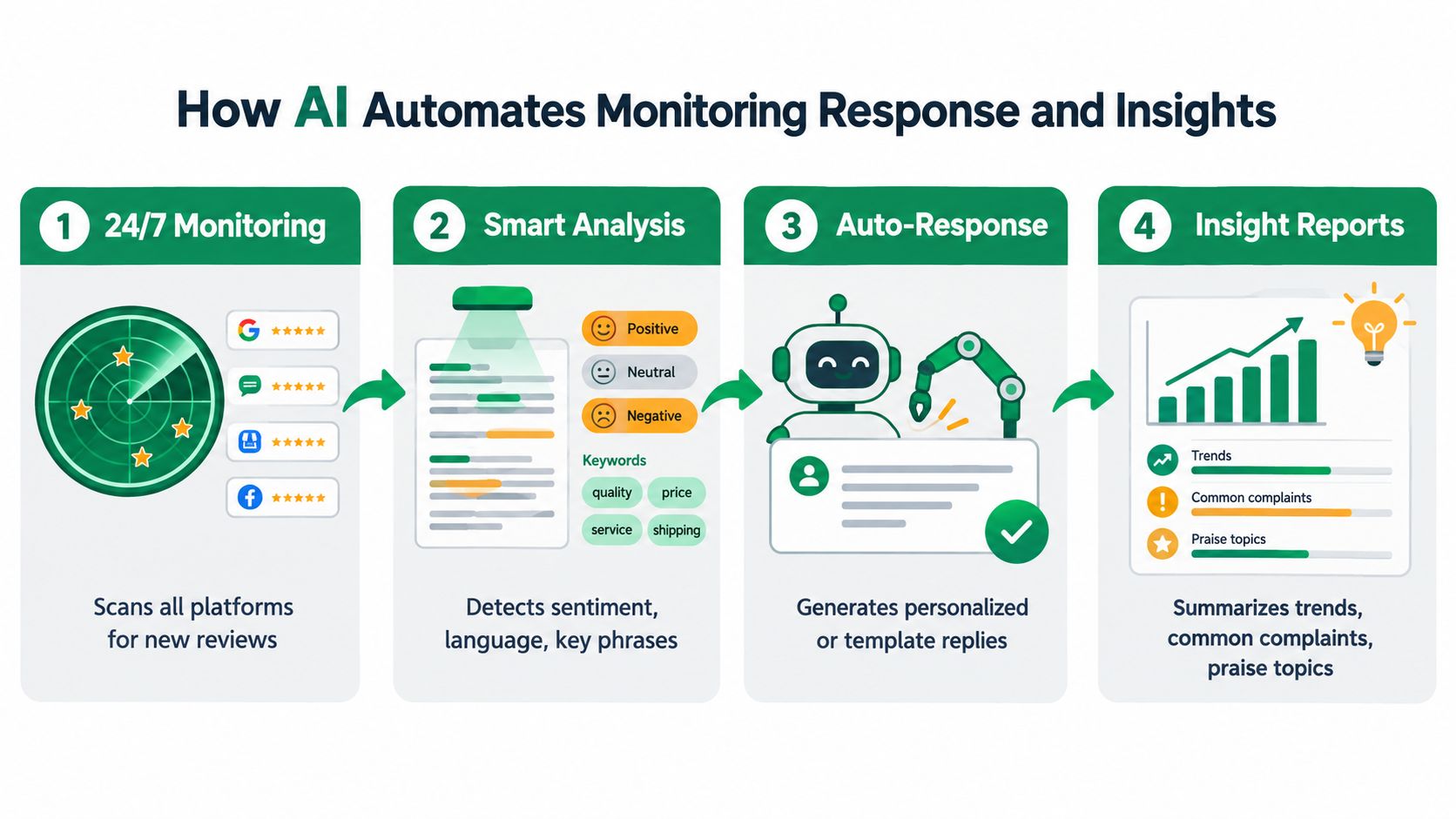
How AI Automates Monitoring Response and Insights
An AI review system moves information through a sequence. Each stage has a different job, and errors at one stage can affect the next. A platform that collects reviews but misclassifies urgency can still create a poor customer experience. A platform that drafts polished replies without current business facts can produce a response that sounds good and says the wrong thing.
1. Monitoring catches the conversation
The system connects to supported review sources and checks for new activity. Instead of asking an office manager to open several dashboards, it places new items in a shared queue. A local auto repair shop might see a five-star review, a complaint about an unexplained charge, and a question about weekend hours in the same workspace.
The queue should preserve useful context, including the location, rating, review text, platform, date, and response status. That information helps a manager determine whether the review is routine, urgent, duplicated, or connected to an existing customer-service case.
2. Analysis turns text into priorities
Sentiment analysis estimates whether the language is positive, negative, or mixed. Topic detection identifies themes such as staff, cleanliness, pricing, delivery, appointment access, or product quality. Triage then assigns a practical route.
For example, “The technician fixed the problem, but nobody called to explain the delay” is not positive or negative. A good system can identify successful service alongside a communication failure. That gives the manager a more useful starting point than a star rating alone.
A 2026 statistics roundup cites a Podium AI Report finding that 42% of businesses with 50 or more employees use AI tools to monitor, analyze, or respond to reviews. The same source reports that AI-powered sentiment analysis can classify thousands of reviews in seconds with 87% accuracy compared with human assessment. These figures are reported in online review management statistics for 2026. They explain why larger organizations and multi-location businesses are using machine-assisted triage, while still leaving room for human review of uncertain cases.
3. Response generation creates a starting point
The drafting layer combines the review with approved business information and response rules. It might use a thank-you template for uncomplicated praise, retrieve an answer about parking from a knowledge base, or prepare a more specific response for a mixed review.
A draft should never promise a refund, claim that an employee has been disciplined, or state that an investigation occurred unless the business has confirmed those facts. The team should also avoid repeating personal details publicly, even when the customer included them in the review.
4. Insight reporting turns repetition into action
A single complaint can be isolated. Repeated complaints about the same topic deserve investigation. AI can summarize recurring themes for a weekly operations meeting, helping a café notice repeated comments about mobile-order confusion or a salon identify a pattern involving appointment reminders.
The report becomes useful when a named person owns the next step. “Several customers mention delays” is an observation. “The store manager will review handoff procedures and report back” is an operational decision.
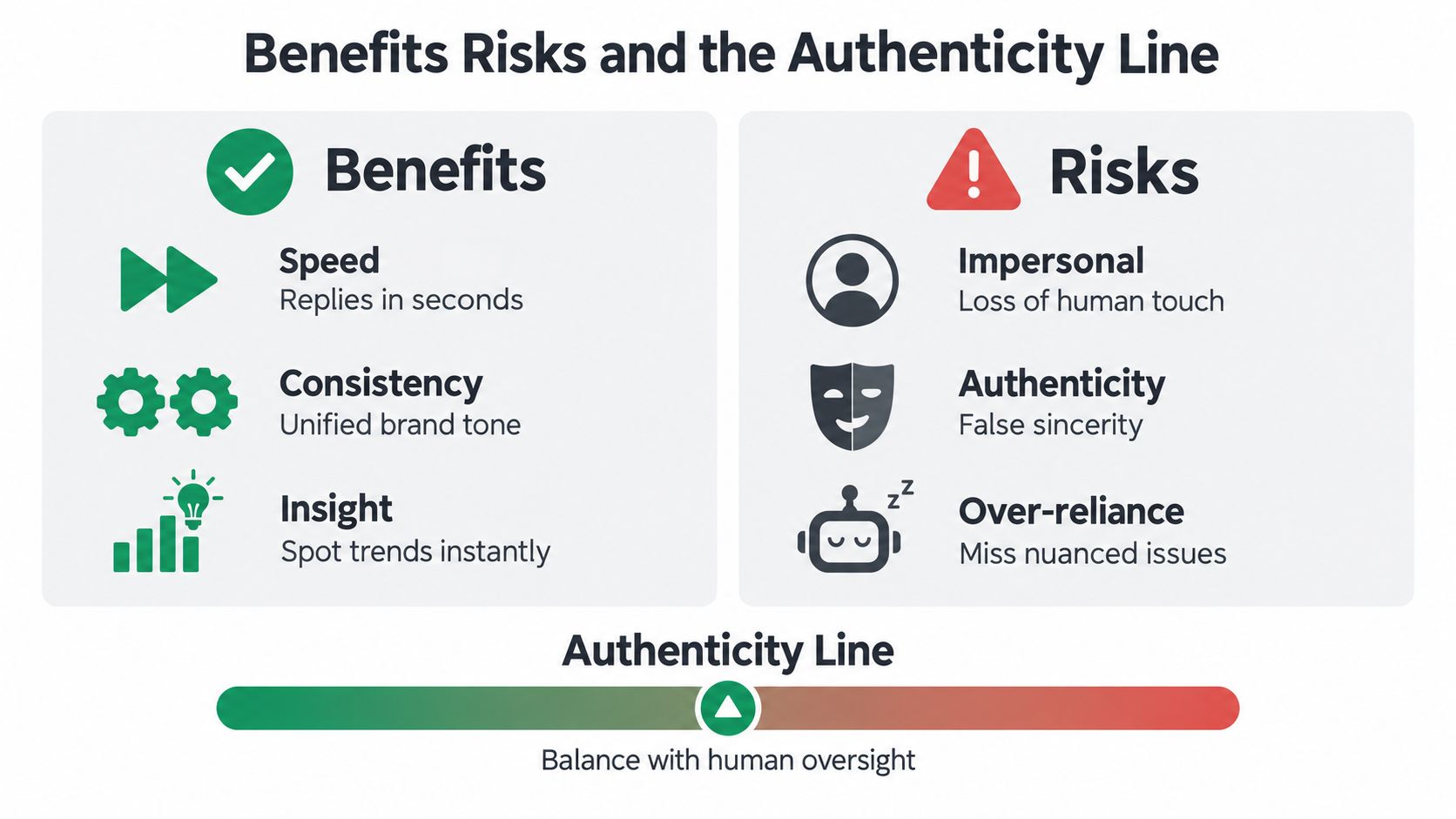
Teams comparing service options can also look at B2B AI driven reputation services for a broader view of managed reputation workflows. For day-to-day monitoring fundamentals, online review monitoring offers a useful operational reference.
From Inbox Chaos to Controlled Workflow
Manual review management often follows an informal pattern: someone notices a review, copies the text into a message, asks a manager what to do, writes a reply, and hopes nobody else responds first. An AI-assisted workflow makes the decision explicit. It routes simple items quickly and protects complex cases from careless automation.
The most practical design uses risk-based routing rather than one setting for every review. A low-risk review can receive a controlled template or a lightly personalized draft. A question requiring a current policy can use retrieval from an approved FAQ. A serious complaint should go to a human, with AI assisting only after the facts are known.
Choosing the right response path for each review
| Review Type | Recommended Approach | Human Role |
|---|---|---|
| Uncomplicated positive review | Approved thank-you template with limited personalization | Confirm the tone and publish |
| Positive review with a specific service detail | AI-assisted draft grounded in approved business information | Check names, facts, and specificity |
| Mixed review with praise and criticism | Assisted draft that addresses each meaningful point | Edit for empathy and confirm the action |
| Routine question about hours, parking, or services | FAQ retrieval followed by a concise draft | Verify that the information is current |
| Complaint involving money, safety, privacy, discrimination, or legal language | Human-only response, with AI used only for internal summarization if policy allows | Investigate, approve, and document the decision |
| Suspected fake, incentivized, or abusive review | Integrity and escalation workflow | Preserve evidence and follow platform policy |
This routing model reflects what a hospitality response system demonstrated in practice. The system used a preprocessing module, a generation model, and a postprocessing module trained on about 8,000 review-response pairs. The example shows why domain-specific training data and text cleanup matter. Raw review text may contain spelling errors, excessive punctuation, or unclear references, and generated language needs constraints before publication. Details are available in the hospitality review-response research paper.
A separate marketplace deployment used retrieval-augmented generation, often called RAG, to process more than 3,800 reviews. It was estimated to save 120 working hours, while negative-feedback response times fell to about 5 minutes. The system selected templates, FAQ lookup, or generated responses according to review type and rating, a pattern that supports routing routine cases away from more complex work. See the marketplace RAG deployment paper for the described architecture.
The lesson isn't that every business needs the same system. It's that automation should follow a decision policy. Templates handle predictability. Retrieval handles factual questions. Generation supports nuance. People remain responsible for judgment.
Benefits Risks and the Authenticity Line
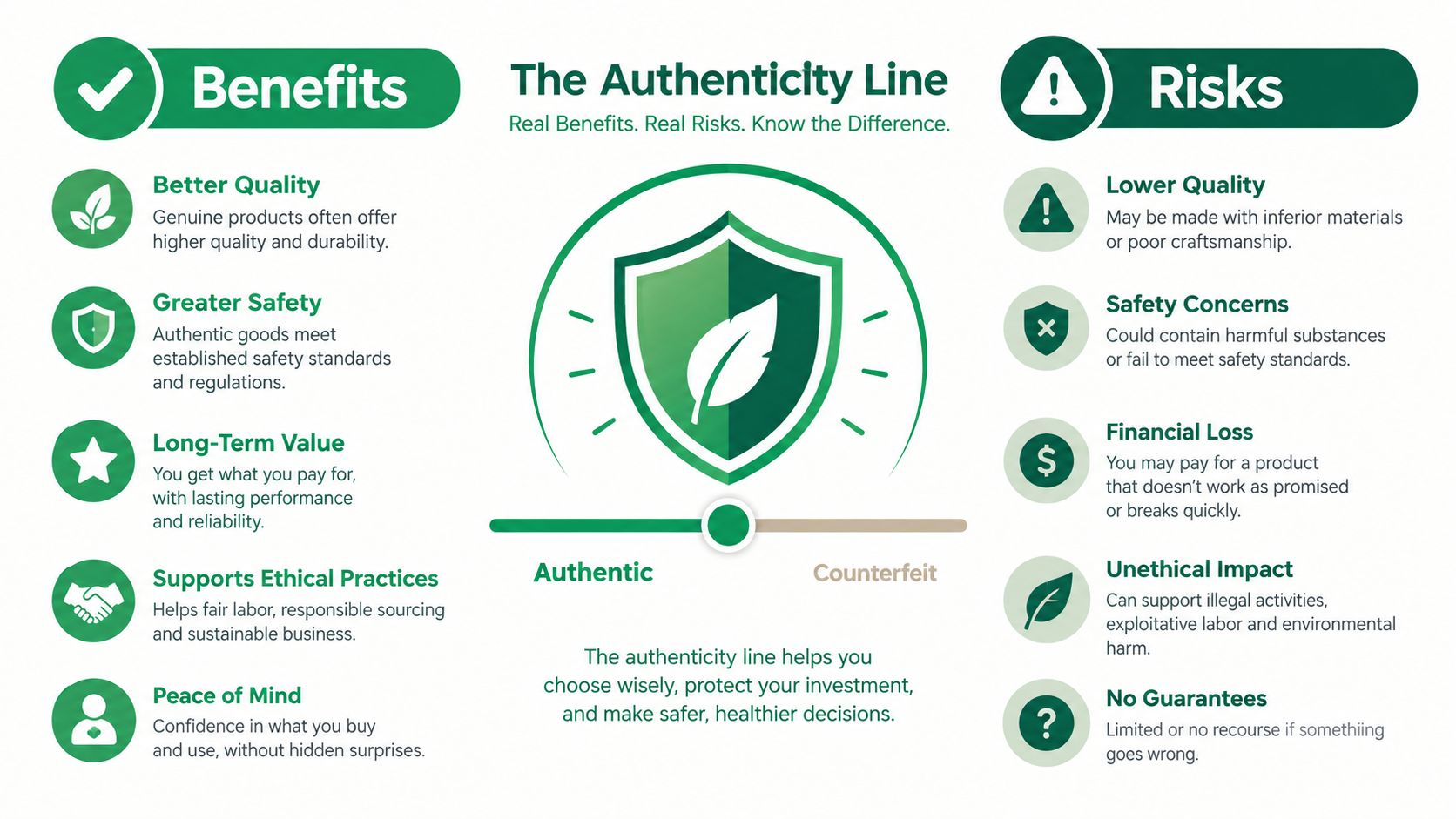
AI can make review operations more manageable, but speed is only one part of reputation quality. A fast reply that sounds false can weaken trust. A consistent reply that ignores the customer's specific concern can look like a mass-produced message. A polished response can also create compliance risk if it makes promises the business hasn't authorized.
Consumer research highlights the tension. One survey found that 70% of respondents trust a business less when review responses are AI-written rather than human-written, while 48.6% of Americans who have seen AI-generated review summaries trust them less than human reviews or not at all. The same research notes that some consumers may prefer an AI-written response when they don't know AI created it, which reveals a gap between hidden preference and informed trust. These findings are reported in GatherUp's research on AI and review authenticity.
Where assistance becomes deception
The line isn't whether a machine touched the text. It depends on what the business claims, how much judgment a person applied, and whether the reply creates a misleading impression.
A useful standard has four parts:
- Use approved facts: Give the system current hours, policies, service descriptions, and escalation instructions.
- Require meaningful review: Staff should read the entire draft, not approve automatically because the wording appears friendly.
- Escalate sensitive cases: Keep allegations, safety issues, personal data, compensation, and legal threats under human control.
- Preserve a natural voice: Edit generic phrases, respond to the actual complaint, and remove exaggerated promises.
The integrity question also applies to the reviews themselves. In 2026, 82% of consumers said they read AI-generated review summaries, and 23% said they would rely solely on them. The same BrightLocal research reports that 42% trust AI platforms to recommend local businesses as much as traditional reviews, while 55% see fake reviews as a growing concern. It also reports that 42% think a review is fake when it appears connected to a paid or incentivized agreement. These findings appear in BrightLocal's local consumer review survey.
That combination changes the responsibility of local businesses. Don't use AI to manufacture praise, pressure customers into positive wording, suppress legitimate criticism, or create replies that pretend a human investigated something when nobody did. Use it to organize genuine feedback and help staff respond accurately.
The authenticity line: Automate the reading and preparation. Keep responsibility for truth, judgment, and customer care with people.
Choosing and Implementing AI Tools for Local Workflows
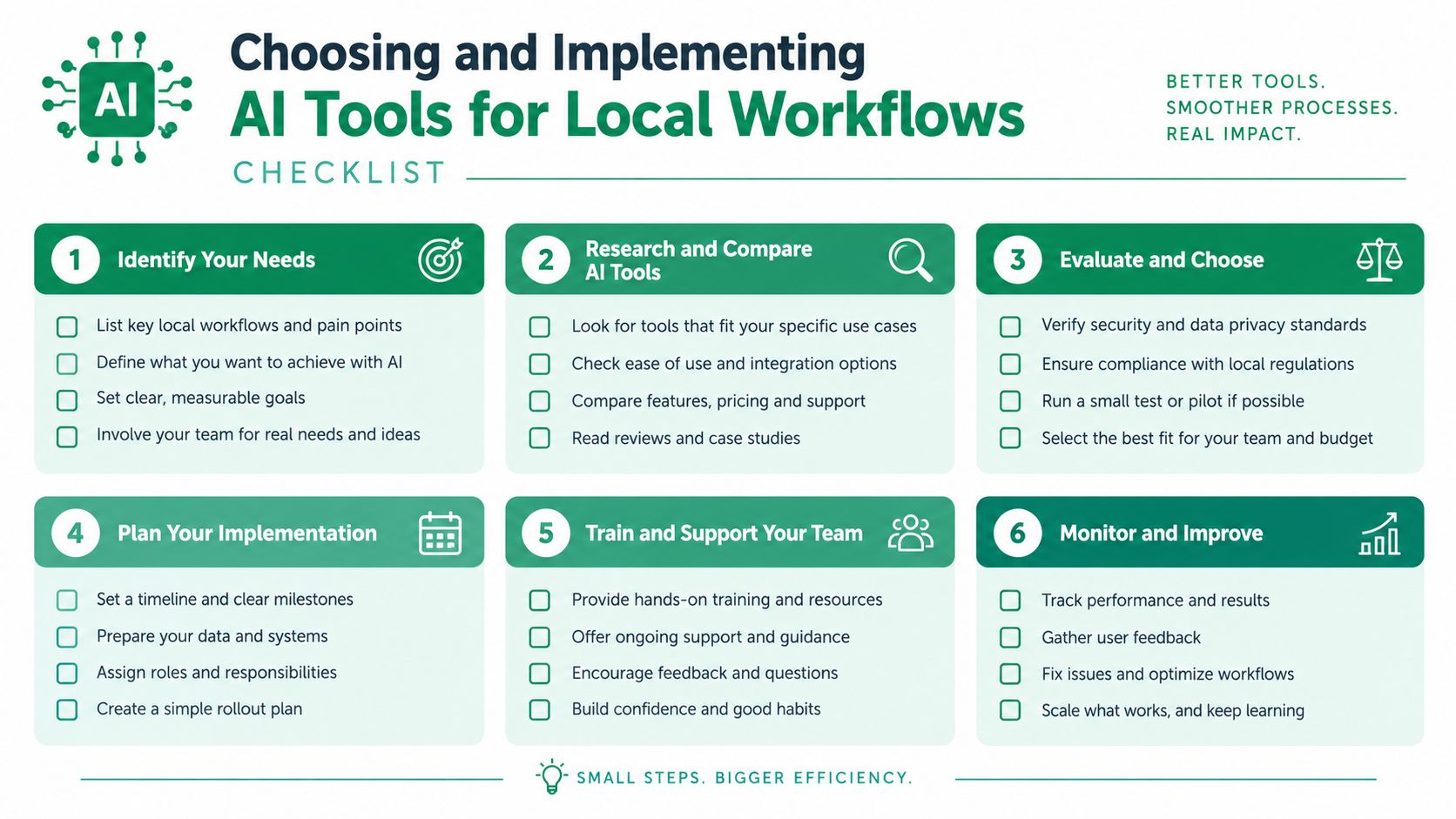
Start with the workflow, not the product catalog. A single-location shop may need review alerts, sentiment labels, response drafts, and a simple approval queue. An agency or franchise team may also need location permissions, shared reporting, audit history, and separate brand rules.
Review the tool's platform coverage before connecting accounts. Check whether it supports Google Business Profile and the other review or citation sources that matter to the business. Confirm who can publish a reply, who can edit brand instructions, and whether the system records approvals. A tool that creates drafts but gives everyone publishing access can introduce more risk than it removes.
A practical rollout checklist
- Map the channels: List every platform where customers leave feedback and assign an owner for each account.
- Define response classes: Separate praise, routine questions, mixed reviews, serious complaints, and suspected abuse.
- Prepare the knowledge base: Add verified services, hours, policies, contact routes, and approved service-recovery language.
- Set permissions: Limit publishing rights and require approval for sensitive categories.
- Pilot one workflow: Start with assisted drafts or monitoring before enabling any automatic publishing.
- Measure quality: Track response coverage, time to first response, escalation handling, recurring topics, and customer sentiment trends.
Training data deserves attention. A system trained on generic language may produce a response that sounds professional but misses local terminology or the business's actual policies. The hospitality example discussed earlier shows why preprocessing and postprocessing matter, not just model selection.
For broader operational context, the Transactional LLC review management guide can help teams organize the non-AI parts of the process, including ownership and response discipline. Businesses and agencies comparing local SEO resources can also use AI Tools for Local SEO to explore tool categories, including review and reputation management. For drafting-specific workflows, see this AI review response generator guide.
Keep the first rollout narrow. Have a manager review drafts for tone, factual accuracy, privacy, and escalation decisions. If the tool cannot show why it classified a review or which business information shaped a draft, treat that lack of visibility as a governance issue, not a minor interface inconvenience.
Building a Reputation System That Scales With Trust
AI review management works best when a business treats it as an operating system for reputation, not a reply button. The system should help staff notice feedback, understand customer intent, respond with appropriate care, and identify changes in the customer experience.
Begin by auditing the current process. Record where reviews arrive, who checks them, which cases get escalated, and where responses stall. Then pilot AI assistance at one location or for one review category. Compare response quality and handling time, but also examine whether staff catch sensitive issues and whether customers receive specific, truthful replies.
A scalable system needs three safeguards:
- Automation for repetition, such as monitoring, sorting, summaries, and controlled drafts.
- Human oversight for judgment, especially complaints involving risk, privacy, money, or safety.
- Integrity controls for trust, including honest review practices, evidence preservation, and clear escalation rules.
Teams that want broader reputation protection can use practical guidance on how to protect your online presence, but the central principle remains local and concrete: don't let efficiency outrun credibility.
A small business doesn't need to imitate a large enterprise. It needs a clear workflow, reliable facts, careful permissions, and people who know when to take over. Start this week by mapping your review channels, selecting one low-risk category for assisted drafting, and scheduling a human quality check before any response reaches a customer.
Audit your current review workflow today, choose one location or service category for a controlled AI pilot, and assign a named person to approve every draft. Measure both response speed and the quality of the customer conversation, then expand only when the process protects trust as reliably as it saves time.