The most popular advice about a Google rating and review strategy is also the least useful: chase a perfect 5.0 average. That goal ignores how local search and consumer trust now work. A flawless score with old, text-only feedback can be less persuasive than a slightly lower average supported by recent, authentic reviews, thoughtful responses, and visual evidence.
Google reviews sit at the intersection of ranking, reputation, and conversion. They influence how prominently a business appears, how quickly prospects understand the customer experience, and whether a searcher chooses to call, visit, or request a quote. The practical shift for 2026 is clear: stop treating stars as the entire strategy and build a review operation that produces credible proof continuously.
How Google Ratings and Reviews Actually Work Today
Google calculates a review score as the average of published ratings. That sounds simple, but the average doesn't tell you how the score was created, whether the feedback is recent, or how actively the business manages the profile. A small rating change can reflect one new customer, while a stable-looking score may conceal an inactive review program.
Google has become the central review surface for local businesses. One industry analysis reported that Google publishes about 78% of all local reviews, while another 2026 roundup placed Google at roughly 80.9% of total online review volume. The same source reported that 52.4% of Google reviews contain a rating without written text, so many star averages are shaped by short-form feedback rather than detailed customer commentary. See Google's review score guidance and the analysis of online review statistics for the underlying context.
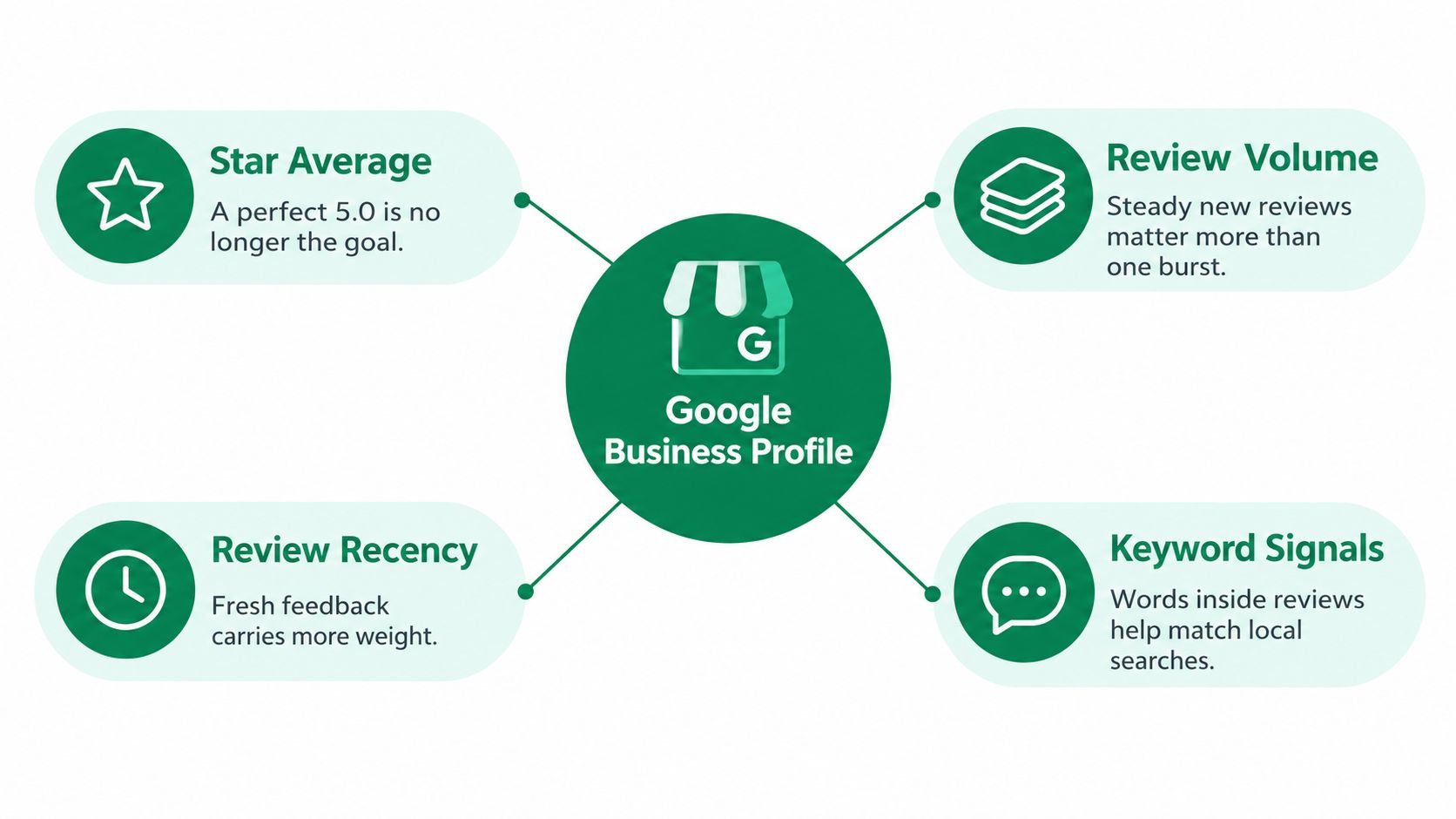
The four signals operators should separate
A useful audit separates the profile into four measurements:
- Star average: A strong rating matters, but perfection isn't the operating objective.
- Review volume: The profile needs a reliable stream of genuine customer feedback.
- Review recency: New experiences help prospects judge whether today's service matches older praise.
- Review content: Specific descriptions can clarify services, locations, staff experiences, and customer outcomes.
This is why a Google Business Profile deserves more than occasional monitoring. Teams that want a deeper foundation can review what a Google Business Profile is, then connect profile management with customer experience operations.
Practical rule: Treat the star average as a diagnostic, not a target. The operating target is a credible, current, actively managed profile.
The distinction matters for agencies managing many locations. A monthly screenshot of each rating won't reveal whether one branch has stopped collecting reviews, whether customers are adding useful photos, or whether managers are ignoring complaints. Build reporting that shows the direction and quality of feedback, not just the headline score.
Impact on Local Rankings and Conversions
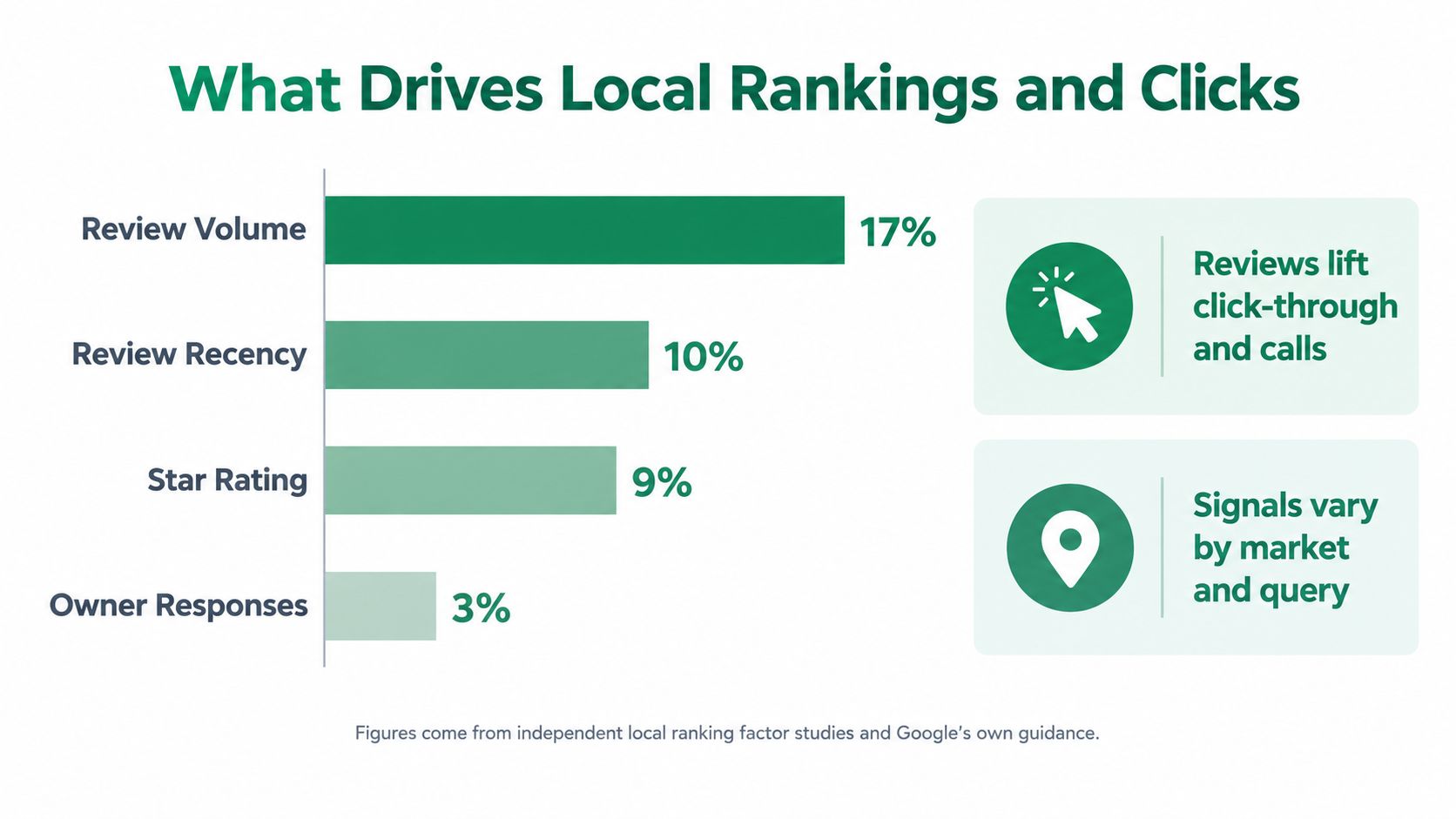
Google says local results depend mainly on relevance, distance, and prominence. Its guidance also states that prominence can reflect review quantity, while more reviews and positive ratings may support local ranking. Review generation therefore belongs in local search operations, not in a separate reputation task. See Google's official explanation of local ranking.
Independent ranking data shows why volume deserves attention. Profiles with 1 to 5 reviews had a 39.3% top-three local pack rate, while profiles with 201 to 500 reviews reached 73.0%, according to Localo's local ranking factor study. Localo identified review count as the strongest single signal it measured. Volume is not a guarantee. Relevance, distance, competition, category accuracy, and website quality still shape the result. Authentic review growth can materially improve a profile's visibility prospects.
Why cadence beats a campaign burst
A concentrated request campaign may create a short-term spike, but it introduces operational and reputational risk. Customers might receive requests long after service, managers may fail to respond promptly, and an unusual pattern can appear less natural than feedback collected through regular follow-up.
A steady workflow gives teams time to:
- Ask at a logical point in the customer journey.
- Route the request to the correct location.
- Monitor new feedback.
- Respond while the interaction remains fresh.
- Identify service issues before they repeat.
Cadence also creates a better stream of current proof. Photos, videos, detailed experiences, and timely owner responses can reinforce trust alongside the star rating, while AI-generated summaries increasingly shape how prospective customers interpret that evidence.
Reviews influence conversions beyond Maps placement. Their content answers questions a service page may not address, including whether staff communicate clearly, appointments run on time, or a location handles complicated requests well. Those details reduce uncertainty for prospects comparing nearby providers.
Measure the full outcome
A local SEO dashboard should connect review activity with business actions. Track review flow, response coverage, recurring themes, photo and video contributions, branded search behavior, calls, direction requests, and qualified leads where data is available. Do not claim that one review caused one sale. Compare trends by location and time period, then use the findings to improve the profile and customer experience.
Use this local search ranking factors framework to align reputation reporting with visibility work. The management decision is straightforward: fund review operations like an acquisition channel, with an owner, a defined process, and regular performance review.
Building a Scalable Review Collection Workflow
A scalable program starts at the point where the customer has enough context to give honest feedback. For a home service company, that may be shortly after the job is completed. For a clinic, it may follow a completed appointment. For a retailer, it may come after delivery or a meaningful product interaction. The timing should reflect the experience, not an arbitrary marketing calendar.
Use the same basic workflow across locations, but allow each branch to adapt the message to its service:
- Capture the transaction: Pass location, service, staff member, and customer contact details from the CRM or point-of-sale system.
- Trigger the request: Send a concise email or SMS after the relevant service milestone.
- Remove friction: Link directly to the correct Google review destination and make the next action obvious.
- Invite useful detail: Ask customers to describe the service they received rather than instructing them to use specific wording.
- Request visual proof appropriately: For businesses where images add genuine context, invite customers to share a relevant photo or short video.
- Route the feedback: Notify the location manager and central reputation team when a review arrives.
A request should never pressure a customer to leave a positive rating. The goal is authentic feedback from real customers, including criticism that helps the business correct its process. If customers upload images, establish a content moderation strategy so teams can review inappropriate, private, or irrelevant material before reusing it elsewhere.
Choose the channel around customer behavior
| Channel | Friction Level | Best Use Case |
|---|---|---|
| SMS | Low | Immediate follow-up after a completed local service |
| Moderate | Detailed post-purchase requests and customers who need more context | |
| Printed card or receipt prompt | Higher | In-person businesses with limited customer contact data |
| Staff-assisted request | Variable | High-touch services where a manager can explain the process naturally |
The channel matters less than the handoff. A beautifully written email won't compensate for a broken link, the wrong location profile, or a request sent before the customer has experienced the service. Review the guidance on how to ask for a review, then test the workflow from a customer's phone.
Don't gate reviews by sending unhappy customers into a private form while directing satisfied customers to Google. That approach distorts feedback and can create policy problems. A better system collects all responses, escalates service recovery internally, and gives every genuine customer the same opportunity to share public feedback.
Writing Review Responses That Win the Next Customer
A review response is public sales copy with a customer-service origin. The reviewer is only one audience. Future customers are also judging the business's competence, accountability, and tone. A generic “Thank you for your feedback” gives prospects little evidence, especially when they are comparing several providers.
Treat response coverage as an operating standard. Aim for 100% response coverage within 48 hours, and treat any review older than a week without a response as a process failure. The supporting Google review guidance reference reinforces the value of responding, while the practical goal is consistency without sacrificing accuracy.
Give every response a job
For positive reviews, reinforce the service context without mechanically repeating the customer's wording. Mention the relevant service or experience when it sounds natural, thank the customer for a specific detail, and invite them back. Keywords have a limited role here. Prospects recognize an SEO template when every reply uses the same phrasing.
Negative reviews require a controlled, useful response:
- Acknowledge the experience: Recognize the customer's frustration without arguing in public.
- Clarify carefully: Correct factual confusion only when you can do so without exposing private information.
- Offer a private route: Provide a direct contact path for resolution.
- Show ownership: State the next action, such as reviewing an appointment, delivery, or staff interaction.
- Close professionally: Do not demand an edited review or promise an outcome you cannot control.
Response standard: Write for the next customer who encounters the problem, not only for the person who reported it.
Response quality matters more than filling space. A short, specific reply can build more trust than a long paragraph that avoids the issue.
Multi-location teams need a response playbook covering tone, escalation rules, privacy boundaries, and examples for recurring scenarios. Central teams can handle policy questions and serious complaints, while local managers add operational detail that makes replies sound human. Give each location clear approval limits so escalation does not leave reviews unanswered.
Track response coverage and time to first response, then review the themes behind complaints. Speed cannot justify a defensive or inaccurate reply. Recurring issues often point to service problems that ranking work cannot fix, while clear, timely responses show prospective customers how the business handles accountability.
Navigating Compliance and Flagging Fake Feedback
A five-star target does not justify risky review tactics. Google's policies distinguish genuine customer experiences from content designed to manipulate reputation. Common violations include incentivized reviews, posts from owners or employees, conflicts of interest, spam, harassment, impersonation, and feedback with no real interaction. Ask for honest feedback from eligible customers, rather than screening out unhappy customers or offering a discount or gift for a particular rating.
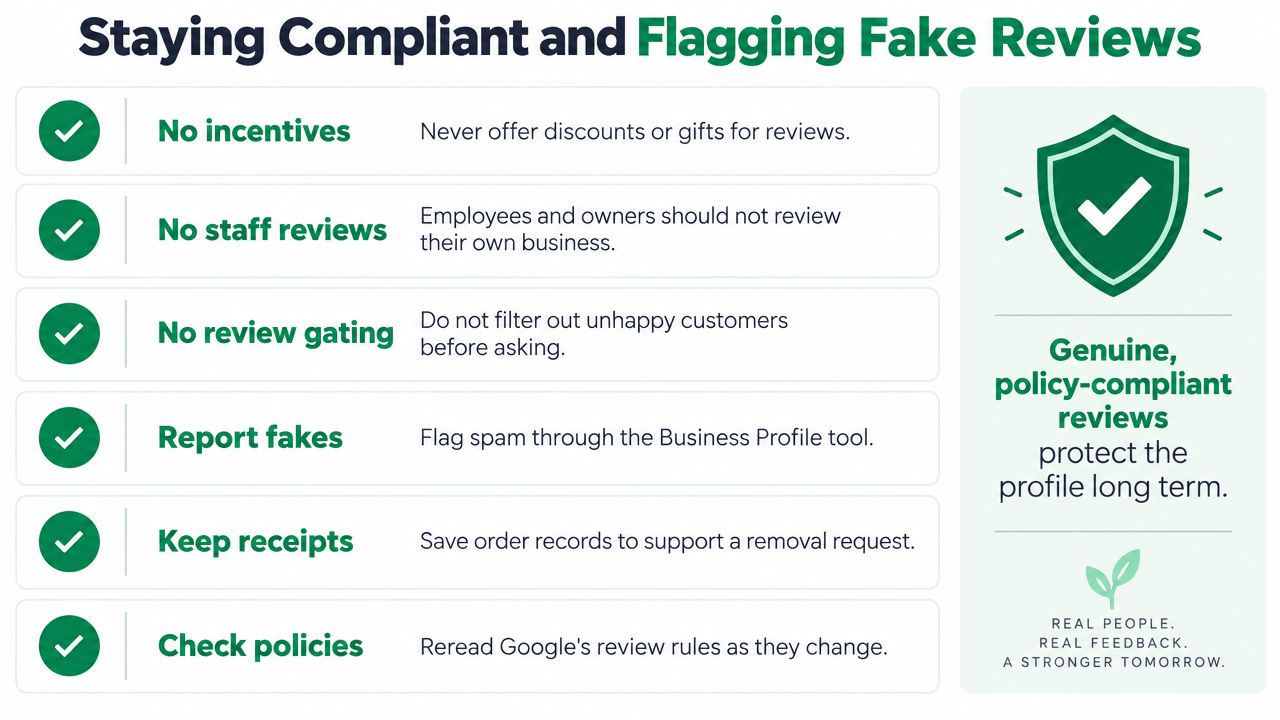
Treat removal requests as evidence reviews
A suspicious review calls for verification, not a public accusation. Preserve the page, examine the account, and identify the exact policy concern. A review that feels unfair may still describe a legitimate negative experience, so disagreement with the rating is not grounds for removal.
Use an internal case record with these fields:
- Review details: Save the text, profile name, date, location, URL, and screenshots.
- Interaction check: Search bookings, orders, support tickets, and staff notes for a matching customer experience.
- Policy diagnosis: Record the specific concern, such as spam, impersonation, or a conflict of interest.
- Formal report: Flag the content through the available Business Profile reporting tools.
- Escalation file: If the initial decision stands, submit the case through the appropriate support route with relevant records.
- Operational continuity: Keep requesting genuine feedback and answering reviews professionally while Google assesses the case.
For multi-location teams, assign ownership for evidence gathering, reporting, and follow-up. Store case notes centrally, but limit access to customer information. Do not organize public pressure or accuse the reviewer in a reply. Do not flag a post solely because it reduced the average rating, and avoid removal services promising guaranteed outcomes. Review compliance protects the profile, while authentic text, photos, video, and consistent response cadence give Google and customers better evidence than a manufactured five-star record.
Adapting to Multimodal Reviews and AI Summaries
A five-star average is no longer enough evidence. Customers increasingly add photos and short videos showing a property's condition, a meal's presentation, completed work, or the setting behind a recommendation. Those details help prospects judge the experience before they visit and give Google more context than a rating alone.
Independent 2026 coverage reported that reviews containing at least one photo grew 34% versus 2024, while short video clips in Google Maps reviews doubled. It also reported that Google introduced AI summaries and stronger fake-review detection during the 2025 to 2026 period. Read the coverage of changes to Google Reviews before setting targets for visual feedback.

Ask for useful evidence
Google controls which themes appear in an AI summary, and customers should write in their own words. Your team can still prompt specific, authentic detail:
- What service did you use?
- Which part of the experience helped you most?
- What should another customer know before visiting?
- If relevant, could you share a photo of the finished work or location?
These questions invite substance without directing sentiment. They also show whether customers naturally mention services, features, and attributes that support local search relevance.
Visual reviews require clear handling rules. Photos may expose a customer's face, address, medical information, vehicle plate, or another person's private data. Define permission, storage, reuse, and escalation procedures before requesting images or video.
AI summaries make consistency more valuable. A profile with many reviews describing the same strengths and recurring problems gives Google clearer themes to summarize. Operations therefore shape reputation directly. Deliver the experience the profile promises, correct recurring failures, and keep claims accurate. Response templates cannot conceal repeated complaints or unsupported promises.
Integrating Reputation into Your Local SEO Strategy
Reputation management belongs inside the local SEO operating system, not in a separate inbox owned by customer support. The profile, location page, CRM, review platform, and reporting dashboard should share enough information to show how customer experience affects visibility and conversion. Agencies that separate these systems often miss the connection between a service failure, a negative review, and a decline in qualified local actions.
Start with a location-level audit. Review the current score, volume, age of recent feedback, response coverage, recurring topics, image and video presence, policy risks, and consistency of business information. Then compare locations using the same definitions. A branch with a strong average but no recent activity needs a different intervention from a branch with active feedback and unresolved service complaints.
Build a practical reporting model
Use three groups of measures:
- Visibility signals: Local pack presence, Maps impressions where available, branded and non-branded query coverage, and profile actions.
- Reputation signals: New reviews, review freshness, rating distribution, response coverage, response quality, and recurring sentiment themes.
- Business outcomes: Calls, direction requests, booked appointments, qualified leads, and revenue attribution where the organization can measure it reliably.
Don't set a single universal review target for every location. Customer volume, service frequency, market competition, and seasonality differ. Set a sustainable cadence based on each branch's normal customer flow, then investigate sudden changes rather than forcing artificial activity.
Diversification matters too. Google remains a major review ecosystem, but the supplied 2026 research also reports that its share of review-platform preference fell from 83% in 2025 to 71% in 2026, indicating that customers aren't relying on one destination alone. Maintain the Google workflow, then identify the other platforms that matter for your category and market. A prospect may discover a business on Google, validate it on a niche platform, and inspect visual content before contacting the company.
AI Tools for Local SEO is one directory option for researching software across Google Business Profile optimization, review management, multi-location SEO, reporting, and related local workflows. Evaluate any platform against the actual operating need, including integrations, permissions, response governance, data access, and human review.
The strongest program is continuous: collect authentic feedback, respond with judgment, inspect visual contributions, flag genuine policy violations, feed recurring issues into operations, and report business outcomes to stakeholders. That approach replaces the fragile chase for five stars with a reputation asset that supports both local visibility and customer choice.
Stop treating your Google rating as a number to defend and start auditing the workflow behind it. Review every location's collection process, response coverage, content quality, and policy controls this week, then assign an owner to improve the weakest stage and measure the effect on qualified calls, directions, and leads.