Only 54% of Google reviews receive any business response, and 68% of negative reviews go completely unanswered, according to a 2026 Google review response benchmark. That makes review management less about finding the perfect template and more about running a reliable triage operation. Teams need to decide which reviews require a public answer, which need private escalation, and which can be left alone without creating unnecessary risk.
The practical challenge gets harder across multiple locations. Businesses using AI-assisted workflows reached a 97% response rate, compared with 41% for manual-only responders, while the average business took 2.7 days to respond in the same benchmark. Speed helps, but an automated reply that misstates what happened can damage trust faster than a delayed, accurate response.
Why Google Review Responses Matter More Than Ever
Review replies are now an operating metric. The 2026 benchmark found that only 54% of Google reviews receive a response, and the average business takes 2.7 days to answer. Negative feedback receives the weakest coverage, with 68% of negative reviews left unanswered. These gaps aren't merely cosmetic. They reveal whether a business has a repeatable process for listening, investigating, and communicating.
Consumer expectations are moving faster than many local teams' workflows. 32% of consumers expect a reply by the next day, according to the same 2026 benchmark analysis. Independent 2025 research also found that 89% of consumers expect businesses to respond to Google reviews, while 97% of review readers read the business's responses. A listing's review section is therefore a public customer-service record, not a private exchange between one reviewer and one manager.
Operational rule: Treat response coverage and response time like service-level metrics, not occasional marketing tasks.
What the benchmarks reveal
The strongest gap appears in the reviews that need the most care. AI-assisted workflows reached a 97% response rate, compared with 41% for manual-only responders, but automation alone doesn't guarantee a useful answer. The response still needs to reflect the review, respect privacy, and follow the business's escalation rules.
A separate August 2026 analysis of 229,882 Google reviews found that only 9.8% of one-star reviews received a public owner response, compared with 29.3% of five-star reviews. Owners also took an average of 19.5 days to answer one-star reviews and wrote replies 3.6 times longer than replies to happy customers. The pattern is familiar in production, teams answer easy praise first and postpone difficult service recovery until the opportunity has cooled.
| Metric | Benchmark | Source |
|---|---|---|
| Reviews receiving any response | 54% | 2026 response benchmark |
| Negative reviews unanswered | 68% | 2026 response benchmark |
| Average response time | 2.7 days | 2026 response benchmark |
| Consumer expectation for a next-day reply | 32% | 2026 response benchmark |
| AI-assisted response rate | 97% | 2026 response benchmark |
| Manual-only response rate | 41% | 2026 response benchmark |
For the local SEO context, Sibley Digital's guide to how Google Reviews impacts SEO is useful background. The safe operational conclusion is simple: a visible, relevant owner response helps future customers evaluate how the business handles feedback. It shouldn't be confused with a guaranteed ranking formula or used as an excuse for keyword stuffing.
Decide Whether Each Review Actually Needs a Reply
The default instruction to “reply to everything” is easy to publish and difficult to run well. In a real queue, the better question is what outcome does this review require? A generic five-star rating, a detailed service complaint, and a suspected spam post shouldn't enter the same response path.
Controlled consumer-expectation research found that reply style changes how people perceive a review. The appropriate approach depends on whether the review is positive or negative, whether the business explains an action or reaction, and whether the exchange remains public or moves privately. The research is discussed in the Journal of Service Management study, which identifies perceived usefulness as the mechanism behind those differences.
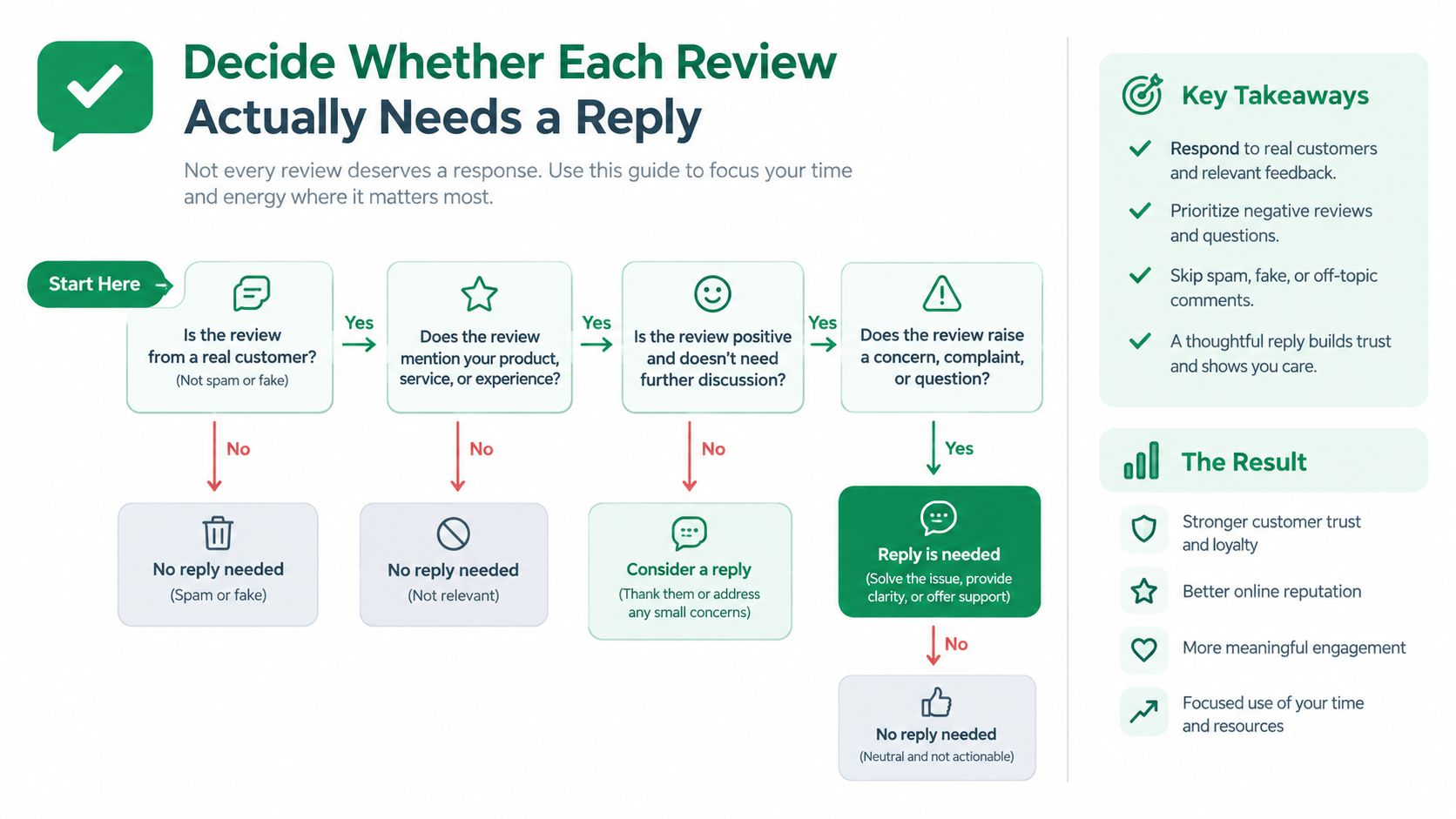
Three practical decision paths
Reply publicly when the review reflects a genuine customer interaction and a concise answer can help both the reviewer and future readers. A short thank-you fits generic praise. A specific response belongs under detailed positive feedback, balanced criticism, and ordinary complaints that don't expose confidential information.
Escalate offline when the review involves a health or safety issue, threatened legal action, an identifiable employee complaint, billing details, or a repeated failure across locations. Publish a brief acknowledgment, then provide a direct contact route. Don't try to resolve sensitive facts in a public thread.
Skip or flag when the content appears to be spam, impersonation, promotional material, or unrelated to the business. Flagging is different from replying. A public argument can give questionable content more attention and may expose information the business shouldn't publish.
Use this quick check before drafting:
- Authenticity: Do internal records show a real customer interaction?
- Severity: Does the review mention safety, legal action, discrimination, or personal data?
- Public value: Would a factual reply help future customers understand the situation?
- Resolution path: Can the business solve the issue without discussing private details?
- Tone risk: Could the proposed response sound defensive, accusatory, or speculative?
A poor public answer creates a permanent artifact. Silence isn't always ideal, but a careless reply can turn a manageable complaint into a broader trust problem.
Anatomy of a Response That Builds Trust
A reliable reply has four working parts. It doesn't need theatrical empathy or a long explanation. It needs to show that someone read the review, understood the relevant issue, and knows what happens next.
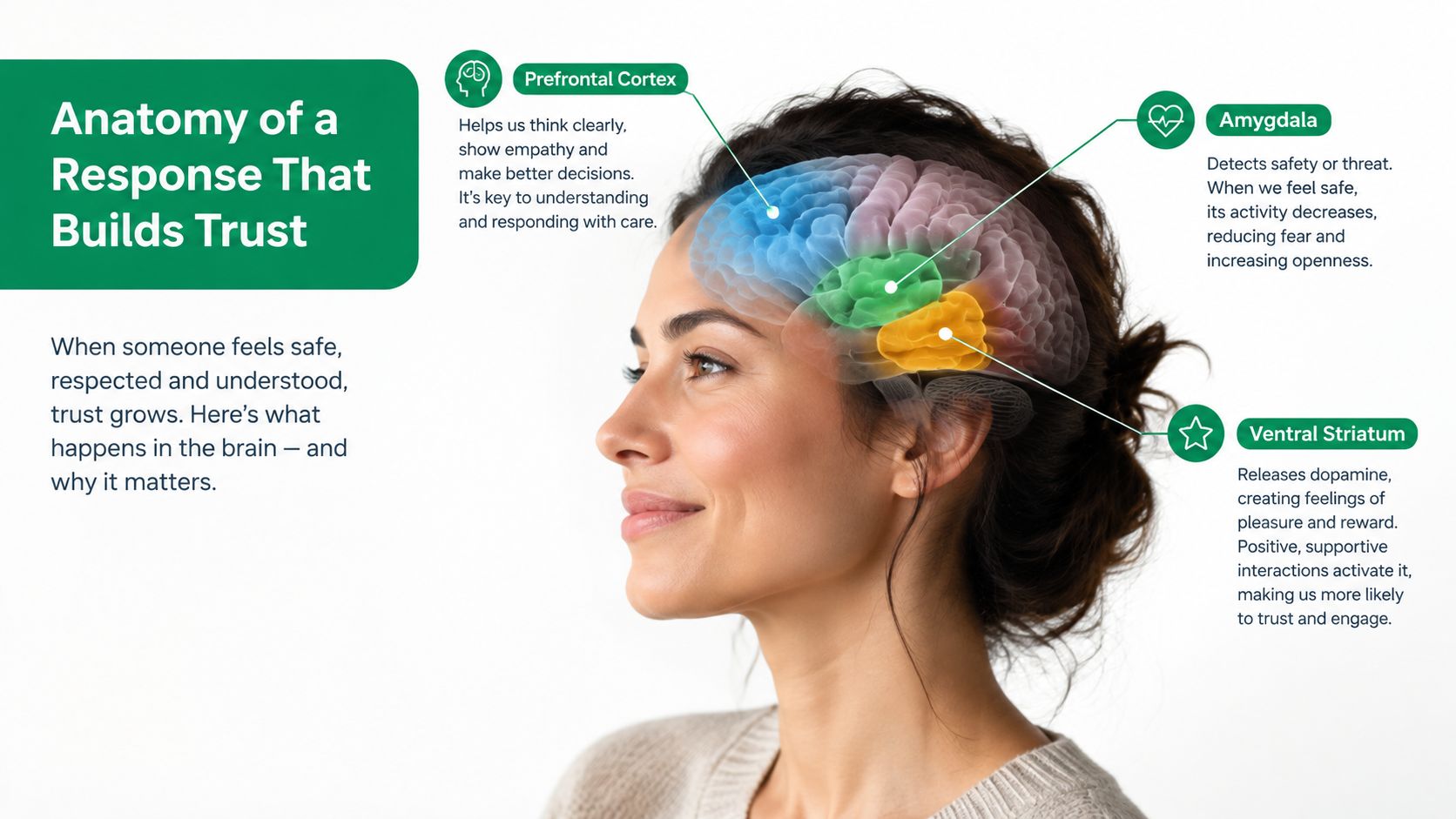
The four-part construction
-
Specific opener. Refer to a detail the reviewer mentioned. “Thank you for mentioning the appointment team's explanation” feels read. “Thanks for your feedback” feels copied.
-
Acknowledgment. Validate the experience without automatically accepting every factual claim. For a service failure, acknowledge the inconvenience. For an inaccurate review, recognize the frustration while reserving the facts for a private conversation.
-
Action statement. State what the team checked, changed, or will review. Avoid promises that depend on information you haven't verified. A concrete operational action carries more credibility than a broad statement about standards.
-
Useful close. Invite a return visit or direct contact, but give the reader a reason and a channel. “Please call the clinic manager at the number on your appointment confirmation” is more useful than “contact us to discuss.”
The structure stays stable while the tone changes:
- Positive: Warm, personal, and appreciative. Mention the detail, thank the customer, and invite them back.
- Neutral: Calm and responsive. Address the mixed point directly and explain the next step.
- Negative: Measured and solution-oriented. Don't justify the failure before acknowledging its effect.
Practical rule: Personalize the fact pattern, not just the reviewer's name.
Most production replies work best at 60 to 120 words. That range is long enough to demonstrate attention and short enough for mobile readers. Avoid filler, defensive explanations, unverified claims, promotional language, and repeated business-name keywords.
The same principle applies to customer-facing conversations elsewhere. Teams that want a deeper treatment of how to build rapport in meetings can apply the same habits here, listen for specifics, respond to what was said, and make the next interaction easier.
Templates for Positive, Neutral, and Negative Reviews
Templates should control structure, not erase judgment. Keep the framework consistent across locations, then change the detail that proves the reply was written for this review. The most important personalization line is the sentence that references the customer's actual experience.
| Review Type | Opening Line | Acknowledgment | Action or Invite | Sign-off |
|---|---|---|---|---|
| Positive | “Thank you, [Reviewer Name], for highlighting [specific detail].” | “We're glad [service or team detail] made your visit easier.” | “We'd be happy to welcome you back when you're ready for [relevant return reason].” | “Best, [First Name], [Business Name]” |
| Neutral | “Thank you for sharing a balanced review of [Business Name].” | “We appreciate your note about [positive point], and we understand that [mixed point] fell short.” | “We'll review [specific issue]. Please contact [channel] if you'd like us to look at your visit directly.” | “Regards, [First Name], [Business Name]” |
| Negative | “Thank you for bringing your experience to our attention, [Reviewer Name].” | “We're sorry that [specific problem] affected your visit.” | “We've asked [role or team] to review this. Please reach [direct channel] so we can discuss the details privately.” | “Sincerely, [First Name], [Business Name]” |
Positive review template
Suggested length: 40 to 70 words.
“Thank you, [Reviewer Name], for mentioning [specific detail from the review]. We're glad [team member, service, or experience] helped make your visit a good one. We appreciate you choosing [Business Name], and we'd be pleased to welcome you back for [specific reason to return]. Best, [First Name].”
Keep the gratitude and invitation reusable. Change the detail line for every meaningful review. Don't turn a simple thank-you into an advertisement.
Neutral review template
Suggested length: 60 to 90 words.
“Thank you for sharing your feedback, [Reviewer Name]. We're pleased that [positive point] worked well, and we understand your concern about [mixed or negative point]. We'll review [specific process] with the team. If you'd like us to look at the details of your visit, please contact [name or department] at [approved channel]. Regards, [First Name].”
This format acknowledges criticism without arguing over the customer's perception. The private next step should be real, staffed, and easy to use.
Negative review template
Suggested length: 70 to 120 words.
“Thank you for sharing your experience, [Reviewer Name]. We're sorry that [specific problem] left you disappointed. We've reviewed [verified action or internal next step], and [accurate outcome or follow-up] is being addressed. We don't want to discuss personal or appointment details publicly, so please contact [direct channel] and ask for [role or manager]. We'd appreciate the opportunity to understand what happened and respond properly. Sincerely, [First Name], [Business Name].”
Never fill placeholders with guesses. For additional examples and variations, use this review response templates resource, then adapt the language to the business's actual escalation policy.
Escalation, Offline Handling, and Legal Boundaries
A public review becomes an escalation case when the reply requires facts that shouldn't be published. Mentions of legal action, injury, safety concerns, discrimination, identifiable staff conduct, or repeated complaints across locations should trigger a controlled handoff rather than an improvised response.
Start with a short public acknowledgment. Don't confirm account details, diagnoses, payment information, employee records, or other personal information. Offer a direct route, such as a manager's approved phone line or customer-care email, and assign ownership before posting. “Please contact us” isn't an escalation process if nobody is responsible for receiving the call.
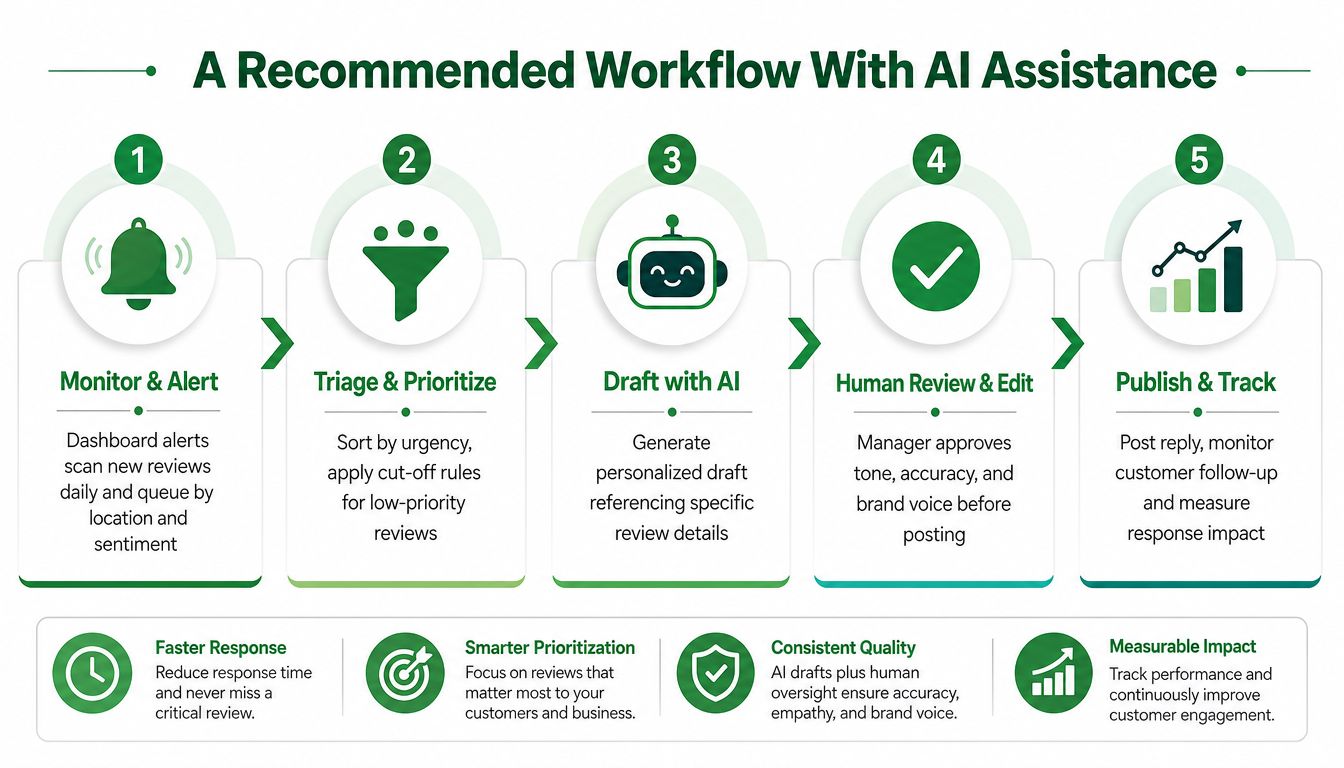
The handoff record
Document the issue in the internal system, not in the public reply. Include:
- Review reference: Location, reviewer name, review date, star rating, and a link to the listing.
- Issue summary: The customer's allegation, stated neutrally and without assumptions.
- Known facts: Relevant appointment, order, staffing, or service records that the team is allowed to access.
- Owner: The manager or specialist responsible for contacting the reviewer.
- Deadline: The internal follow-up time and the next review checkpoint.
- Outcome: Whether the issue was resolved, remains open, or needs further review.
Google's review policies matter at this stage. A business shouldn't publish personal information, retaliate against a reviewer, or use a public response to pressure someone into changing feedback. Flag content when it appears to violate Google's rules, but don't assume that an unfair or unflattering review automatically qualifies for removal. Reporting and replying are separate decisions.
Legal counsel should handle threats, allegations involving regulated services, personal injury, discrimination claims, or any situation where the factual record is disputed and the public response could create exposure. Front-line teams can acknowledge the concern and route it. They shouldn't conduct a legal argument in Maps.
A Recommended Workflow With AI Assistance
AI works best as a queue assistant, not an autonomous reputation manager. It can sort reviews, identify likely urgency, and produce a first draft. It shouldn't decide whether a safety allegation is credible or invent a policy, refund, opening hour, or service detail.
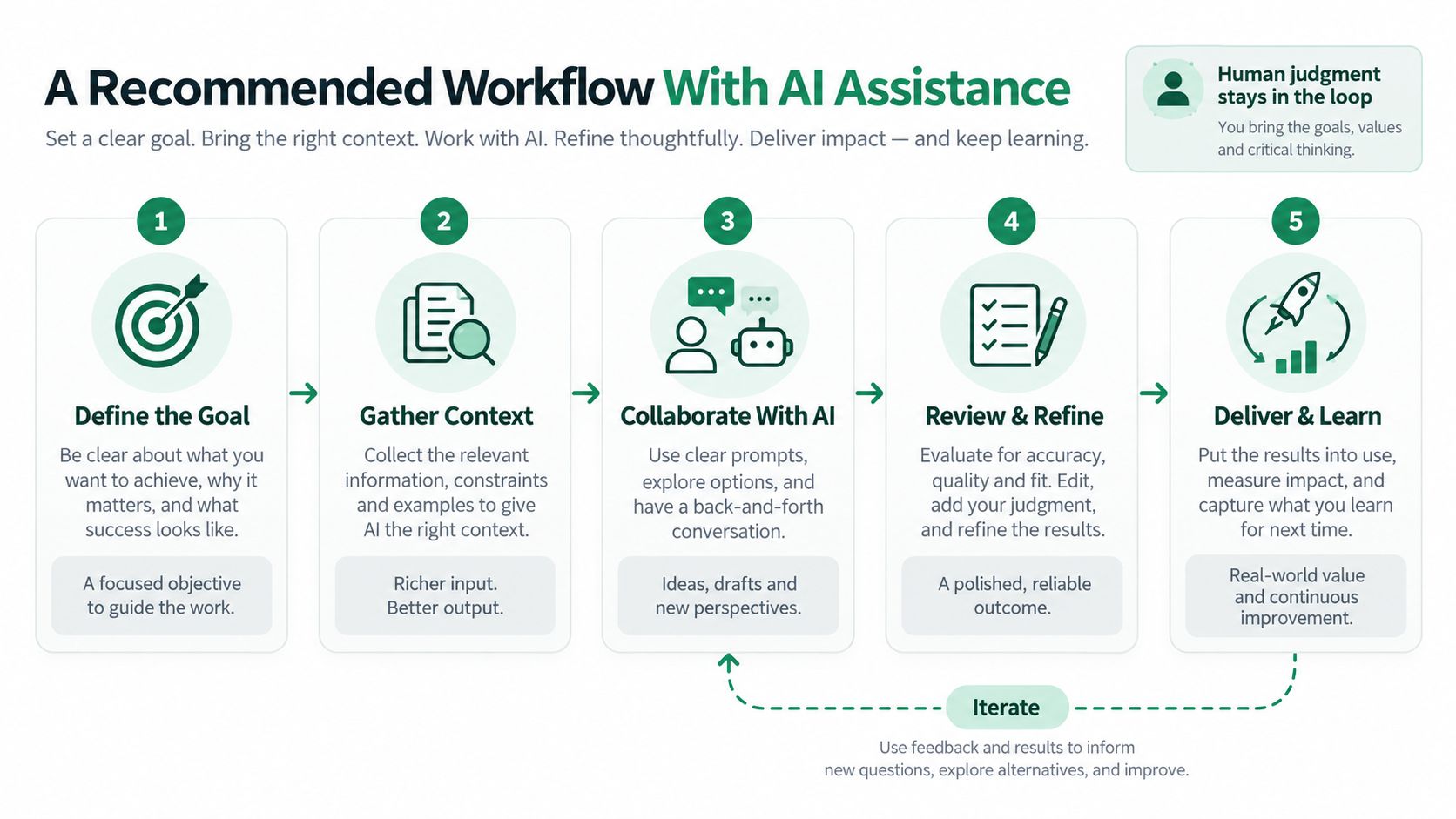
A production sequence
Monitor and alert. Pull new reviews into a shared dashboard or approved integration. Route each item to the correct location and record the review timestamp, sentiment, star rating, and any escalation terms.
Triage and prioritize. Send urgent complaints to a human queue first. Separate genuine service issues from praise, questions, suspected spam, and reviews that require private handling. Define who can approve routine replies and who must approve sensitive ones.
Draft with constraints. Give the assistant a pinned style guide with approved business facts, prohibited claims, escalation language, and required personalization fields. Ask it to quote or paraphrase only details present in the review and verified internal notes.
Review before publication. A human checks names, dates, services, tone, privacy, and factual accuracy. The reviewer should compare the draft with the original review, because AI can produce fluent language that changes the meaning.
Publish and verify. Post through Google Business Profile or an approved platform, then revisit the listing to confirm the reply appears. A submitted response may face moderation or publication delay, so the workflow needs a verification step rather than assuming the action succeeded.
Teams building a broader tool stack can evaluate directories such as AI Tools for Local SEO, which organizes software across review management, Google Business Profile operations, analytics, and other local workflows. For drafting specifically, this AI review response generator guide can help teams define prompts and review controls.
Log every published reply, edit, escalation, and moderation issue. When a manager changes an AI draft, preserve the edited version as a training example for future prompts. Rotate prompts when the assistant starts repeating openings, overusing brand language, or missing the details that make a response credible.
Measuring and Tracking Response Performance
A review program needs a scorecard that separates queue activity from customer-facing results. The key question is not how many drafts the team created. It is whether the team replied to the reviews that warranted attention, met its service standard, handled risk correctly, and recorded what happened after publication.
Track the published response rate, based on live owner replies rather than tasks marked complete. Measure median time to reply, because a few severely delayed cases can make an average look healthier than the typical customer experience. Record whether each review was replied to, escalated offline, or intentionally left unanswered. That classification makes coverage meaningful, especially when some reviews do not require a public response.
Sentiment requires restraint. Compare the thread before and after the response, then record whether the issue was resolved, remained unresolved, or produced no visible change. A changed review can indicate a successful recovery, but it does not prove that the public reply caused the change.
The operating scorecard
| KPI | Definition | Operating standard |
|---|---|---|
| Published response rate | Reviews with a live owner reply divided by reviews marked as requiring a response | Set a location-level coverage standard and investigate exceptions |
| Median time to reply | Typical elapsed time between review publication and live response | Set a next-day service goal for priority reviews |
| Triage accuracy | Reviews correctly classified as reply, escalate, or skip | Audit samples for missed risk and unnecessary replies |
| Sentiment outcome | Resolved, unresolved, or unchanged status after follow-up | Record the outcome without claiming the reply caused it |
| Location rating movement | Direction of the displayed rating over time | Compare trends with review volume, seasonality, and service changes |
| Google Business Profile actions | Calls, direction requests, and website clicks associated with the listing | Review changes alongside other profile updates |
The 2026 benchmark cited earlier in this guide found a substantial difference between businesses using AI-supported workflows and those relying only on manual handling, with response rates of 97% and 41%, respectively. That finding supports investment in queue design and drafting assistance. It does not support removing human approval from sensitive reviews, privacy issues, possible fraud, or complaints that could create legal exposure.
Track quality with a small audit sample each week. Check whether replies mention the correct service, avoid private customer information, reflect the review accurately, and use a tone appropriate to the situation. A high response rate paired with inaccurate or repetitive replies is an operational failure, not a success.
The weekly review ritual
Set aside a short weekly operating review. Pull the latest queue, identify reviews that missed the internal service level, sample published replies for tone drift, and inspect escalations that moved offline. Compare locations only when they use the same definitions. One manager's “resolved” should not mean another manager's “published.”
Review listing performance through Google Business Profile analytics guidance, keeping calls, direction requests, website clicks, review volume, owner-reply volume, and profile edits in the same record. These measures provide context for changes in customer activity. They should not be treated as isolated proof that a reply improved rankings or conversions.
A practical monthly audit asks three questions: Did the team respond to the reviews that mattered most? Did each reply use verified, specific information? Did the workflow identify moderation, privacy, and escalation problems before publication? Add a fourth question for scale: Which queue decisions could be standardized without weakening judgment?
Keep a simple log of review ID, location, rating, triage decision, publication time, escalation owner, outcome, and any correction made after publication. That history helps identify recurring service failures, overloaded managers, and prompts that produce weak drafts. It also shows whether the operation is improving response quality, rather than merely increasing activity.
Set the process before adding more templates. Define the triage rules, assign escalation owners, set response-time standards, and audit AI-generated drafts before publication. Then review the outstanding Google Business Profile queue this week and classify every item as reply, escalate, or skip.