A local plumbing company can have a service page, a Brooklyn location page, an emergency plumbing page, and a blog post all appearing relevant to the same search. The problem isn't necessarily weak content. It may be unclear page ownership. Searchers see one intent, while the site presents several competing URLs.
A useful keyword cannibalization checker needs to reveal those competing URLs, show whether the conflict appears in ranking data or Google Search Console, and support a repeatable process for deciding what to change. This comparison evaluates each tool by its evidence source, local and multi-location suitability, scale, workflow depth, and limitations.
The distinction matters. Ranking platforms can expose URL changes and competing results for tracked terms. GSC-connected tools can show whether impressions and clicks are split on your site. A crawler or content analysis tool may identify overlap before Google has assigned meaningful visibility, but it can't prove that the overlap is harming performance.
The tools below are intended for local marketers, agencies, and teams managing location pages at scale. For adjacent workflows, AI Tools for Local SEO also serves as a directory for discovering software across local research, listings, rank tracking, reputation, technical SEO, and multi-location operations. A broader audit perspective is available in this website audit guidance from 3228 Digital UK.
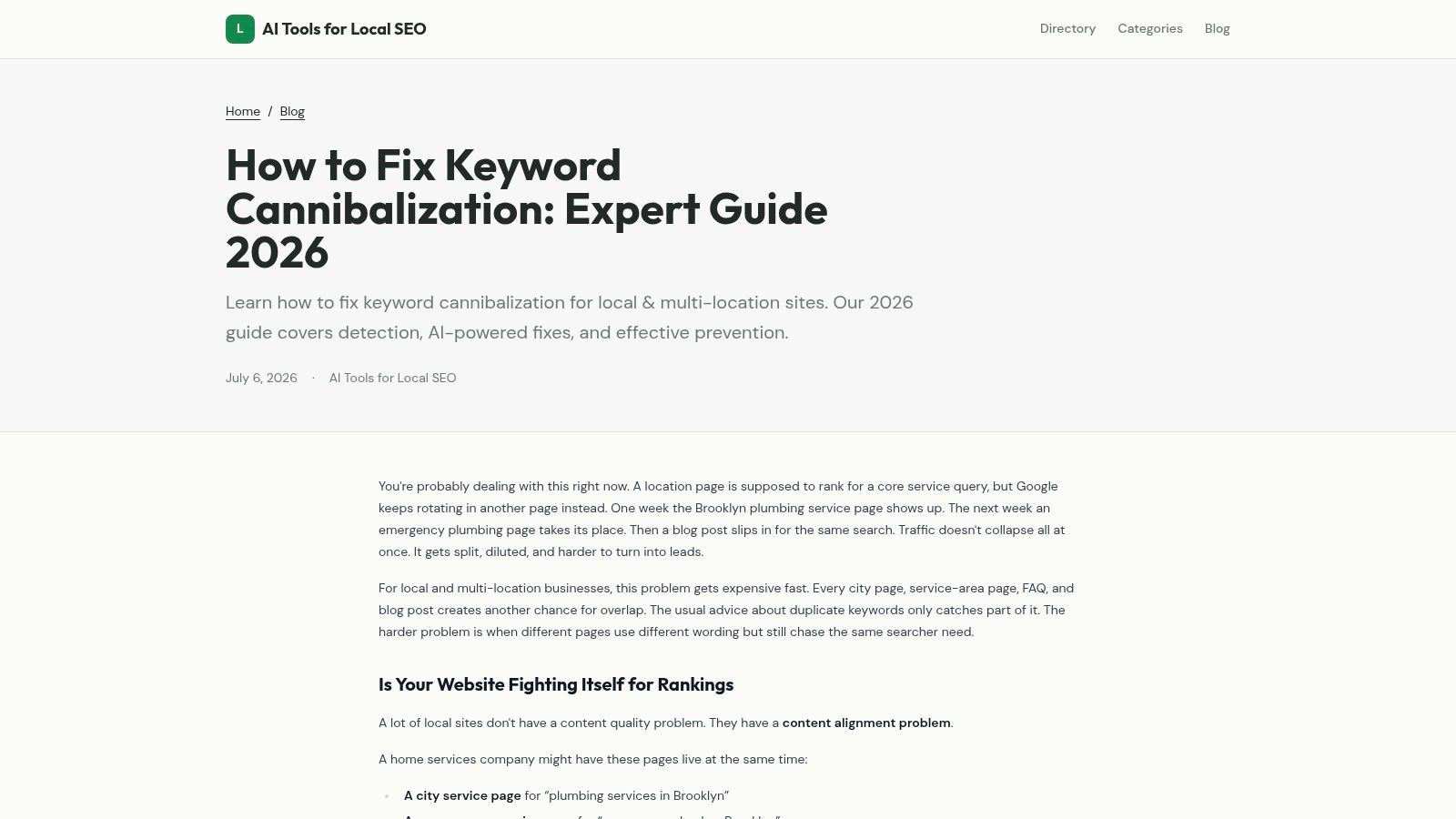
1. How to Fix Keyword Cannibalization Expert Guide 2026
How to Fix Keyword Cannibalization Expert Guide 2026 is the strongest starting point for local and multi-location teams because it treats cannibalization as a page-alignment problem, not merely a duplicate-keyword alert. A service page, city page, emergency page, FAQ, and blog article may all mention the same service while serving different or overlapping intents. The guide helps separate those cases before someone merges valuable pages unnecessarily.
Its practical value comes from the end-to-end workflow. It covers discovery, AI-assisted auditing, keyword-to-page mapping, consolidation, canonicalization, redirects, noindex decisions, internal linking, and content differentiation. The examples are especially relevant to local businesses, where a location page may need to remain separate from a service page even if both rank for related queries.
Best use for agencies and local teams
The guide is useful when several people must coordinate a fix. An agency can use its mapping approach to assign one primary URL to an intent, document secondary URLs, and give developers or writers a clear remediation brief. Teams can also pair the workflow with guidance on how many keywords to target per page, rather than assigning every variation to every location page.
Practical rule: Overlap is a reason to investigate, not automatic proof that pages should be merged.
The main limitation is implementation. Redirects, content consolidation, canonical tags, internal-link changes, and targeted noindex rules require judgment and technical coordination. Automated tools can accelerate the audit, but this guide doesn't turn remediation into a one-click operation. Its strongest role is as a decision framework that helps teams choose a fix and apply it consistently across a large site. For additional ranking context, see Boocoo's guide to improving Google rankings.
2. Semrush Position Tracking Cannibalization Report
Semrush Position Tracking offers one of the clearest dedicated workflows for teams that want ranking-based cannibalization detection without manually combining exports. Its Cannibalization report surfaces tracked keywords for which multiple URLs from the site rank, then organizes the findings through Keywords and Pages views. Historical position graphs help analysts investigate whether URLs are swapping positions or whether one page consistently owns the query.
The Cannibalization Health score adds a monitoring layer. It can help an agency communicate whether a tracked keyword set is becoming cleaner or more conflicted over time, although the score remains a product metric rather than proof of lost clicks. Semrush also supports custom keyword sets and granular location targeting, including city and ZIP-level tracking, which makes it relevant to local campaigns.
Evidence and limitations
The evidence here comes from ranking data, not directly from your complete GSC query history. The report only evaluates keywords added to Position Tracking, so it won't automatically represent the entire organic keyword universe. That limitation is important for local teams that publish new city pages or discover unexpected queries outside their original tracking set.
Semrush works best when the account has a carefully maintained keyword map. A plumbing agency, for example, can track service and location combinations separately, then inspect whether the emergency page, core service page, or location page is appearing for the wrong term. Pairing the report with rank tracker reviews for local SEO workflows can help teams decide whether its broader tracking capabilities fit their reporting process.
Its On Page SEO Checker integration can support the next step, but it won't decide whether to merge two pages or preserve them for different intents. Pricing and feature access vary by plan, so confirm current availability before selecting it for a multi-client operation.
3. Ahrefs Site Explorer and Opportunities
Ahrefs approaches cannibalization through two connected discovery paths. In Site Explorer, the Organic Keywords report can be filtered to find queries where multiple URLs rank. The Opportunities report also surfaces a Potential cannibalization signal, giving users a proactive way to find likely conflicts while reviewing broader organic opportunities.
This is primarily a ranking-data and SERP-context solution. Ahrefs' keyword history helps analysts determine whether two URLs appeared together briefly, alternate over time, or repeatedly compete for the same query. That distinction matters because a temporary second result may be harmless, while persistent URL switching deserves closer inspection.
Where Ahrefs fits
Ahrefs is a strong choice for analysts who already use Site Explorer for content and competitor research. The workflow stays inside a familiar environment, and the broad keyword dataset can expose conflicts that weren't included in a manually built tracking campaign. That makes it useful for content-heavy sites with service pages, guides, location pages, and older articles accumulated over time.
The limitation is workflow depth. Ahrefs provides useful signals, but it isn't positioned here as a single, dedicated cannibalization dashboard that walks a team from detection through remediation and post-fix validation. Paid access is generally needed for the deeper workflows, while free access is limited.
For local marketers, the tool can identify that several pages rank for a service query, but the analyst still needs to inspect the actual SERP and page intent. A city page and a service page may both be appropriate if they answer different needs. Ahrefs can identify the overlap, but human review must determine whether it represents harmful competition or useful coverage across a customer journey.
4. SISTRIX Keyword Cannibalization Filter and History
SISTRIX is built for analysts who want to understand how URL ownership changes over time. Its keyword tables include a “Show Keyword Cannibalization” filter, while ranking history and URL-change views help reveal whether Google is rotating pages for the same query.
That historical perspective is the tool's main analytical advantage. A current snapshot can show two ranking URLs, but it may not explain whether one is a recent replacement, a stable secondary result, or part of a long-running ownership problem. Reviewing the history helps an SEO identify patterns before selecting a fix.
Useful for large content libraries
SISTRIX can be applied at host or directory level. That makes it practical for sites with separate sections for locations, services, resources, or regional operations. An agency could isolate a client's location directory, compare it with the blog, and investigate whether the same commercial intent is being targeted across both areas.
The tool's evidence is based on its ranking database and tracked visibility signals, rather than your site's direct GSC impressions and clicks. It can therefore identify likely conflicts, but it can't by itself prove that users are splitting engagement between the URLs. Validation still requires GSC or another first-party performance source.
New users may face a learning curve because SISTRIX is organized around modules and analytical views rather than a simplified, single-purpose checker. Module-based pricing can also make the total cost harder to estimate for agencies with several markets or properties. Its best fit is an SEO analyst who values historical diagnosis and is comfortable connecting ranking evidence to a separate remediation workflow.
5. SE Ranking Rank Tracking with Cannibalization Guidance
SE Ranking takes a practical middle path. Its rank-tracking workflows help identify multiple ranking URLs for a keyword and cases where the wrong page appears for the intended query. Its Google Search Console integration then gives teams a way to check whether the ranking conflict corresponds with split impressions and clicks.
That combination is more important than a branded report name. Ranking data helps you discover a potential issue, while GSC data helps establish whether the issue is visible in your site's own search performance. A small local team can use the first signal to locate competing pages, then use the second to decide whether the conflict deserves engineering or editorial time.
Best for configured workflows
SE Ranking suits small to mid-size sites and teams already using it for rank tracking, audits, research, and reporting. A local agency can organize tracked terms by client, service, market, and landing page, then review URL conflicts during regular reporting. The platform's broader feature set also reduces the need to move between tools for basic supporting checks.
Its limitation is configuration dependency. There isn't a single branded cannibalization dashboard that removes the need to define the right keyword set, locations, and GSC connection. If tracking is incomplete, the diagnosis will be incomplete too.
For multi-location work, separate city-level tracking and consistent landing-page naming are essential. Otherwise, an apparent conflict may reflect two legitimate markets being combined in one report. SE Ranking can support the process, but the agency must establish governance rules before interpreting the output.
6. AccuRanker Fast Rank Tracking with Cannibalization Detection
AccuRanker is a specialized rank tracker with explicit cannibalization detection based on ranking data. Its Landing Pages and Organic Site Explorer views show which URLs are associated with tracked keywords, while filters, tags, and segmentation help agencies organize large keyword sets.
Speed and clarity are the main reasons to consider it. An agency monitoring several local markets can tag terms by location, service, client, or page type, then isolate conflicts without sorting through unrelated ranking records. The resulting URL-to-keyword view is useful when an account manager needs a concise explanation of which pages are competing.
A strong discovery layer
AccuRanker is most effective as the discovery stage of a broader workflow. It can show that two URLs are ranking for the same tracked query, but ranking data alone doesn't reveal how many impressions or clicks each URL received in GSC. It also doesn't decide whether a service-area page should be merged with a city page, especially when both pages may serve distinct local intents.
The tool requires disciplined keyword and landing-page mapping. If an agency tracks only a narrow set of commercial terms, it may miss conflicts emerging in informational searches or long-tail local variations. Conversely, a poorly organized keyword list can make legitimate market segmentation look like cannibalization.
Because AccuRanker is a standalone rank tracker, teams often pair it with a crawler, content inventory, GSC analysis, and implementation tools. Its value is highest when fast ranking visibility and agency segmentation matter more than having every SEO function in one platform.
7. Sitechecker Dedicated Keyword Cannibalization Checker
Sitechecker's Keyword Cannibalization Checker is built around Google Search Console evidence. It connects to a verified property, identifies queries associated with multiple URLs, and lets users drill into the affected pages with their impressions and clicks. For client work, that distinction is valuable because the report reflects the site's own search data rather than an external ranking model.
Strongest for proving observed impact
A GSC-based report can answer a more practical question than “Which pages might overlap?” It can show whether several URLs received visibility for the same query and whether engagement was distributed among them. Search Console guidance commonly uses the Pages view for this purpose, filtering a query and inspecting the URLs that received impressions.
Sitechecker also provides an API endpoint for cannibalized keyword lists. That can help agencies feed findings into internal dashboards or client reporting systems, provided the property and access permissions are configured correctly.
The limitation is equally clear. Sitechecker depends on GSC data freshness and coverage, and it can analyze only verified properties. It won't provide competitor cannibalization analysis or reveal ranking conflicts for queries that haven't generated recorded site data.
For local teams, that tradeoff is usually sensible. A city page and emergency page may both appear in the same report, but the impressions and clicks give the analyst evidence for prioritization. The team must still review intent before consolidating anything. A page with fewer clicks may serve a distinct conversion path and shouldn't be removed just because it shares a query.
8. Ryte Search Success Cannibalizations Report
Ryte places cannibalization inside its Search Success environment. Its Cannibalizations report highlights queries with multiple ranking URLs, adds contextual guidance, and supports filters by device and country. The surrounding site-quality and SEO monitoring features make it suitable for teams where editors, technical SEOs, and content owners share responsibility.
The device and country filters are particularly useful for local and international analysis. A page conflict visible on mobile in one country may not represent the same problem elsewhere. Separating those dimensions helps prevent a team from applying a global fix to a market-specific observation.
Best for collaborative QA
Ryte's strength is workflow context rather than a narrow ranking feature. A content lead can use the report to identify competing pages, while a technical team reviews indexing, canonical, internal-link, or template issues within a wider site-quality process. That supports ongoing quality assurance on mid-size and large sites.
Its limitations affect smaller teams. The platform is typically a heavier investment than lightweight checkers, and its value depends on using the broader Ryte modules. If a business only needs a simple GSC query-to-URL report, the surrounding functionality may be more than necessary.
Ryte's report should also be treated as a prioritization aid, not an automatic consolidation queue. Multiple URLs can be legitimate when they target separate stages of a local journey, such as a general service explanation, a location page, and an emergency contact page. The team needs to compare search intent, page purpose, and conversion role before changing the site structure.
9. SEOTesting GSC-Powered Keyword Cannibalization Report
SEOTesting focuses on the measurement stage as much as discovery. Its GSC-connected Keyword Cannibalization report lists queries for which multiple site URLs appear, then supports testing and reporting after teams make changes such as merges, redirects, or canonical updates.
That makes it useful for teams that don't want to stop at an alert. An analyst can record the affected query and URLs, implement a controlled change, and compare subsequent performance with the pre-change period. The platform's purpose is closer to test-and-learn SEO than to broad competitor research.
A practical choice for small teams
The interface and focused toolkit suit small agencies and in-house teams that need clear outputs without adopting a large all-in-one suite. GSC evidence also makes client conversations easier because the discussion can center on observed impressions, clicks, pages, and query behavior.
The limitation is coverage. SEOTesting requires verified GSC access and analyzes your own site, so it won't show competitor URL behavior or discover ranking opportunities outside the connected property. Its conclusions are also limited by the quality and time range of the available Search Console data.
Local marketers should use the report to validate whether a suspected conflict affected a real query, then choose the fix based on intent. A redirect may be appropriate when two pages offer the same answer. Content differentiation may be safer when a city page and a service page attract different searchers despite overlapping wording.
For complementary ranking checks, teams can use this guide on checking a website's Google ranking before and after a remediation.
10. Senuto Visibility Analysis and Tracker
Senuto combines domain-level visibility analysis with ongoing tracking. Its Visibility Analysis report summarizes affected URLs and queries, while the Tracker shows which subpages appear for the same keywords over time. That pairing gives agencies two useful perspectives, discovery across a domain and monitoring for recurring conflicts.
The combination is valuable for organizations managing several properties or markets. A team can inspect whether multiple pages are associated with one query, then use tracking to see whether the same URLs continue appearing or whether ownership changes after an update.
Suitable for agency governance
Senuto can support a governance process in which each location, service, and content section has a documented owner. Local and market views can help analysts investigate intent mismatches, although teams should confirm that the available data locale matches their target market. Interface and documentation may feel more natural for European projects, and some features may require add-ons on lower-tier plans.
Senuto's evidence remains visibility and ranking-oriented. It can reveal competing URLs and changes over time, but it doesn't replace GSC when the question is whether impressions and clicks were split in the site's own search results. An analyst should export or cross-check the most important conflicts before recommending a redirect or consolidation.
For multi-location teams, the biggest operational benefit is repeatability. The tool can become part of a scheduled review of city pages, service templates, and local content, provided the team records why each overlap is acceptable or harmful rather than treating every duplicate query as an error.
Top 10 Keyword Cannibalization Checkers, Feature & Detection Comparison
| Tool / Resource | Detection & Core Capability | UX & Key Metrics | Best for (Target Audience) | Unique Advantage & Price Note |
|---|---|---|---|---|
| How to Fix Keyword Cannibalization: Expert Guide 2026 | AI-assisted audit methods, keyword-to-page mapping templates, detection workflows | Playbook format with examples and prevention playbooks; knowledge product (not software) | Local & multi-location businesses, agencies needing repeatable workflows | Scalable remediation playbooks + tool recommendations; requires technical effort, no subscription fee for guide content |
| Semrush – Position Tracking (Cannibalization report) | Cannibalization Health score; shows keywords where multiple URLs rank; location filters to city/ZIP | Fast report, historical views by keyword/page, integrates with On Page SEO Checker | Agencies and multi-location local projects tracking keywords | Purpose-built cannibalization report; full features require paid Semrush plans |
| Ahrefs – Site Explorer & Opportunities | Organic Keywords view to find multiple URLs per query; “Potential cannibalization” signal in Opportunities | Strong SERP and keyword history for context; reliable data scale | SEO teams needing deep SERP context and research | Robust data and context; best signals available on paid plans |
| SISTRIX – Keyword Cannibalization filter & history | One‑click “Show Keyword Cannibalization” filter, ranking history and URL‑change overviews | Analyst-friendly visualizations, good for diagnosing URL swaps over time | Analysts and teams managing large content libraries | Clear diagnostics for large sites; module-based pricing can increase cost |
| SE Ranking – Rank tracking with cannibalization guidance | Tracks ranking URLs per keyword; Google Search Console integration to confirm impressions/click split | Practical workflows inside broader SEO platform; configurable tracking depth | Small–mid businesses and budget-conscious teams | Competitive pricing vs large suites; no single branded cannibalization dashboard |
| AccuRanker – Fast rank tracker with cannibalization detection | Explicit cannibalization detection from ranking data; landing page views to assign ownership | Very fast rank refresh, strong filtering, tagging and segmentation | Agencies and multi-location monitoring that need speed | High refresh speed and clean URL-to-keyword visibility; standalone paid tracker |
| Sitechecker – Dedicated Keyword Cannibalization Checker (GSC-based) | GSC-backed cannibalization report showing impression/click splits and affected pages; API access | GSC-grounded evidence, drill-downs and easy onboarding | Agencies and consultants proving impact to clients | GSC-based proof for clients + API; dependent on verified GSC properties |
| Ryte – Search Success (Cannibalizations report) | Cannibalizations report with automated insights; filters by device and country | Strong UX for editorial/SEO collaboration; integrated site-quality monitoring | Mid–large sites with combined content and technical teams | Good collaboration features and contextual guidance; typically higher pricing |
| SEOTesting – GSC-powered Keyword Cannibalization report | GSC-connected cannibalization lists and test-and-learn reporting to measure post-fix impact | Focused testing toolkit with simple setup and measurable outcomes | Small teams and agencies running experiments and measuring fixes | Affordable, outcome-focused testing; requires verified GSC access |
| Senuto – Visibility Analysis & Tracker (Cannibalization reports) | Domain-level visibility report with impacted URLs + Tracker to monitor cannibalization over time | Combines visibility summary with ongoing tracking; local/market views | Agencies managing multiple properties and markets | Two complementary views (visibility + tracking); EU-skewed UI and some add‑on costs |
Turn Conflicting URLs Into a Repeatable Workflow
The right keyword cannibalization checker depends on the evidence you need first. Ranking-based platforms such as Semrush, Ahrefs, SISTRIX, AccuRanker, SE Ranking, and Senuto are useful for discovering competing URLs, URL swaps, and visibility patterns. They can find likely conflicts even when you haven't manually inspected GSC, but they rely on tracked or modeled ranking data and don't automatically prove that users lost clicks.
GSC-connected tools such as Sitechecker, SEOTesting, SE Ranking, and Ryte provide stronger first-party validation. In Google Search Console, filter a query and inspect the Pages view to see which URLs received impressions and clicks. Search Console-based practitioner guidance treats multiple pages in that view as the practical starting point for investigation, not as automatic proof that every overlap needs a fix.
The evidence from the 2026 audit of major content sites shows why large sites should take the issue seriously. The study found an average of 4.7 URLs per top keyword among successful sites, while 68% had significant cannibalization, defined as ranking 5 or more URLs for one keyword. Only 12% showed excellent control with 1 to 2 URLs per keyword. Those findings don't mean every overlapping URL is harmful. They do show that page ownership deserves deliberate governance as content libraries expand.
A practical decision sequence
Start by mapping one primary URL to each search intent. Separate service, city, emergency, informational, and transactional purposes before comparing URLs. For multi-location sites, review city and service-area variants separately, because similar wording can represent legitimate geographic targeting rather than duplicate intent.
Then combine evidence:
- Discover with ranking data: Find queries with multiple ranking URLs, URL swaps, or unexpected page ownership.
- Verify with GSC: Check whether the URLs split impressions and clicks for the same query.
- Review the pages manually: Compare intent, audience, location, conversion role, and unique information.
- Choose the narrowest fix: Use consolidation or a redirect when pages serve the same purpose. Use canonicalization when similar versions must remain accessible. Consider noindex only when a page shouldn't compete in search. Use internal links and content differentiation when pages serve distinct intents.
- Record the decision: Add the primary URL, secondary URL, intent, action, owner, and review date to the content map.
Historical views deserve special attention. If rankings show URL swapping, investigate before editing. A stable second result may be useful coverage, while repeated ownership changes can indicate that titles, internal links, content focus, or page architecture aren't giving search engines a clear preference.
After remediation, establish a baseline and monitor the affected query, URLs, impressions, clicks, rankings, and conversions. A data-driven 2026 workflow recommends a 28-day baseline after changes and advises rolling back when rankings or impressions fall by 15% or more, as described in this GSC-based cannibalization audit workflow. That threshold is a monitoring rule from the cited framework, not a universal law, so teams should interpret it alongside seasonality, demand changes, and implementation quality.
Don't let a checker make the strategic decision for you. Use the tool to expose evidence, use GSC to validate business impact, and use a page map to prevent the same conflict from returning. For a broader audit process, this website audit checklist from Bruce and Eddy can help structure recurring reviews. When your team needs adjacent AI-powered resources for local content, listings, reviews, rank tracking, or multi-location SEO, explore AI Tools for Local SEO and shortlist tools that fit the workflow you can maintain.
Choose one platform from this list, connect it to your tracked ranking data or Google Search Console, and audit your highest-value service and location queries this week. Document every competing URL, assign one page to each intent, apply the least disruptive evidence-based fix, and schedule a post-change review so your organic visibility and local leads have a clear path to recover.