A dentist in a mid-sized city can do almost everything that appears in a typical marketing checklist and still lose local visibility. She may pay for directory distribution, rely on a hastily assembled website, and publish regularly on Facebook, yet appear below competitors she considers less experienced. The problem usually isn't effort. It's that disconnected activity rarely creates the consistent, useful evidence search systems need.
Local business SEO in 2026 has become harder to reduce to one Google Maps tactic. Google Business Profile still matters enormously, but AI Overviews and generative search tools can summarize local options before a searcher studies the classic map pack. The businesses that keep growing tend to manage a recurring stack of inputs: accurate business information, complete profiles, fresh reviews, useful local pages, relevant links, and trustworthy references across the web.
That stack also applies to adjacent customer-retention work. A restaurant, for example, may connect local discovery with a restaurant rewards system that gives returning customers another reason to engage directly with the business. For a broader view of how search visibility is distributed across traditional and AI-mediated surfaces, the share of searches analysis is a useful reference.
The Local SEO Moment Most Businesses Are Missing
The dentist's marketing problem is familiar because local visibility produces contradictory signals. One consultant recommends more citations. Another insists that blog posts are the answer. A directory vendor promises broader distribution, while a website freelancer adds city names to every page. Meanwhile, the owner checks Google Maps and sees three nearby practices outranking her, even though their services, equipment, and patient experience seem weaker.
The missing moment is the transition between being listed and being understood. Search engines need to connect the business name, address, services, hours, reputation, website content, and local relationships into one reliable entity. A profile that exists but is incomplete, stale, or inconsistent doesn't provide the same confidence as a profile that the business actively maintains.
Local visibility now has more than one front door
Google Business Profile remains central because local discovery still happens across Search and Maps. Independent 2026 industry reporting found that an average small-to-medium business receives 1,009 Google Business Profile searches per month, including 781 discovery views rather than direct brand searches, as reported in Google Business Profile statistics for 2026. The practical lesson is clear. A business isn't only competing for people who already know its name. It's competing during moments when searchers are looking for a service, category, or nearby option.
AI-mediated discovery adds another front door. Reporting summarized by Shopify indicates that AI Overviews appear on local queries at rates ranging from about 40% to 68%, depending on the dataset, while generative tools surface fewer local businesses than Google's traditional 3-pack, as discussed in local SEO statistics and AI discovery. That difference creates a strategic gap. A business can work hard to improve map visibility while remaining difficult for an AI system to identify, describe, or recommend.
Practical rule: Treat local SEO as an operating habit, not a one-time optimization project.
Busywork doesn't solve this gap. A directory blast may create duplicate records. Generic AI-written city pages may add words without adding local evidence. Weekly social posts may build awareness without strengthening the business entity that search systems evaluate. The businesses that plateau often confuse output with signal.
What Local Business SEO Means in 2026
Local business SEO makes a business visible and credible to nearby searchers across three connected surfaces:
- The local pack and Maps, where proximity, relevance, profile quality, reviews, and user actions influence visibility.
- Local organic results, where service pages, location pages, internal links, and locally relevant authority support rankings.
- AI-generated summaries, where systems combine information from profiles, websites, reviews, and third-party references.
Traditional organic SEO can target a topic for a broad audience. Local SEO answers a narrower question: Is this business relevant, trusted, and available for this searcher in this place? Proximity matters, but it does not replace relevance or prominence. A nearby business with vague services and incomplete information may lose to a slightly more distant competitor that matches the query clearly and provides stronger evidence.
The three surfaces a local business can rank on in 2026
| Surface | What It Shows | Primary Ranking Inputs |
|---|---|---|
| Local pack and Maps | Nearby businesses with profiles, directions, calls, reviews, and related actions | Google Business Profile completeness, categories, relevance, reviews, proximity, and behavioral signals |
| Local organic | Website pages that answer service and location needs | Dedicated service pages, location relevance, internal linking, locally relevant inbound links, and technical accessibility |
| AI-generated summaries | Recommendations or answers assembled from multiple sources | Consistent entity information, specific content, structured data, reviews, citations, and third-party corroboration |
The working vocabulary matters. GBP means Google Business Profile. NAP means name, address, and phone number. A service-area business, or SAB, serves customers at their locations and may not receive them at a public storefront. The local pack refers to map-based business results. Local organic refers to standard website listings with geographic intent.
Keep business information specific and synchronized across these surfaces. That principle also anchors this local SEO guide for 2026. AI systems do not need endless keyword repetition. They need consistent context showing what the business does, where it operates, and why it fits the search.
Human review still matters. AI tools can compare listings, identify missing service details, and summarize review themes quickly. They cannot reliably decide whether a service description reflects the actual operation, whether a location page offers useful local evidence, or whether a third-party mention is trustworthy. Use automation for collection and checking, then apply judgment before publishing or changing the business's public information.
Owning Your Google Business Profile
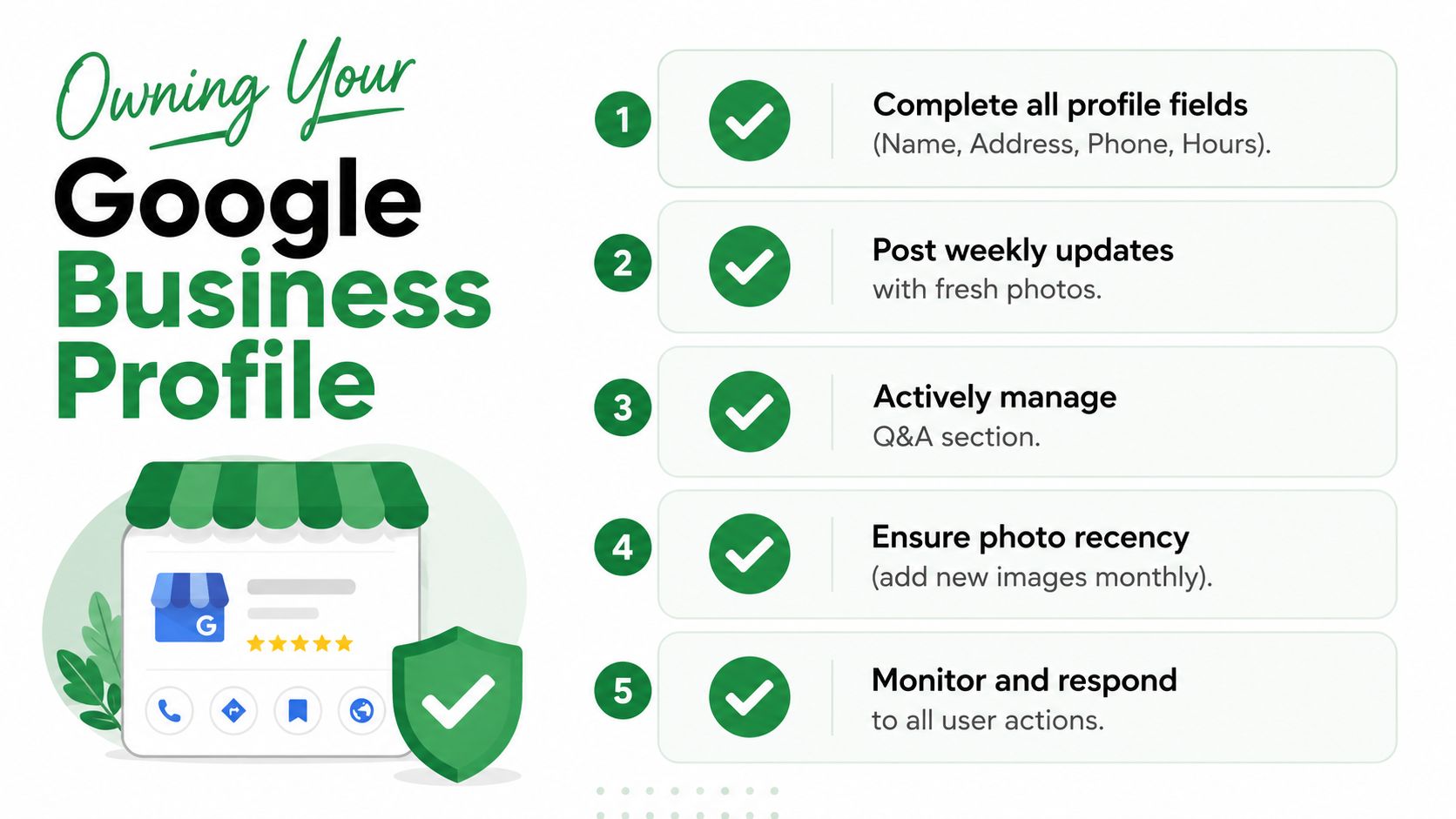
Google Business Profile is usually the highest-impact local asset, but many owners treat it like a form they completed once. That approach leaves useful signals untouched. A local ranking-factors study summarized by Visionary Marketing found profile completeness correlated at 0.71 with local visibility, while review velocity over the previous 90 days correlated at 0.64 and behavioral signals such as calls, directions, and clicks correlated at 0.51, as reported in local SEO ranking factors for 2026.
Those figures don't mean a business can force a ranking by filling every field. Correlation isn't a guarantee, and proximity and query relevance still constrain what Google can show. They do indicate that profile management deserves more attention than cosmetic keyword changes.
Prioritize evidence over profile decoration
Start with the primary category. Choose the category that best describes the core business, then add additional categories only when they reflect real services. Don't stuff the business name with locations or services. That creates a misleading identity and can introduce policy and trust problems.
Write service descriptions in customer language. A dentist shouldn't rely only on clinical terminology if patients search for emergency appointments, same-day consultations, or a specific treatment. Add accurate hours, special hours, messaging availability, attributes, products, and service details. For an SAB, make the service area and customer-facing contact information clear without presenting an ineligible storefront address.
Fresh activity gives the profile an operational layer. Publish useful updates, add current photographs, review questions and answers, and respond to user actions. The work doesn't need to be elaborate. A photo of a newly renovated reception area, an explanation of holiday hours, or a direct answer about parking can help customers make decisions while giving the profile current context.
A complete profile is materially more credible to customers. The same 2026 industry summary reports that customers are 2.7 times more likely to consider a business reputable when its profile is complete, with complete profiles associated with a 70% increase in visit likelihood and a 50% increase in purchase consideration, according to the underlying Google Business Profile research. Use the Google Business Profile audit checklist to identify missing fields and stale assets.
Operating standard: A GBP updated every week is more useful than one optimized perfectly and then abandoned.
On-Page Local SEO and Site Architecture
Your website gives the profile somewhere authoritative to point. It also supplies the detail that a business listing can't carry, including service explanations, staff credentials, location-specific information, accessibility notes, and answers to customer questions.
Begin with NAP consistency. Put the exact business name, address, and phone number in visible places such as the header, footer, contact page, and location page. Keep the same details in structured data. Small formatting differences aren't always fatal, but conflicting addresses, outdated phone numbers, or multiple business names make entity resolution harder for both search engines and AI systems.
Build pages that deserve to rank
A business with one physical location needs a page that explains that location thoroughly. A multi-location business should give each legitimate location its own page. Include an embedded map, directions or transit notes, parking information, local services, hours, staff details, and original photographs where they add genuine value.
Don't copy one city page, replace the city name, and publish it across a service area. Doorway pages create a poor user experience and rarely establish meaningful local relevance. A page for a dental practice in one neighborhood should contain details that distinguish that practice from a template written for every nearby suburb.
Use LocalBusiness schema with accurate hours, geographic information, and service types. Add BreadcrumbList markup when it reflects the site's actual hierarchy. Schema won't compensate for false information, but it can make relationships and page purpose easier for systems to interpret.
Internal links should follow the customer's decision path. A guide about tooth pain can link to the emergency dentistry service page. A neighborhood page can link to the relevant location and appointment page. Use descriptive anchor text that tells visitors and crawlers what they'll find.
| Element | Why It Matters | Priority |
|---|---|---|
| NAP in visible site areas and schema | Connects the website to the business entity | High |
| Unique location pages | Demonstrates real geographic relevance | High |
| Service pages | Matches specific commercial intent | High |
| Internal links | Clarifies relationships among services and locations | High |
| LocalBusiness and BreadcrumbList schema | Gives structured context to crawlers | Medium |
| City-name keyword stuffing | Adds noise without useful evidence | Avoid |
| Image-only homepage | Hides important business context from users and crawlers | Avoid |
Reviews as an Operating System, Not a Project
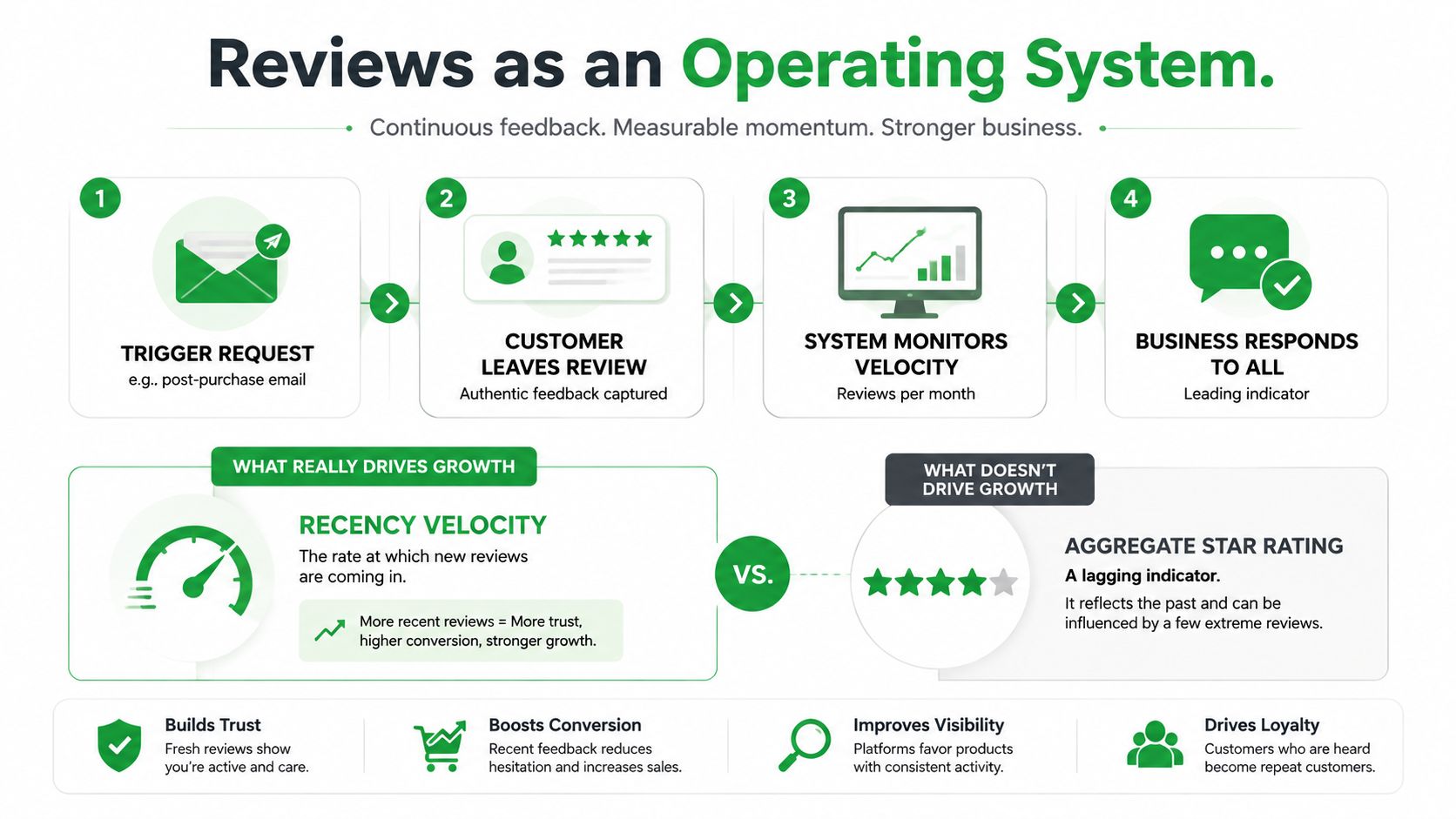
A star rating summarizes history. Review recency and response behavior show whether the business is active now. Whitespark's 2026 local ranking-factor reporting places reviews at roughly 16% to 20% of local-pack weight, with recency the strongest factor within the reviews category, as summarized by local search review management guidance. The same source reports that 89% of people expect business owners to respond to reviews, so response speed affects customer trust as well as search activity.
That changes the job description. “Get more reviews” is too vague to run. A manager needs a repeatable process with a trigger, a channel, an owner, and a response standard.
Design the request around the customer journey
Trigger the request immediately after the service has been completed or the purchase has been delivered. A trades business might use SMS after a technician closes the job. A professional service firm may use email after a consultation or milestone. Give the customer a direct short URL to the GBP review form and explain that honest feedback helps the team improve.
Never pressure customers to submit only positive reviews, and don't manufacture reviews. Authenticity matters because detailed customer language can reveal service gaps, useful FAQs, and the terms people use when describing their experience.
Respond to every review, including criticism. A strong response acknowledges the specific issue, avoids exposing private information, and moves the conversation toward a direct resolution. Mention the service naturally when relevant, but don't turn a response into keyword copy.
Response standard: Publicly show that the business listens. Privately solve what shouldn't be handled in a review thread.
Review the profile regularly for recurring complaints, praise, and unanswered questions. Share patterns with operations, not just marketing. A slow appointment process, unclear parking instructions, or confusing billing language can be fixed at the source, which improves future feedback more reliably than rewriting a response template.
Teams that need a repeatable workflow can use this resource on how to manage reviews for local search, then adapt the process to their own customer journey. The review management workflow is most effective when one person owns monitoring and another team member can resolve operational issues.
Citations and Local Link Building Compared
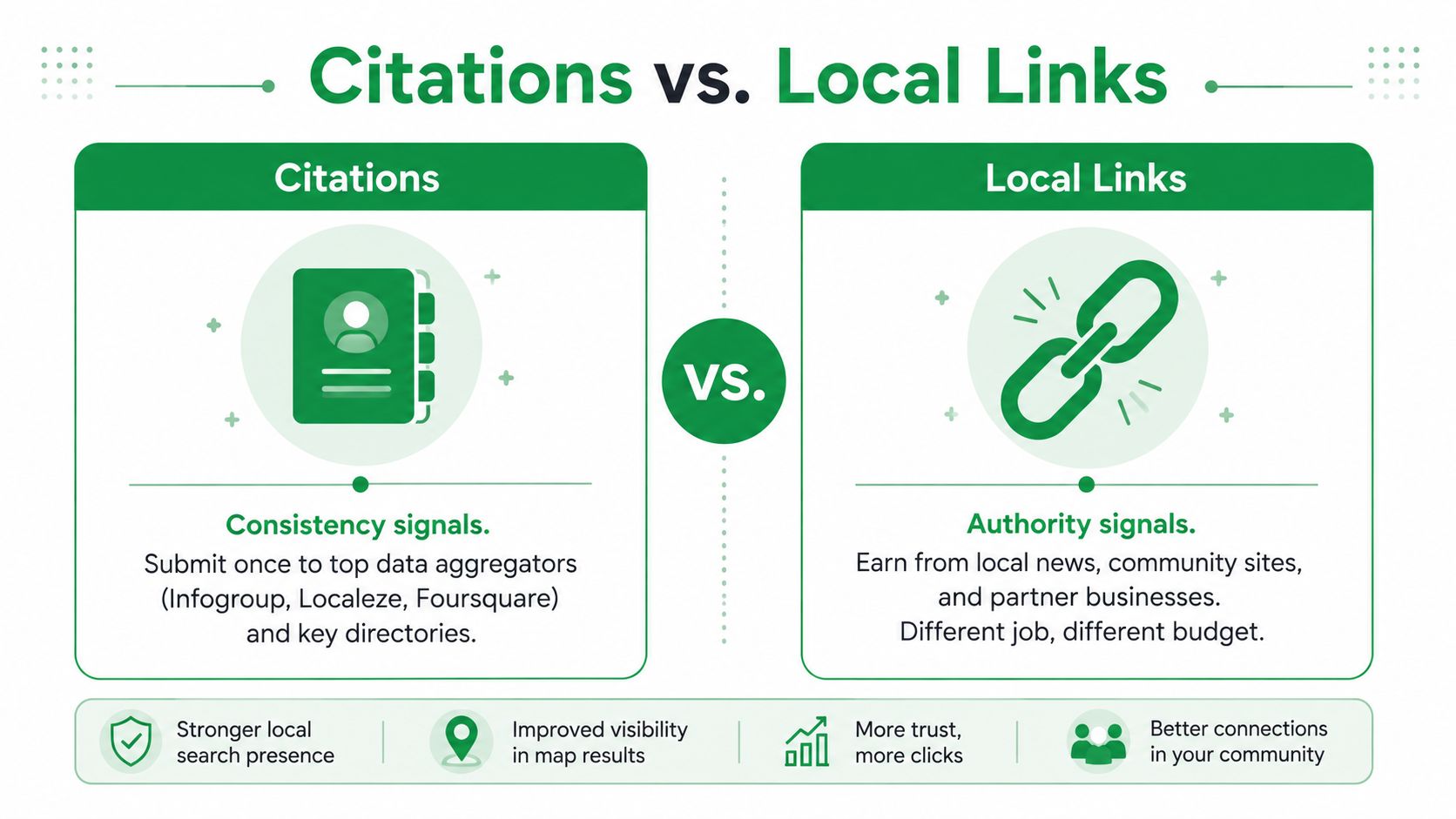
Citations and links support different jobs. A citation confirms business details on a directory or platform. A backlink connects another website to yours and can transfer local relevance, authority, and referral value. Treating them as interchangeable is how local SEO budgets get spent on volume instead of usefulness.
Citation work is hygiene
Claim and correct the major data sources first. For many businesses, that includes established aggregators such as Infogroup, Localeze, and Foursquare, plus directories that matter to the industry. A healthcare provider may prioritize a medical platform. A restaurant may need accurate profiles on dining and travel services. A home-service company may focus on trusted trade directories and local organizations.
Check for duplicate listings, old addresses, misspellings, and phone numbers that no longer route calls. After the core records are corrected, schedule periodic audits. The purpose isn't to collect every possible directory badge. It's to keep important business references aligned.
A mass submission service can look productive because it produces a report full of URLs. It can also create duplicate records and future cleanup work. Once the high-value listings are accurate, the next citation usually offers less value than a useful local relationship.
Local links create a growth lever
Earn links through activities that would make sense even without SEO. A chamber of commerce profile, a community sponsorship, a supplier directory, a neighborhood publication, or an event host can all provide context around the business. Local journalists and bloggers may link to a business that contributes expertise or participates meaningfully in the community.
| Citations | Local links | |
|---|---|---|
| Primary job | Confirm consistent identity data | Build relevance and authority |
| Best sources | Core aggregators and trusted vertical directories | Local news, community sites, partners, event hosts |
| Useful activity | Correct once, then audit for drift | Build relationships and earn coverage |
| Common waste | Submitting to every low-value directory | Paying for unrelated or manipulative links |
| Measurement | Accuracy and duplication status | Relevance, quality, referral value, and authority |
A handful of relevant local links can be more valuable than a large pile of generic directory submissions. Track citation accuracy separately from link acquisition, because one is maintenance and the other is growth.
Content, Measurement, and AI in the Loop
Local content works when it records real knowledge rather than decorating a page with a city name. A contractor can explain how a local housing style affects a repair. A clinic can answer what a first appointment involves. A restaurant can describe dietary options, service hours, and the experience customers can expect.
Useful formats include service-area explainers, staff-authored guidance, before-and-after galleries, customer questions, and case narratives based on genuine work. Specificity is the advantage. An AI system can produce fluent general advice, but it can't know which entrance has step-free access or which neighborhood jobs the team handles unless a human supplies that information.
Measure business actions, not vanity movement
Rank tracking has a place, but a position report isn't a revenue report. Monitor map-pack visibility for priority services, calls and direction requests from GBP, branded search activity, and assisted conversions in GA4. Compare those signals with appointment quality and close rates so the marketing team doesn't celebrate impressions that never become useful enquiries.
AI tools can reduce repetitive labor. They can draft several response options, summarize recurring review themes, generate a first outline for a location page, suggest FAQ questions, and produce a schema draft. They can also help compare competitor profiles or organize a citation audit.
Human review remains mandatory for anything customer-facing. A manager must verify hours, service availability, local references, compliance language, and the details that distinguish one branch from another. AI should accelerate research and drafting, not invent local experience.
| Task | AI Does Well | Human Must Lead |
|---|---|---|
| Review responses | Drafts courteous variations and identifies sentiment | Approves tone, privacy, facts, and resolution |
| Location page copy | Organizes supplied information into a clear structure | Adds genuine local detail and verifies every claim |
| Review analysis | Groups recurring themes and questions | Decides which operational problems need action |
| Schema generation | Produces a technical first draft | Confirms accurate hours, services, address, and eligibility |
| Performance reporting | Combines recurring metrics into summaries | Connects visibility to calls, leads, customers, and revenue |
AI-mediated discovery favors businesses that are quotable and entity-consistent. That doesn't require writing for machines. It requires publishing clear answers, maintaining accurate profiles, and earning references that corroborate the same business identity.
The 90-Day Local SEO Action Plan
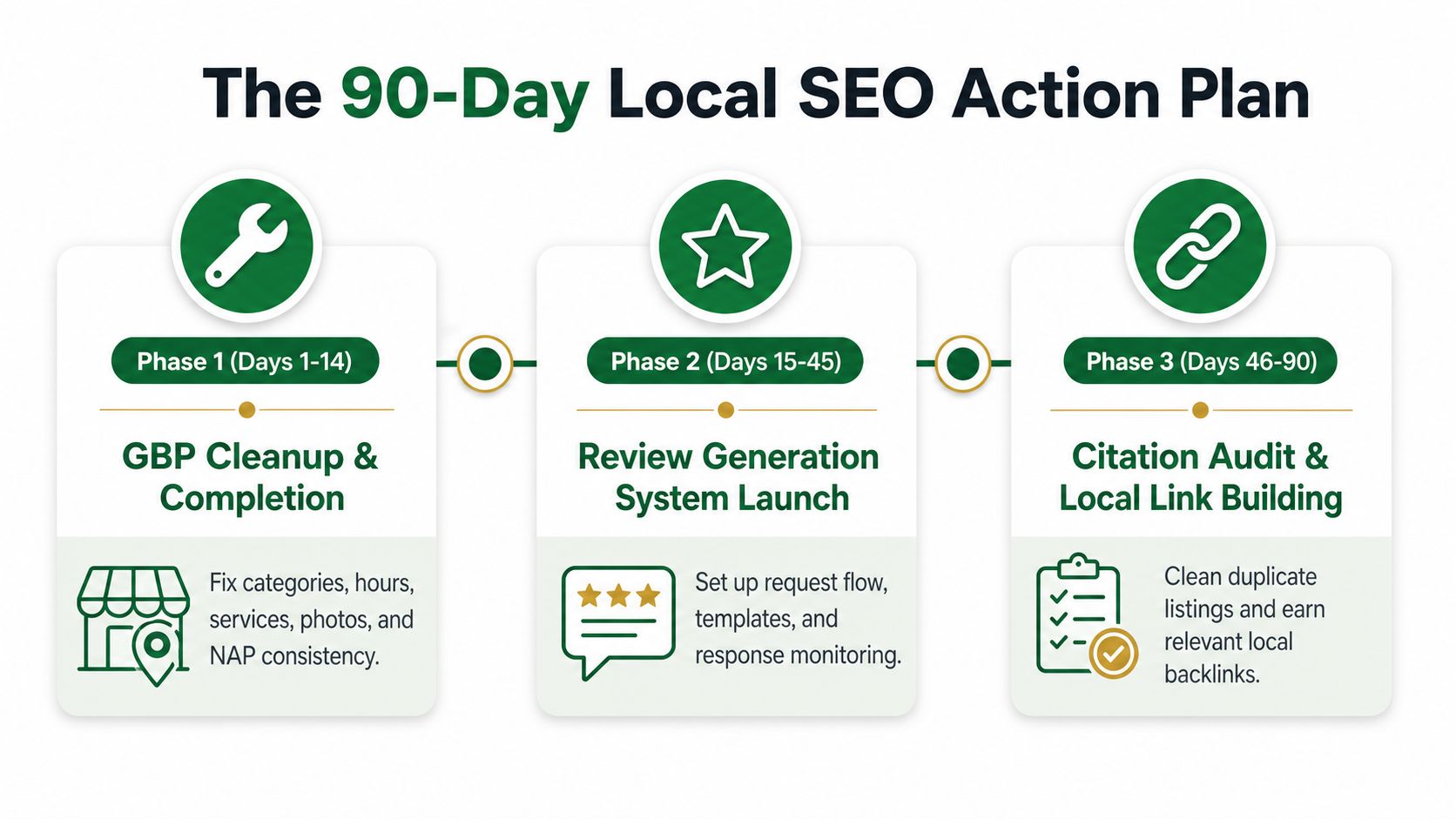
A practical 90-day program should start with assets the business controls, then add operational consistency, then measure outcomes. Don't begin with outreach if the GBP lists outdated hours or the website sends visitors to an old phone number.
Days 1 to 14
Clean and complete the Google Business Profile. Verify the primary and additional categories, service details, hours, special hours, attributes, description, messaging, photographs, and questions. Remove misleading information and document the approved business name, address, phone number, and service areas.
Days 15 to 45
Repair the website foundation. Correct NAP inconsistencies, improve the main location page, create legitimate location pages where needed, add accurate LocalBusiness schema, and connect service pages to location pages with useful internal links. Replace boilerplate with details customers can verify and use.
Days 46 to 75
Launch the review operating system. Define the post-service trigger, request channel, reminder process, monitoring owner, and response standard. At the same time, build a focused outreach list of chambers, community groups, suppliers, local publications, and event partners that could mention the business naturally.
Days 76 to 90
Connect measurement and AI assistance. Establish a baseline for map visibility, GBP calls, direction requests, branded searches, and assisted conversions. Use AI to summarize reviews and prepare drafts, but require a human to approve every public response and every local page.
Avoid the traps that consume attention without building trust: citation blasts, purchased reviews, copied city pages, generic AI content at scale, and rank tracking for phrases local customers don't use. A 44-expert local search survey ranked Google Business Profile signals as the most important factor for the local pack, while dedicated service pages, internal linking, and locally relevant inbound links ranked highly for local organic search, as documented in the local search ranking factors survey. That supports a two-layer plan, profile management for Maps and strong site architecture for organic discovery.
Start by auditing the business you have, not the one a template assumes. Then use the AI Tools for Local SEO directory to find software for profile audits, review workflows, citation monitoring, local content, rank tracking, and reporting. Choose tools that reduce repetitive work, keep human judgment in the loop, and help your team maintain the recurring signals that local customers and search systems can trust.