Google Business Profile signals account for 32% of local pack ranking weight, making GBP optimization the highest-impact action a local business can take. Reviews, website relevance, proximity, and citations still matter, but an incomplete or miscategorized profile limits every other effort.
That's the practical starting point for local maps SEO. Google Maps visibility isn't won by adding random directory listings or publishing a stream of generic blog posts. It comes from making the business entity clear, relevant, trusted, and measurable across the local search ecosystem.
What Local Maps SEO Is and Why It Matters Now
Forty-six percent of all Google searches have local intent, meaning nearly half of queries seek a nearby business, service, or place, according to BrightLocal's local SEO statistics. That makes map visibility especially valuable for businesses whose customers call, visit, request directions, or book locally.
Local maps SEO is the practice of improving a business's visibility in Google's local 3-pack, Google Maps results, and map-based search features. It overlaps with traditional SEO, but the ranking environment is different. A service page can rank well in the blue links while the corresponding business remains absent from the map pack, particularly when the Google Business Profile uses the wrong category or sends inconsistent location signals.
A local business generally competes across three surfaces:
- The local 3-pack: The map and business listings displayed within standard Google search results.
- Native Google Maps results: Results users see after opening Maps and searching by service, category, business name, or location.
- Map results embedded in AI experiences: Google's AI Overviews and related answer surfaces can summarize local options while drawing from multiple business and third-party sources.
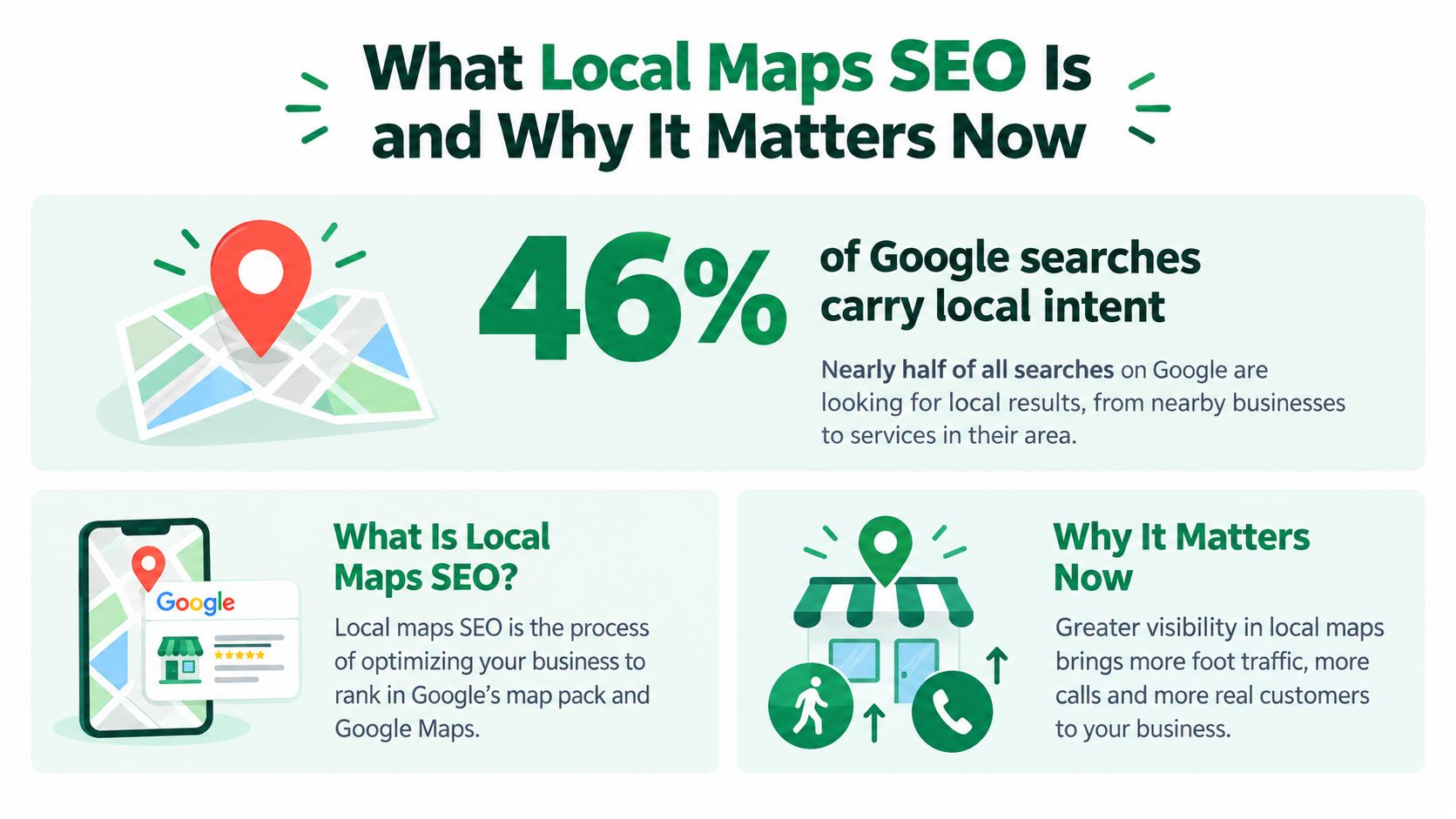
The work has three distinct jobs. First, allocate effort according to the actual ranking-factor weight distribution, rather than treating every local SEO task as equally important. Second, strengthen the profile, reviews, website, citations, and local authority signals that support visibility. Third, connect impressions and rankings to calls, direction requests, website actions, and revenue.
That's why a practitioner's audit starts with the profile and searcher location, not with a checklist of 100 directories. Citation work, schema, content, and links are useful when they resolve a real weakness. They're noise when they distract from a wrong primary category, duplicate profile, missing service, or unanswered review.
How Google Maps Ranking Actually Works
A practical audit starts with the weight distribution, not only the familiar proximity, relevance, and prominence trio. A BrightLocal summary of an industry expert survey assigns Google Business Profile signals 32%, reviews 20%, on-page signals 15%, behavioral signals 9%, links 8%, citations 6%, personalization 6%, and social signals 4% of local pack or Maps ranking weight. These figures are directional, not a fixed formula for every query. The Google local algorithm and ranking factors breakdown provides the full distribution.
| Ranking Factor Category | Approximate Weight | Key Signals Included |
|---|---|---|
| Google Business Profile | 32% | Category, business details, services, profile completeness, photos, Q&A |
| Reviews | 20% | Volume, relevance, recency, responses, customer sentiment |
| On-page signals | 15% | Service and location relevance, contact details, local content |
| Behavioral signals | 9% | Search and interaction patterns |
| Links | 8% | Local and industry authority |
| Citations | 6% | Consistent business references across directories |
| Personalization | 6% | User-specific context |
| Social signals | 4% | Local engagement and references |
The distribution changes how I allocate audit time. If a client has a wrong primary category and inconsistent directory listings, I would spend the first hours correcting the category and core profile data, then address citation cleanup. The category sits inside the 32% Google Business Profile group, while citations account for 6%. Citation consistency still matters, but weeks spent removing low-value duplicates are difficult to justify while Google is classifying the business incorrectly.
Proximity remains a constraint. The searcher's location influences which businesses enter the competitive set before other signals can separate them. A relevant profile outside the practical service radius may not outrank a nearby competitor with weaker website content or fewer reviews.
A review-count study summarized by WebsiteBuilderExpert's local search ranking factor resource shows why proximity and reviews must be assessed together. Across the top 21 local map positions, proximity represented 55.2% of measured factor influence and review count 19.2%. Within the top 10, proximity fell to 36.2%, while review count rose to 26% and review keyword relevance reached 22.8%.
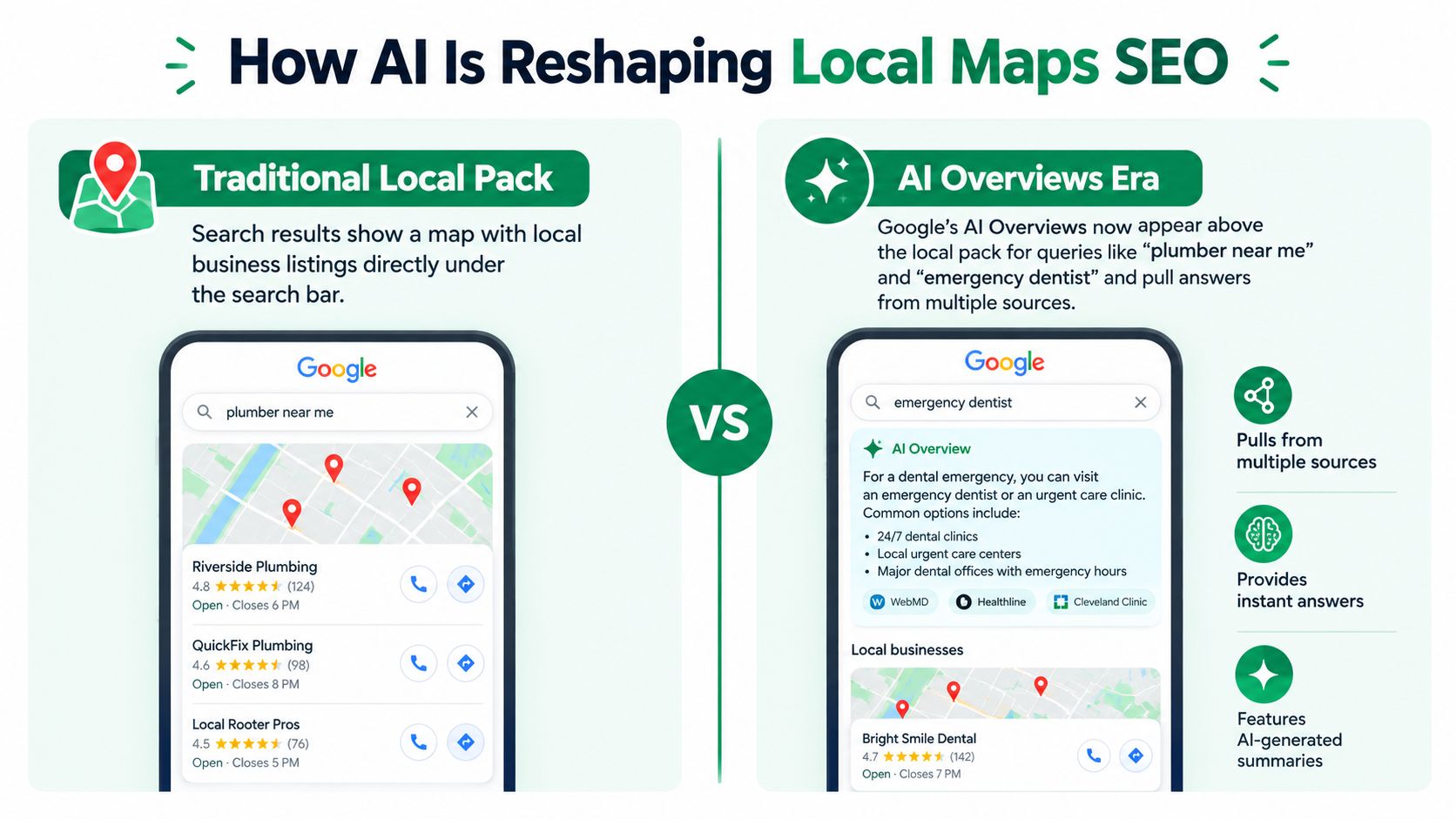
AI Overviews add another visibility constraint for high-intent searches. A business can retain map relevance while receiving less direct exposure if Google summarizes local options above or around the map pack. Track map impressions, calls, direction requests, and website actions, rather than treating a stable position as proof that visibility and leads are unchanged.
Practical rule: Confirm that Google can consider the business for the searcher's location. Then improve the profile, review, website, and authority signals that distinguish nearby competitors.
Optimizing Your Google Business Profile for Map Visibility
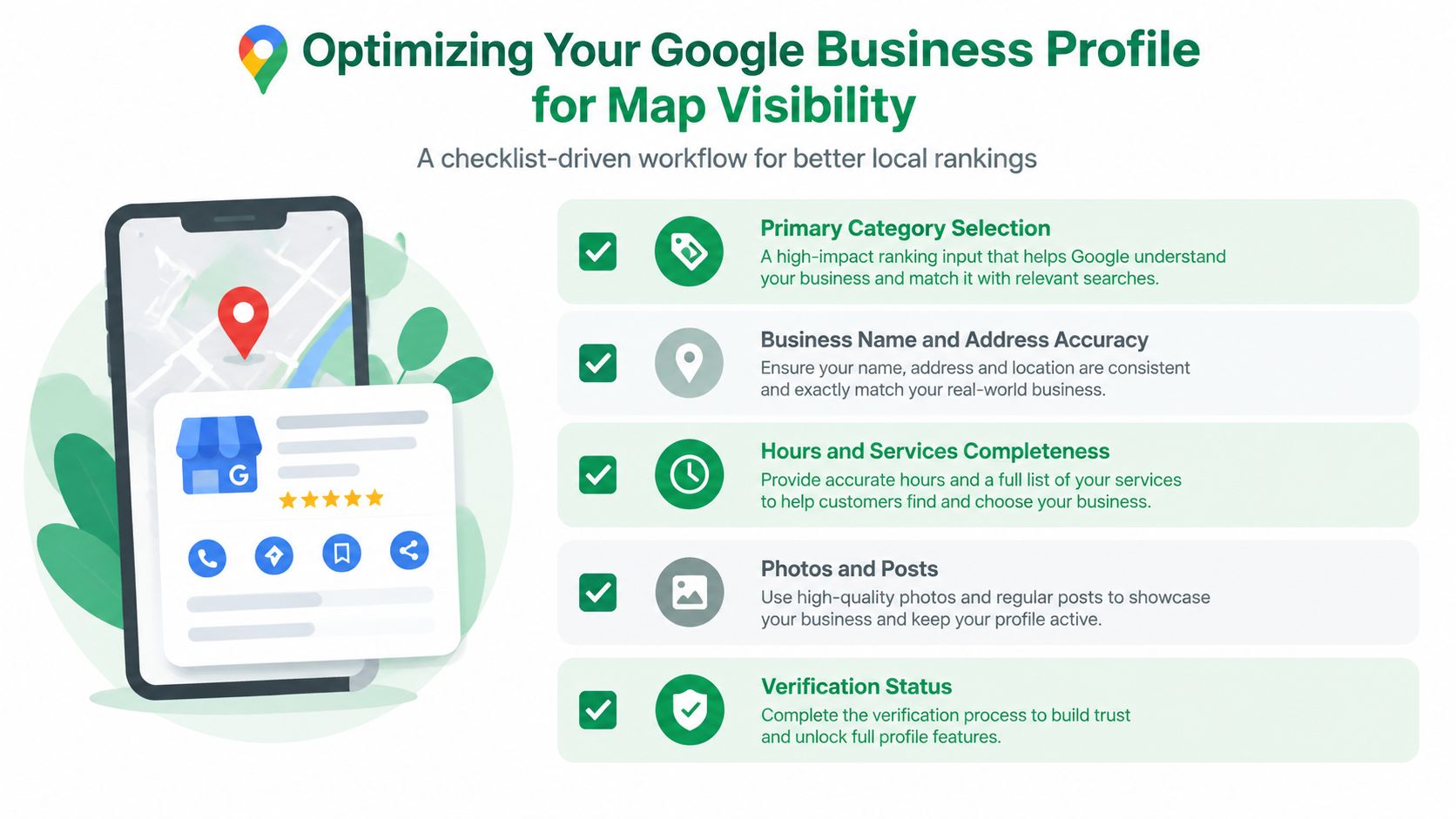
A GBP audit should follow a fixed order. Start with the primary category, not the business description. The category determines the core searches for which Google can consider the profile, so choose the most accurate category that describes the main commercial activity. Don't add service keywords or city names to the business name unless they're part of the actual world name. That shortcut can create guideline and suspension problems.
Prioritize fields that clarify the entity
Confirm the business name, address, phone number, website, hours, service area, and map pin. For a storefront, the displayed address must reflect the customer-facing location. For a service-area business, configure the service area accurately and avoid presenting an address where customers don't visit.
Complete the description, services, attributes, messaging settings, and holiday hours, but separate useful completeness from decorative completion:
- High-impact accuracy: Primary category, business name, address, phone, hours, service area, and website.
- Relevance support: Service entries, attributes, Q&A answers, and a description that clearly identifies the business and its services.
- Supporting activity: Original photos, updates, and posts that help customers understand the operation.
- Conversion detail: Booking paths, messaging availability, service descriptions, and clear contact options.
Photo metadata and a rigid weekly posting schedule are often overpromoted as ranking tactics. Uploading original images of the team, premises, vehicles, equipment, and completed work is valuable for trust and conversion, but there's no verified basis here for claiming that geotagged EXIF data or a specific posting cadence produces a predictable ranking lift. Use photos to prove the business exists and operates as described, not to manipulate a metadata field.
Clean up technical risk
Verify ownership, inspect for duplicate profiles, and check whether Google has restricted edits or suspended the listing. If the profile was recently moved, renamed, or merged, document the evidence before making more changes. Spam cleanup matters too. Report competitors using fake locations or keyword-stuffed names through the appropriate Google process rather than copying their behavior.
For a detailed operational walkthrough, use this Google Business Profile setup guide. It's useful when an owner or agency needs a repeatable onboarding checklist rather than a one-off profile edit.
Building the Supporting Signals Around Your Profile
Once the GBP accurately represents the business, supporting signals should corroborate the same entity. Citations account for 6% of local pack ranking weight in the BrightLocal distribution cited earlier, so they matter, but they shouldn't consume the budget reserved for category strategy, reviews, or meaningful website improvements.
A sensible cleanup starts with the business's core identity. Record the exact name, address, phone number, website, hours, and service areas. Then check major data sources and relevant directories before chasing obscure listings. Tools such as Moz Local and BrightLocal can help identify mismatches and distribute corrected information, while industry directories and local organizations add context that broad aggregators may not provide.
Prioritize foundational data sources such as Foursquare, Neustar, Localeze, and Infogroup, then review trade-specific platforms, chambers of commerce, licensing directories, and reputable local publications. After a rebrand or address change, don't create a new listing because an old one is inconvenient. Correct, merge, or remove duplicates where the platform allows it, and keep a record of unresolved cases.
For a plain-language explanation of the process, see this guide to what local citations are.
Match website signals to the profile
The website should confirm what the GBP says. A local service business may need useful service pages, location pages for areas it serves, consistent contact information, and locally relevant project or customer information. Avoid creating thin city pages that merely swap a place name into the same template.
Structured data helps machines interpret the page, but it isn't a substitute for useful content. LocalBusiness schema can describe the business entity, Service schema can clarify offerings, and FAQPage schema can identify question-and-answer content where it accurately applies. An embedded Google Map can reinforce the relationship between the site and the business location, but it won't rescue weak relevance or inaccurate profile data.
| Signal | Approx. Ranking Weight | Recommended Effort |
|---|---|---|
| On-page signals | 15% | Build useful service and location pages, then maintain accurate entity details |
| Links | 8% | Earn relevant local, trade, community, and supplier references |
| Citations | 6% | Correct core data first, then maintain priority directories |
| Structured data | Not separately quantified | Implement accurate markup that matches visible page content |
The trade-off is simple. Spend enough effort to remove contradictions and establish local authority, but don't turn citation volume into the campaign's central KPI.
Reviews as a Ranking and Conversion Lever
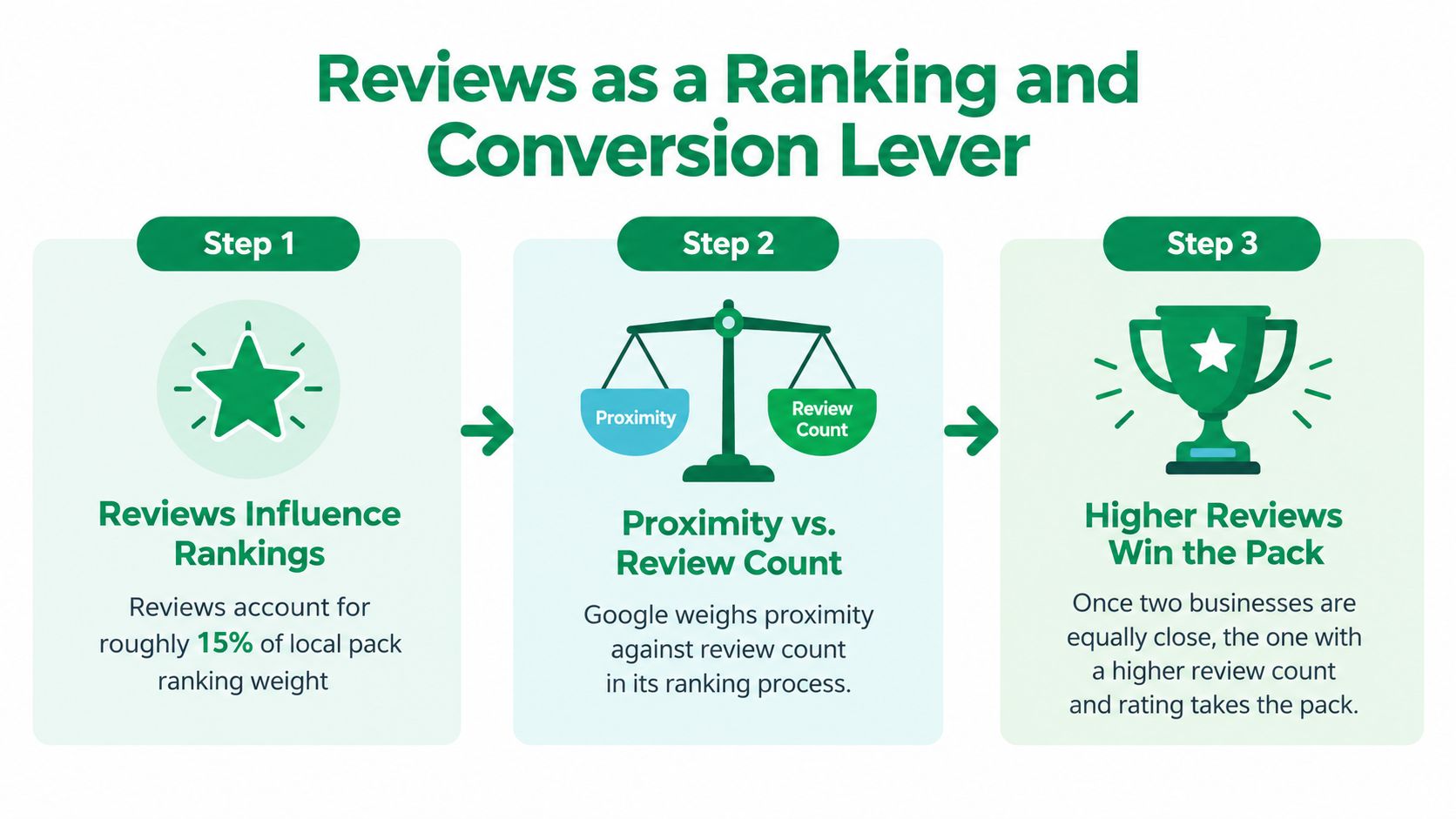
Reviews affect both map visibility and the customer's decision after a listing appears. Earlier ranking analysis shows that proximity can determine whether a business enters the comparison set, while review quantity and relevant wording carry more weight as nearby competitors are evaluated. Treat those signals as part of a workflow, not as a reason to chase ratings in isolation.
Buying reviews, scripting customer comments, or offering rewards for positive ratings creates policy and trust risks. A better process asks every eligible customer for honest feedback after completed work, then handles the response consistently.
Turn completed work into honest feedback
Send a post-service SMS or email with a direct review link once the customer has received the service. Keep the request clear, ask for honest feedback, and never prescribe a rating or specific wording. Teams that need help designing the message can follow this practical guide on how to ask for a review.
Review management needs an owner and a response standard:
- Positive reviews: Thank the customer and refer to the service detail they mentioned.
- Specific praise: Reinforce that capability without copying one template across every response.
- Negative feedback: Acknowledge the experience, avoid arguing publicly, and move resolution to a private channel.
- Suspected spam: Record the evidence and use Google's reporting process instead of retaliating.
Responses add context, but customer-written language often gives prospective buyers the clearest evidence of what the business does. A mention of emergency plumbing, boiler repair, or a particular neighborhood is more informative than a generic five-star rating. It can also reinforce service relevance for people comparing nearby providers.
Track the workflow, not only the average rating. Monitor how many eligible customers receive a request, whether reviews mention target services, response coverage, and recurring complaints. A steady request process usually provides more useful feedback than occasional campaigns aimed at lifting the score.
Teams managing multiple locations can apply the operating principles in Franchise Foundry's guide to review management, especially for ownership, escalation, and response consistency.
How AI Is Reshaping Local Maps SEO
Optimizing the GBP is still essential, but it's no longer safe to assume that a strong profile guarantees visibility in every local answer surface. Recent coverage of local search argues that AI Overviews can reduce reliance on traditional map packs for some high-intent searches, while consistency, citations, and structured data help validate the business entity across multiple sources. See the analysis of how businesses get found in the Maps pack for that broader perspective.
Traditional local results usually present several businesses for comparison. An AI-generated answer may instead summarize options, explain why they fit, and pull supporting details from the business profile, review platforms, directories, and local publications. That creates a second visibility problem. A business can appear in Maps but remain absent from an AI summary because the surrounding web does not consistently confirm what the business is, where it operates, or which services it provides.
Build an entity that machines can verify
The practical response isn't to abandon GBP work. It's to make every authoritative reference agree:
- Business identity: Use the same real-world name, contact information, and location details.
- Service clarity: Describe services consistently on the profile, website, and relevant directories.
- Local authority: Seek legitimate mentions from trade associations, community organizations, local publications, and relevant industry sources.
- Machine-readable content: Use accurate structured data and write concise answers that can stand alone when extracted.
Do not treat Wikipedia or Wikidata entries as guaranteed placements, and don't create them merely to manufacture authority. The standard should be legitimate notability and accurate information. AI visibility is an additional layer on top of local SEO foundations, not a shortcut around proximity, relevance, reviews, or profile quality.
Measuring and Monitoring Your Maps Performance
Rank checks alone don't prove that local maps SEO is producing business value. A useful measurement system separates visibility, engagement, and revenue actions, then tracks each from a consistent search location.
Grid-based rank tracking helps reveal how visibility changes across a city or service area. Track the same service and location queries from defined points, and distinguish between local pack position, Google Maps position, and finder results. A business may perform well near its address but disappear several miles away. That's a geographic reality, not necessarily a failed campaign.
Review GBP Insights for search queries, profile views, calls, website actions, and direction requests. Treat these as leading indicators, then connect them to actual outcomes. Add UTM parameters to the website link in the profile, use a call-tracking number that forwards to the business line, and record direction-request or booking outcomes in the client's CRM.
Use a cadence that supports decisions
A weekly review should catch operational problems. A monthly review should support strategic changes and competitor comparisons.
| Metric | Source | Review Cadence |
|---|---|---|
| Local pack and Maps visibility | Grid rank tracker | Weekly or monthly |
| Search queries and profile activity | GBP Insights | Weekly |
| Calls and website actions | GBP Insights, analytics, call tracking | Weekly |
| Direction requests | GBP Insights and customer records | Weekly or monthly |
| Reviews and response coverage | GBP and review platform | Weekly |
| Competitor categories, services, photos, and reviews | Manual audit and tracking tools | Monthly |
| Leads, bookings, and revenue | CRM, call tracking, analytics | Monthly |
A plateau can indicate a category problem, a proximity ceiling, weak review relevance, or a website that doesn't validate the profile. Don't respond by publishing more posts automatically. Compare the profile against nearby competitors using the same search points and inspect which signal category is weaker.
Your 90-Day Local Maps SEO Action Plan
The order matters because the ranking distribution favors the profile and reviews before lower-weight supporting work. A 90-day plan should establish accuracy first, then corroboration, then sustained activity and measurement.
Days 1 to 30 focus on the profile
Audit ownership, duplicates, primary category, business name, address, phone, hours, service area, website, map pin, and profile restrictions. Complete the services and attributes that accurately describe the business, replace outdated images with original operational photos, and set up a compliant review-request process.
At the same time, establish the measurement baseline. Record grid visibility, GBP actions, calls, direction requests, website actions, review count, and the main competitors appearing for the target searches.
Days 31 to 60 build corroboration
Correct priority citations and NAP mismatches. Improve the website pages that confirm services and locations, then implement accurate LocalBusiness, Service, or FAQPage markup where appropriate. Look for legitimate local links and mentions from suppliers, associations, community organizations, and publications.
This is also the point to check entity consistency beyond the profile. AI-mediated discovery increasingly favors businesses whose identity and services are supported by multiple trustworthy sources, so remove contradictions rather than producing more thin content.
Days 61 to 90 improve momentum and accountability
Maintain the review workflow, respond to every review with individualized language, publish useful profile updates when the business has real news, and compare visibility against the original baseline. Attribute calls and bookings rather than reporting rank movement as the final outcome.
For a solo operator, the weekly checklist can stay compact:
- Profile check: Confirm hours, services, messages, and recent customer-facing updates.
- Review workflow: Send honest requests after completed work and answer new reviews.
- Data check: Inspect important directory listings and correct meaningful inconsistencies.
- Performance check: Review calls, directions, website actions, and ranking changes.
- Competitor check: Note category, service, review, and profile changes nearby.
Agencies managing multiple locations should delegate profile edits, citation cleanup, review responses, content production, and reporting to separate owners with a shared QA process. Add service-area pages when the business has a genuine offer, local proof, and distinct customer intent for that area. If those pages would be thin or duplicative, invest first in the profile, reviews, and entity consistency.
Audit your Google Business Profile against the ranking priorities above, document the gaps, and track calls, direction requests, reviews, and qualified leads from a fixed baseline. Then execute the first 30 days before expanding into citations, content, or AI visibility work.