A new HVAC client in a mid-sized metro can arrive with a familiar problem: no reliable baseline, no clear view of which competitors own local search, and roughly three months to show that local SEO is producing business rather than decorative reports. The owner may know the service area well, but that knowledge doesn't reveal which neighborhoods search for emergency repairs, which competitors dominate the map pack, or why residents choose one contractor over another.
Local market research answers those questions by studying the market in layers. It connects search demand with Google Business Profile competition, human decision behavior, and the emerging AI surfaces that increasingly shape discovery before a customer visits a website. Done properly, it gives an SEO team a defensible path from local evidence to calls, quote requests, booked jobs, and location-level growth.
What Local Market Research Actually Covers for Local SEO
The first mistake many teams make is treating local market research as a keyword list. A keyword list can show what people type, but it can't explain who appears in the map pack, what customers praise or criticize, or whether an AI-generated answer mentions the business at all.
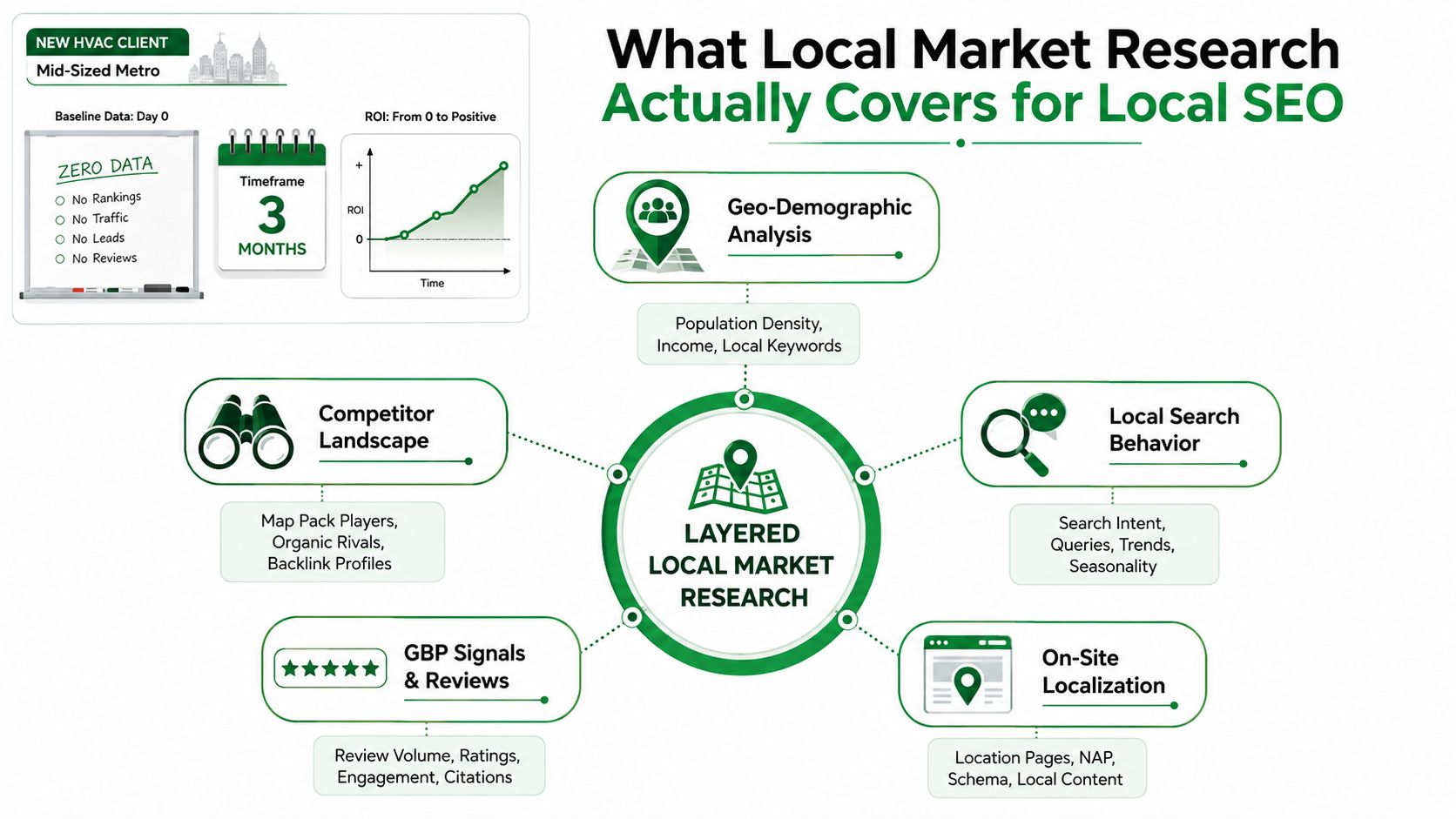
Four surfaces require four research questions
Search demand is the first layer. It asks what residents search for, how they describe a service, which modifiers indicate urgency, and whether demand is concentrated around a city, suburb, or neighborhood. A local SEO team should separate broad service terms from service-and-city combinations, “near me” searches, and informational questions.
Google Business Profile competition is a different investigation. The relevant question isn't which domain ranks organically. It's which businesses appear in the map pack for priority queries, what categories they use, how complete their profiles are, how their reviews describe the customer experience, and whether their service areas overlap with the target market.
Human decision behavior adds the reason behind the click or call. Review language, customer interviews, lost-lead surveys, service records, and sales notes can reveal that people care about weekend availability, transparent pricing, clean work, or fast responses. Those findings can shape page copy, GBP attributes, review requests, and conversion paths.
The fourth surface is AI-generated discovery. Research now needs to examine whether local businesses appear in AI overviews, map and app answers, and other zero-click experiences. One recent consumer benchmark reported that 60% of consumers click AI-generated overviews in Google Search, while 84% search for local businesses online daily and 59% expect a response within 24 hours. Those figures come from Rio SEO's 2025 local search consumer behavior study.
Keep the evidence streams separate
Search platforms, GBP audits, customer evidence, and AI-surface checks produce different kinds of evidence. A rank tracker won't tell you why a competitor receives better reviews, and review sentiment won't establish whether a neighborhood has enough search demand to justify a new landing page.
For practical guidance on foundational visibility work, DesignStack's local SEO tips are useful alongside a deeper market-research process. The workflow should move from demand mapping to SERP and GBP analysis, then to customer evidence, and finally to AI-surface monitoring. Each layer should produce a clear decision, not merely another dashboard.
Setting Goals, Service Areas, and the Local Demand Layer
A plumbing company may want more emergency bookings, while a dental practice may prioritize new-patient calls and appointment forms. A retailer may measure success through direction requests and store visits. Local research starts by naming that business outcome, then connecting it to the geography and search behavior that can produce it.
Write the goal in operational terms. Define a service-area polygon based on travel time, staffing, licensing, service economics, and existing demand. A service-area business that serves selected suburbs should not automatically target an entire metro. Broad targeting can produce attractive visibility reports while generating inquiries the business cannot fulfill profitably.
Build a demand map
Group search terms into three working sets:
- Head terms: Broad searches such as “plumber Tampa” or “HVAC repair Austin.” They establish category language and indicate broad market presence.
- Service and city patterns: Specific searches such as “emergency drain cleaning Tampa.” These combine a clear service need with a location qualifier.
- Neighborhood modifiers: Searches such as “South Tampa plumber.” They show whether a community warrants a dedicated page, localized content, or closer GBP service-area alignment.
Local search behavior supports this level of detail. A 2024 consumer-behavior benchmark found that 80% of U.S. consumers search for local businesses online at least weekly, 32% do so daily, and 72% use Google for local business information. The same research family reported that 39% estimated at least 41% of their searches were local-specific, while 45% said Google was their default platform for local searches. The findings are documented in local SEO consumer behavior statistics.
Search volume is only one input. Smaller markets may show sparse or unstable volume data, so weigh service relevance, local intent, commercial action in the SERP, and the company's ability to fulfill demand. A lower-volume emergency query may deserve priority over a broader informational phrase when it leads directly to a callable job.
Classify intent before choosing the asset
| Query Pattern | Intent | SERP Feature | Primary Asset |
|---|---|---|---|
| “HVAC repair near me” | Transactional | Map pack, local services, business profiles | Optimized GBP and service page |
| “Emergency drain cleaning Tampa” | Emergency | Map pack, call actions, service pages | GBP, emergency service page, prominent phone CTA |
| “South Tampa plumber” | Transactional and geographic | Map pack, local landing pages | Location page and GBP service-area alignment |
| “Why is my AC leaking?” | Informational | Organic articles, featured answers, AI overview | Helpful troubleshooting content with service CTA |
| “Best dentist open Saturday” | Transactional and availability-led | Reviews, map pack, business details | GBP hours, attributes, appointment page |
Similar wording can require different assets. Map results and direct contact actions indicate that the GBP and conversion path need attention. Explanatory results call for useful content connected to the relevant service, rather than a sales page forced onto an informational query. This demand layer should produce a publishing or optimization decision, not just a keyword list.
Mapping the Local SERP and Your Real GBP Competition
Organic competition and map pack competition are related, but they aren't the same contest. A national directory may outrank a local company in the blue links while having no meaningful presence in the map pack. Conversely, a neighborhood contractor may dominate local results with a modest website because its GBP, proximity, categories, reviews, and local relevance align with the query.
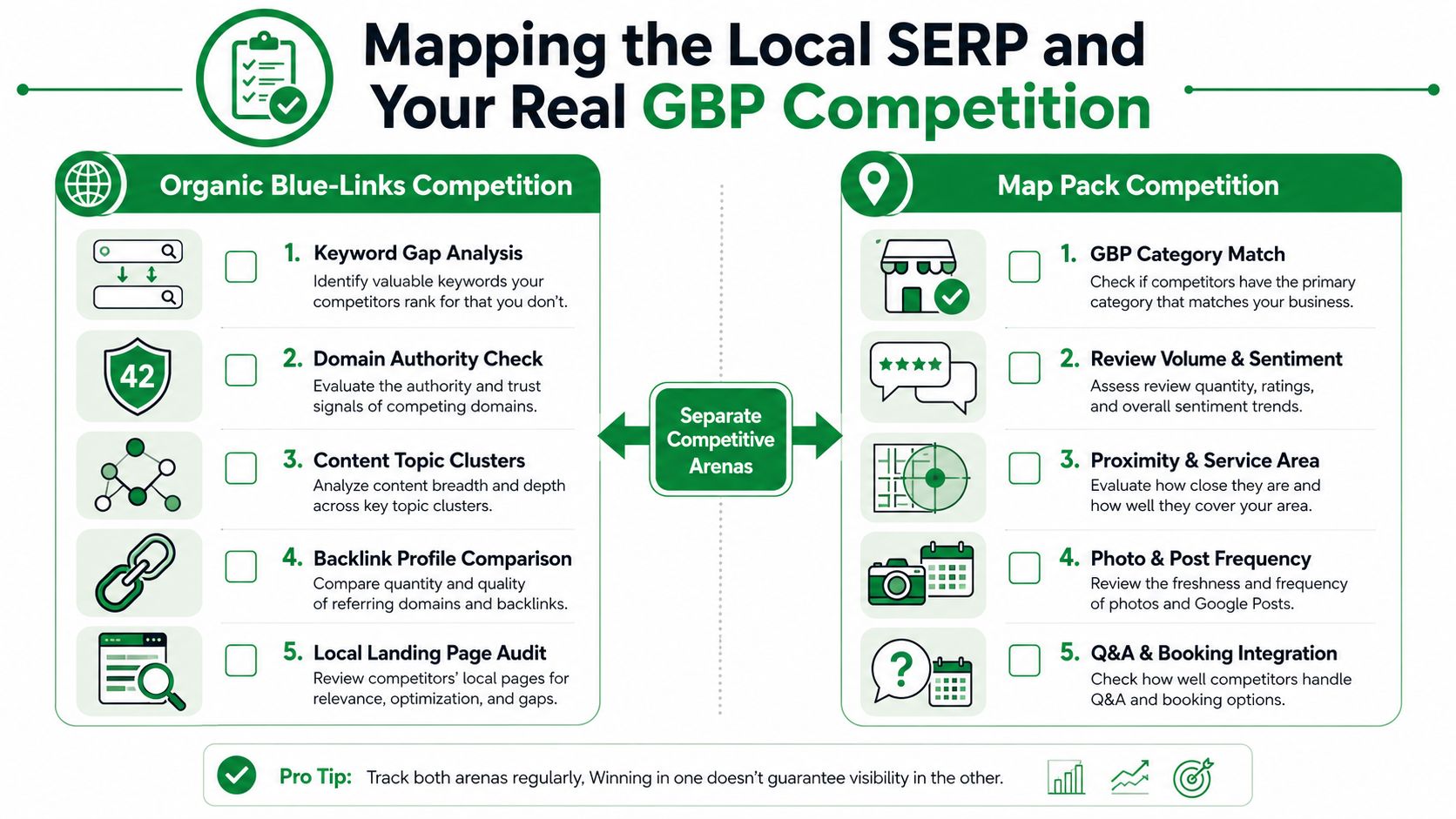
Record the SERP as a local snapshot
Search from the target ZIP code, use a clean browser environment, and record the same query set at a consistent time. For every priority query, log:
- Map pack players: Business names, categories, review themes, visible services, and contact options.
- Organic leaders: The top results, domain type, location-page structure, content format, and local relevance.
- Paid and AI surfaces: Sponsored placements, AI-generated overviews, citations, and whether the business appears before a click.
- Conversion paths: Phone actions, booking links, directions, quote forms, and any friction between discovery and contact.
This process reveals whether the client faces a strong service-business competitor, a directory-heavy SERP, or a mixed field. It also prevents an agency from promising organic gains when the immediate commercial opportunity sits inside the map pack.
Audit the profile, not just the ranking
Inspect each serious GBP competitor across the same fields. Check the primary category and relevant secondary categories, business name and contact consistency, services, attributes, hours, photos, posts, Q&A, booking options, and review patterns. Don't count photos mechanically. Note whether they show completed work, staff, premises, equipment, or recognizable local context, and whether the images appear current.
Review quality matters as much as review quantity. Rio SEO's location-level research analyzed more than 164,000 U.S. business locations across eight industries, a scale suited to cross-market comparison rather than isolated anecdotes, as described in its 2023 local search consumer behavior study. The research process should use that kind of location-level thinking, even when an SMB has a smaller dataset.
Use a simple internal score, not gut instinct. Rate each competitor from one to five for category fit, listing accuracy, review strength, content completeness, visual freshness, and conversion readiness. Keep the scale consistent, document the evidence behind every score, and separate observed facts from interpretation.
For teams adapting competitive research methods from other channels, Trendy's guide to competitive analysis for influencers offers a useful reminder: comparison works only when every competitor is assessed against the same criteria. Track local SERPs with a purpose-built workflow such as local SERP tracking, then connect ranking observations to profile changes and business outcomes.
Customer and Demographic Insights You Can Verify
Search behavior tells you what people ask for. Reviews and customer records often explain what makes them choose one provider. A local market research project becomes much more useful when those two evidence types meet at the neighborhood level.
Start with the leading competitors and export their recent review text. For a substantial review-mining exercise, pull the last 200 reviews per top competitor as a working sample, then tag recurring language. The number is a workflow choice, not a market statistic. Useful tags include pricing clarity, wait times, weekend availability, pet friendliness, technician professionalism, cleanliness, communication, and appointment reliability.
Turn language into testable hypotheses
Suppose multiple reviews mention that a veterinary clinic accommodates anxious pets. That theme can support an attribute hypothesis, a service-page section, a review-request prompt, and a neighborhood campaign aimed at households searching for low-stress care. If reviews repeatedly criticize slow callbacks, the insight belongs in the operational plan as much as in the SEO plan.
A short survey can validate whether review themes reflect the wider customer base. Ask past customers and lost leads:
- What service were you looking for?
- How did you first find the business?
- Which factor most influenced your decision?
- What nearly stopped you from booking?
- In your own words, what would you want this business to improve?
Distribute the survey through email, SMS, post-service follow-up, and sales-team outreach. Track the channel and customer status for every response. If the business needs a lightweight survey platform beyond a familiar default, teams can find a SurveyMonkey alternative and compare options against response collection, exports, and consent requirements.
Separate verifiable evidence from anecdotes
Review text, GBP Q&A, business hours, service lists, and publicly visible profile details can be checked directly. U.S. Census American Community Survey data can support ZIP-level demographic overlays, while Google Mobility patterns may add directional context about movement and access. Neither source should be treated as a direct statement of customer motivation.
A practical two-day workflow looks like this:
- Day one morning: Export reviews, create tags, and mark the location associated with each review when available.
- Day one afternoon: Compare themes with GBP attributes, Q&A, services, and existing landing-page copy.
- Day two morning: Overlay customer ZIPs with census context and separate served neighborhoods from unserved ones.
- Day two afternoon: Build persona sheets tied to specific query clusters, profile attributes, objections, and conversion actions.
| Tag Theme | Example Phrase | Frequency | Service Area Implication | Action Tied to Insight |
|---|---|---|---|---|
| Pricing clarity | “The estimate matched the final bill” | Track in the export | Price-sensitive neighborhoods may need clearer qualification | Add estimate guidance and review prompts |
| Response speed | “They called back quickly” | Track in the export | High urgency areas may value immediate contact | Emphasize response process and call availability |
| Weekend availability | “They came on Saturday” | Track in the export | Working households may search outside weekday hours | Display accurate hours and create availability messaging |
| Staff professionalism | “The technician explained everything” | Track in the export | Trust may influence higher-consideration services | Use the theme in service copy and review requests |
Where AI Tools Fit at Each Stage of the Research Stack
AI works best here as a compression and comparison layer. It can cluster a large keyword set, summarize review themes, flag inconsistent listings, and compare competitor profiles. It can't decide whether a new service-area page makes commercial sense without evidence about capacity, profitability, and actual customer demand.
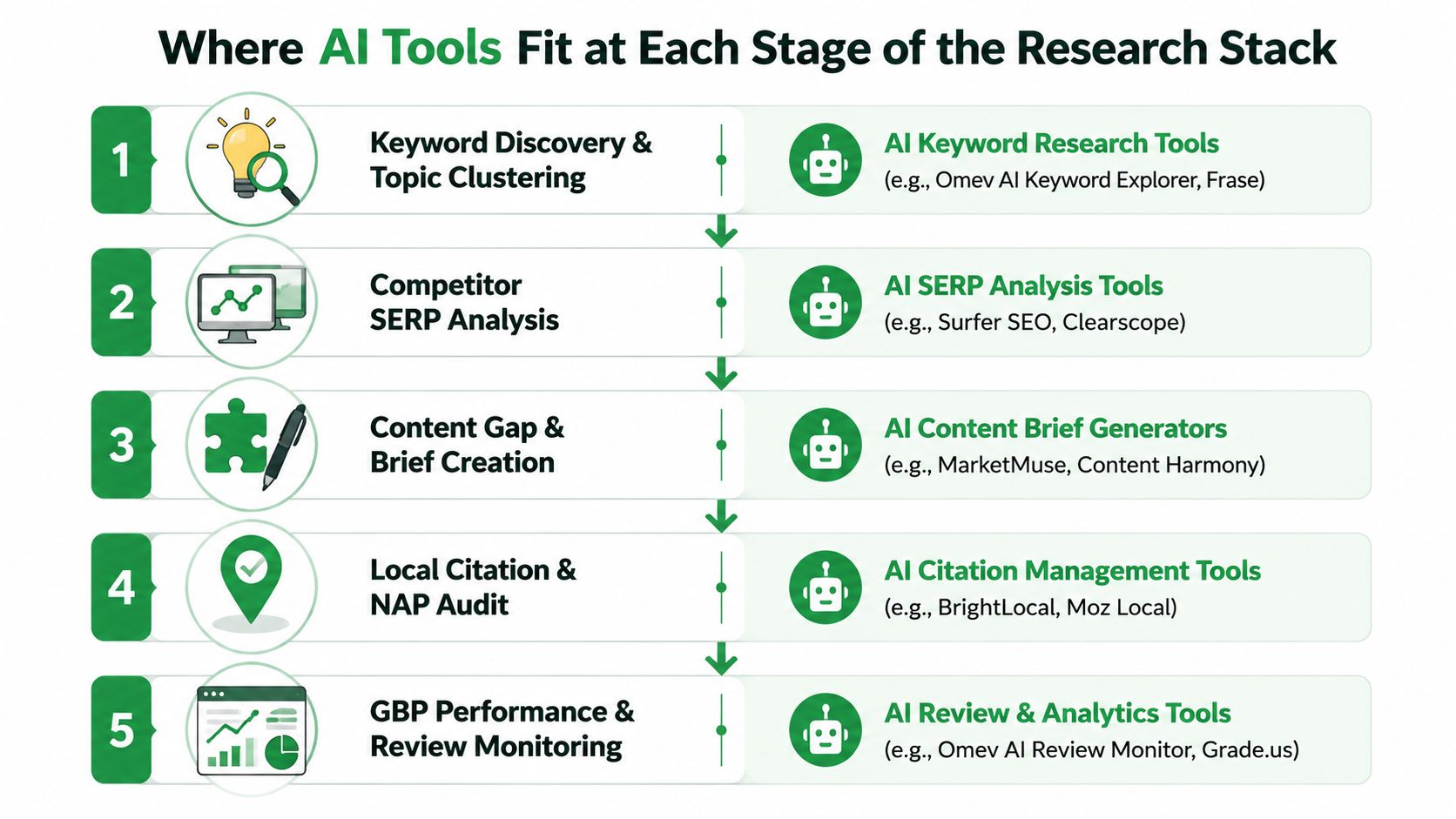
Assign AI to a bounded research job
For keyword and market research, use AI to cluster head terms, service-and-city combinations, neighborhood modifiers, and questions by intent. Review the raw queries before accepting a cluster. Automated grouping can merge services that require different pages or confuse emergency intent with general research.
For GBP optimization, AI can compare categories, services, attributes, hours, photo gaps, and profile completeness across a defined competitor set. The output should be an audit queue. A human still needs to confirm whether a category is legitimate and whether a suggested attribute reflects the actual business.
Citation tools can scan listings for name, address, phone, hours, and URL inconsistencies. They're useful for finding gaps quickly, but a citation platform's match doesn't prove that the listing is strategically important. Confirm ownership, relevance, and whether the source sends customers or supports trust.
Review management tools can tag sentiment and draft response options. Treat drafts as starting material. Responses need business-specific facts and must avoid promising remedies or services the company can't deliver.
Rank tracking tools can monitor map-pack and organic movement by neighborhood. Compare movement against actual profile edits, page changes, review activity, and seasonal demand instead of assigning every fluctuation to AI-generated recommendations.
A solo business can start with a keyword tool, a spreadsheet, a GBP audit checklist, a citation scanner, and a review-monitoring workflow. An agency managing multiple locations may add segmented rank tracking, shared review tagging, listing management, and a central evidence repository. The AI-powered market research guide provides context for evaluating directory categories and assembling a workflow. The AI Tools for Local SEO directory is one place to review tools across keyword research, GBP optimization, citations, review management, and analytics.
Decision rule: Use AI to compress and compare evidence. Don't use it to manufacture a strategic conclusion you can't defend with the raw search, profile, review, or customer data.
From Findings to a Prioritized Local Action Plan
Research produces more opportunities than most SMB teams can execute. The answer isn't to publish everything, fix every listing, or chase every competitor. Rank each opportunity by likely business impact, implementation effort, and confidence in the evidence.
Use a five-point internal scale for each factor. Impact estimates the likely influence on rankings, calls, or qualified inquiries. Effort covers hours, approvals, technical work, and operating cost. Confidence reflects whether the recommendation comes from repeated local evidence or a weak assumption. You can calculate a simple priority score as impact multiplied by confidence, divided by effort, then keep the formula consistent across projects.
Use evidence to choose the first move
A GBP hours correction with high confidence and low effort usually belongs ahead of a new neighborhood page supported only by a vague keyword suggestion. Citation cleanup deserves early attention when core business information conflicts across important directories. Review generation should follow a compliant process that asks real customers for honest feedback, not scripted praise.
| Action Bucket | Impact (1-5) | Effort (1-5) | Confidence (1-5) | Priority Score | Mapped KPI |
|---|---|---|---|---|---|
| GBP accuracy and category review | Score internally | Score internally | Score internally | Use consistent formula | Calls or bookings |
| Citation cleanup | Score internally | Score internally | Score internally | Use consistent formula | Calls and form submissions |
| Review generation process | Score internally | Score internally | Score internally | Use consistent formula | Review activity and calls |
| Service-page optimization | Score internally | Score internally | Score internally | Use consistent formula | Form submissions or quote requests |
| Neighborhood landing pages | Score internally | Score internally | Score internally | Use consistent formula | Qualified leads by area |
The table deliberately leaves scoring to the team. A universal score would pretend that every market, service, and operating model has the same economics.
A practical 30, 60, and 90-day sequence
First 30 days: Correct GBP hours, contact details, categories, services, attributes, and booking paths. Clean the most important citation inconsistencies. Establish baseline reporting for calls, direction requests, forms, and booked jobs.
By 60 days: Create a compliant review-request process, improve the pages tied to the strongest service intent, and address conversion friction such as unclear pricing guidance, weak phone visibility, or incomplete appointment information.
By 90 days: Publish neighborhood pages only where the demand map, service capacity, customer evidence, and SERP review support them. Add a linkable local asset, such as a useful service-area guide or community resource, when it answers a real information gap.
Keep each bucket accountable to one primary KPI. Rankings can diagnose visibility, but calls, direction requests, form submissions, quote requests, and bookings tell you whether the work matters commercially.
Measuring Results Without Falling for Vanity Metrics
Impressions, clicks, and average position can help diagnose visibility, but they don't prove that a local SEO program generated profitable demand. A business may gain impressions for broad informational searches while receiving no qualified calls. It may also appear in an AI overview or map result without producing a conventional website visit.
Local search behavior makes that distinction more important. Industry reference data has long estimated that 46% of Google searches had local intent, and a 2026 roundup reported 1.5 billion “near me” searches each month, roughly 50 million per day. Those figures are cited in local search statistics and benchmarks. The practical lesson is not to chase a single traffic number. It's to measure how visibility contributes to a decision.
Build an input-to-outcome loop
Map each research input to a business action:
- GBP accuracy work: Calls, direction requests, bookings, and messages.
- Review-theme improvements: Quote requests, calls, and conversion rate from profile visits.
- Service-page changes: Form submissions, tracked calls, and qualified leads by service.
- Neighborhood targeting: Leads and booked jobs segmented by service area.
- AI-surface monitoring: Presence in cited answers, branded searches, direct contacts, and assisted conversions.
Offline attribution needs discipline. Ask callers how they found the business, record the service and location in the CRM, and compare self-reported sources with GBP actions and analytics. Don't force a precise attribution model when the available evidence only supports directional conclusions.
Review the measurement loop monthly. Look for ranking gains without corresponding calls, strong GBP activity without completed bookings, rising leads from areas the business can't serve, and review themes that remain unresolved. These mismatches often expose tracking problems, poor qualification, or a strategy that optimized visibility instead of demand.
A useful measurement checklist includes:
- Define the commercial conversion before selecting the keyword.
- Segment results by service area and query cluster.
- Track GBP calls, directions, bookings, and messages separately.
- Record offline lead source and outcome in the CRM.
- Compare visibility changes with qualified leads, not impressions alone.
- Check whether AI and zero-click surfaces assist discovery without a website session.
- Revisit the research assumptions when rankings improve but revenue signals don't.
For a broader way to think about visibility across search behavior, share of searches can serve as a useful conceptual reference. The reporting standard should remain simple: show what changed, what customers did, what the business earned or qualified, and which evidence supports the next action.
If your local SEO reports still focus mainly on rankings and traffic, start a layered local market research audit this week. Map your priority queries, record the businesses appearing in the map pack, inspect their GBP signals, mine customer language, and connect every recommendation to a measurable call, form, booking, or service-area outcome.