You're staring at the same problem most local businesses face right now. The phone isn't ringing like it used to, the map pack keeps moving, and the last “SEO audit” probably gave you a neat checklist without telling you what to fix first or when to recheck it.
That's the wrong way to use local SEO audits. A real audit is a diagnostic, not a document. It tells you where visibility is leaking, which signals are dragging you down, and what needs to be re-audited after the fix lands. If you treat it like an annual cleanup, you'll keep losing ground to competitors who are updating profiles, pages, and citations the moment something changes.
The better approach is operational. Audit the technical base, the GBP and citation layer, the review profile, and the link profile on a schedule, then trigger a fresh audit any time the business changes address, phone number, category, or service mix. The businesses that win usually aren't doing more random optimization, they're running a tighter audit cadence.
The simplest way to think about it is this. An audit should produce ranked findings, a remediation order, and clear KPIs tied to each fix. If it doesn't do that, it's just a prettier version of guesswork.
What a Local SEO Audit Really Is
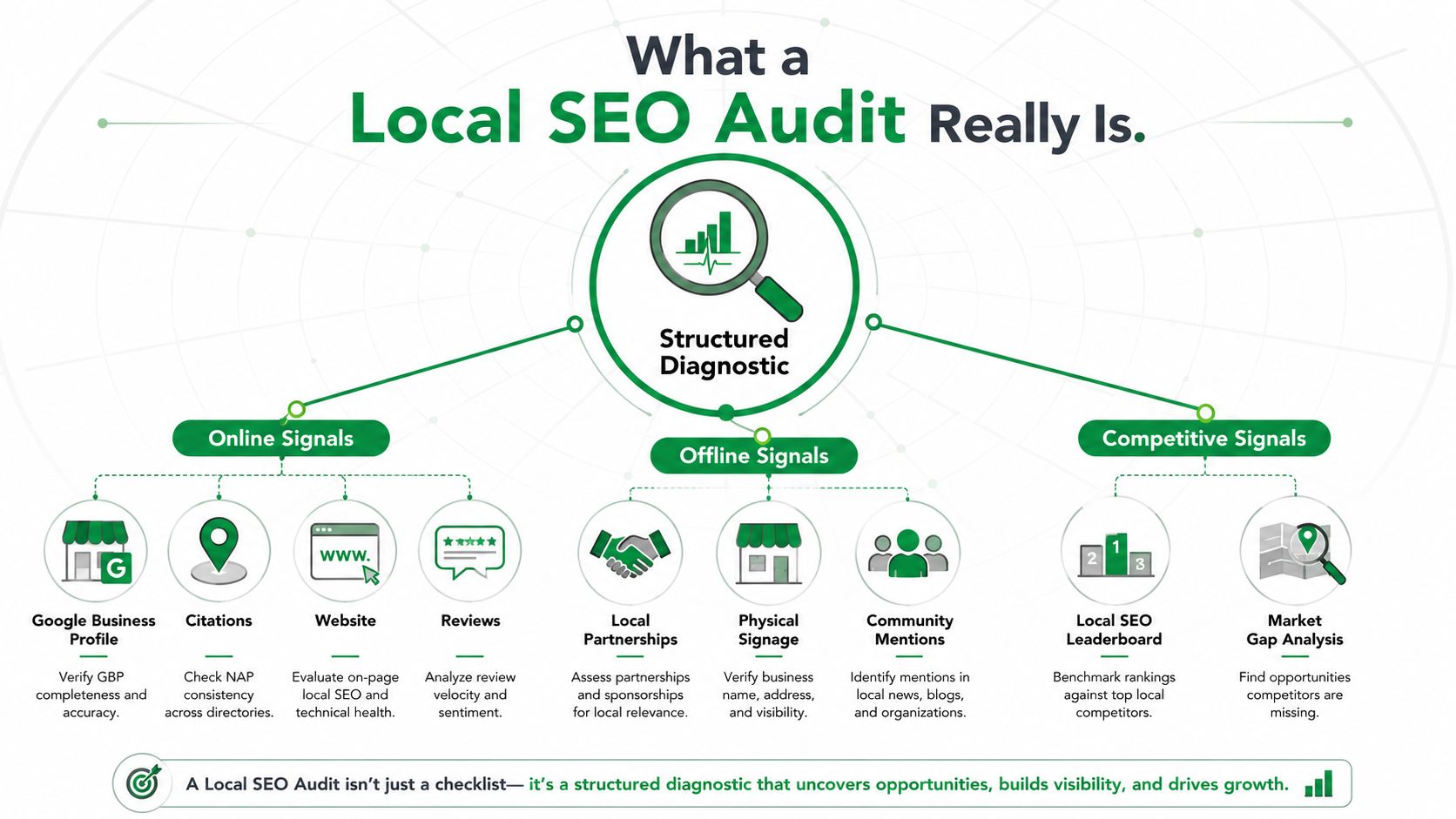
A local business can lose map visibility without a dramatic failure. The listing remains active, the website still loads, and calls gradually decline as competitors strengthen their local signals. An audit identifies the cause before a ranking drop becomes a revenue pattern.
Local SEO audits are structured diagnostics of the signals behind local pack and localized organic performance. Review technical health, on-page relevance, Google Business Profile quality, citations, reviews, and links together, then rank findings by likely business impact. A list that gives every issue equal priority wastes the team's time.
Why this is different from a normal crawl
A site crawl covers only part of local performance. Local rankings also reflect proximity, prominence, and relevance across the listing, the landing page, and the surrounding market. An audit must connect those layers, or the team may spend weeks improving pages while the profile, reviews, or citations remain the stronger constraint.
The overview on local SEO marketing explained provides useful context on how local visibility extends beyond content and links. Use it to align stakeholders before assigning audit work.
The audit must produce three outputs: a prioritized remediation order, a test for each major change, and a trigger for re-auditing. Trigger a new review after an address, phone number, category, service area, or site architecture changes. Schedule routine checks as well, because local signals drift even when the business does not.
The audit should feed seven phases
Run the work as an operating cadence. Technical findings establish the site's constraints, on-page findings shape local landing-page improvements, and GBP findings direct citation and profile cleanup. Review patterns expose reputation gaps, link analysis shows authority gaps, AI tools can extract and group evidence, and human judgment decides which fixes deserve implementation first.
Tie each phase to a KPI. Track local pack visibility, calls, driving-direction requests, branded search lift, and review acquisition rate, then compare movement after the related fix and at the next audit trigger. AI can compress collection, categorization, and comparison, but it cannot decide whether a category change, content rewrite, or citation correction will produce the strongest ranking movement. That decision belongs in the remediation plan.
Technical and On-Page Foundations to Audit First
Start with crawlability and indexation, because nothing else matters if the right pages aren't reachable. Pull data from Search Console and server logs first, then check which local landing pages are indexable, which are being crawled too often, and which are being ignored altogether.
After that, look at page experience and mobile rendering. Slow or broken location pages suppress performance, especially when a page is supposed to support a city or service query. If a page loads poorly on mobile, the GBP click still happens, but the landing-page session often dies before the user reaches the call button.
Work in dependency order
Audit NAP on every template-rendered contact block before you touch content. One bad footer, one old address in a service-area template, or one stale phone number in a location module can spread inconsistency across the site faster than any citation mistake. If a page is supposed to support local trust, its identity data has to match the master record exactly.
Then validate LocalBusiness schema against Google's documentation and spot-check rich result eligibility. The goal isn't decoration, it's making sure structured data supports the entity Google is already trying to understand. If schema is broken, don't guess. Fix the markup before you chase copy changes.
A strong internal-link map matters too. Your GBP landing pages should receive the cleanest internal equity from the homepage, primary service pages, and related location content. Orphan pages and bad redirects are a waste of crawl budget and a common reason local pages underperform even when the copy looks fine.
Rule of thumb: technical issues tell you whether a page can rank. On-page issues tell you whether it deserves to.
For a fast way to catch pages that shouldn't be indexed, the no-index workflow at this internal checker belongs in the first pass, not the last.
| Audit Step | Tool Category | Output Artifact | Next Phase |
|---|---|---|---|
| Crawlability and indexation | Search console, log analysis, crawler | Crawl gap list | On-page and internal linking |
| Mobile and speed review | Performance testing tool | Page issue report | Content and template fixes |
| NAP template audit | Site crawler, spreadsheet review | CSV of inconsistent NAP mentions | GBP and citation cleanup |
| Schema validation | Structured data testing tool | Schema error list | Rich result and entity cleanup |
| Internal linking review | Site crawler, mapping tool | Link equity map | GBP landing page prioritization |
| Redirect and orphan sweep | Crawl tool, redirect checker | Redirect and orphan list | Final remediation queue |
Google Business Profile and Citation Auditing
Most audits either get too shallow or too noisy. The right way to review GBP and citations is by benchmarking against the local market, not by staring at your own profile in isolation. Local ranking is relative, so the question is never just “is this profile complete,” it's “how does it compare with the businesses beating us?”
Start with categories. Compare the primary and secondary category choices against the top three competitors in the same geo-grid, because category misalignment is one of the easiest ways to lose relevance without realizing it. Then check name, address, phone, hours, and service area across the website and the top citation sources for exact-match consistency.
Prioritize by authority, not by volume
The best citation audit workflow is simple. Lock the canonical NAP from Google Business Profile, search the business name, phone, and address separately, then compare what you find against the master record. Expert workflows also recommend prioritizing fixes on high-trust sources first, including platforms such as Yelp, BBB, chambers of commerce, and state licensing boards, because those corrections tend to carry more practical weight than a dozen low-value directories. For deeper process notes on citation cleanup, local citation building guide is a solid reference point.
You also need to flag duplicate listings, suspended profiles, and unauthorized GBP edits immediately. A duplicate or hijacked listing can create split trust signals that are harder to fix than a simple citation typo. If a business has moved, rebranded, changed phone numbers, or added services, the full citation and GBP audit should happen right away instead of waiting for the next calendar review.
Use this comparison lens:
| Attribute | This Business | Local Median | Gap Severity | Weighted Impact |
|---|---|---|---|---|
| Primary category match | ||||
| Secondary category coverage | ||||
| NAP consistency | ||||
| Hours accuracy | ||||
| Photo depth | ||||
| Q&A completeness | ||||
| Post cadence |
The audit output should be a prioritized correction list, not a pile of notes. Fix the fields and citations that create the biggest visible gap to the local pack leaders first, then work down to lower-impact directories and profile enhancements.
For a practical walkthrough of profile review structure, the internal guide at Google Business Profile audit is a good complement to this process.
Review Signals and Reputation Audit
Reviews are not a vanity metric. They're a ranking input, a trust signal, and one of the fastest ways to see whether a business is gaining momentum or losing it. If the profile looks healthy but the map pack keeps slipping, the review layer is often where the gap shows up first.
Pull the last 90 days of reviews for each location and compare them against the top three map-pack competitors. Review velocity, recency distribution, and average rating all matter, but they matter together. A profile with steady new reviews and active owner replies usually looks stronger than one with a prettier star average and long dead stretches.
What to measure first
Track three things before you touch response templates or reputation campaigns.
- Review velocity: How many reviews arrive each month compared with competitors.
- Recency distribution: How many reviews came in the last 30, 60, and 90 days.
- Owner response behavior: Response rate, response time, and whether replies reinforce service keywords naturally.
A profile that looks active every week is easier to trust than one that peaks once and then goes quiet for months.
Also inspect reviewer quality. Profiles with photos and history usually look more credible than obvious throwaways, and patterns matter more than one odd complaint. Watch for incentivized flows, bulk posting from one device, or repeated off-topic rants that distort the average and weaken the profile's trust story.
The remediation playbook should be blunt. Set a response SLA that keeps replies fast, define the target review pace for each location, and prepare three reply patterns for negative, neutral, and keyword-rich positive reviews. The point isn't to script fake enthusiasm, it's to make sure every review gets handled consistently and usefully.
If you want a structured way to separate sentiment trends from one-off noise, the review workflow in review sentiment analysis fits neatly into this audit phase.
Local Links, Authority, and Competitor Gap Audit
A local plumbing company can rank well organically yet lack links from its chamber, regional news sites, trade associations, and nearby suppliers. That gap matters because local authority depends on relevance, not just the raw strength of a domain. Audit the sources that connect competitors to the market they serve.
Build the review around referring-domain gaps. Pull the business's referring domains alongside the three competitors ranking in the map pack for the same primary keyword. Sort the results into chambers and associations, news and broadcast, niche directories, sponsorships, and supplier or partner pages. This comparison shows whether competitors have earned stronger local relationships or accumulated broader, less relevant links.
Score each domain by relevance
Use three filters for every linking opportunity. First, local relevance. Check whether the city or region appears in the page or domain context. Second, topical relevance. Confirm that the site fits the business category or an adjacent service. Third, authority. Judge whether the page deserves outreach time compared with the next prospect.
Audit the existing backlink profile for obvious toxicity. PBN footprints, foreign-language directories, and exact-match anchor spikes from a small group of domains need review. Do not disavow links casually. Take action only when the pattern is clear and the profile shows a genuine cleanup problem.
Practical rule: refresh the local link audit when a business opens a location, changes service lines, or sees a competitor enter the market with stronger local press.
Turn the findings into a shortlist that reflects actual access. Prioritize chambers that accept members, news outlets with community submission forms, and partner pages where a reciprocal link is realistic within one outreach cycle. Record the expected effort, relationship owner, relevance, and target page so the audit produces assigned work rather than an aspirational list.
Re-audit after a successful placement cycle, a major competitor campaign, or a meaningful change in local visibility. Track referring domains by category, relevant links earned, target-page coverage, and the number of competitor gaps closed. Link count alone is a weak KPI if the new sources do not support the business's location or services.
| Link Category | Your Site | Competitor A | Competitor B | Competitor C |
|---|---|---|---|---|
| Chambers and associations | ||||
| Local news coverage | ||||
| Niche directories | ||||
| Sponsorships | ||||
| Supplier or partner pages |
AI Tools That Speed Up Each Audit Phase
Use AI where it removes grunt work, not where it overrides judgment. The best workflow is category specific, because no single stack should pretend to solve crawling, reviews, citations, and link prospecting with the same model.
Technical crawlers handle the noisy parts first. They flag indexation, schema, and speed issues, then an AI summarizer turns that export into a prioritized punch list the team can work through without reading a hundred-line dump. That saves time, but the output still needs a human to decide whether the issue is worth fixing now or should wait.
Match the tool to the bottleneck
For on-page content, use a page-level gap analyzer that compares the client's local pages with the top three organic competitors and extracts missing topics, entities, and local modifiers. That helps separate thin copy from incomplete coverage. For GBP, location-data platforms can scan the map pack and surface category choices, photo depth, and post cadence, while an LLM can draft the first pass of descriptions and Q&A responses for review.
Citation work is where AI saves the most repetitive labor. A bulk NAP consistency check across major aggregators can cluster duplicates and flag mismatches before a person decides which listings to merge or correct. Reviews are similar, because sentiment models can tag incoming feedback by service line and surface response opportunities without manually sorting every comment.
| Audit Step | AI Tool | What It Replaces | Human Still Owns |
|---|---|---|---|
| Indexation and schema check | Technical crawler | Manual crawl review | Fix priority and validation |
| Review summarization | AI summarizer | Reading every review line by line | Tone, escalation, policy compliance |
| Citation and NAP audit | Citation manager | Directory-by-directory checking | Merge and correction decisions |
| Rank tracking | AI rank tracker | Manual map-pack checks | Interpretation and next actions |
Link prospecting also benefits from AI, but only up to a point. It can build prospect lists and draft outreach personalization, yet it can't replace relationship work, local knowledge, or common sense about who links to whom. Any AI output that touches GBP edits should still be validated against Google's guidelines before it goes live.
Audit Cadence, KPIs, and the Findings You Should Fix First
Strong local teams treat audits as an operating rhythm, not a one-time project. Schedule a 90-minute monthly sweep for rank tracking, GBP health, review velocity, and citation drift. Use a quarterly deep audit to revisit technical issues, competitor gaps, and backlink quality. This cadence catches deterioration before it becomes a ranking or lead problem.
Scheduled reviews are only the baseline. Trigger an immediate re-audit after a location change, rebrand, new phone number, category shift, ranking drop, suspension, or a new competitor entering the market. A changed business or market invalidates old audit conclusions.
KPIs tied to each audit phase
Assign every audit area a measurable business outcome, then compare the result with the previous audit.
- GBP and citation work should influence local pack visibility, calls, and driving-direction requests.
- Review work should improve review acquisition rate, response rate, and reputation consistency.
- Technical and on-page work should strengthen indexation quality, location-page visibility, and branded search lift.
- Link work should support authority growth and competitive resilience.
Priority fix order: correct category errors first, close review response gaps next, then resolve citation inconsistencies.
The findings most likely to move rankings are usually operational defects: NAP inconsistency, missing or thin service pages, slow or unindexed location pages, unclaimed GBP categories, and unanswered negative reviews. Fix those before cosmetic content updates. Cosmetic refinements matter after the structural leaks are closed, not while they continue suppressing visibility.
Use the Leaping Lemur Media journal for broader field notes on local execution and client-facing reporting. Apply those ideas to your market, service mix, and reporting process rather than copying a generic workflow.
Document the monthly sweep and quarterly audit in one shared system. Add trigger rules so the team knows who re-audits, which checks to repeat, and when to validate the fix. AI can compress collection, clustering, and summarization, but a specialist must set priorities, approve GBP changes, and connect improvements to KPI movement. Keep AI Tools for Local SEO bookmarked as a working reference, then choose a stack that fits the number and type of locations you manage.