The most popular advice about local SEO backlinks is also the least useful: get as many links as possible, preferably from websites with the highest Domain Rating. That approach treats a neighborhood plumbing company like a national software brand. Local search doesn't work that way. A link from a small regional newspaper, chamber of commerce, supplier, or community organization can carry more practical local meaning than a generic high-authority directory with no connection to the service area.
Backlinks still matter, but the winning question isn't “How many can we build?” It's “Which local entities can credibly confirm that this business belongs in this place?” The 2026 Whitespark Local Search Ranking Factors study coverage reports that link signals account for about 24% of local organic ranking weight and 8% of Local Pack weight, based on input from 47 local SEO experts. The same coverage attributes 13% of AI search rankings for local businesses to link signals.
That distinction changes the campaign. You need links that reinforce the right location, point to the right page, and come from organizations with a genuine geographic or topical relationship. High-DR links can help general authority, but localized trust is the scarce asset in map visibility.
Why Local Relevance Beats Raw Domain Authority
Domain Rating is a useful diagnostic, not a local ranking strategy. It estimates the strength of a website's backlink profile, but it doesn't tell you whether that website has an audience in your service area, covers your industry, or provides meaningful context for your business.
A regional business journal may have less general authority than a national directory. Yet its article about your new branch, community project, or local expertise gives search engines several connected signals: your brand, your service, your location, and a real-world reason those entities belong together. A neighborhood association, local council, or chamber can provide an even clearer geographic relationship.
The difference becomes more important in the Local Pack. Link signals are materially weaker there than in localized organic results, while Google Business Profile signals form the largest broad group in the 2026 synthesis from Mettevo's local link-building analysis. That doesn't make backlinks irrelevant. It means a backlink campaign should support, not replace, an accurate and well-maintained Google Business Profile, consistent citations, strong reviews, and a useful location page.
Practical rule: A relevant local link should strengthen the relationship between your business, service, and service area. A high-authority link that adds none of that may be less valuable than its headline metric suggests.
What geographic context looks like
Consider two potential placements for an electrician serving Bristol. One is a generic national directory that accepts every trade in every market. The other is a local construction newsletter covering renovation projects, planning issues, and supplier activity in Bristol.
The directory might show a stronger authority score. The newsletter offers better context because its audience, editorial subject, and geographic coverage all align with the business. That alignment can also send qualified referral visitors, create local recognition, and give the linked service or location page a reason to exist in the local search ecosystem.
This is why a small business shouldn't copy national link-building playbooks without adjustment. A useful overview of how priorities differ is this comparison of local SEO for small firms, particularly for businesses that lack the resources of multi-market brands.
Quantity is a poor primary target
Large-scale data still shows a strong relationship between backlink profiles and visibility. Semrush-reported figures cited by Rankmax's local SEO statistics roundup put businesses in Google's Local Map Pack at an average of 993 backlinks and 216 referring domains. The same source reports that the number one organic result has 3.8 times more backlinks than results in positions two through ten, while 92.3% of the top 100 ranking domains had at least one backlink in a 13-month study.
Those figures describe correlation, not a quota for your campaign. They don't mean a local business should purchase hundreds of links or imitate a competitor's total. They show that authoritative pages often have broad, diverse link profiles. For a local campaign, diversity should mean different credible local relationships, not a larger pile of directory submissions.
Proven Strategies for Earning High-Value Local Links
A worthwhile local backlink usually comes from a clear value exchange. You contribute something useful to a community, publisher, partner, or organization. They reference your business because the link helps their audience, not because you sent a generic SEO request.
Community sponsorships with a real footprint
Sponsorships work when the business participates beyond writing a cheque. Local sports clubs, charity runs, school programs, arts groups, and neighborhood events often maintain sponsor pages, event guides, or partner profiles.
Start by checking whether the organization has linked sponsor pages from previous events. Then ask what the business can provide that improves the event, such as equipment, professional services, refreshments, transport, prizes, or volunteer time. Request a link to the most relevant page, usually the local service page or location page, rather than insisting on a keyword-heavy anchor.
A small sponsor profile can become more valuable when the relationship continues. Offer a short educational session, host a collection drive, or provide a useful resource for participants. The organization gains material and support. The business earns visibility, community goodwill, and a legitimate reason to remain referenced.
Avoid sponsorship packages that promise dozens of unrelated links across a network of sites. A genuine local relationship is an asset. A manufactured footprint can look like a paid placement with little editorial value.
Local PR and newsjacking
Local journalists need timely, specific material. “We provide excellent services” isn't news. A new local hire, response to a regional issue, unusual customer trend, community initiative, expert comment, or free public workshop may be.
Build a short media list covering regional newspapers, business journals, radio sites, trade publications with local editions, and independent community blogs. Monitor planning decisions, weather events, public works, seasonal problems, and local business developments. When a relevant story appears, offer a concise comment backed by practical experience.
Your pitch should make the editor's work easier:
- Lead with the local angle: Explain why the issue matters to residents in the publication's area.
- Offer a usable contribution: Provide a short quote, data you collected yourself, expert commentary, or a customer-safe image.
- Point to a useful resource: Link to a guide, service explanation, or location page only when it supports the story.
- Respect editorial control: Don't demand anchor text, placement, or a guaranteed link.
Newsjacking fails when the response arrives late, ignores the journalist's subject, or reads like an advertisement. Speed and relevance matter more than polished marketing language.
Partnerships with neighboring businesses
Non-competing businesses often serve the same audience. A wedding photographer can collaborate with a venue, florist, alterations shop, and caterer. A home renovation firm can build relationships with architects, estate agents, builders' merchants, and interior designers.
Look for pages that already help customers choose suppliers, prepare for a project, or complete a local task. Suggest a resource that benefits both audiences, such as a joint checklist, local guide, workshop, or referral page. A partner may link to your location page from its supplier page, while you provide a useful reciprocal reference where it genuinely helps visitors.
Don't force reciprocal links on every relationship. Search engines and users can distinguish a useful recommendation from a patterned exchange. The strongest partnerships produce shared content, referrals, events, or customer support first. The backlink follows naturally.
Reclaiming unlinked mentions
Search for your brand name, founder name, event name, products, and local projects. Check local news, association pages, supplier sites, event recaps, and community articles. If a page mentions the business without a link, contact the author or site owner with the exact URL and a simple request.
Broken-link reclamation works similarly. Find a relevant local resource page with an outdated or dead reference, create or identify a suitable replacement on your site, and explain the problem clearly. Don't pitch an unrelated homepage just because it is available.
For prospecting and evaluating submission opportunities, this guide to local site submission can help distinguish genuine community resources from low-value directories. The standard remains simple: the site should have a real audience, a credible editorial purpose, and a connection to the locality or topic.
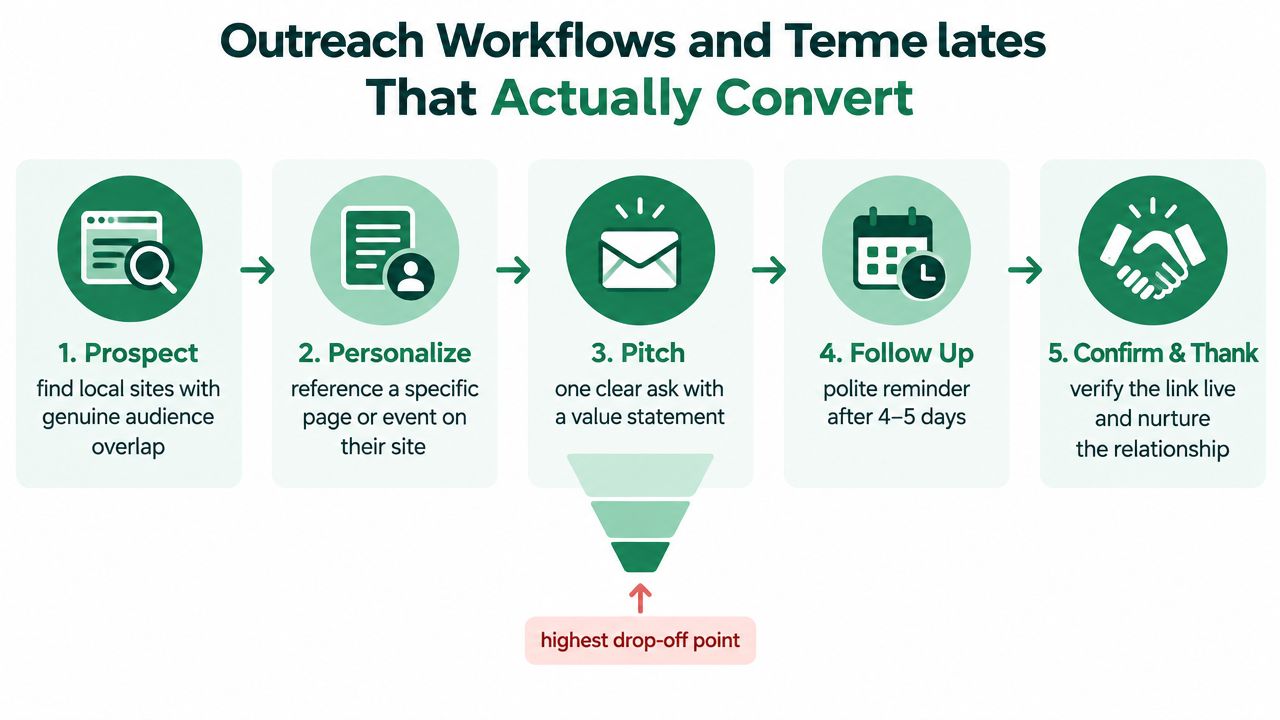
Outreach Workflows and Templates That Actually Convert
Most local outreach fails before the recipient evaluates the offer. The message goes to a generic inbox, opens with a manufactured compliment, lists SEO metrics, and asks for a link without explaining why the recipient's audience benefits.
A better workflow starts with the page, not the link. Identify a specific event, resource, sponsor page, article, or broken reference. Find the person responsible for partnerships, editorial content, community programs, or website updates. A named contact with a relevant role is more useful than sending the same message to every address you can find.
A practical five-step process
- Prospect carefully. Confirm the site serves the target locality or audience. Check recent activity, existing outbound links, and whether the organization appears genuine.
- Personalize one detail. Mention a recent article, event, resource page, or project. Keep the observation factual and brief.
- Make one clear request. Ask for a sponsor-page link, a resource replacement, an expert contribution, or a correction to an unlinked mention.
- Follow up once or twice. A polite reminder after four to five days is reasonable. Add new information rather than repeating the original email.
- Confirm and maintain the relationship. Check that the link works, thank the contact, and record the relationship for future community opportunities.
The third step usually causes the greatest drop-off because the pitch becomes self-serving. Replace “Can you give us a backlink?” with a concrete value statement: “We created a homeowner checklist that answers the question raised on your renovation resource page. If it fits, it could replace the outdated reference.”
Two outreach angles that feel credible
For a sponsorship inquiry, write something like:
Subject: Support for the [event or club name]
Hi [name], We serve customers in [area] and noticed that [specific event or program] is preparing for its next activity. We can provide [specific contribution].
Could you send the sponsor options and confirm whether partners are listed on your website? If there is a suitable page, please link to our [specific local page] so participants can find the service details.
Thanks, [name]
For a broken local resource link:
Subject: Possible replacement for your [page title] resource
Hi [name], I was reviewing your [specific page] and noticed that the link to [old resource] no longer works. We maintain a guide covering [exact subject], including [useful feature].
If it meets your editorial standard, it may be a suitable replacement. Either way, I thought you'd want to know about the broken reference.
Regards, [name]
Don't promise payment for editorial coverage, exaggerate your local importance, or ask a publisher to use an exact-match city keyword. Good outreach gives the recipient an easy decision and preserves the relationship if the answer is no.
Distributing Link Equity Across Multi-Location Brands
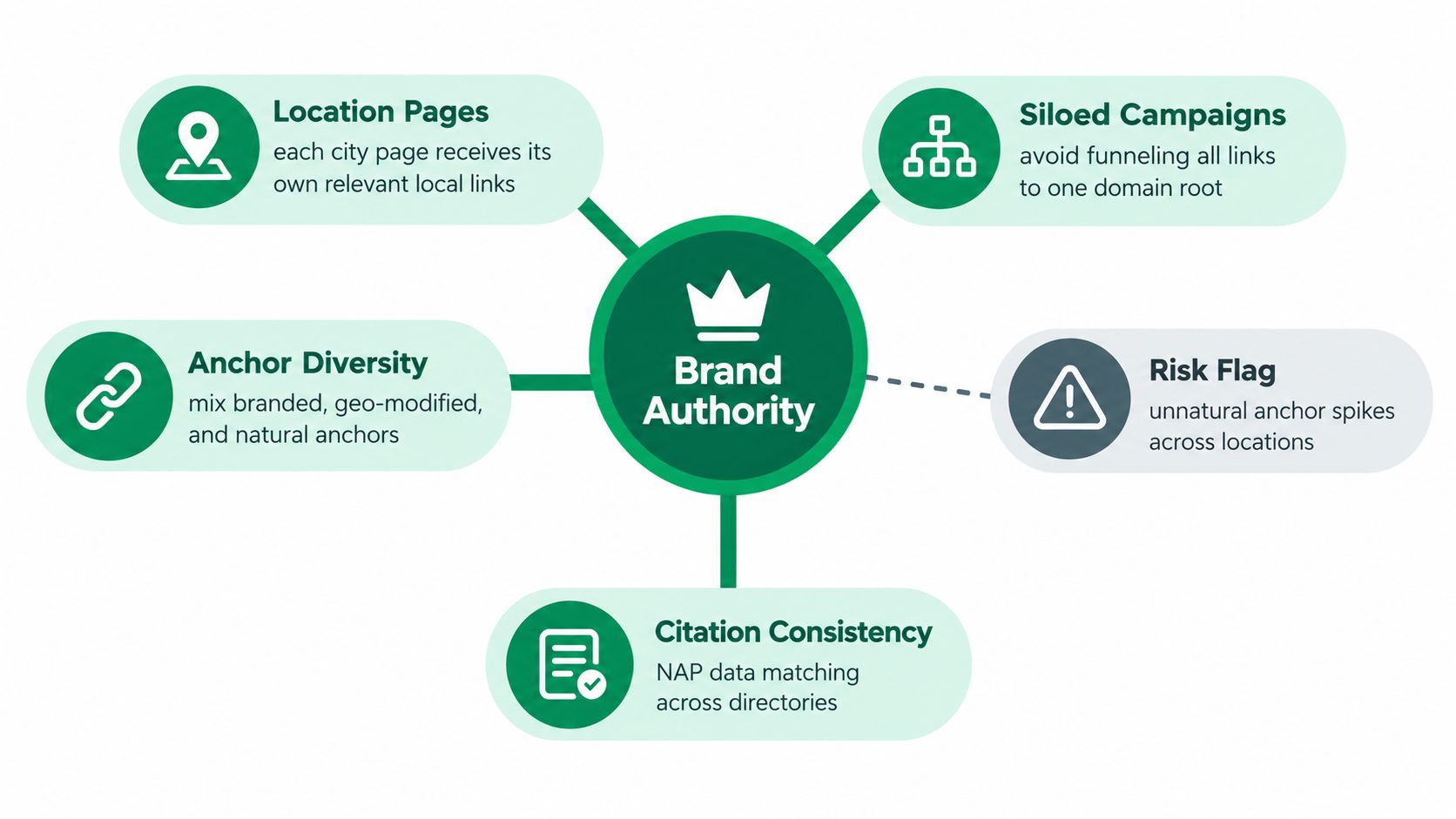
Multi-location SEO creates a page-allocation problem. A national brand can earn a strong link and still fail to strengthen the city page that needs local authority. Sending every local mention to the corporate homepage concentrates signals at the wrong level and leaves individual location pages under-supported.
Start with a prospect map. Assign every opportunity a locality, audience, page type, and relationship owner. A chamber serving Manchester should usually point to the Manchester location page. A national trade publication may be more appropriate for a corporate service page. A regional supplier serving several branches could link to a regional hub, provided that hub helps users choose the correct location.
Match the page to the reason for the link
Use the homepage for brand-level stories, corporate partnerships, national resources, and broad press coverage. Use a regional hub when the source covers multiple towns and the page organizes those areas. Use a city or neighborhood page when the story, organization, service, or customer need is specific to that locality.
The link's anchor should reflect the publisher's natural language. Branded anchors, the company name, plain URLs, and descriptive phrases generally create a more believable profile than repeated city-plus-service anchors. A franchise campaign that forces identical anchor text across every location creates a pattern no local audience would naturally produce.
Build separate local relationship pipelines
Each branch should have local prospects, not just access to a shared list. Track nearby associations, media, schools, suppliers, charities, event organizers, and complementary businesses. A central team can set standards and review risk, while local managers contribute genuine relationships and opportunities.
This is especially important because recent practitioner analysis summarized by Visionary Marketing's local ranking factors coverage points toward locality-relevant sources, such as local press, chambers, and educational institutions, as stronger associations than generic guest posts. The practical implication is not to collect identical links for every branch. It's to develop a distinct local authority profile for each market.
For a larger operational model, this resource on local SEO for multiple locations is useful when coordinating page architecture, listings, and location-level workflows. Keep the system simple enough that teams can identify which page should receive a link before outreach begins.
Measuring Local Link Impact and Managing Risk
A local link campaign should be judged by more than newly acquired referring domains. Rankings can move for many reasons, and a link may assist discovery, authority, referral traffic, or conversions without producing an obvious immediate position change.
Track the destination page and the surrounding query set before outreach begins. In Google Search Console, monitor impressions, clicks, CTR, and average position for local queries. In Analytics, segment conversions from location pages and city-specific landing pages. If a local publisher sends visitors, review referral engagement and lead quality rather than treating every visit as equal.
A benchmark cited by Vouch Local's analysis of local backlinks and citations places the average time for backlink impact to appear in rankings at about 3.1 months. Use that as a planning reference, not a promise. The same source reports that 94% to 95% of pages have no backlinks, which makes a clean, relevant profile meaningful, but doesn't guarantee a ranking outcome.
Local Link KPI Tracking Matrix
| KPI Category | Specific Metric | Primary Tool | Expected Impact Timeline |
|---|---|---|---|
| Visibility | Impressions for local queries | Google Search Console | Often develops over a few weeks to a few months |
| Engagement | Clicks and CTR for location pages | Google Search Console | Review after the linked page has been crawled and exposed |
| Rankings | Average position for city and service queries | Search Console or rank tracker | Use the backlink impact benchmark of about 3.1 months as a planning reference |
| Business outcome | Conversions from location and city pages | Analytics | Evaluate alongside assisted and direct conversions |
| Referral value | Visits and qualified enquiries from linking sites | Analytics | Can appear as soon as the placement receives visitors |
| Profile quality | New, lost, and suspicious referring domains | Backlink analysis tool | Review continuously and during scheduled audits |
Risk controls that protect the profile
Reject sitewide footer links, irrelevant neighborhood directories, private link networks, and placements surrounded by unrelated commercial links. Be cautious with paid sponsorships that require a followed link as the primary deliverable. If a link exists because of advertising or sponsorship, follow the publisher's disclosure and linking practices rather than disguising the relationship.
Review anchor text across locations. Repeated exact-match anchors, sudden bursts from one channel, and identical linking patterns can make a campaign look engineered. Prefer editorially natural references, and document why each link exists, what page it supports, and whether the relationship is ongoing.
For competitor-gap research and backlink review, Site Open Explorer can be considered alongside Google Search Console and a conventional backlink index. The tool choice matters less than maintaining a record that connects each link to a locality, page, purpose, and business outcome.
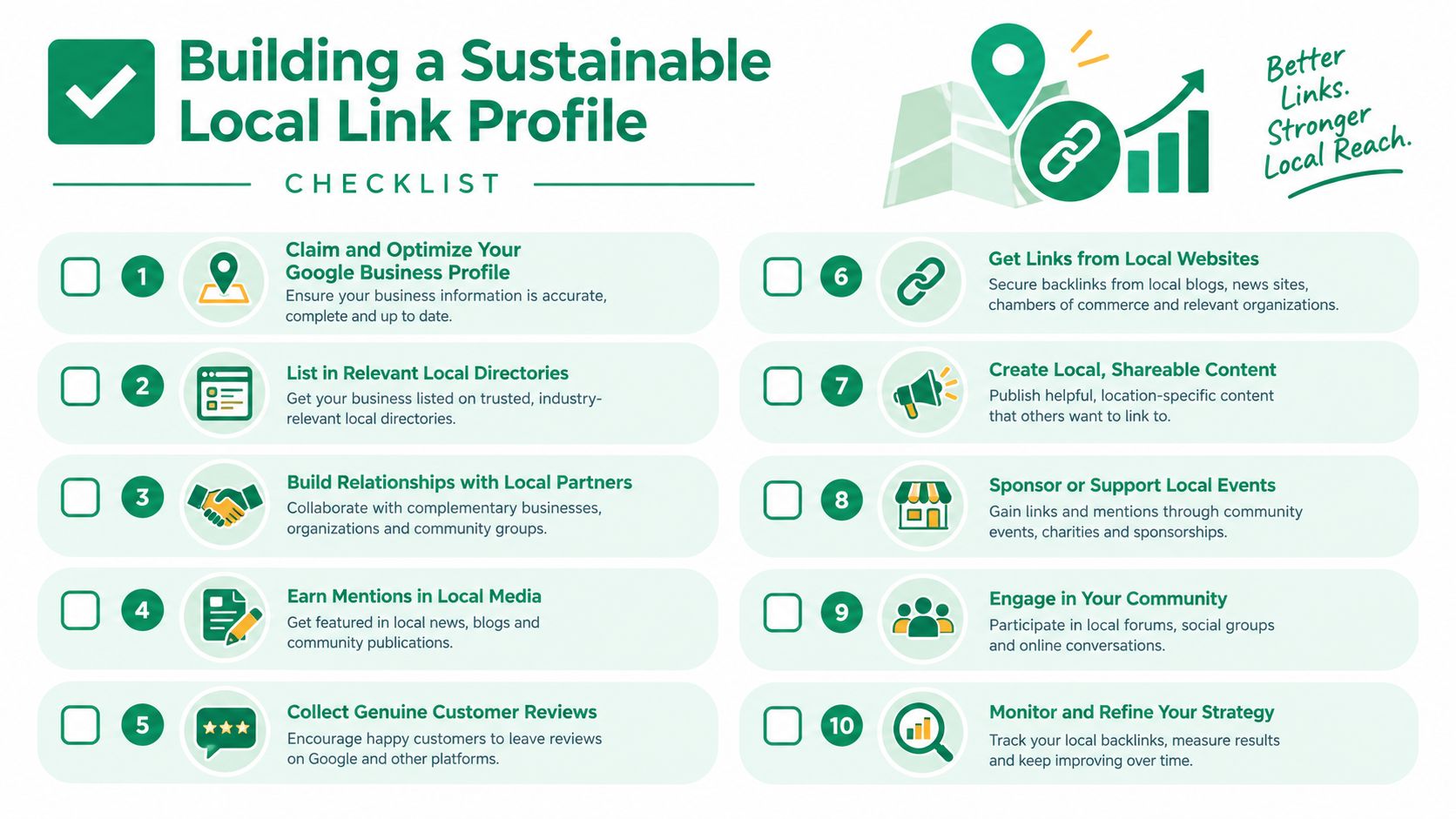
Building a Sustainable Local Link Profile
Sustainable local link building looks less like a database purchase and more like community participation. The strongest opportunities usually come from activities a business would pursue even without SEO, such as supporting a local program, educating customers, contributing expertise, or helping a regional organization serve its audience.
That doesn't mean every relationship produces a link. Some create referrals, press mentions, reviews, partnerships, or useful local knowledge instead. A resilient profile grows from a mix of these relationships rather than from a single tactic repeated until the pattern becomes obvious.
Audit the profile with a local lens
Review your current links and ask:
- Does the source serve the same town, region, or customer community?
- Does the linking page have a real purpose for visitors?
- Does the destination page match the subject and locality?
- Are local branches receiving their own relevant references?
- Do anchor texts read naturally when viewed together?
- Are any links sitewide, irrelevant, paid, or difficult to explain?
- Which local competitors have relationships you haven't explored?
- Which unlinked mentions could be reclaimed?
- Which community relationships could continue beyond one event?
- Can each new link be connected to visibility, referral activity, or enquiries?
Prioritize the next three targets by relevance, credibility, audience overlap, and achievable value exchange. Don't rank them solely by Domain Rating. A local source that reaches the right residents and can credibly describe the business may deserve attention before a larger but disconnected publication.
Local authority is earned in public. The link is evidence of the relationship, not a substitute for one.
The practical shift is straightforward. Stop treating local SEO backlinks as inventory. Treat them as references earned through useful work in a defined community, then direct each reference to the page that represents that place and service. That approach supports organic visibility, map visibility, referral traffic, and a link profile that can withstand changes in search systems.
Audit your backlink profile and location pages this week. Identify three geographically relevant organizations, verify which page each should reference, and send a personalized outreach message offering something useful to their audience. Track every contact, placement, local query, referral visit, and conversion so your next link-building decision comes from evidence rather than link-count anxiety.