A homeowner's breaker trips late in the evening. They search for an electrician nearby, scan the map results, and call one of the first businesses they trust. They're not looking for a general article about electrical work. They need a qualified provider who serves their area, handles the right problem, and answers quickly.
That's why local SEO for electricians should be treated as a call-generation system, not a vanity project built around rankings alone. The practical question isn't whether your website receives broad traffic. It's whether your business appears when someone needs emergency repairs, a panel upgrade, or an EV charger installation in an area you serve.
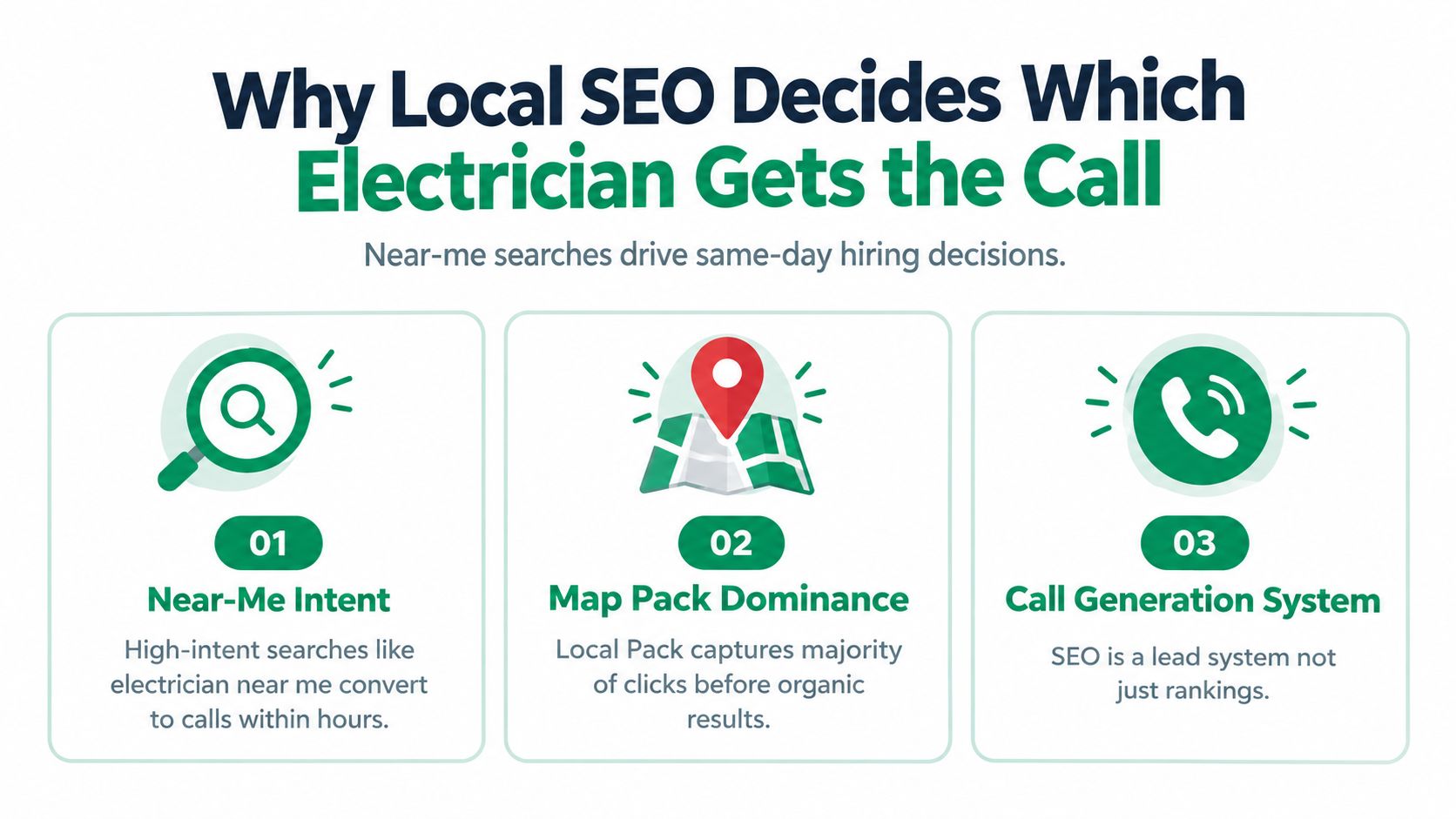
Why Local SEO Decides Which Electrician Gets the Call
A strong organic ranking can help, but it may not be the first result a customer sees. For urgent electrical searches, Google often places a map-based Local Pack above traditional organic listings. The electrician shown with a clear service area, relevant category, recent reviews, and an obvious call button has a short path from search to phone call.
The concentration is substantial. One analysis reports that 93% of Local Pack clicks go to the top three results, while the first position has a 17.8% click-through rate. The same source reports that 46% of Google searches have local intent, and that near-me queries grew 900% in two years, reinforcing the commercial value of local visibility for service businesses such as electricians. The local SEO statistics for electrical services explain why a broad traffic strategy can miss the moment that matters.
Search intent is tied to the job
A query such as “electrician near me” signals immediate local need, but it doesn't tell you enough about the job. A customer searching for “EV charger installation,” “electrical panel upgrade,” or “commercial electrician” has already supplied valuable service context. Those searches can be easier to convert because the page or profile can answer a specific need instead of forcing the visitor to browse a generic services list.
Consumer behavior supports that urgency. A local-search roundup reports that 76% of people who perform a near-me search visit a business within 24 hours, 28% of local searches lead to a purchase, and 64% of smartphone users contact a business within an hour. These figures come from local SEO statistics compiled by Biziq, and they fit the way emergency and same-day electrical decisions happen.
Relevance, proximity, and reputation work together
Google needs to determine three things quickly. Does the business offer the requested service? Does it serve the searcher's location? Does the profile give customers enough reason to trust it? A profile that is close to the searcher but vague about services can lose to a more relevant competitor. A detailed profile with weak reviews may also struggle to turn visibility into calls.
Winning locally means building the signals around actual jobs. That includes an accurate Google Business Profile, dedicated service pages, consistent business information, service-specific reviews, and a mobile experience that makes calling easy. For a broader framework covering actionable local marketing strategies, focus on tactics that connect visibility to customer action rather than collecting impressions without tracking leads.
Use this guide to the benefits of local SEO as a strategic reminder: your target isn't “more traffic.” Your target is more qualified calls from the places and services your electrical business can profitably serve.
Finding Profitable Keywords and Content Gaps Other Electricians Miss
Most electrician keyword lists start with “electrician near me,” “emergency electrician,” and “electrician in [city].” Those terms matter, but they're often the most crowded part of the market. A better plan starts with a business decision: which services deserve a dedicated page because they create valuable, specific demand?

Start with service economics, not search volume
Separate your services into intent groups:
- Emergency work: breaker faults, power-loss troubleshooting, sparking outlets, and urgent electrical repairs.
- Planned repairs: rewiring, lighting work, code corrections, and fault diagnosis.
- Upgrade projects: panel upgrades, surge protection, and service capacity improvements.
- Specialist installations: EV charger installation, generator connections, and other equipment-specific work.
- Commercial services: maintenance, tenant improvements, inspections, and electrical repairs for business premises.
The purpose isn't to create a page for every possible wording. It's to identify distinct customer problems with distinct sales conversations. “Panel upgrade” needs different proof and explanations from “emergency electrician.” Combining them on one generic page weakens relevance and makes the customer work too hard.
Use AI to expose thin competition
AI tools can accelerate the research workflow, but they shouldn't decide your priorities without human review. Give a research tool your service list, target locations, competitor URLs, Google autocomplete suggestions, and questions customers ask during calls. Ask it to cluster queries by service intent, identify pages competitors lack, and separate informational questions from requests that indicate a buying decision.
The underserved opportunity is often specific rather than broad. Recent coverage identifies EV charger installation as the fastest-growing residential electrical keyword lane in North America, while noting that it remains under-competed in many metros. That makes it a strong candidate for a dedicated service and location strategy, particularly when competitors rely on generic emergency pages. This analysis of local SEO for electricians provides the basis for prioritizing emerging, high-intent service categories.
Panel upgrades deserve the same scrutiny. Look for competitors with thin copy, no installation process, weak photos, no permit or safety context, and no city-specific relevance. A useful page can win attention without making unsupported promises. Explain warning signs, suitable property types, what the assessment involves, and how a customer can request an evaluation.
Apply a page decision filter
Before publishing, ask:
- Does this service have a distinct customer need?
- Can the business provide useful, original details about it?
- Is there a location where the service is available?
- Do competitors have a strong page for the same combination?
- Can the page lead naturally to a call, form, or booking action?
If the answer is yes, build the page. If the only reason is that an AI tool suggested another keyword variation, hold off. Thin pages aimed at every neighborhood can create maintenance work without creating useful relevance.
For a more detailed process, use this resource on localized keyword research. The best output is a prioritized map of services, locations, and page types, not a spreadsheet full of phrases nobody searches with commercial intent.
Optimizing Your Google Business Profile to Win the Map Pack
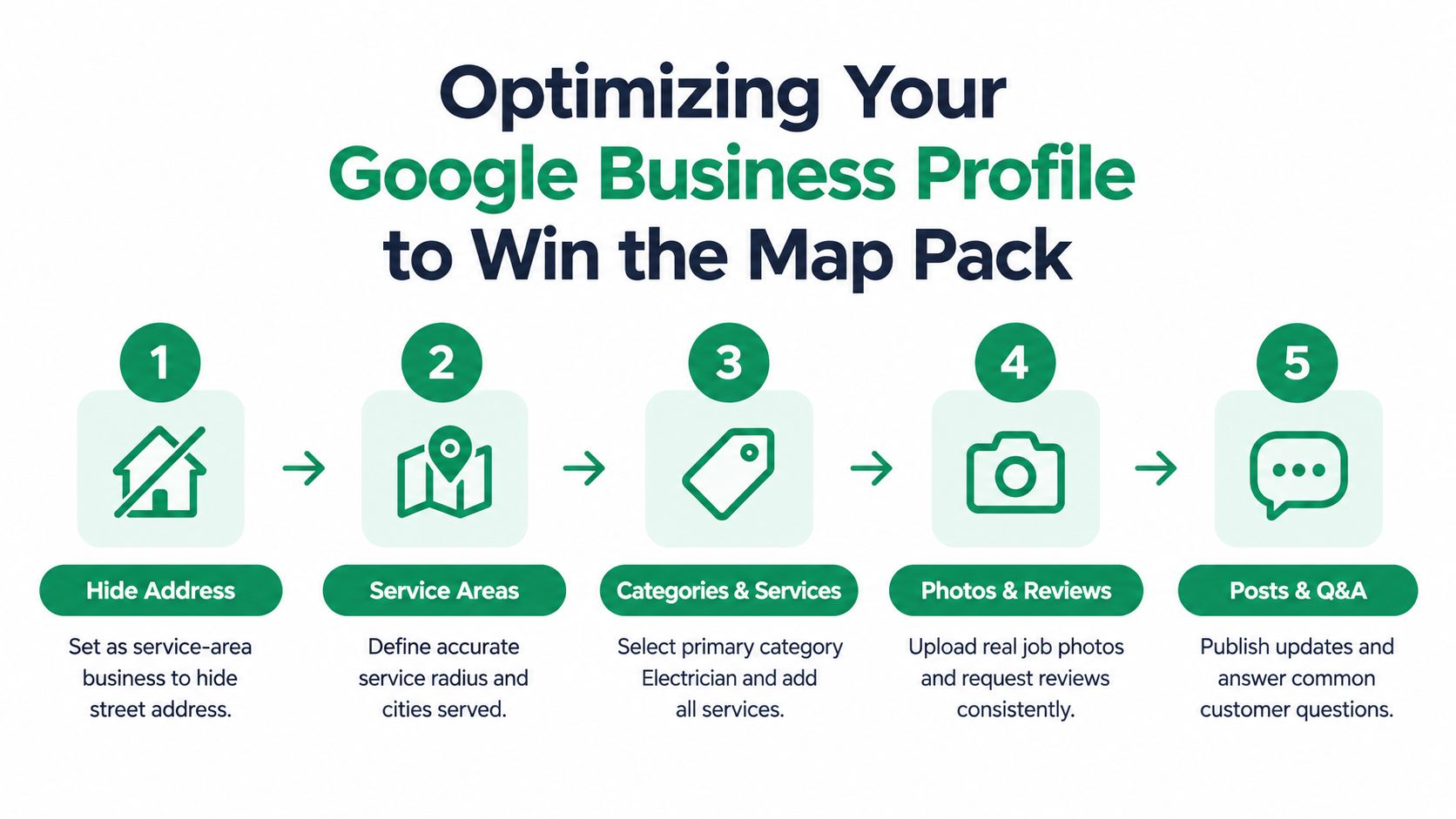
Your Google Business Profile is often the shortest route between a local search and a phone call. Electricians frequently lose visibility because the profile is configured like a storefront when the business operates as a service-area business. Fixing that setup should come before publishing another blog post.
Configure the service area correctly
If customers don't visit your address, switch the profile to service-area mode and hide the street address. List real cities or postal codes that your team serves. Google doesn't support a radius-only service area, so entering a broad regional radius is a common setup error.
The practical guidance for electricians is to keep coverage within about a two-hour drive of the base location and define no more than 20 specific locations, according to this service-area optimization guide for electricians. Don't add every nearby city just to appear broader. A service area should reflect where your crews can respond and complete work.
Build the profile in a fixed order
Use this checklist so the profile supports both relevance and conversions:
- Set the business type: Hide the street address when customers don't visit the premises.
- Choose the primary category: Use the most accurate primary category, normally Electrician for an electrical contractor, then add relevant secondary categories where appropriate.
- Add actual services: Include emergency repair, panel upgrades, EV charger installation, lighting, rewiring, inspections, or commercial work only when you provide them.
- Write for customers: Explain what you do, where you work, and how people can contact you. Don't turn the description into a keyword list.
- Upload real media: Use job photos, vehicles, team images, equipment, and completed installations. Stock imagery doesn't prove local activity.
- Keep hours current: Emergency availability and standard office hours should be represented accurately.
- Monitor questions: Answer common customer questions clearly and update outdated information.
AI can speed up the audit. Feed it the profile export, service list, website pages, and recurring customer questions. Ask it to flag missing services, conflicting hours, vague descriptions, and unanswered questions. A human should approve every recommendation before publication, particularly anything involving service eligibility or emergency availability. This Google Business Profile optimization workflow can help structure that review.
Match the profile to the website
Your selected service areas should match the cities and postal codes supported by your website. Keep the business name, phone number, and address or service-area information consistent across Google, Yelp, Angi, HomeAdvisor, and BBB. Inconsistent details can dilute relevance and make it harder for Google and customers to understand where the business operates.
The profile won't compensate for a website that claims coverage in places the crews don't serve. Accuracy beats reach. Build the profile around the actual dispatch territory, then expand only when operations can support the promise.
Building Location Pages and On-Page Signals That Google Trusts
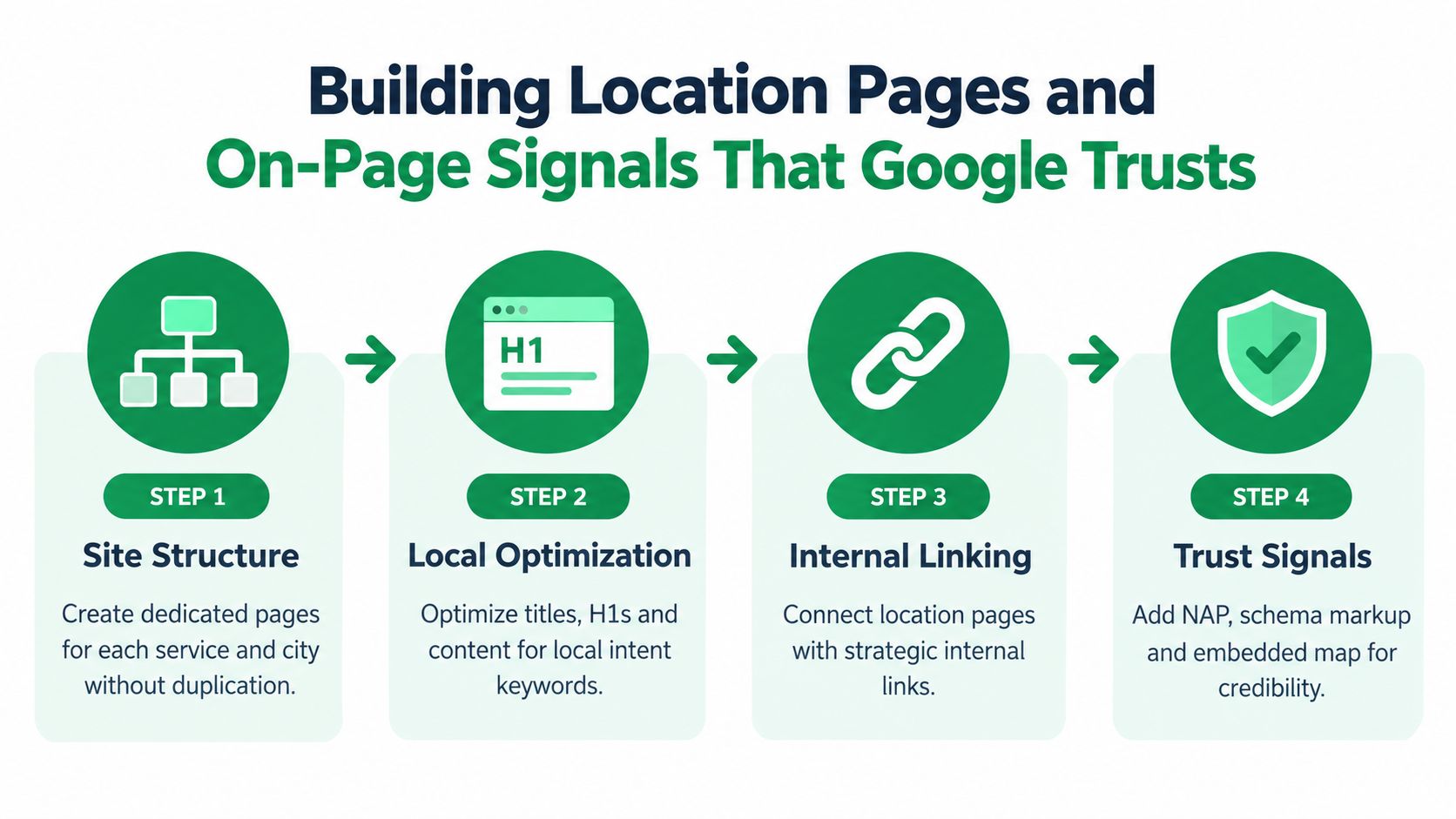
A location page shouldn't be a city name pasted into a template. It should help a resident understand whether your electricians handle their problem, work in their area, and offer a credible next step. The strongest architecture separates service intent from location intent, then connects the two naturally.
Create useful page combinations
Start with core service pages, such as panel upgrades, EV charger installation, emergency repairs, and commercial electrical work. Add city pages only where the business has genuine operational coverage and enough local detail to make the page useful. Then create focused combinations when they represent a real customer demand, such as “EV charger installation in [city]” or “panel upgrades in [city].”
A credible page can include:
- A clear service promise: State the work and location in the title, H1, and opening copy.
- Local operating detail: Explain the types of properties, neighborhoods, or customer situations served without inventing landmarks or local claims.
- A practical process: Describe assessment, communication, installation or repair, and follow-up in accurate terms.
- Relevant proof: Add genuine project photos, testimonials, qualifications, and service details.
- A direct conversion path: Make the phone number, request form, and response expectations easy to find.
Don't publish near-identical pages for every suburb. Doorway-style pages give customers little value and create a poor experience. If two locations share the same service and no meaningful local information, combine them into a stronger service-area page.
Connect technical signals
Use descriptive title tags, one clear H1, logical subheadings, and internal links between related services and locations. A panel upgrade page should link to relevant electrical inspection or surge protection content when those services are connected. A city page should link to the services available there, not to every page on the site.
Add structured data that accurately describes the business. LocalBusiness and Electrician schema can help search engines interpret business details, service information, contact data, and operating hours. Schema won't rescue weak content, but it can support a consistent entity description when the visible page content matches the markup.
Keep the name, address, and phone details consistent wherever they appear. Embed a map only when it helps users understand the business location or service area. Mobile performance matters because a customer with an urgent electrical issue may arrive from a phone and need to call immediately. Compress images, remove unnecessary scripts, keep buttons prominent, and test forms on real devices.
AI auditing tools can compare titles, headings, internal links, schema fields, and mobile issues across a group of pages. Use the output to find omissions and inconsistencies, then have a person confirm that every local statement is true. Automation should reduce inspection time, not manufacture local experience.
Earning Reviews and Citations That Actually Move Rankings
A perfect star rating isn't the whole reputation strategy. Electricians need reviews that are recent, detailed, service-specific, and authentic, because those qualities help potential customers understand what happened on the job and help Google connect the profile with relevant service intent.
A 2025 study of 3,269 Google Business Profiles found that, across positions 1 through 21, proximity explained 55% of visibility and review count explained 19%. Within the top ten, proximity's influence fell to 36%, while review count rose to 26% and review keyword relevance reached 22%. These findings are reported in the Google local ranking study from Etavrian. They point to a useful trade-off: proximity can dominate initial visibility, but review strength becomes more influential among competitive results.
Ask at the right moment
Request feedback after the customer has experienced the service, not weeks later when the details have faded. For an emergency call, send the request after the repair and payment are complete. For a scheduled installation, ask after the customer has seen the finished work and received any relevant handover information.
Make the request easy, but don't script the customer's opinion. You can remind them to describe the service they received if they choose to do so. A review mentioning a panel upgrade, EV charger installation, fast troubleshooting, or clear communication gives future customers more useful information than a vague compliment.
Practical rule: Ask for an honest account of the completed job, never for a specific rating or manufactured wording.
The same source notes that profiles with a perfect 5.0 can be trusted less than profiles around 4.5, and that businesses with 50 or more reviews are reported to be much more likely to appear in the Local Pack than businesses with fewer than 10. Treat those observations as reasons to build a steady, genuine process rather than chasing an artificially flawless profile.
Keep citations clean
Review activity won't fix contradictory business listings. Check the business name, phone number, website, address, and service-area details across major directories and trade platforms. AI listing tools can scan for mismatches, group duplicate profiles, and alert you when information changes. A team member still needs to approve corrections, especially when a directory has old ownership or address data.
Use AI for review operations too. It can identify recurring themes, flag unanswered reviews, draft a polite response for approval, and categorize feedback by service type. Don't publish automated replies without review. Customers can tell when a response ignores the actual job, and reputation management should sound like a real business owner who understands the work.
Growing Authority With Local Links Content and Smart Tracking
Local authority comes from being recognized by the community and by the businesses that serve the same customers. An electrician can earn relevant links through supplier relationships, trade associations, local sponsorships, property-management partnerships, neighborhood resources, and educational content that answers real safety questions.
The strongest link opportunities usually have a legitimate reason to exist. A supplier may list certified installers. A local organization may feature a sponsor. A property manager may recommend a contractor for tenant electrical issues. A community publication may reference a practical guide about preparing a home for an electrical upgrade. These relationships are more durable than mass directory submissions or low-quality guest posts created only to place an anchor text.
Create content worth referencing
Build content around questions your team hears repeatedly:
- Upgrade planning: Explain what homeowners should prepare before requesting a panel assessment or EV charger installation.
- Safety decisions: Describe warning signs that justify professional electrical troubleshooting.
- Property management: Create a practical resource for landlords and facilities teams handling recurring electrical issues.
- Local conditions: Address accurate, local considerations without padding the page with city names.
- Service comparisons: Clarify when a repair, replacement, or upgrade may require an on-site assessment.
AI can turn call notes, technician checklists, and customer questions into outlines. It can also suggest internal links, identify missing subtopics, and adapt a detailed guide into a Google Business Profile update or email. The electrician should supply the expertise and verify every safety statement. AI shouldn't invent regulations, licensing requirements, or technical assurances.
Measure calls, not vanity traffic
Track performance by service area and service type. Review map visibility for the actual cities you serve, organic impressions for priority pages, phone calls, form submissions, and booked-job outcomes. Compare the data against the services you want to grow. A surge in traffic to a general electrical article matters less than qualified calls from an EV charger page.
Rank tracking tools can monitor Local Pack positions from defined locations, while analytics platforms can connect landing pages with calls and form completions. AI reporting can summarize changes, identify pages losing visibility, and surface recurring lead-quality issues. Keep a human review in the loop so an automated summary doesn't mistake more impressions for better business performance.
Use a practical 30, 60, and 90-day sequence
During the first 30 days, correct the Google Business Profile, service areas, categories, hours, phone details, and major citation inconsistencies. Audit the website and identify the service pages most likely to create calls.
By 60 days, publish or improve the priority service pages, starting with under-served high-intent opportunities such as EV charger installation and panel upgrades. Launch a review request process and create a simple dashboard for calls, forms, rankings, and lead quality.
By 90 days, pursue relevant local partnerships, publish a reference-worthy guide, expand successful service-location combinations, and review which pages produce real inquiries. Automate repetitive audits and reporting, but keep strategy decisions tied to technician capacity, margins, response times, and booked work.
Local SEO becomes reliable when research, execution, reputation, authority, and measurement reinforce one another. Start with the profile and service pages that can generate the next call, then use the data to decide what deserves further investment.
If you want to build a focused system for local SEO for electricians, explore the AI-powered tools curated by AI Tools for Local SEO. Choose tools for keyword research, Google Business Profile audits, citation monitoring, review workflows, on-page checks, rank tracking, and reporting, then apply them to your real service area and priority jobs. Begin by auditing your profile and selecting one commercially important page to improve this week.