A customer searches for a local plumber, finds three listings, and notices three different phone numbers. One address includes a suite number, another doesn't, and the opening hours conflict. The customer doesn't investigate. They search again, choose the competitor whose information looks reliable, and move on.
That lost call may never appear in your analytics as a citation problem. It still began with one.
Citations, usually mentions of a business's name, address, and phone number across the web, shape how search engines identify a local business and how customers judge its credibility. Their value extends beyond rankings. Clean citations create a consistent, verifiable identity that supports discovery, customer confidence, and the accuracy of every digital interaction that follows.
The Frustrated Customer Who Found Two Different Phone Numbers
The customer's problem isn't technical. They want to know whether the business is real, open, and reachable. Conflicting information makes that answer uncertain, especially when the customer is ready to book an urgent service.
This is why name, address, and phone number consistency matters. A citation can appear on a directory, review platform, local publication, trade association page, or community website. Each mention becomes another public reference point for the business.
Small errors create large doubts
A wrong phone number can send a customer to voicemail, a former employee, or another company. An old address can make someone believe the business has relocated or closed. Incorrect hours can lead a visitor to arrive when nobody is available.
The business owner may see these details as minor administrative mistakes. The customer sees them as evidence that the company may be difficult to deal with. Search engines face a similar problem. When different websites describe the same business differently, they have less certainty that each listing refers to the same legitimate entity.
Practical rule: Treat every public business listing as customer-facing information, not background SEO paperwork.
Citation work also exposes problems that ordinary marketing reports miss. A company might have excellent reviews and a well-designed website, yet still lose prospects because an old directory profile displays the wrong contact details. Paid advertising can send more people to the business, but it won't repair contradictory information that customers encounter elsewhere.
The practical lesson is straightforward. Citations are digital footprints. They help search engines connect a business with its location and services, while giving customers enough consistency to take the next step. That dual role explains why citations deserve attention even when rankings aren't the immediate concern.
What a Citation Is and Why It Matters
A citation is an online mention of a business's identifying information, most commonly its name, address, and phone number, or NAP. It does not need to link to the company website. A directory profile, chamber listing, local news reference, review-platform page, or industry association entry can all serve as a citation.
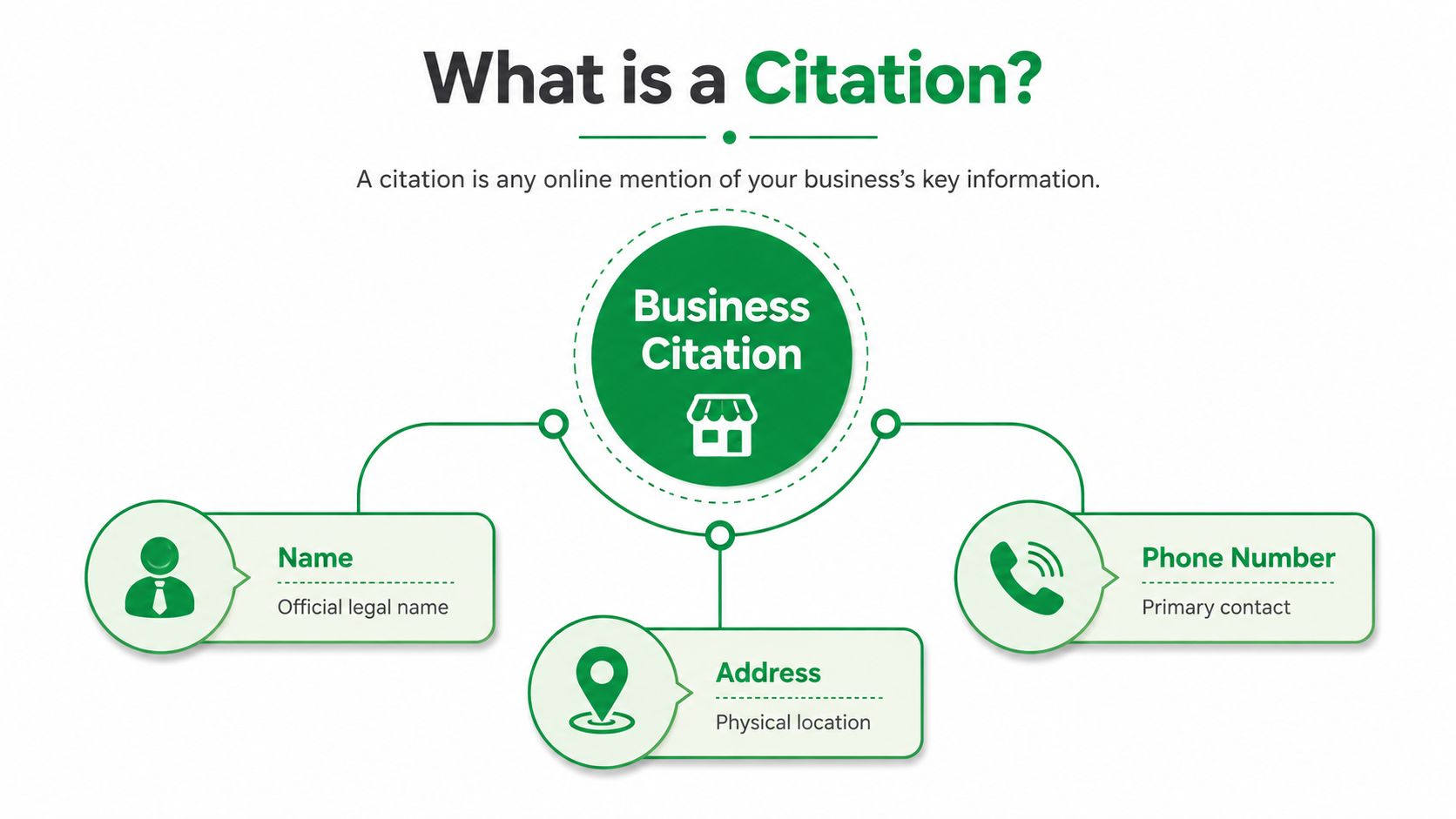
A citation functions like a professional reference on a résumé. One reference can confirm that a candidate exists and has relevant experience. Several credible references with matching details make evaluation easier. Local businesses gain the same benefit when reputable websites confirm their identity and location.
The two audiences behind every listing
Search engines examine these references to assess whether a business is established, relevant, and connected to a particular place. Customers may find a listing directly, compare it with another source, or rely on it before deciding whether to call.
Every citation therefore needs to pass three checks:
- Identity: Does the listing describe the correct business?
- Accuracy: Can a customer use the information without hesitation?
- Context: Does the platform fit the industry, location, or community?
The most useful key items for business listings make a profile complete and usable, rather than merely present. A listing with the correct business name but an incomplete address or outdated phone number can create doubt instead of trust.
Quantity isn't the same as quality
A large collection of weak listings does not automatically build authority. Some directories offer little editorial value, limited user engagement, or irrelevant categories. Chasing every available profile can also produce duplicates and expand the number of records someone must maintain.
A smaller group of accurate, relevant citations often gives a business a stronger operating foundation. The objective is to establish one coherent identity in places where search engines and potential customers reasonably expect to find it. That requires prioritizing reputable platforms and budgeting time to review changes, rather than treating citation building as a one-time checklist.
How Citations Build Trust in the Eyes of Search Engines
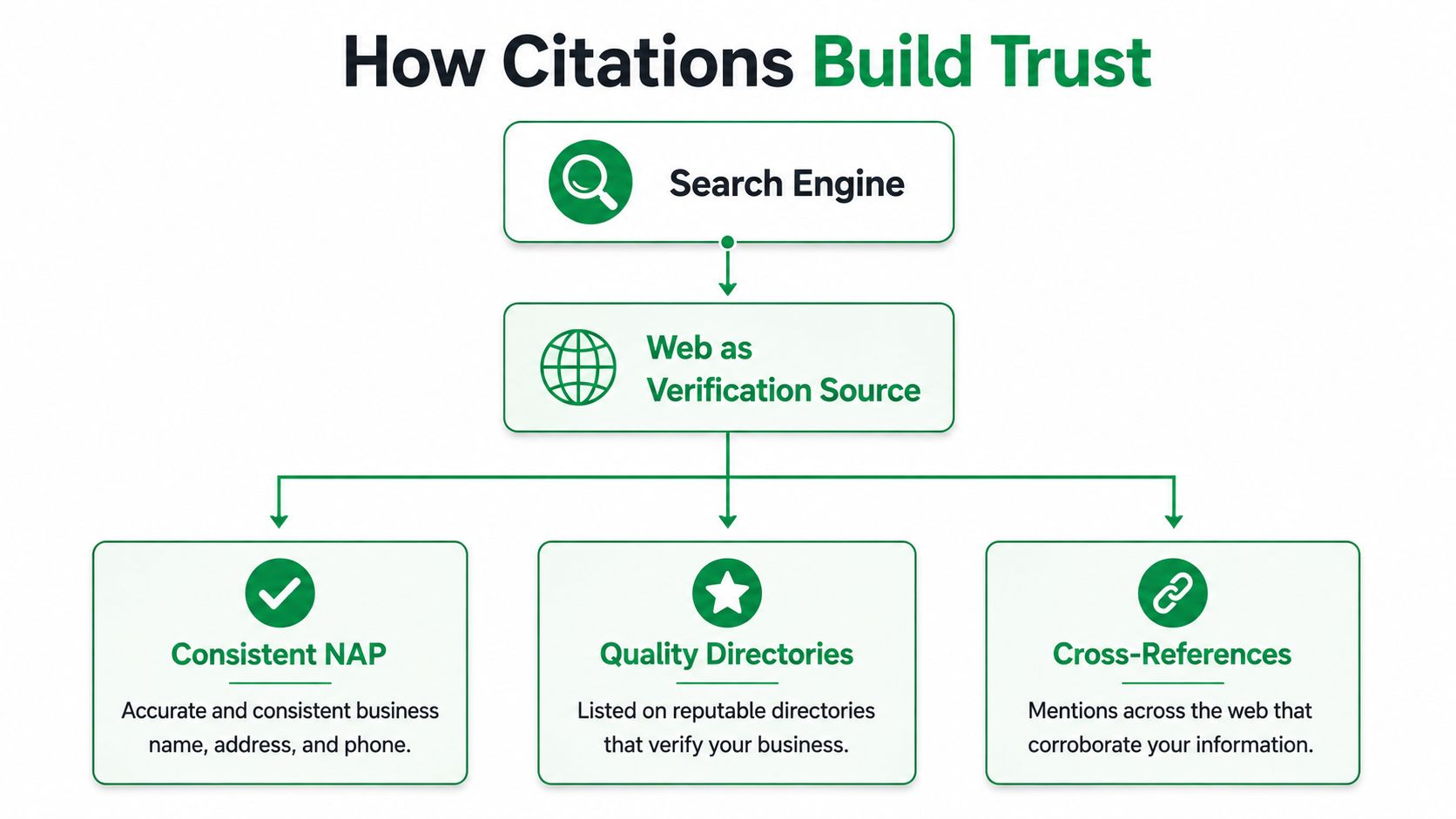
Search engines use the web as a verification network. They can't rely on a physical visit to confirm every local business, so they compare information from multiple sources. Consistent citations reduce uncertainty about whether a business exists, where it operates, and which contact details belong to it.
A BrightLocal survey found that 90% of local SEO experts consider accurate citations important to local search ranking, while none considered citations unimportant. That result reflects professional consensus, not a guarantee that any individual listing will produce a ranking change. It does show that citation accuracy remains part of the core local SEO foundation. BrightLocal's local citation survey provides the underlying industry evidence.
Consistency reduces ambiguity
Search engines need to distinguish between businesses with similar names and determine whether several references point to one entity. Matching NAP details help connect those references. Small formatting differences aren't always fatal, but meaningful discrepancies, especially different phone numbers or addresses, can weaken that connection.
Consistency also supports human verification. If a searcher checks a directory after finding a business in search results, matching details reinforce the impression that the listing is current.
Authority gives references different weight
Not every website is equally useful. A relevant local organization, respected review platform, or established industry directory generally gives a citation more context than an obscure site built only to host listings.
Authority isn't just a metric to chase. Relevance matters. A specialist directory can help clarify what a business does, while a local organization can reinforce where it operates. The strongest citation profile combines accuracy with sensible placement.
Discoverability expands the verification trail
Citations create more entry points. A customer may find a business through a service directory rather than a search engine results page, or may use a local association site to compare providers. Those sources can also help search engines associate the business with a service category and geographic area.
A citation works best when it is both trustworthy and useful. A listing that nobody trusts, visits, or can interpret clearly is weak evidence, even if the NAP happens to be correct.
The Measurable Impact of Citation Quality on Visibility and Conversions
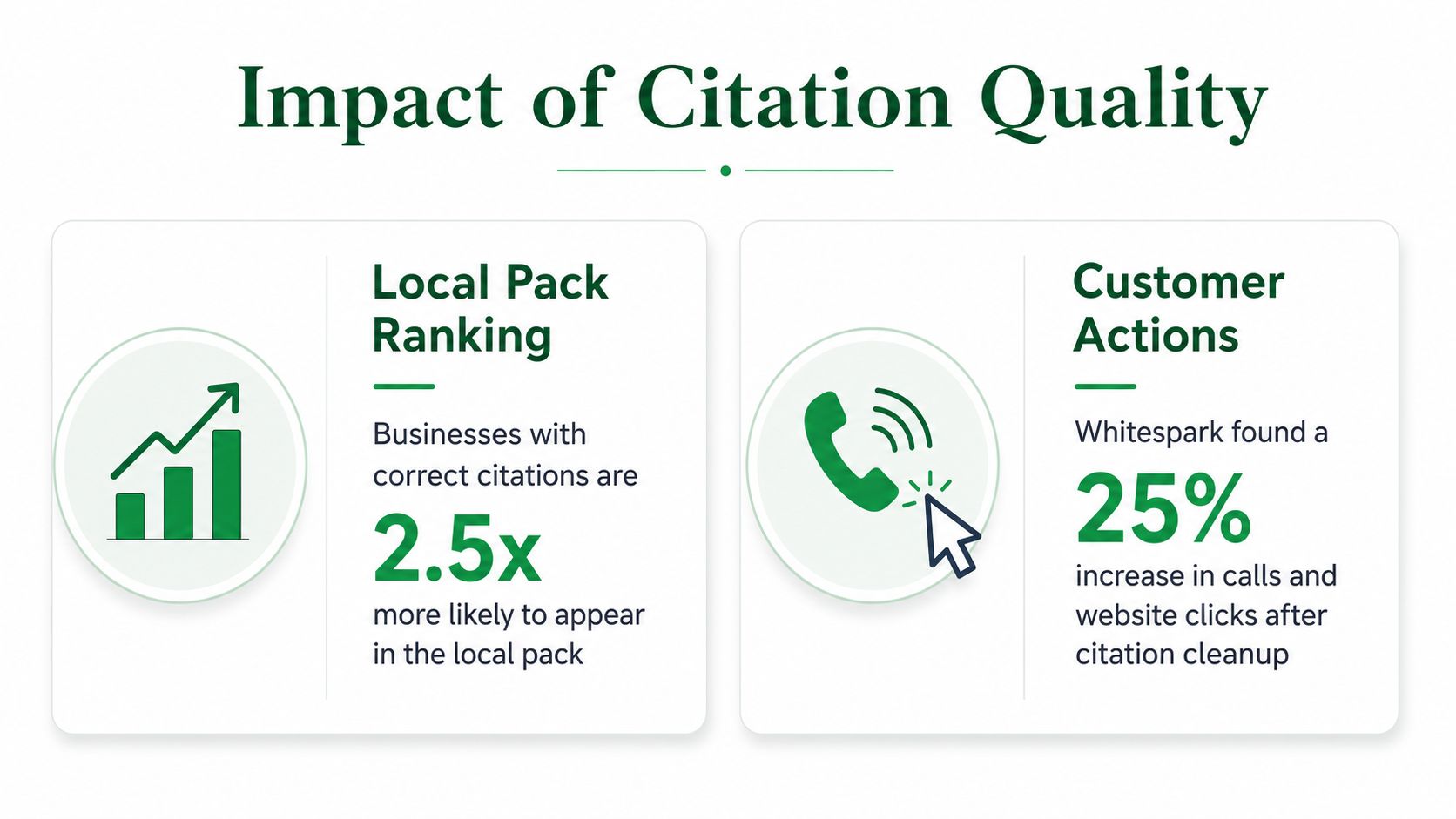
Citation work is often dismissed as a background task because the edits happen on directories rather than on a company's website. Whitespark's cited experiment gives that assumption a serious challenge. Locations included in an extended directory network recorded 89% more visibility in direct search and 77% more visibility in indirect search than locations using only base-directory listings, as reported in the experiment summary.
The same comparison recorded 91% more map views, followed by 102% more driving directions, 13% more phone calls, and 87% more website clicks. Each figure is linked to the cited experiment, and each represents a different stage of the customer journey.
Visibility is only the first outcome
More direct visibility suggests that a business can appear more often when searchers already know the company or search for it explicitly. Indirect visibility matters when customers search by service and location without naming the business.
Map views sit closer to action. A person who opens a map listing may be checking proximity, route options, or contact details. Driving directions indicate stronger intent, while calls and website visits show that the listing has helped move the searcher into a business-owned channel.
| Citation outcome | What it can indicate |
|---|---|
| Direct visibility | Existing awareness or branded discovery |
| Indirect visibility | Service and location discovery |
| Map views | Local comparison and proximity checking |
| Driving directions | Readiness to visit |
| Phone calls | Immediate contact intent |
| Website clicks | Interest in further evaluation |
The experiment doesn't mean every business will receive the same result. Directory quality, industry, location, competition, listing accuracy, and the rest of the local SEO profile all influence performance. It does show that citation breadth can affect actions, not just theoretical visibility.
For teams managing several locations, AI citation tracking can support a more disciplined process by recording cited URLs, separating simple mentions from actual citations, and preserving historical records. That makes it easier to see whether a correction was applied consistently rather than assuming the work is finished because one platform looks accurate.
Common Citation Problems and What They Cost Your Business
The most expensive citation problems are usually ordinary. A business changes its phone system, moves offices, hires an agency, or creates a new profile without realizing that older information is still public.
I've seen businesses approach citation cleanup as a quick editing exercise. The first directory gets corrected, the obvious duplicate is updated, and the work stops. Months later, a customer finds an old profile through a different source, and the business is back to explaining why the public information doesn't match.
Inconsistent NAP details
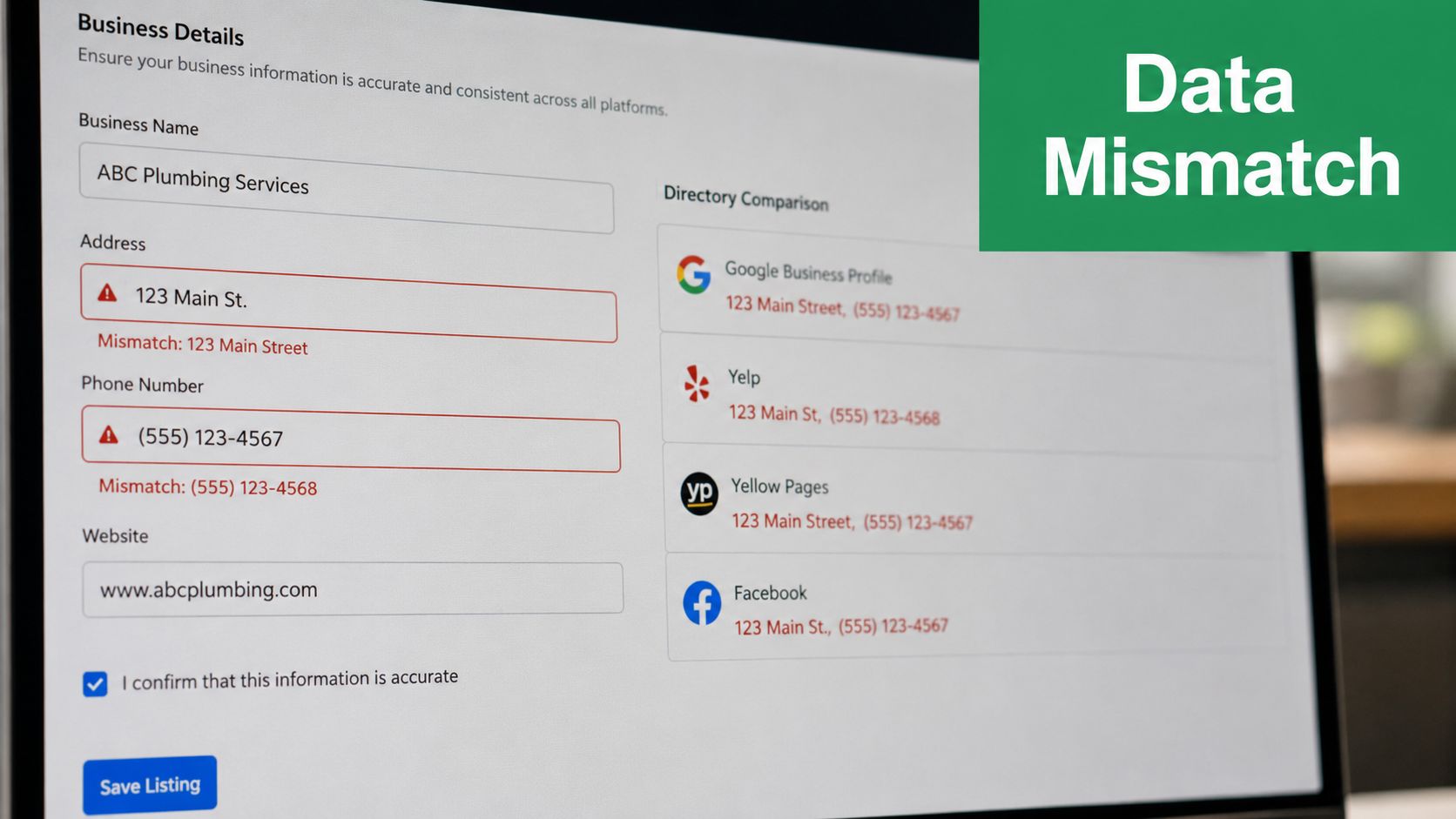
One listing uses “Main Street,” another uses “Main St,” and a third includes a former suite number. Some formatting differences may be harmless, but conflicting phone numbers, addresses, or business names create genuine uncertainty.
The cost is practical:
- Missed contacts: A customer may call a disconnected or incorrect number.
- Reduced confidence: Conflicting details make the business look poorly managed.
- Wasted effort: Staff spend time correcting misunderstandings instead of handling customers.
- Weaker entity matching: Search engines have more difficulty connecting references to one business.
Duplicate listings split attention
Duplicate profiles can divide reviews, customer activity, and business information between multiple versions. Customers may leave feedback on one profile while another version appears more prominently in search. Owners then have to determine which listing is legitimate, claim the right profile, and request removal or merging where the platform allows it.
Stale information keeps misleading people
An old address can send customers to the wrong location. Outdated hours can create a failed visit. A former service description can attract inquiries the business no longer handles.
AI-generated summaries add another reason to maintain source information carefully. When summaries compress information from multiple pages, customers may not see the original context. Clear, current references give both human reviewers and automated systems a better trail to follow. University guidance on verifying claims and tracing original sources also highlights a broader principle, unsuitable citations can damage the quality of the work that relies on them.
A Practical Framework for Building and Maintaining Clean Citations
Citation management works best as a repeatable operating process, not a one-time burst of directory submissions. Start with a single source of truth for the exact business name, public address, primary phone number, website, hours, categories, and location-specific details.
Phase one, audit the existing profile
Search for the business name, phone number, address variations, and old branding. Record every listing in a spreadsheet or citation management system. Include the platform, profile URL, login or ownership status, visible NAP details, duplicate status, and the action required.
Don't rely only on the first page of search results. Check major directories, industry platforms, local organizations, review sites, map services, and any profiles created by previous marketing providers.
Phase two, correct the highest-risk errors
Prioritize listings that customers are likely to use and profiles that search engines may treat as important references. Correct the primary business details first, then address duplicates and ownership issues.
Use the same formatting standard throughout. Decide how the street address, suite, phone number, and business name should appear, then apply that standard consistently. Keep evidence of changes, including the date, platform, person responsible, and confirmation received.
Don't expand a messy profile. Clean the identity first, then add relevant citations.
Phase three, expand with purpose
Add listings where the business belongs. Relevant industry directories, local associations, chambers, service marketplaces, and review platforms can support both discovery and credibility. Avoid directories that exist only to collect thin business records.
For a deeper workflow covering discovery, submission, and quality control, use this guide to local citation building.
Phase four, monitor after changes
Businesses change. Phones are replaced, offices move, hours shift, and platforms alter their profiles. Schedule recurring checks, monitor duplicate creation, and review new mentions after major business updates.
Manual tracking may suit a single-location company with few listings. Larger businesses can use tools that scan directories, identify mismatches, track ownership, and export change histories. A directory such as AI Tools for Local SEO can help teams evaluate software categories for local listings and citations alongside tools for auditing, monitoring, and reputation management. Choose based on coverage, update control, reporting, and the amount of human review the workflow requires.
Why Citations Deserve a Permanent Place on Your Local SEO Priority List
Citations are foundational infrastructure for local search. They help search engines validate a business, help customers confirm that the business is reachable, and give teams a practical way to audit how the company is represented across the web.
They aren't a substitute for a useful website, strong reviews, relevant content, or a well-maintained business profile. They also aren't a license to submit the business to every directory available. The trade-off is clear. Careful citation work takes time, but careless expansion creates more records to correct and more opportunities for customers to encounter conflicting information.
Accuracy beats activity
Every incorrect listing creates friction. Every verified listing removes some of that friction. The value comes from making the public record coherent enough that a customer can move from discovery to contact without hesitation.
Academic research also demonstrates why attribution matters beyond search marketing. In the historical development of citation analysis, Eugene Garfield and the Institute for Scientific Information published the first Science Citation Index in 1964, indexing 613 journals and 1.4 million citations across five printed volumes, as documented by the History of Information. That system made it possible to trace influence and connect later work to earlier sources. Local citation management applies a practical version of the same idea, it preserves a traceable identity across distributed sources.
If your business profile is inconsistent, start with an audit this week. Build the master record, locate the highest-risk discrepancies, correct the primary listings, and set a recurring review schedule. Clean citations won't solve every local SEO problem, but ignoring them leaves search engines and customers with reasons to hesitate.
Review your business name, address, phone number, hours, and duplicate listings today. Then document every correction in one central record so your team can maintain a consistent local presence instead of repeatedly repairing the same citation errors.