The best AI rank tracker depends on which local results matter to your business. A single average position can't explain whether a business appears in Google Maps, enters the Local Pack, ranks organically from a specific ZIP code, or gets cited in an AI-generated answer. Modern search visibility now spans classic SERPs, map results, mobile experiences, AI Overviews, and other answer surfaces, so comparing tools by generic feature counts produces weak buying advice.
Evaluate Maps and Local Pack accuracy, city or ZIP precision, device segmentation, AI visibility, scan frequency, reporting, integrations, and pricing structure. A credit-based geo-grid tool solves a different problem from a full SEO suite, while an enterprise tracker built for high-volume refreshes may be excessive for a freelancer managing a handful of clients.
This list compares ten tools by the local search job they solve. It separates local visibility, organic tracking, geo-granular coverage, AI and LLM monitoring, multi-location operations, reporting, and cost control. For broader discovery, AI Tools for Local SEO curates solutions across rank tracking, multi-location SEO, reporting, Google Business Profile workflows, and related local marketing tasks.
1. Semrush
Semrush is the strongest fit for teams that want local rank tracking and wider SEO research in one ecosystem. Its Position Tracking workflow supports local and device segmentation, ZIP and city-level monitoring, and Local Pack reporting. That makes it useful when an agency needs to connect ranking movement with keyword research, technical audits, competitor analysis, and client reporting rather than operate a standalone tracker.
Its AI Visibility capabilities extend the measurement beyond blue links. The platform monitors brand appearance across Google AI Overviews and multiple large language model surfaces, giving teams a way to compare traditional rankings with emerging answer visibility. This distinction matters because strong organic placement and AI citation aren't interchangeable outcomes. A 2026 analysis reported that the overlap between Google's top-10 results and AI Overview citations declined from 76.10% in July 2025 to 37.9% by March 2026 (SEOlla's analysis of AI rank tracking changes).
Best fit and trade-offs
Semrush suits agencies, in-house SEO departments, and multi-service consultants that value integration depth. Daily updates, API access, SERP feature data, research modules, and reporting tools can reduce the need to move data between platforms.
The trade-off is operational complexity. As projects, keywords, and limits expand, costs can rise, and non-specialists may need time to understand the platform. Teams new to ranking measurement should first learn what rank tracking actually measures, especially when local and AI visibility are reported beside classic positions.
Practical rule: Choose Semrush when AI visibility is part of a broader SEO operating system, not when you only need occasional Maps scans.
2. SE Ranking
SE Ranking works well for SMBs and agencies that want daily local rank tracking, share-of-voice reporting, and client collaboration without committing to the broadest enterprise-style ecosystem. Its position tracking supports Google and Bing, local targeting, device segmentation, and SERP feature monitoring. Local teams can use those views to separate ordinary organic movement from changes in map and result-page exposure.
The platform's AI Search add-on extends reporting into Google AI Overviews and other AI channels. That gives agencies a practical way to explain AI exposure to clients who don't want a separate visibility platform. It also supports white-label workflows, guest links, and agency reporting, so the tool can serve both the analyst doing the work and the client reviewing the outcome.
Where it earns its place
SE Ranking's main advantage is flexibility. Teams can assemble a tracking and reporting workflow without buying every adjacent SEO capability, while agencies can provide share-of-voice context alongside position changes. The 2026 plan refresh is described as offering clearer limits, although buyers should still verify current allowances against their keyword, project, location, and AI-monitoring needs.
The interface covers a lot, which can feel overwhelming during initial setup. AI tracking also requires a paid add-on, so the headline subscription isn't the full cost if AI visibility is central to the workflow. Before choosing a plan, define whether you need a basic keyword ranking checker or a combined local and AI reporting system.
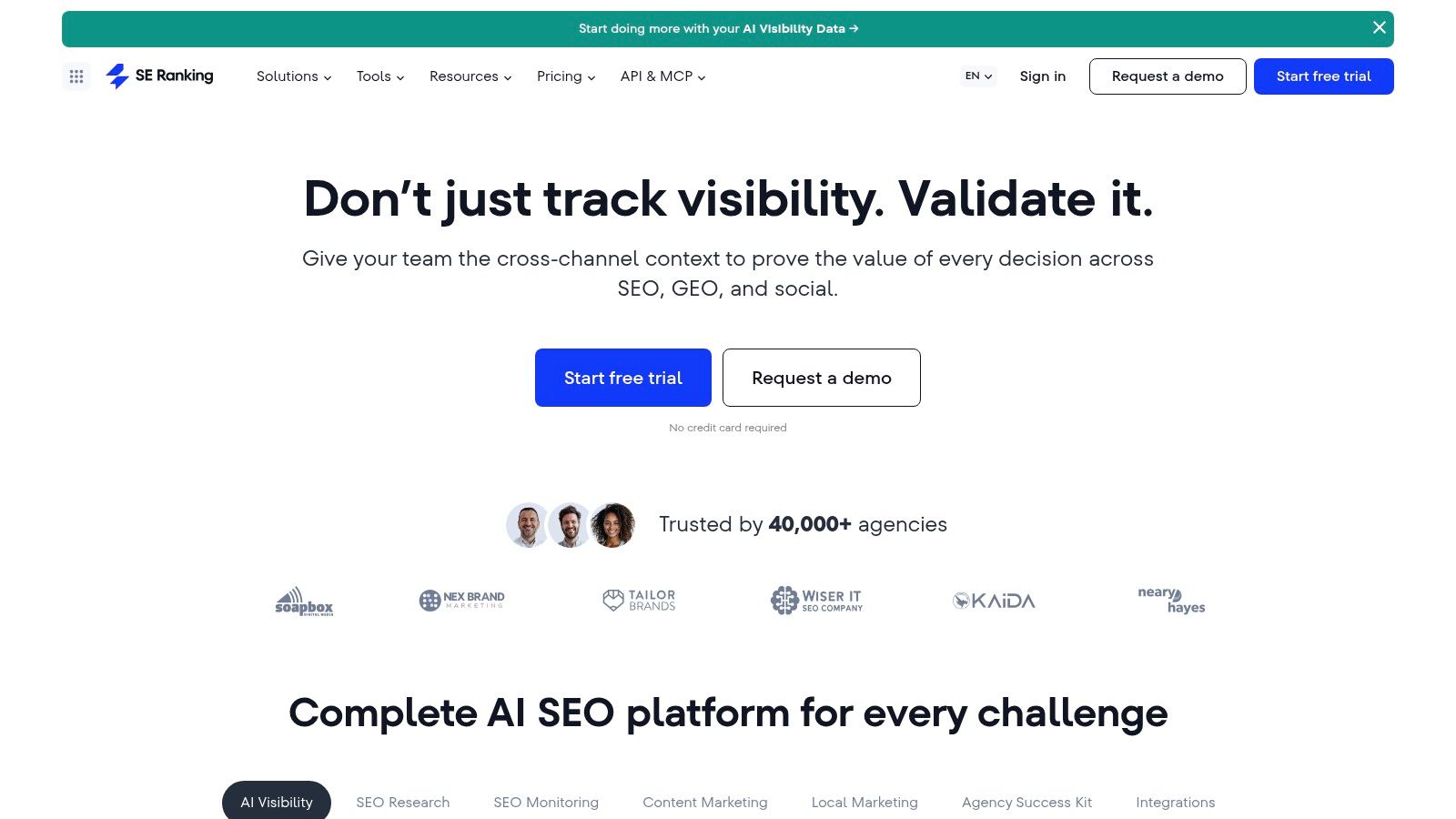
SE Ranking is a sensible middle path for teams that want AI search reporting plus traditional SEO operations, but don't need the deepest geo-grid specialization or a large enterprise data layer.
3. BrightLocal
BrightLocal is built around the local SEO workflow rather than the general SEO suite. Its Local Rank Tracker and Local Ranking Grids separate Google Maps, Local Finder, and organic rankings by city or ZIP, which makes the platform particularly useful for agencies delivering location-level reports to clients.
That separation solves a common measurement error. A business may rank well organically while remaining weak in the Local Pack, or appear prominently near its address while disappearing farther across the service area. BrightLocal's location-centric reporting helps analysts show those outcomes independently instead of hiding them inside one blended score.
Best for client-ready local reporting
BrightLocal combines rank tracking with Google Business Profile, citation, and review workflows. Agencies can therefore connect ranking observations with the local signals they manage day to day. Its straightforward interface also makes reports easier for business owners to understand, especially when the audience cares more about Maps visibility and profile performance than technical SEO terminology.
The limitation is equally clear. AI visibility beyond Google's traditional search environment isn't the platform's core focus today. If a client specifically wants monitoring across AI Overviews, ChatGPT, or other answer engines, BrightLocal may need to sit beside a dedicated AI visibility product.
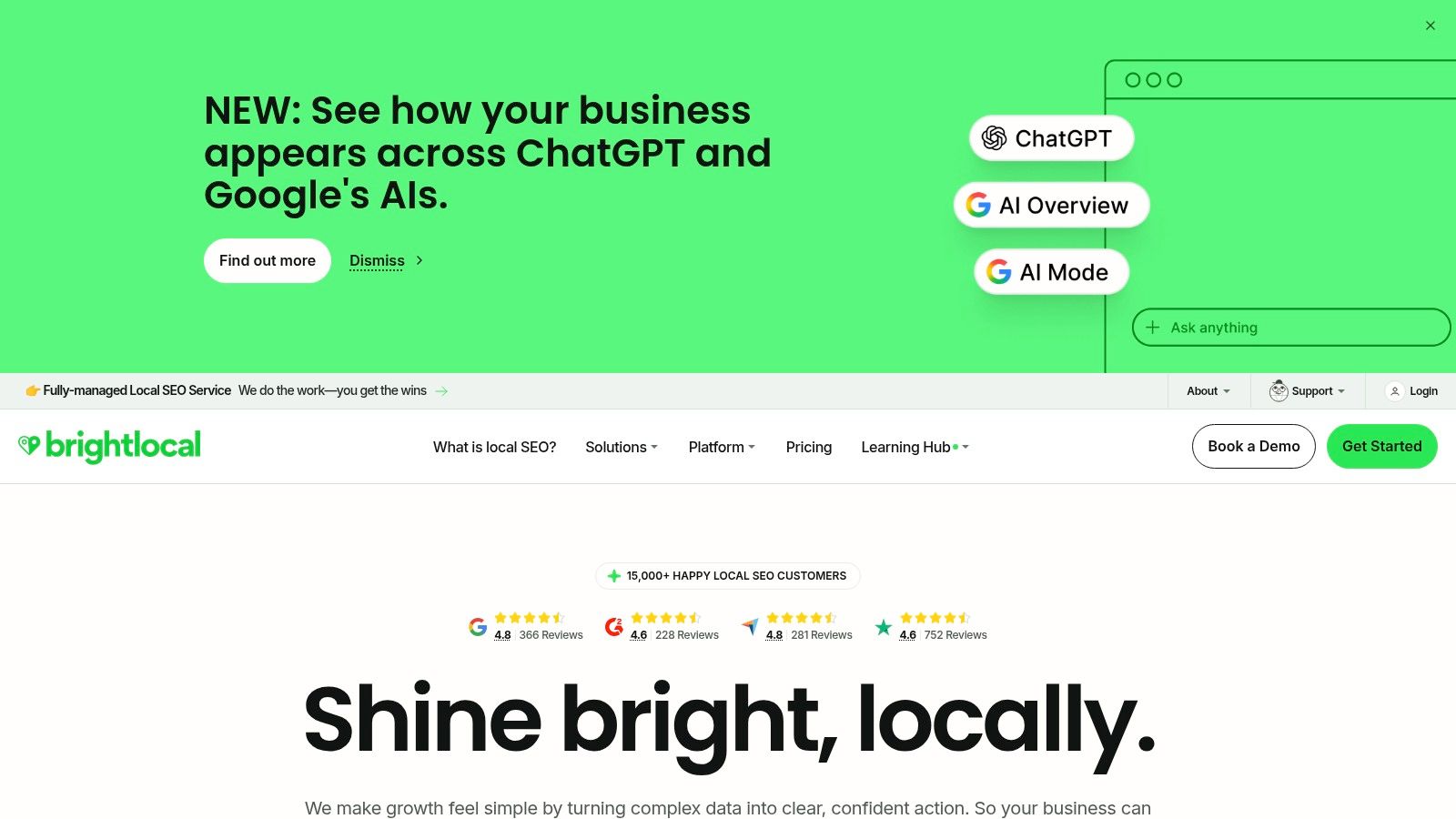
BrightLocal makes the most sense when the reporting question is, “How visible is each location in local search?” It makes less sense when the question is, “Which AI systems cite this brand, and which URLs do they use?”
4. Whitespark
Whitespark focuses on the local search job many broad platforms simplify: distinguishing Local Pack performance from organic rankings across a geographic area. Its Local Ranking Grids show how visibility changes from one point to another, helping practitioners investigate neighborhood-level differences instead of relying on a single search location.
That depth is important because local rankings aren't a universal number. They depend on proximity, relevance, prominence, device context, and the query's local intent. A location that appears strong from one point can look materially weaker elsewhere, particularly for service-area businesses and brands with several offices.
Why practitioners choose it
Whitespark tracks beyond the top ten results, which can reveal movement before a listing reaches the most visible positions. It also offers white-label reporting, making it practical for agencies that need to turn granular local data into client deliverables.
The platform's weakness is its scope. It doesn't provide broad AI or LLM visibility tracking beyond Google SERPs, so it won't answer whether a brand is being cited in conversational search. Heavy geo-grid use can also increase costs, which means teams should decide how often each location needs scanning rather than treating maximum coverage as automatically better.
A local tracker is only as accurate as its geography. If the business serves several neighborhoods, test whether the tool exposes that variation before trusting its average position.
Whitespark is a strong local-first choice for practitioners who need clear Maps and organic separation, but it isn't a complete answer for fragmented AI discovery.
5. Local Falcon
Local Falcon solves one narrow problem exceptionally directly: visualizing Google Maps visibility across a service area. Its geo-grid scans display rankings across neighborhoods and ZIP codes in a heat-map format, making it easy to identify where a Google Business Profile performs well and where it loses ground.
The credit-based model changes how teams should use it. Each grid pin consumes a credit, so Local Falcon is better suited to on-demand investigation, periodic audits, and targeted campaign checks than automatic high-frequency monitoring of every keyword and location. That structure can help a small business or franchise control spend when daily scans aren't necessary.
The operational trade-off
Local Falcon supports multi-keyword and multi-location scan management, which gives agencies a focused way to investigate Maps performance across accounts. Its visual output is also accessible to clients who may struggle to interpret a conventional ranking table.
The narrow scope is intentional, but it means the platform isn't a replacement for a full SEO suite. It concentrates primarily on Maps and Google Business Profile visibility, with little emphasis on organic research, backlinks, technical audits, or cross-LLM citation tracking. Credit management also requires planning. A team should reserve detailed scans for locations and queries tied to real business decisions rather than scan indiscriminately.
The best use case is a business asking, “Where across this service area does our profile appear in Maps?” For that question, a dedicated geo-grid tool can be more useful than a larger platform whose local data is less central to the workflow.
6. AccuRanker
AccuRanker is designed for organizations that prioritize fast, high-volume rank tracking and clean reporting. It offers on-demand updates, SERP feature data, competitive insights, share-of-voice tracking, exports, and integrations that support agency and enterprise reporting.
The platform is particularly useful when teams need to refresh data outside a standard schedule. That matters for campaign launches, major page changes, algorithm updates, and client meetings where the analyst wants current evidence rather than an older scheduled snapshot.
Strong data operations, narrower AI scope
AccuRanker's reporting is built for professional deliverables, and its data depth suits large keyword sets. The trade-off is cost scaling with keyword volume. A small team tracking a limited local footprint may not benefit enough from high refresh speed to justify paying for a larger data workload.
Its AI assistance is positioned mainly around analysis and insights layered on top of ranking data. That differs from a platform designed to measure cross-LLM inclusion, mentions, or citations directly. Teams should therefore separate AI-assisted interpretation of SERP data from AI-surface visibility tracking during procurement.
AccuRanker is a practical choice for agencies and larger accounts where speed, exports, and high-volume reliability matter more than a wide ecosystem of local marketing tools. It also suits teams that already know exactly which rankings they need and don't want a lengthy suite onboarding process.
7. Nightwatch
Nightwatch combines traditional SERP monitoring with AI visibility elements in a dashboard aimed at teams that want a lower-entry alternative to larger SEO suites. It supports local and device rank tracking, SERP feature detection, and AI Visibility options, so users can keep classic ranking data and newer AI signals in the same reporting environment.
The platform's appeal is adoption. A smaller team may not need the research, backlink, content, and audit modules bundled into a broad SEO platform. Nightwatch's simpler interface and no-per-seat approach can make collaboration easier when several people need access without creating a separate license calculation for every user.
A good fit for focused teams
Nightwatch is strongest when the business needs straightforward tracking with some AI visibility, rather than a highly specialized geo-grid engine or a deep multi-platform AI research suite. Its entry pricing is positioned competitively against larger platforms, though buyers should verify current keyword, location, refresh, and AI limits before comparing plans.
The limitations are predictable. Its AI visibility scope is narrower than Semrush or SE Ranking, and its adjacent SEO ecosystem is smaller. That can be an advantage for teams that want less clutter, but it may force agencies to combine Nightwatch with separate tools for audits, keyword discovery, citations, or reputation work.
Use Nightwatch when the core requirement is a team-friendly dashboard that blends local rankings, device context, SERP features, and selected AI signals without imposing the learning curve of a much larger platform.
8. Nozzle
Nozzle is for agencies and analysts who need to inspect exact SERP context, not merely store a position history. Its flexible crawl scheduling ranges from hourly to quarterly, and its data model captures SERP features and item-level rankings, including positions inside local packs.
That level of customization changes the reporting workflow. Instead of asking only whether a keyword moved up or down, an analyst can examine the ranking page, competitors, landing pages, pack items, and feature ownership associated with the query. Nozzle Vision adds visualizations that can help clients understand those relationships without reading a dense export.
Deep data requires a capable operator
Nozzle is a strong choice for customized monitoring across many locations or competitors. Its winners-and-losers dashboards, competitor views, landing-page analysis, and flexible schedules give experienced teams more control over how they diagnose visibility changes.
The cost is complexity. The interface is data-heavy, and Nozzle isn't an all-in-one SEO suite. AI and LLM visibility aren't core modules today, so a team looking for citations in AI-generated answers will need another layer of measurement.
Nozzle is best when the local search question is detailed and diagnostic, such as whether a competitor replaced a business inside a pack, whether a specific landing page gained visibility, or how a SERP feature changed the available click path. It's less suitable for a buyer who wants a simple dashboard with broad AI coverage already packaged in.
9. GeoRanker
GeoRanker targets agencies and service-area businesses that need location-precise checks across cities, ZIP codes, devices, and search engines. Its credit-based usage model lets teams control spend around the actual volume of geo-checks rather than committing to a broad fixed package.
That structure can work well for recurring checks across many markets. The platform supports Google, Bing, mobile, and desktop location options, while API access allows agencies to place rank data into custom reporting or internal systems.
Flexible geography, less polished presentation
GeoRanker's strength is operational flexibility. A business with scattered service areas can sample each market without pretending that one city-wide position represents every customer. This aligns with the wider shift toward granular local tracking, where tools increasingly monitor city, ZIP, neighborhood, and even street-level differences. One local tracking product, for example, describes scanning across nine local search points to expose Google Maps visibility (Local Falcon's local rank tracking information).
The platform's UI and reporting are less polished than those of leading all-in-one tools, so agencies may spend more time shaping the raw data into client-ready narratives. AI and LLM visibility coverage is also limited. GeoRanker is therefore a strong infrastructure choice for geo-checks, not a complete AI search measurement platform.
Choose it when geography and API access matter more than presentation polish. Credit-based tracking can also be more economical for periodic scans, but teams should model usage before expanding locations, devices, keywords, and refresh frequency.
10. ProRankTracker
ProRankTracker is a practical option for freelancers and smaller agencies that need dependable daily tracking without buying a complete SEO suite. It supports daily updates, location and device filters, multiple search engines, basic local tracking, white-label reports, shareable dashboards, and API access on higher tiers.
The platform's value is simplicity. A consultant can deploy straightforward keyword and local reporting without learning a large research ecosystem or configuring an elaborate data warehouse. White-label reports also support client delivery when the reporting requirement is clear and conventional.
Budget-conscious tracking with a defined ceiling
ProRankTracker's main limitation is its lack of dedicated AI search visibility tracking as of 2026. It can report traditional rankings, but it won't provide the same answer-engine perspective as tools that monitor AI Overviews, LLM mentions, or citations. Its adjacent SEO features are also fewer than those found in broader platforms.
That doesn't make it a poor choice. It makes it a focused one. If clients primarily want daily organic and local position reports, bulk rank tracking can be more relevant than paying for AI functionality nobody will act on.
ProRankTracker fits the buyer who values clear reporting, manageable term counts, and controlled cost. It isn't the right choice when AI citation monitoring or advanced geo-grid analysis is a core requirement.
Top 10 AI Rank Trackers, Features Comparison
| Tool | Core focus / key features | AI & Maps visibility | Target audience | USP / strength | Pricing model |
|---|---|---|---|---|---|
| Semrush | Full SEO suite; daily local/device tracking, Local Pack, API, reporting | Tracks Google AI Overviews + multiple LLMs; Local Pack reporting | Agencies & teams needing broad ecosystem | Integrated research + tracking + emerging AI/LLM visibility metrics | Subscription; cost grows with projects/limits |
| SE Ranking | All‑in‑one SEO: daily local tracking, share‑of‑voice, reporting, collaboration | AI Search add‑on for Google AI Overviews and AI channels (paid add‑on) | SMBs and agencies seeking flexible plans | Flexible pricing, white‑label & agency features | Subscription with optional AI add‑on; clearer limits |
| BrightLocal | Local SEO: GBP tools, citations, reviews, local rank grids and reporting | Strong Maps/GBP tracking; limited cross‑LLM AI visibility | Local businesses & multi‑location agencies | Built for local workflows; client‑friendly reports | Subscription bundles (may include unneeded tools) |
| Whitespark | Local Pack vs organic tracking; geo‑grid scans; white‑label reporting | Deep Maps/Local Pack focus; no broad LLM tracking | Local SEO practitioners and agencies | Trusted accuracy; tracks beyond top‑10 | Subscription; geo‑grid usage can raise costs |
| Local Falcon | Geo‑grid Maps rank tracker with heat‑map visuals; multi‑keyword scans | Focused on Maps/GBP; not LLM/AI search tracking | Small businesses, franchises, agencies needing on‑demand scans | Visual heatmaps; cost‑efficient for ad‑hoc scans | Credit‑based pay‑per‑scan model |
| AccuRanker | High‑speed rank tracking; SERP feature data; enterprise reporting | AI‑assisted analyses on top of tracking; limited cross‑LLM scope | High‑volume agencies & enterprises | Very fast refresh rates; robust client reporting | Subscription; pricing scales with keyword volume |
| Nightwatch | Local/device rank tracking + SERP features; team‑friendly UX | Includes AI visibility elements; narrower scope than larger suites | Small teams and growing agencies | No per‑seat fees; competitive entry pricing | Subscription; team‑friendly pricing (no per‑seat) |
| Nozzle | Highly customizable schedules; item‑level ranks; detailed visualizations | Not focused on AI/LLM visibility today | Agencies needing precise Maps/organic/feature context | Exceptional SERP depth and client visual tools | Subscription; data‑heavy plans may cost more |
| GeoRanker | Geo‑granular rank checks (city/ZIP), mobile/desktop, API access | Limited AI/LLM coverage | Agencies with many local markets or multi‑location clients | Credit model for cost control; API for integration | Credit‑based model; periodic scans can be cheaper |
| ProRankTracker | Budget daily rank updates, device/location filters, white‑label | No dedicated AI search visibility (as of 2026) | Freelancers and small agencies | Competitive pricing for term counts; easy deployment | Subscription tiers; API on higher plans |
Choose the Tracker That Matches Your Reporting Reality
There isn't one universal best AI rank tracker because local search teams don't measure the same outcome. A franchise operator needs neighborhood-level Maps evidence. An agency may need white-label reports across many locations. An enterprise SEO team may prioritize refresh speed, API access, and high-volume data. A content team may care more about whether AI systems cite its pages than whether a keyword moved from one organic position to another.
Choose Semrush or SE Ranking when AI visibility belongs beside broader SEO workflows. Semrush is better suited to agencies that want a large research, tracking, and reporting ecosystem with AI visibility capabilities. SE Ranking offers a more flexible all-in-one route for SMBs and agencies, although AI monitoring can require an additional paid component.
For local-first client work, BrightLocal and Whitespark are more natural fits. BrightLocal emphasizes Google Business Profile, citations, reviews, and client-friendly location reporting. Whitespark is particularly useful when the analyst needs clear Local Pack versus organic separation, geo-grid detail, and visibility beyond the top ten.
Use Local Falcon or GeoRanker when the central problem is credit-controlled geographic sampling. Local Falcon concentrates on Maps heat maps and on-demand scans. GeoRanker adds broader search engine, device, API, and city or ZIP workflows. Both require more deliberate planning than an unlimited-looking dashboard because every additional scan affects the operating model.
AccuRanker and Nozzle suit teams that need high-volume or highly customized data. AccuRanker favors fast refreshes, integrations, exports, and agency-scale reporting. Nozzle favors analysts who want detailed SERP feature and item-level context, even though its data-heavy interface demands more expertise.
Nightwatch is a sensible choice for simpler team adoption and selected AI visibility. ProRankTracker is better for budget-conscious users who mainly need conventional daily ranking reports and white-label delivery.
Before signing up, run the same local queries from the locations and devices that matter. Check whether the tool separates Maps, Local Finder, Local Pack, organic results, and AI surfaces instead of blending them into one score. Then verify scan frequency, historical storage, exports, API availability, user access, report customization, and the total cost of locations, keywords, devices, competitors, and AI monitoring.
The global SEO rank tracker market was valued at USD 250 million in 2025 and is projected to reach USD 600 million by 2034, with a projected 10.5% CAGR from 2026 to 2034, according to Ahrefs' rank tracker market reference. That growth reflects sustained demand, but it doesn't make every platform suitable for every workflow. Your best choice is the one whose data matches the geography, surfaces, cadence, and reporting decisions your team makes.
Audit your current local reporting before choosing a platform. List the locations, devices, keywords, scan frequency, SERP features, AI surfaces, exports, and client deliverables you need, then test the two tools that best match that list. Explore the AI Tools for Local SEO rank tracking and reporting directory to compare additional local-first options and build a tracking stack that reflects how customers really discover your business.