A multi-location dental group can run a polished rebrand and still lose patients because one phone number changed in the wrong places. After updating its website and business profiles, the group discovered that three aggregator sites still displayed an old number with one incorrect digit. A prospective patient called the dead line, heard nothing useful, and moved on to another practice.
That problem isn't solved by submitting the correct details once. Local businesses need a reliable way to establish a canonical record, distribute it, identify conflicts, suppress duplicates, and watch for changes after publication. A citation management tool provides that control layer. It manages business information across the local-search ecosystem, rather than treating listings as a one-time directory submission task.
Why Local Businesses Need a Citation Management Tool
A local citation is any online mention of a business's identifying information. That can include its name, address, phone number, website, hours, category, and location details. Some listings are highly visible to customers. Others sit in data sources that influence what downstream directories display.
For a single-location business, a spreadsheet may seem sufficient. An owner can record the listing URL, login details, correction status, and last review date. The approach becomes fragile when the business adds locations, changes its phone system, moves offices, or discovers that third-party platforms have created duplicate profiles.
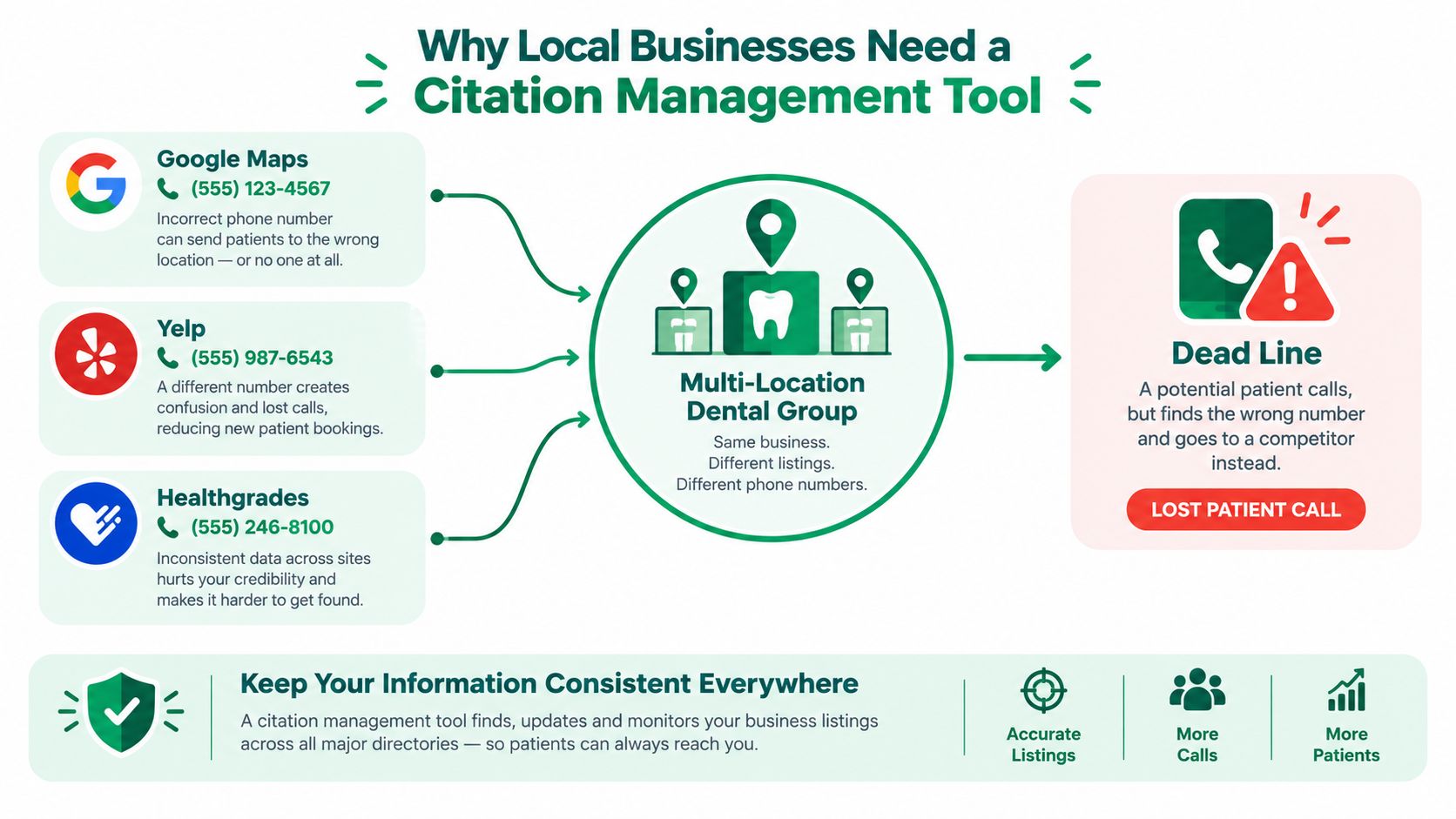
The control problem behind local listings
A useful citation management tool centralizes the approved business record, then uses that record to manage listings across important directories, aggregators, map services, and industry platforms. It should help a team answer practical questions quickly:
- What is the approved record? The business needs one controlled version of its name, address, phone, hours, URL, category, and location attributes.
- Where does that record appear? The team needs visibility into live listings, missing profiles, duplicates, and sites that still show outdated information.
- Which changes require review? A platform may reject an update, retain an old profile, or allow a third party to edit the listing.
- What needs attention first? A wrong phone number on a customer-facing directory deserves faster action than an obscure profile with limited visibility.
Manual tracking doesn't fail because staff members are careless. It fails because local data changes in several places at once, while the spreadsheet remains a passive record. NAP drift, duplicate profiles, closed locations, old hours, and inconsistent categories can remain unnoticed until a customer reports a problem.
Why submissions aren't enough
Submission services can push information outward, but distribution doesn't guarantee accuracy. A directory may accept the record and later overwrite it. An aggregator may send stale data to another platform. A duplicate may remain live because nobody has reconciled it with the claimed profile.
That distinction matters for both single-location businesses and franchises. A local shop needs a manageable way to protect its presence. A franchise marketing team needs permissions, location-level controls, approval workflows, and a reliable audit trail. Businesses that want a broader introduction to the topic can review this practical guide to build local search presence before choosing an operational approach.
The best way to think about citations is as business data infrastructure. A citation management tool doesn't replace accurate source information, ownership checks, or human judgment. It gives the team a system for applying those controls consistently. For additional context on the role citations play in local discovery, see why citations are important.
How NAP Consistency Shapes Local Search Visibility
A customer searches for a branch, finds the right business name, then calls an outdated number or arrives at an incorrect suite. The listing exists, yet the business still loses the visit. NAP consistency means that a business's name, address, and phone number match across its online profiles. For a field-level definition, see our what does NAP stand for explainer.
The standard also covers supporting information such as suite numbers, location labels, hours, website URLs, and categories. The goal is entity resolution: search engines, directories, map services, and customers should associate multiple records with the same real-world business. A different phone number, abbreviated address, or conflicting category creates an avoidable ambiguity.
The fields that deserve control
Begin with a master record using the exact public-facing format approved by the business. Set rules for the official name, location descriptor, street address, suite notation, and customer-facing phone number. Single-location businesses can manage this centrally. Franchises need the same rules applied across branches, with location-specific values kept separate.
Control the surrounding fields as well:
- Hours: Maintain regular hours, holiday schedules, and temporary closures through a defined approval process.
- Website URL: Send each branch to its correct location page instead of directing every listing to a generic homepage.
- Category: Choose categories that accurately describe the business and remain consistent where a platform permits.
- Location details: Keep suite numbers, floor information, service areas, and accessibility details where they help customers identify the premises.
One mismatched suite number can direct a customer to the right building and the wrong door. It can also make a directory record resemble a separate entity.
Search visibility is only part of the result. A customer may see and trust a listing, then fail to contact the business because the phone number is old or the hours are wrong. Presence without usable information weakens the listing as a conversion asset.
Fix the source, not just the symptom
A correction on one directory may disappear if an upstream source continues distributing the old record. The practical sequence is to identify the canonical profile, trace conflicting versions, update authoritative sources, and verify the downstream listings.
Citation management therefore works best as a data-integrity pipeline. The tool should help teams detect NAP drift, surface duplicate or hallucinated listings, and flag records that need human review before another submission spreads the error. Automation can find patterns and apply approved updates, while ownership checks and judgment still belong to the team.
For a plain-language overview, use this SEO citation guide for Indiana businesses. Submission volume can't compensate for fragmented business data. Reviews, content, and location-page improvements can support visibility, but they cannot correct a phone number that sends customers elsewhere. A citation management tool earns its place by making consistency visible, enforceable, and verifiable.
Core Features That Make Citation Tools Work for Local SEO
A simple directory submitter sends information to selected sites. A true citation management tool manages the record before, during, and after distribution. The difference appears in the controls around synchronization, ownership, duplicate handling, monitoring, and reporting.
Record synchronization
The tool should let the team create a canonical profile for each location and synchronize approved fields with important data sources and downstream directories. For a franchise, that means separating shared brand rules from location-specific values. A central brand name may stay fixed while the address, phone, hours, and landing page vary by branch.
The deliverable is a cleaner source record and a faster way to push approved changes. Synchronization is only useful if the platform shows failed updates, rejected fields, and records that require manual intervention. A green “submitted” status isn't the same as a verified live update.
Duplicate detection and suppression
Duplicate listings divide attention and create ambiguity. Customers may find an unclaimed profile with old hours while the business actively manages another profile. The tool should identify likely duplicates, distinguish claimed from unclaimed records, and support a documented merge, suppression, or ownership workflow.
Accuracy matters more than the number of duplicates detected. A system that labels two nearby branches as the same business creates a new problem. Human review remains important for shared addresses, departments, practitioners, and businesses with similar names.
Schema and structured data
The website should reinforce the same canonical entity used in listings. A citation platform may help generate or validate local-business structured data, including location details, contact information, hours, categories, and relevant identifiers.
Schema won't correct a wrong master record. It can, however, reduce the chance that the website publishes one version of the business while directories publish another. Treat it as a representation of the approved record, not as an independent source of truth.
Automated updates and conflict queues
Automation is valuable for repetitive updates, particularly when a business changes hours or opens a new location. The platform should allow a team to prioritize important directories, record submission status, and route conflicts into an editor queue.
A conflict queue protects quality. It gives a marketer somewhere to review a platform that rejects a category, changes an address format, or requests additional verification. Tools that hide these exceptions may look efficient while leaving inaccurate profiles live.
Monitoring and analytics
Monitoring should surface new listings, unauthorized edits, NAP changes, stale hours, missing profiles, and closed-location ghosts. The team should be able to see what changed, when it changed, and whether the platform detected the change automatically or received it from a user report.
Reporting should translate citation health into decisions. Useful views can include presence rate, duplicate suppression status, unresolved conflicts, correction age, and the relationship between listing health and local-pack performance. Correlation isn't proof of causation, so reports should help teams investigate rather than promise a ranking lift from citation volume alone.
| Feature | Local-SEO Outcome |
|---|---|
| Canonical location records | One approved version of business data |
| Source and directory synchronization | Fewer conflicting records and faster updates |
| Duplicate detection | Cleaner entity signals and fewer competing profiles |
| Claimed and unclaimed reconciliation | Better ownership control and clearer customer paths |
| Schema support | Website details that reflect the approved location record |
| Submission workflows | Repeatable distribution with visible exceptions |
| Change monitoring | Faster detection of edits, stale information, and new listings |
| Citation health reporting | A practical way to prioritize fixes and explain work to stakeholders |
The strongest platform is rarely the one with the longest directory list. It's the one that helps a team identify the correct record, fix the highest-impact conflict, verify the live result, and retain evidence of what happened.
Where AI Capabilities Strengthen the Citation Pipeline
AI becomes useful in citation management when it reduces interpretation work, not when it blindly publishes more records. A local marketer may have a clean master profile but still face unstructured directory pages, inconsistent abbreviations, duplicate entities, and listings that look plausible but don't represent a real business.
The pipeline can begin by ingesting the approved location record from a spreadsheet, CRM, business profile, or internal database. AI can map varied field names into a consistent schema, identify missing values, and flag a phone number that differs from the approved record before distribution begins.
From parsing to anomaly detection
The next task is parsing. Directory pages often place the business name, address, phone, hours, and category in different layouts. An AI-assisted system can extract those fields from semi-structured pages and normalize formats for comparison. That replaces much of the copy-and-paste work involved in a manual audit.
Entity clustering is the next layer. The system can group records that appear to describe the same business, even when one uses an abbreviated name or omits a suite number. It should present the evidence for the match rather than merge records without a clear audit trail. A location manager still needs to review ambiguous cases.
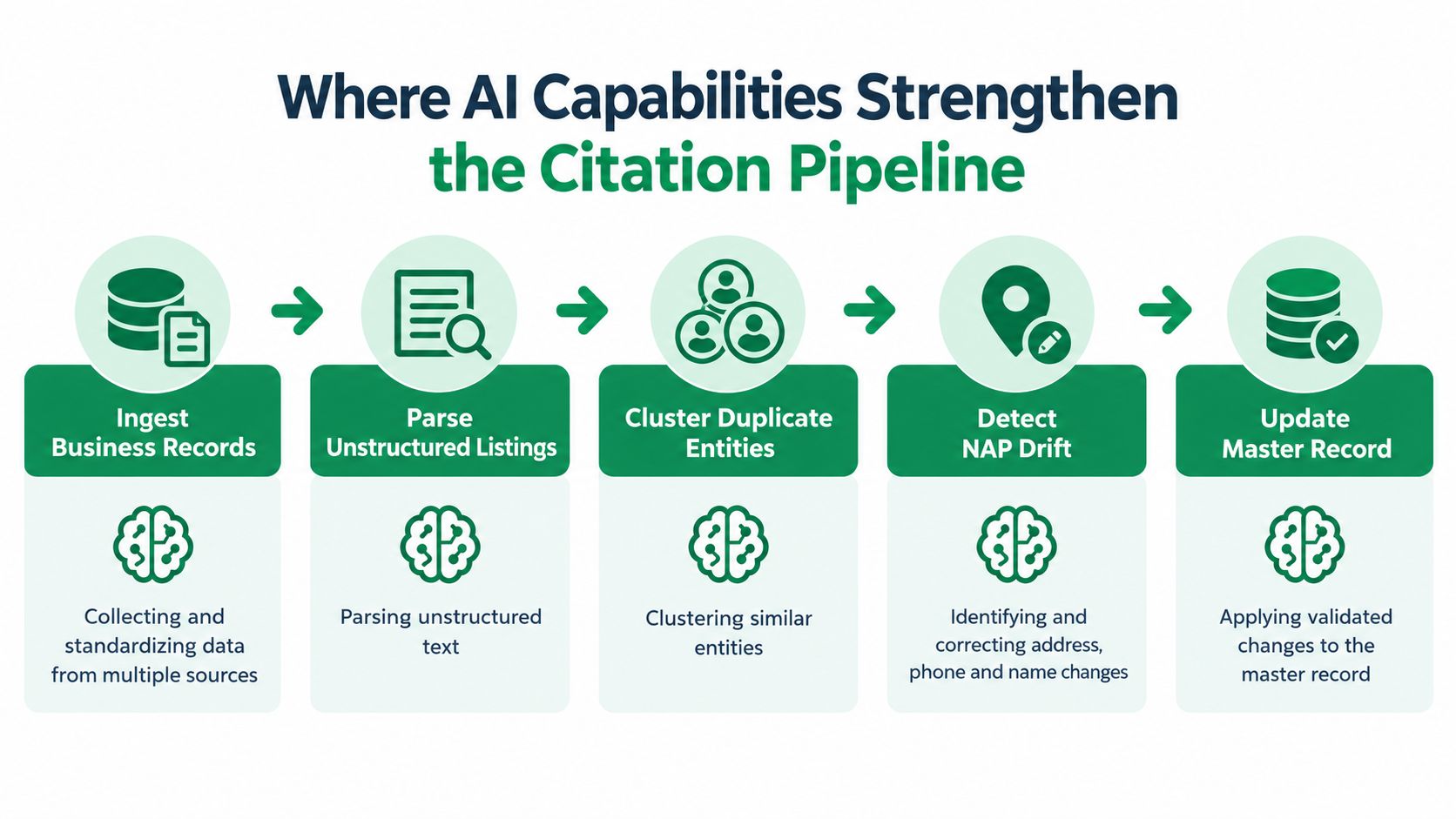
AI can then compare every extracted record with the master profile and rank anomalies. A changed phone number, missing suite, altered category, or suspicious website URL deserves a different response from a harmless formatting variation.
Hallucinated listings need a different response
AI can also flag listings that appear to be fabricated, spammy, or unsupported by an authoritative source. This is particularly important as teams use generative systems to discover directories and summarize local search results. A plausible-looking listing isn't proof that the business exists on that platform.
The same caution applies to research and content workflows. A study summarized in the supplied research reported potentially hallucinated citations in 2.6% of papers published in 2025, compared with about 0.3% in 2024, with errors involving authors, publication years, journal titles, and DOIs (research evidence on AI-generated citations). The local-search equivalent is a listing that has a real-looking name but an incorrect address, phone number, or URL.
AI can assist with schema variations, prioritize directories that appear relevant to a location, and predict which anomalies deserve human review. It can't validate a wrong master record. If the source data is incorrect, automation scales the error faster than a person working from a spreadsheet.
For teams evaluating this workflow, AI citation tracking provides a useful lens on monitoring rather than one-time publishing. The practical success measures are fewer unresolved anomalies, shorter audit cycles, cleaner listing-driven call paths, and better visibility into local-pack performance. The tool should show those outcomes without pretending that AI alone caused every ranking change.
Choosing the Right Citation Management Tool for Your Stack
Choosing a citation platform is a workflow decision, not a feature-count contest. A small business may need straightforward publishing and a manageable audit view. A franchise may need location permissions, approval rules, API access, and reporting that separates brand-level issues from branch-level issues.
Start by scoring the criteria below against the work your team performs. Ask vendors to demonstrate the workflow with a deliberately messy location record, not a prepared sample with no duplicates or conflicts.
| Criterion | Why It Matters | What to Test | Trade-off |
|---|---|---|---|
| Directory coverage | Determines where the tool can distribute or monitor records | Ask for current coverage by country, industry, and platform | Broad coverage may offer less depth on individual sites |
| Monitoring freshness | Reveals how quickly the tool notices edits and listing changes | Change a test field and measure detection and verification workflow | Faster monitoring can cost more or create more review alerts |
| Duplicate accuracy | Prevents false merges and unresolved competing profiles | Test similar names, shared addresses, and practitioner listings | Aggressive matching finds more candidates but may increase manual review |
| NAP enforcement | Keeps approved fields consistent across locations | Check field-level rules, overrides, and approval controls | Strict rules improve control but may slow legitimate exceptions |
| Schema support | Connects website data with the location record | Inspect generated markup and update behavior after a profile change | Convenience may not replace technical validation |
| Google Business Profile and CRM integration | Reduces duplicate entry and supports operational handoffs | Test permissions, sync direction, error handling, and field mapping | Deep integration can create dependency on one platform |
| Franchise access control | Lets local managers update permitted fields without changing brand data | Review roles, approvals, audit logs, and location groups | More control layers require clearer governance |
| Pricing model | Changes the economics of single-location and multi-location use | Compare per-location, flat-fee, add-on, and service charges | Low entry cost may exclude monitoring or human support |
| Data ownership and export | Protects the business if it changes vendors | Request a complete export of records, statuses, and history | Strong export rights may be less common in tightly managed platforms |
| API availability | Supports custom dashboards and CRM workflows | Test documentation, rate limits, fields, and write permissions | Flexibility requires internal technical capacity |
| Reporting depth | Helps marketers prioritize and explain work | Look for unresolved conflicts, duplicate status, and location-level views | More metrics can obscure the few actions that matter most |
Test the exception path
Most platforms perform well when the address, phone, category, and hours are clean. The meaningful test is what happens when a directory rejects an update, a third party changes a field, or two locations share a building.
Score each shortlisted tool on accuracy, control, speed, integration, and total operating effort. Give the highest weight to the problem that currently costs your team the most time or creates the greatest customer risk. A platform that covers fewer sites but verifies updates may be more useful than one that distributes broadly and leaves conflicts unresolved.
Implementing and Maintaining Citations Over Time
Citation work should run as a continuous loop: audit, fix, publish, monitor. The loop keeps a business from treating a rebrand, move, or new location as an isolated submission project.
Audit
Run a baseline audit before making changes. Capture the current name, address, phone, hours, category, URL, ownership status, duplicate status, and correction history for each important listing. Separate live customer-facing profiles from records that influence distribution behind the scenes.
Fix
Prioritize records that can affect calls, directions, bookings, and trust. Correct the master record first, then resolve duplicates and inaccurate listings. Keep evidence of ownership and document exceptions so another team member can understand why a listing remains open or suppressed.
Publish
Push the clean record to authoritative sources and priority directories. Verify that updates went live rather than treating a successful submission message as completion. For multi-location businesses, use approval rules so local managers can maintain operational details without changing protected brand fields.
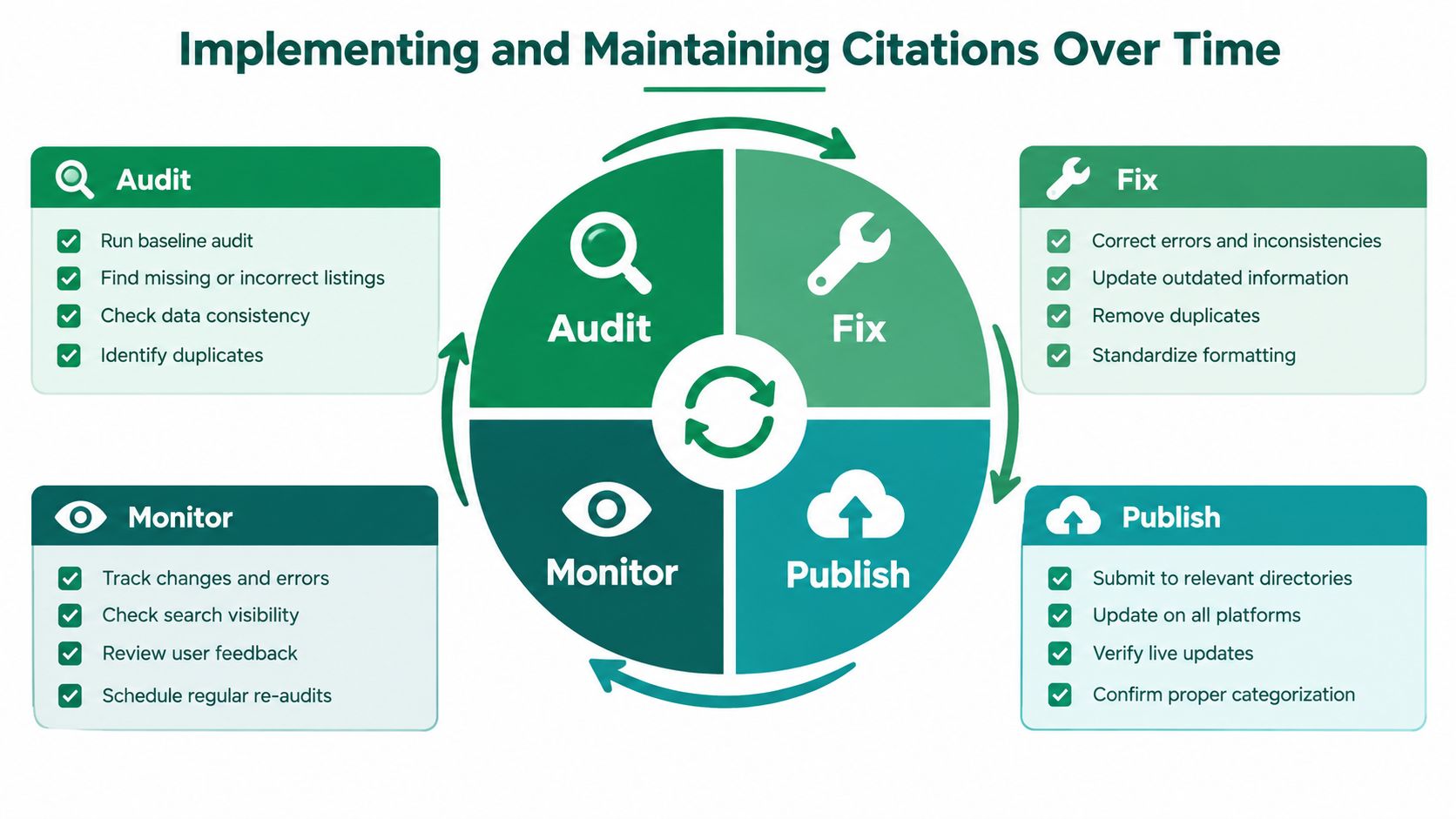
Monitor
A small team can schedule a regular review of new duplicates, unauthorized edits, stale hours, and closed-location profiles. Run a deeper audit when the business rebrands, opens a location, changes its phone system, relocates, or receives a Google Business Profile suspension. Those events can invalidate assumptions that were correct during the previous review.
The sustainable cadence matters more than a heroic cleanup. Assign an owner, define escalation rules, and record the date of the last verified update. A citation management tool should make that routine visible enough that maintenance doesn't depend on one employee remembering every directory.
Tool Categories Worth Exploring in the Directory
The right category depends on operational maturity. A solo owner with one location has a different problem from an agency managing franchise records, and neither should choose software solely because it lists more directories.
| Category | Best For | Primary Trade-off |
|---|---|---|
| All-in-one local SEO suites | Agencies and multi-location teams that also manage reviews and reporting | Convenience can mean less depth in citation-specific controls |
| Citation-cleanup specialists | Brands recovering from long-standing duplicates and inaccurate records | Strong cleanup workflows may provide fewer ongoing marketing features |
| DIY submission platforms | Bootstrapped businesses managing a straightforward location record | Lower complexity can leave more verification and monitoring to the owner |
| AI-augmented monitoring tools | Teams that already publish listings but need anomaly detection | Detection assistance doesn't remove the need for human approval |
Match the category to the problem
All-in-one suites make sense when listings are one part of a wider local program. They can reduce the number of logins and connect citation status with reviews, rankings, and location reporting. The compromise is that a broad platform may not handle an unusual duplicate or disputed listing with the depth of a specialist.
Cleanup specialists are better suited to businesses that have inherited years of inconsistent addresses, old phone numbers, duplicate profiles, or closed branches. They can provide focused remediation, but the business still needs a maintenance process after the initial cleanup.
DIY platforms work when the business has a stable record and someone willing to verify the results. They aren't a substitute for ownership controls or monitoring when the company changes frequently.
AI-augmented monitoring is the most interesting category for mature teams. It can parse listings, detect drift, and surface suspicious records, while a separate system handles publishing. The trade-off is governance. An alert is only useful when someone knows how to validate it and what action to take.
A directory such as AI Tools for Local SEO can help teams compare tools across local listings and citation workflows. Broader marketing journey insights can also help agencies connect citation maintenance with the customer experience beyond the directory itself.
Choose the category that fits your weakest process. If publishing is the bottleneck, start there. If inaccurate records keep returning, prioritize monitoring and source control. If the business has no reliable master record, fix that governance problem before buying more automation.
A citation management tool earns its value by protecting the integrity of local business data after the initial submission. Before you choose one, define the canonical record, list the locations and platforms that matter, test duplicate and conflict handling, and assign ownership for monthly monitoring. Then compare your shortlist against the workflow above and select the system that helps your team detect, verify, and correct the problems customers encounter.