A local business often has everything needed for useful content already in its day-to-day work: service questions from customers, reviews, staff expertise, before-and-after examples, neighborhood knowledge, and seasonal demand. What it lacks is a repeatable way to turn that material into pages and posts that help people choose the business.
Strong local content isn't generic AI copy with a city name inserted. It connects a specific audience, location, problem, proof source, and next action. The 10 content creation ideas below move from commercial research and decision support through implementation, trust building, automation, and industry-specific execution. Each one includes a practical production pattern and an AI prompt for outlining or variation.
Use the prompts to accelerate research briefs, headings, examples, and repurposing. Don't let AI approve service details, local claims, customer stories, regulated advice, or sensitive information. Verify those elements with a person who knows the business. For more prompt inspiration, explore these AI trend prompts for content creation.
1. Tool Comparison and Stack-Building Guides
A comparison guide works when a buyer is already evaluating options. For local SEO, that might mean comparing Google Business Profile tools, review management platforms, citation services, or rank trackers for a business with one location versus a franchise team.
Don't write a feature catalogue copied from vendor pages. Test the tools where possible, record the requirements of each workflow, and separate free trials, freemium plans, paid features, integrations, and support limitations. A local plumber may need review alerts and service-area tracking. An agency managing many locations may care more about permissions, bulk updates, exports, and client reporting.

Build the article around a decision matrix rather than a winner. Explain which option fits which operating constraint, then show a small stack that combines complementary tools. A comparison of AI SEO tools for local workflows can support the research phase, but the final guide should still reflect your own testing.
Practical rule: Every recommendation needs a reason tied to a business situation, not just a longer feature list.
Refresh the guide whenever pricing, integrations, or product capabilities change. A useful AI prompt is:
“Create a comparison brief for [audience] choosing between [tools]. Separate essential features from optional features, include local SEO use cases, list questions that require hands-on verification, and recommend a decision path without declaring one universal winner.”
For visual repurposing, a comparison can also become a short explainer using AI video generator options, provided the script contains verified product details.
2. Case Studies and Success Stories from Local Businesses
A local case study earns trust by showing the work between the problem and the outcome. Start with a business that has permission to share its process, then document the starting condition, the changes made, the obstacles, and the evidence collected afterward.
A strong story might follow a restaurant correcting inconsistent listings, a dental practice improving its review-response workflow, or a home-service company reorganizing service-area pages. Don't invent a dramatic ranking lift or attach a result to the campaign if other changes happened at the same time. Use approved analytics, call records, profile data, screenshots, customer feedback, or a clearly labelled qualitative outcome.
The story should answer questions a prospective customer or practitioner has:
- Starting problem: What was difficult, inaccurate, slow, or unclear?
- Implementation: Who changed what, and in what order?
- Evidence: Which records support the account?
- Trade-off: What did the business stop doing or simplify?
- Next step: What will the team maintain?

A local SEO content strategy can provide background, but your case study needs firsthand proof. Video interviews and short customer clips add credibility only when the speaker approves the wording and context.
Use this prompt:
“Outline a consent-based local SEO case study for [business type] in [location]. Include the initial problem, verified actions, evidence sources, limitations, customer impact, and lessons for similar businesses. Mark every claim that needs confirmation, and do not create metrics or quotes.”
3. AI Tool Tutorials and Step-by-Step Setup Guides
Tutorials serve people who have chosen a tool and need to complete a task without getting lost. The best version doesn't describe every menu. It takes one meaningful workflow, such as setting up location tracking, monitoring reviews, importing business data, or preparing a content brief, and leads the reader to a usable result.
Show the actual sequence. Identify the required account permissions, fields, files, integrations, and decisions before the first screenshot. Then include the mistakes that cause confusion, such as inconsistent business names, incomplete service areas, incorrect categories, or an automation that sends a draft directly to publication.
A tutorial can become a small learning path:
- Quick start: Complete the first useful setup.
- Quality control: Check the output against business records.
- Advanced route: Adapt the workflow for multiple locations or users.
- Reusable asset: Download a worksheet, prompt, or review checklist.
Screenshots age quickly, so add a visible update note and revisit the tutorial when the interface changes. A guide on using AI for content creation should also distinguish between generating a draft and approving a local claim.
A tutorial earns its place when the reader can complete the task, spot a failure, and recover without contacting support.
Ask AI:
“Create a step-by-step tutorial brief for [tool] and [local SEO task]. List prerequisites, exact decisions, likely errors, verification points, beginner and advanced paths, and a final quality-control step. Do not assume interface labels that haven't been confirmed.”
4. Trend Reports and Industry Benchmarking Data
A trend report gives local businesses context for decisions that otherwise feel speculative. It might examine how agencies use local SEO software, which workflows create friction, or what features practitioners are testing. The authority comes from transparent methodology, not a polished chart.
Define the audience and sample before collecting responses. Explain who participated, how questions were phrased, what the data does not represent, and whether answers came from business owners, marketers, agencies, or tool vendors. If you publish a benchmark, define the metric precisely. “Visibility” could mean map-pack appearances, tracked keyword positions, profile actions, or something else entirely.
Turn one report into several formats without changing the meaning:
- Executive summary: The decision-relevant findings.
- Methodology page: Sampling, questions, limitations, and definitions.
- Chart series: One insight per social asset.
- Webinar: A discussion of practical implications.
- Download: The full report in exchange for appropriate contact details.
A useful current reference point is the 2025 B2B content marketing research from the Content Marketing Institute, which reports video as the most effective content type for the surveyed marketers and also shows that effectiveness is not guaranteed by adoption alone. Use such research as context, not as proof of your own audience's behavior.
Prompt AI with:
“Design a research brief for a local SEO trend report about [topic]. Define the audience, sampling requirements, neutral questions, metric definitions, possible biases, chart concepts, and claims that the final report must avoid.”
5. Interactive Tools and Calculators
A calculator or audit scorecard is useful when the visitor wants help making a decision, not another article to read. Examples include a local listing audit, a review-response readiness assessment, a location-page maturity score, or a cost comparison between manual and automated workflows.
Start with the decision the tool should support. Every input needs a clear purpose, and every output needs an explanation. If the calculator estimates return on investment, show the assumptions and let the user change them. If it assigns a score, explain what each score range means and what action follows.
The page should work on a phone and avoid collecting information that isn't necessary. Let users save or share results where appropriate, but explain how submitted data is handled. A lead form shouldn't interrupt the result before the visitor understands what the assessment found.
Make the output actionable
A weak scorecard says, “Your local SEO needs improvement.” A useful one identifies the missing evidence, points to the relevant workflow, and gives the business a sensible next action. Tooltips can define terms such as service-area coverage, citation consistency, or review response time without forcing the user to leave the page.
Use this AI prompt:
“Design an interactive local SEO assessment for [audience]. Define each input, scoring rule, assumption, result explanation, privacy consideration, and recommended next action. Keep the output useful even when the visitor doesn't submit contact details.”
6. Expert Interviews and Roundtable Discussions
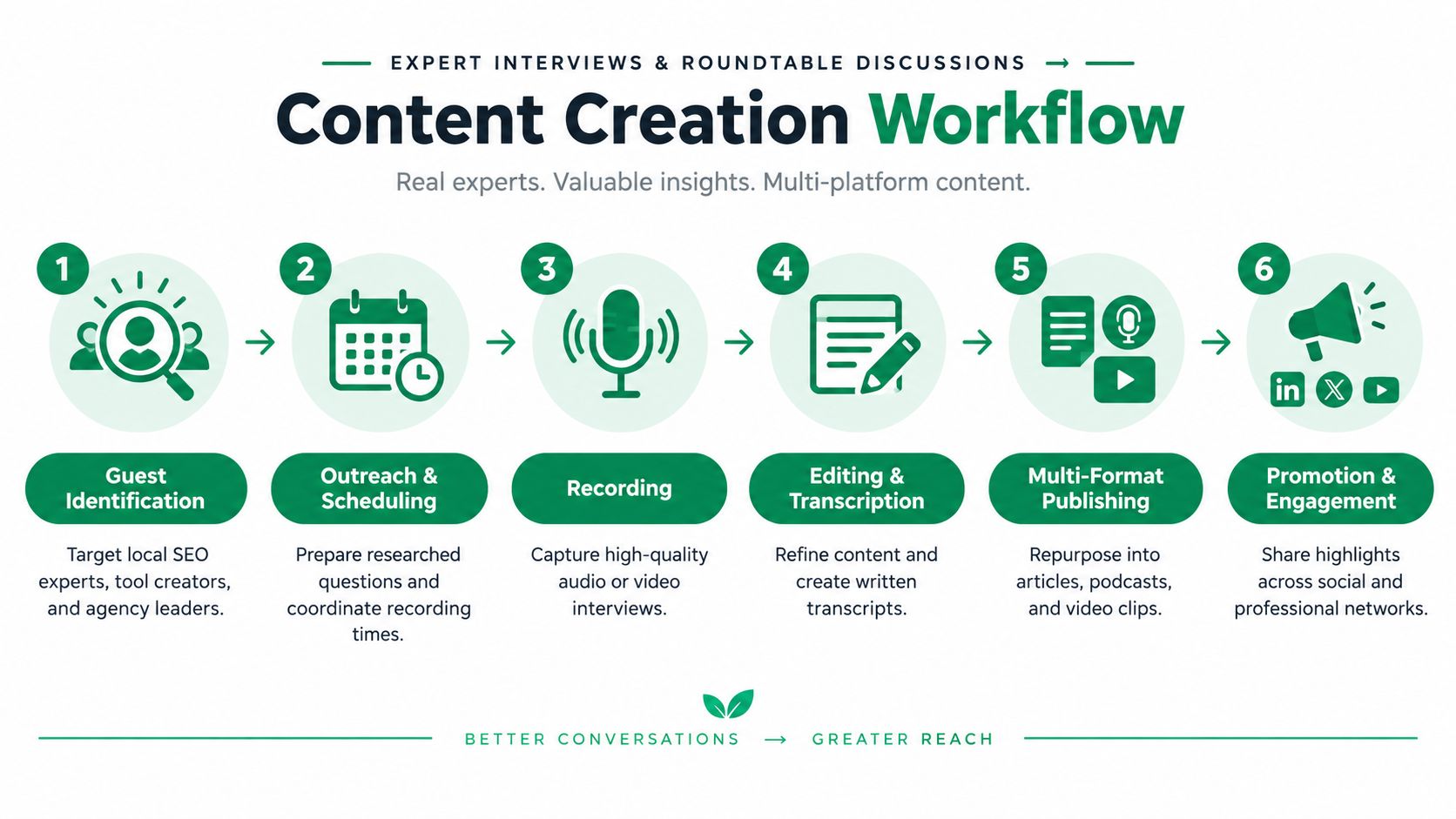
An expert interview becomes valuable when the questions expose decisions, constraints, and disagreements. Ask a local SEO practitioner how they handle duplicate listings, a tool creator where automation fails, or a multi-location manager how local teams approve content. Avoid broad questions that produce familiar advice.
Research the guest first. Bring a specific scenario, ask for the reasoning behind a recommendation, and request examples that can be verified or clearly labelled as opinion. A written Q&A can become a podcast, video clips, a quote-led article, and a series of posts, but the guest should approve the transcript and any shortened excerpts.
Record the conversation even if the main deliverable is text. Natural answers often contain practical detail that disappears from a prewritten questionnaire. Still, don't turn every exchange into content. Remove customer names, account details, and operational information that the speaker hasn't authorized.
Interview standard: Ask for the decision behind the tactic, the condition that would change it, and the evidence used to judge it.
A roundtable works best when participants have different operating contexts. Give them a shared scenario, let them disagree, and summarize the conditions behind each position instead of forcing a single verdict.
Ask AI:
“Prepare a researched interview brief for [guest role] about [local SEO problem]. Write specific questions, follow-ups that test assumptions, requests for evidence, sensitive topics to avoid, and possible repurposing angles. Don't invent the guest's opinions.”
7. Strategy Frameworks and Decision Trees
A framework turns a broad local SEO problem into a sequence of choices. A business with one location doesn't face the same operational constraints as a franchise team, and a company with a steady stream of customer questions may need a different content system from one with limited internal expertise.
Begin with a real decision. For example, should the team create a service page, answer a customer question, update a profile, produce a video, or fix an existing asset first? Then define the conditions that change the recommendation. Include exceptions, because a clean flowchart that ignores regulated services, multiple service areas, or missing proof can create bad advice at scale.
Use consistent language throughout the framework. “High intent” should mean the same thing at every branch. Add a worksheet that asks the reader to record the audience, location, problem, evidence, production effort, and next action.
A useful framework might route a business toward a comparison when the audience is evaluating options, a tutorial when the audience needs implementation help, or a case study when trust is the main barrier. Peer review helps expose bias in those recommendations.
Prompt AI:
“Build a decision tree for [audience] choosing a local content format for [problem]. Use audience intent, location specificity, available proof, production effort, risk, reuse potential, and desired conversion as decision inputs. Include edge cases and explain every branch.”
8. Workflow Automation and Integration Guides
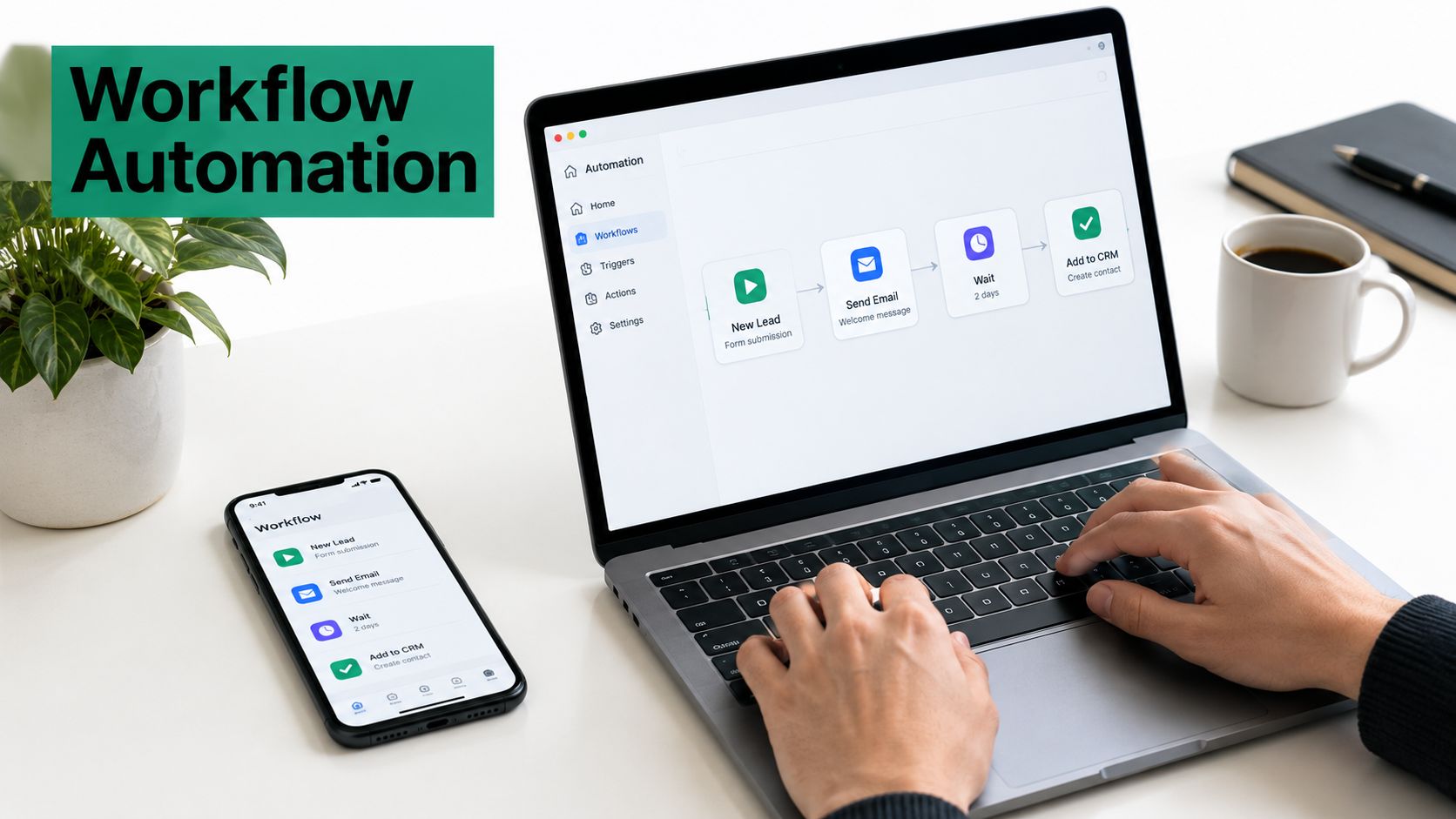
Automation content should begin with a repetitive handoff, not a list of software integrations. A useful guide might send a review alert to a team channel, move approved location data into a reporting dashboard, or notify a manager when a reputation issue needs attention.
Map the workflow before naming the tools. Identify the trigger, the data fields, the destination, the approval point, and the failure response. Then explain how to prevent duplicate records, missing fields, permission errors, rate limits, and accidental publication. An automation that saves a manual step but creates unreviewed customer-facing text isn't automatically an improvement.
Show the data mapping in plain language. Readers need to know which field contains the location name, which field carries the review text, and where a human must approve the response. Include a troubleshooting section based on observed failures, not imagined ones.
Keep a human approval gate
Use automation for routing, alerts, formatting, and repetitive preparation. Keep a person responsible for customer-sensitive replies, factual claims, legal or healthcare content, and any action that changes public business information.
Ask AI:
“Map an automation for [business type] that connects [tool A] to [tool B]. Define the trigger, fields, permissions, approval gate, failure scenarios, rate-limit questions, test cases, and rollback process. Keep customer-facing publication under human control.”
9. AI Feature Spotlights and Deep Dives
An AI feature spotlight should answer a narrow question: what does the feature do, where does it help, and where does it fail? Review-response drafting, local keyword suggestions, citation cleanup, rank predictions, and content repurposing all need different tests.
Run the feature on representative inputs. Include a straightforward example, an ambiguous example, and an edge case. Check whether the output preserves the business's actual services, location details, customer intent, and tone. Show what the AI produced, what a human changed, and why the change mattered.
Avoid vendor language such as “intelligent,” “frictionless,” or “fully automated” unless you define the behavior behind it. Privacy and disclosure deserve their own treatment, especially when content includes customer information or firsthand local knowledge. Adobe's 2026 creator research highlights the tension between AI-assisted performance and the visibility of distinctive human voices, making trust a practical evaluation criterion rather than a branding detail.
Test the boundary, not just the happy path. A feature that produces a polished draft on an easy input may still need close review in real local conditions.
Use this prompt:
“Create a critical test plan for [AI feature] used by [business type]. Include representative inputs, edge cases, factual checks, privacy risks, disclosure questions, human edits, and criteria for deciding whether the feature is useful.”
10. Vertical-Specific Implementation Guides
A vertical guide becomes more useful as it gets closer to the customer's actual decision. A restaurant needs content around menu intent, dining occasions, reservations, and local discovery. A home-service company needs service-area clarity, urgent problem solving, trust signals, and a way to handle calls or quote requests. A healthcare or legal business needs extra care with claims, privacy, and professional rules.
Choose one business type and one operating context first. A guide for an independent dentist shouldn't assume the permissions, staffing, and compliance requirements of a franchise. Interview practitioners, review the customer journey, and identify the evidence the business can safely publish.
Organize the guide around implementation rather than a generic tool list:
- Audience need: What situation brings the customer to search?
- Local proof: Which service details, staff expertise, reviews, or community facts can be verified?
- Workflow: Who creates, reviews, publishes, and updates the asset?
- Measurement: What action indicates useful progress?
- Risk control: Which claims or customer details require special review?
For a software company serving local marketers, a vertical guide can also show how a practitioner evaluates SaaS video production for demonstrations and educational assets. Keep the recommendation tied to the use case, not to a universal stack.
Prompt AI:
“Create an implementation brief for [business type] in [location]. Map customer intents to content formats, required local proof, responsible reviewer, conversion action, update trigger, compliance risks, and safe examples. Ask for missing business facts instead of filling them in.”
Top 10 Content Creation Ideas Comparison
| Content Type | Implementation complexity | Resource requirements | Expected outcomes | Ideal use cases | Key advantages |
|---|---|---|---|---|---|
| Tool Comparison & Stack-Building Guides | Medium, systematic testing and side-by-side evaluation | Moderate, hands-on tool access, screenshots, periodic updates | Informed purchasing decisions, higher conversion/affiliate revenue | Buyers comparing platforms, agencies building tech stacks | High commercial intent, objective authority, long shelf life |
| Case Studies & Success Stories from Local Businesses | Medium–High, interviews, data validation, permissions | High, client coordination, interviews, metrics collection, media | Trust building, proof of ROI, sales enablement | Sales collateral, client pitches, industry-specific persuasion | Credible social proof, emotional storytelling, shareable evidence |
| AI Tool Tutorials & Step-by-Step Setup Guides | Medium, create clear workflows and media assets | Moderate, screencasts/GIFs, test accounts, documentation | Faster onboarding, increased tool adoption, reduced support | Onboarding clients or new hires, support resources | Highly actionable, immediate utility, evergreen with updates |
| Trend Reports & Industry Benchmarking Data | High, survey design, statistical analysis, synthesis | Very high, research team, survey distribution, data visualization | Thought leadership, press coverage, backlinks, strategic insight | Strategic planning, benchmarking, vendor positioning | Original data authority, shareability, high credibility |
| Interactive Tools & Calculators (ROI, Audit Scorecards) | High, build logic, UX, and calculation methodology | High, development, UX, maintenance, data validation | Strong engagement, qualified lead generation, actionable estimates | ROI estimation, quick audits, lead capture funnels | Interactive value, personalized results, data capture |
| Expert Interviews & Roundtable Discussions | Medium, scheduling, interviewing, multi-format production | Moderate, recording/editing, transcription, promotion | Network growth, varied insights, amplified reach via guests | Thought leadership, trend exploration, repurposable content | Authentic first‑hand insight, influencer amplification, repurposable |
| Strategy Frameworks & Decision Trees | Medium, domain expertise and visual design required | Moderate, frameworks, templates, design resources | Reduced analysis paralysis, clearer decision-making | Tool selection, prioritization, agency SOPs | Structured guidance, reusable templates, easy to follow |
| Workflow Automation & Integration Guides | Medium–High, technical setup and troubleshooting | Moderate–High, API access, test environments, code snippets | Time savings, reduced manual errors, scalable operations | Agencies automating multi-tool processes, operations teams | Practical, efficiency-focused, immediately implementable |
| AI Feature Spotlights & Deep Dives | Medium, feature testing and clear technical explanation | Moderate, hands-on testing, comparative examples, ethics review | Better understanding of AI value, informed vendor selection | Evaluating AI capabilities, advising clients on adoption | Differentiates from generic content, timely expertise on AI |
| Vertical-Specific Implementation Guides (by Business Type) | High, tailor content to industry nuances and compliance | High, vertical research, interviews, case examples | Highly relevant conversions, long-tail organic traffic | Industry-specific marketing, franchise or multi-location support | Deep relevance, higher conversion intent, targeted SEO gains |
Build a Local Content System, Not a One-Off Post
Ten isolated posts won't create a durable local search presence. A system connects the idea to the audience, the evidence, the production step, the review process, and the next business action. It also gives each useful source material more than one job without turning every channel into a copy-and-paste exercise.
Start with a decision framework or comparison guide. This clarifies who you're helping, what choice they face, and which constraints matter. Follow it with a tutorial or vertical guide that shows how to act. Add a case study or interview once you have proof, then use automation to distribute approved information and reduce repetitive work.
Interactive assets, trend reports, and AI deep dives can expand the system after the core workflow is reliable. They shouldn't become excuses to avoid publishing a useful service page or answering a recurring customer question. The right order depends on the business, but the operating logic remains consistent.
Choose one audience, one local SEO problem, one proof source, and one measurable next action before drafting. For example, an independent home-service business might target homeowners comparing emergency providers, use verified service-area details and customer questions as evidence, and direct readers to request an assessment. A multi-location marketer might target location managers, use approved listing data and support records, and ask them to complete a profile review.
AI can speed up the upstream work. Adobe's 2025 research found that approximately two-thirds of organizations were testing or actively using generative AI for ideation and concept creation, while only 14% had implemented solutions with proven return on investment, as reported in its AI and digital trends research. That gap is a useful warning. More ideas don't automatically create better local content. Teams still need evidence, editorial judgment, and a workflow that connects publication to business value.
Use AI to generate angles, outlines, variations, summaries, and repurposing plans. Keep firsthand local details, customer language, claims verification, and final approval with people. If your team needs to explore software for research, profile optimization, content, reviews, rankings, reporting, or automation, AI Tools for Local SEO is one directory you can use to compare relevant categories and assemble a stack around your workflow. No tool is best for every business, so evaluate each option against your locations, permissions, evidence, capacity, and review process.
Choose the first idea from a real customer question this week. Write the brief with its location, proof source, and conversion action, run the relevant AI prompt, verify every business detail with the team, and publish one useful asset that can be adapted into another format.