A location manager opens Google Maps on Monday morning and notices that several recent reviews have vanished. Customers can still find the business, but the profile looks thinner, the latest feedback is missing, and the team has no record of which reviews disappeared or why. The immediate instinct is to ask for more reviews. That may be the wrong first move.
Google Business Profile reviews are customer-facing proof, but they're also a platform-risk variable. A business can follow its normal process, trigger an automated spam filter, and lose legitimate contributions without receiving a clear explanation. Multi-location brands need a system that collects feedback, responds to it, monitors changes, preserves evidence, and knows how to escalate a problem when Google's systems get it wrong.
Why Google Business Profile Reviews Deserve a Real Strategy
A dental group with several practices can spend months building a strong review profile, then see a sudden drop after a policy sweep. The owner notices fewer fresh reviews, customers mention that the profile looks outdated, and booking-page activity weakens. By the time someone compares the listing with last week's screenshots, the team has already lost valuable evidence.
That scenario is why reviews should be treated as two assets at once. They're reputation currency for prospective patients, diners, homeowners, and shoppers. They're also content controlled by a third-party platform, where automated detection can remove legitimate reviews, pause new-review intake, or restrict a profile when Google identifies policy concerns.
Google reviews dominate local feedback in many markets. In 2024, they represented 81% of global online review volume, up from 79% in 2023. The same local SEO statistics collection reports that consumers were 2.7 times more likely to consider a business reputable when they saw a complete Google Business Profile, and 70% more likely to visit in person. Reviews therefore belong in the same operating conversation as profile completeness, location pages, calls, and booking journeys. For a broader view of the listing's role, see this guide to why a Google Business Profile is important.
What local teams should measure
A lifetime star average is too blunt to manage a location properly. The useful signals are:
- Freshness: Are customers still leaving feedback recently?
- Velocity: Is review activity steady, or has it abruptly stopped?
- Distribution: Do reviews come from genuine customers across different services, teams, and locations?
- Response quality: Does the business acknowledge what each reviewer said?
- Platform health: Are reviews visible to customers, or only inside the owner dashboard?
The local pack is influenced by a combination of relevance, distance, and prominence. Reviews don't operate as a standalone ranking lever, but they can strengthen the prominence and trust picture around a location. A profile with recent, specific, varied feedback gives searchers more context than one with an old cluster of generic praise, even when both profiles carry a similar average rating.
Practical rule: Manage reviews as an operating system, not a marketing campaign. The team should know what changed, who owns the response, and what evidence exists before a problem appears.
A disciplined cadence includes a response check during the week, a review-volume audit, source attribution, sentiment tracking, and a recovery folder for removed or suppressed content. Collection matters, but recovery and compliance determine whether the asset remains dependable.
The Review Volume Numbers That Actually Matter
Review count matters because customers use it as a shortcut for experience and activity. It also correlates with local visibility, although no universal count guarantees a top position. Market competition, category, location, relevance, and the quality of the surrounding profile still influence the outcome.
A study of more than 93,000 local businesses found that businesses in Google's top three local positions averaged 47 reviews, compared with 38 reviews for positions seven through ten. The dataset also found that 74% of local businesses had at least one Google review, while the average profile held 39 reviews. Those findings come from the BrightLocal Google Reviews study, and they support a practical sequence: move every location off zero first, establish a dependable baseline, then build enough volume to compete in the local market.
The same research found an average rating of 4.42 stars, and only 5% of businesses fell below three stars. That makes star chasing a weak strategy for most established brands. When competitors already have strong ratings, the more useful differentiation often comes from review recency, review detail, and consistent volume.
Use benchmarks as direction, not promises
The vertical thresholds requested by many local SEO teams can be useful as internal planning references, but the provided evidence doesn't verify fixed counts for home services, healthcare, restaurants, legal practices, or retail. Don't present those figures as universal ranking requirements. Build a location-specific baseline from the businesses that directly compete in each market.
| Vertical | Baseline Count for Top-3 | Monthly Acquisition Target | Velocity Warning Signal |
|---|---|---|---|
| Home services | Compare leading local profiles and set a competitive floor | Set a steady target based on completed jobs and current demand | A sustained slowdown compared with the location's normal pace |
| Healthcare | Establish a baseline that reflects the local pack, service mix, and patient volume | Build a repeatable request process across eligible patient journeys | New reviews stop arriving while competitors remain active |
| Restaurants | Benchmark nearby businesses with similar cuisine and service area | Ask consistently after completed dining experiences | Recent feedback becomes sparse or concentrated in one period |
| Legal | Compare firms competing for the same practice-area searches | Use a compliant request process after meaningful client milestones | The profile relies on old testimonials without fresh activity |
| Retail | Measure against nearby stores with comparable products and footprint | Coordinate requests across locations and service touchpoints | One branch falls materially behind the brand's other locations |
Build from a floor, then monitor momentum
For each location, record the current review count, recent review dates, average rating, unanswered items, and the sources used to request feedback. Set a realistic growth target for the next planning period, but don't reward staff for hitting a number at the expense of policy compliance or customer experience.
A sudden pause deserves an audit, not panic. Check whether the request link works, whether customers can sign in, whether the profile is verified, and whether Google has restricted new contributions. Review volume should be interpreted alongside response time, complaint themes, and visibility changes. A large historical total can hide a profile that has gone quiet.
Building a Review Collection Workflow That Sticks
The strongest review program fits into an existing customer journey. Staff shouldn't have to remember a complicated script, customers shouldn't have to search for the listing, and the request shouldn't arrive so late that the interaction feels disconnected.
Start at the moment of service
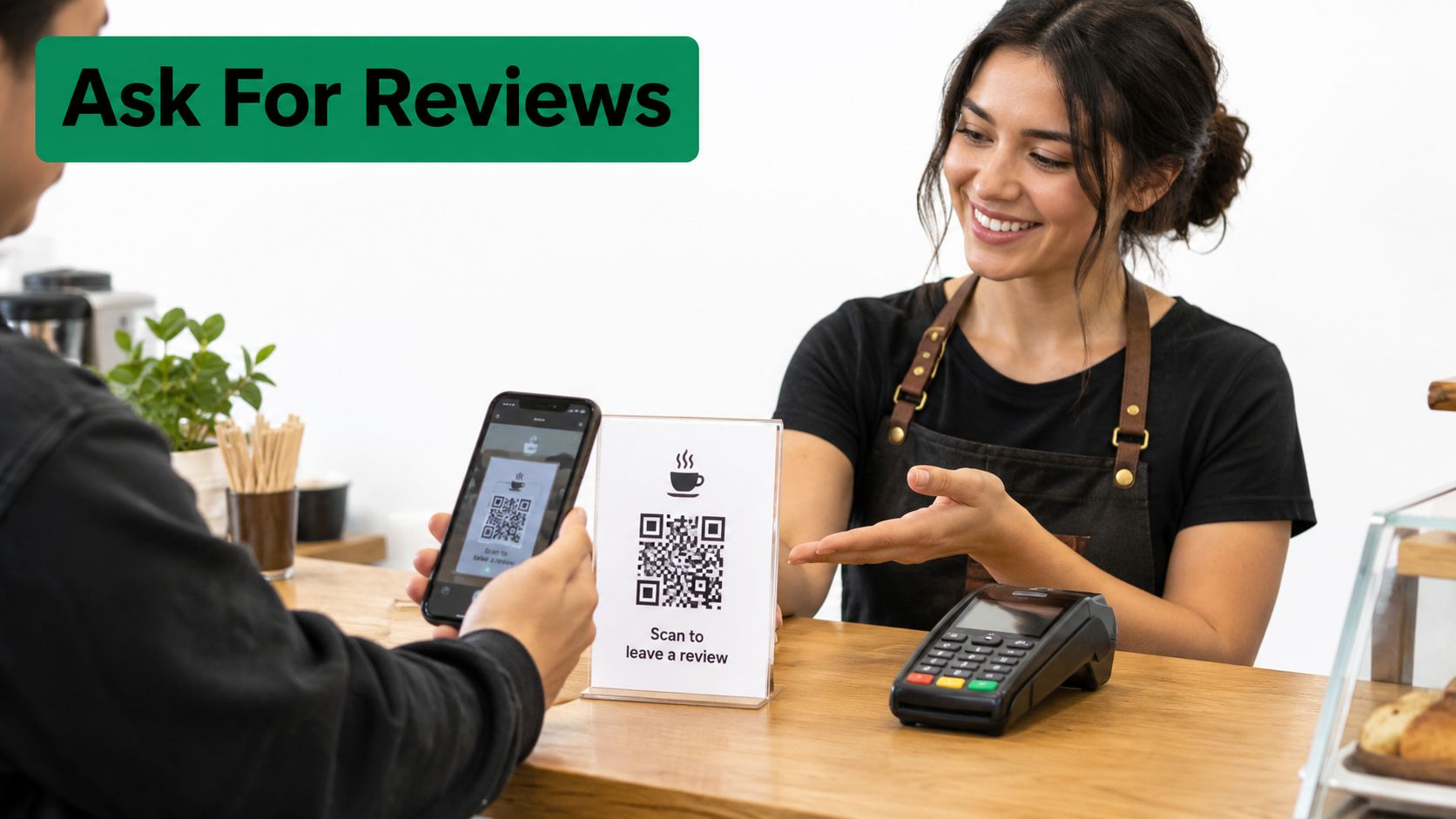
For in-person businesses, place a branded QR card at checkout, reception, or the handover point. The staff script should take seconds: thank the customer, explain that honest feedback helps the local team, and point to the card without directing the customer toward a positive rating.
The card needs a direct, tested review link. Scan it on both common mobile operating systems, confirm that it opens the correct location, and check it again whenever a profile or location structure changes. A broken short link creates silent failure because the team sees that requests were made, while customers never reach the review form.
Follow up while the experience is still clear
A post-service email should arrive soon after the appointment or completed order, while the customer can still remember the interaction. Keep the subject line short, use the business and location name, and place one prominent button that opens the correct Google review path without unnecessary app redirects.
Avoid sending every customer through the same generic funnel if the brand has many branches. Insert the location dynamically, test the link for each profile, and suppress the request when a customer has an unresolved service issue. That doesn't mean hiding negative feedback. It means giving the service team a chance to address an active failure before an automated message makes the situation feel careless.
Use SMS carefully
SMS can work well when the customer has opted in during booking or checkout. Send the request after the service is complete, identify the business clearly, provide a direct review path, and include the required opt-out instructions for the messaging program.
The common failure points are predictable:
- Broken links: Test every location URL and redirect.
- Account friction: Tell customers they may need to sign in to Google, without implying that they need a particular type of account.
- Poor timing: Don't send requests during inconvenient hours or before the service is complete.
- Location confusion: Confirm that the message names the branch the customer visited.
- Policy risk: Ask for honest feedback, never only five-star reviews, and never offer rewards in exchange for posting.
For more wording and workflow examples, use this guide to how to ask for a review. Staff incentives should reward completed service and compliant request activity, not the number of positive reviews. Gated funnels that route only satisfied customers to Google create an artificial record and can expose the brand to policy action.
Reviewer diversity also matters operationally. A profile built from one narrow campaign, one employee group, or one unusual burst can look less credible than a steady stream of genuine feedback from normal customer interactions.
Writing Replies That Earn Trust and Lift Conversions
A reply should prove that a person read the review. “Thanks for your feedback” is acceptable as a starting point, but it isn't a finished response when the customer has mentioned a hygienist, a delayed repair, a specific dish, or a particular branch.
A reliable response has four parts:
- Acknowledge the situation. Refer to the actual experience rather than repeating the rating.
- Add local context. Mention the location, service, product, or staff member when appropriate and safe.
- Resolve or escalate. Explain the next step without debating private details in public.
- Close constructively. Invite a return visit or a private conversation, depending on the issue.
The wording should change with the review. A positive comment deserves warmth and specificity. A mixed review needs appreciation plus ownership of the shortcoming. A complaint involving a staff member requires restraint, privacy, and a clear route for follow-up.
Before and after examples
Positive review
Before: “Thank you for the five-star review.”
After: “Thank you for mentioning Sarah and the quick appointment at our Bristol clinic. We're pleased the check-in process felt straightforward, and we'll share your feedback with the team. We look forward to seeing you again.”
Mixed review
Before: “Thanks for your feedback. We'll do better.”
After: “Thank you for sharing both sides of your visit to our Leeds branch. We're glad the adviser helped you choose the right product, but the wait at collection fell short of our standard. Please contact the branch manager through the details on our profile so we can review what happened.”
One-star complaint involving a staff member
Before: “We're sorry you feel this way. This isn't like us.”
After: “We're sorry that your interaction at our Cardiff location left you frustrated. We take concerns about staff communication seriously, but we can't discuss an individual colleague's circumstances in a public reply. Please contact the manager through our profile so we can review the visit with you directly.”
Set a response service level
Aim to respond quickly enough that a new visitor sees active ownership, with a same-day target for serious complaints. A cited reputation-management study found that businesses responded to 46% of Google reviews on average and took about six days to reply. Consumer research in the same reputation-management guide reported that 93% expected a response, while 19% expected a same-day reply. The guide also found that 50% of consumers would be less likely to choose a business when responses looked templated.
Response coverage has measurable value. The cited research reported a 4.1% improvement in Google profile conversion for every 25% of reviews answered, while another study linked active response behavior with a 12% increase in review volume and a 0.12-star rating lift. Treat those figures as study findings, not guaranteed outcomes for every location.
For larger teams, review response tools can help route new reviews and prepare drafts, but a manager still needs to check names, facts, tone, and privacy. A useful library of review response templates should speed up judgment, not replace it.
Reporting, Removing, and Recovering Suppressed Reviews
Not every negative review violates Google policy. A customer can be unfair, vague, or factually disputed and still have the right to publish an opinion. Flagging criticism just because it hurts the rating can waste time and make the business look defensive.
Google's review-content policy guidance says that only reviews violating policy are eligible for removal. The same guidance explains that automated spam detection can mistakenly remove legitimate reviews, and policy violations can lead to restrictions where existing ratings or reviews are unpublished for a period.
Preserve evidence before you escalate
Create a location-level evidence file as soon as a review disappears or a suspicious contribution appears. Include:
- Screenshots: Capture the review, reviewer name, date, rating, owner response, and the profile view where the content is missing.
- Visibility checks: Record whether the review appears publicly, in Maps, in Search, and inside the owner dashboard.
- Review details: Note unusual links, phone numbers, copied language, irrelevant claims, or signs that the reviewer has no connection with the business.
- Pattern information: Compare the timing and wording with activity across other locations.
- Customer records: Where lawful and appropriate, confirm whether the reviewer appears in the business's normal customer history. Don't expose private customer information in an appeal.
Don't retaliate with review-bombing, ask staff to post counter-reviews, or pressure customers to bury criticism. Those actions create a second compliance problem and make a clean investigation harder.
Choose the right escalation path
Use the in-platform flag when an individual review clearly matches a policy category. If the initial decision doesn't resolve the issue, submit the case through the Business Profile support route with a concise explanation and the evidence package. For policy-violating content that slips through ordinary reporting, use Google's Business Redressal Complaint Form.
A legitimate review can also be suppressed during a spam sweep. The warning sign is a mismatch between what the owner sees and what a normal logged-out searcher can see. Ask several people to check the public listing, record the exact review details, and document the date the content disappeared. Then explain that the contribution appears legitimate, provide location and transaction context where appropriate, and request a review of the automated action.
Keep an appeal log with the case number, submission date, response, and next action. Escalation works better when each contact adds evidence instead of repeating the same paragraph. Businesses evaluating outsourced reputation workflows can also examine how providers present client reviews for CS Outsource and whether their process preserves verifiable context rather than just displaying star averages.
Monitoring and Automating Without Losing the Human Touch
A review program needs several monitoring layers because different problems appear at different speeds. A new one-star complaint needs immediate ownership. A gradual decline in review freshness belongs in a weekly report. A missing cluster of reviews requires an evidence trail and a platform-risk investigation.
Build the stack in layers
- Real-time alerts: Notify the assigned manager when a new review arrives, especially for low ratings or sensitive topics.
- Daily digest: Show unanswered reviews, overdue responses, and reviews routed to another team.
- Weekly report: Track count, recent activity, topic patterns, response coverage, and location differences.
- Monthly comparison: Compare each location with its own prior performance and with relevant local competitors.
AI-assisted triage is useful for sorting reviews by themes such as wait time, staff conduct, billing, cleanliness, delivery, or appointment access. It can also identify urgent service failures and produce a first draft that includes the right location. The final response still needs human review.
Automation breaks trust when it ignores emotional context. A generic draft sent to someone describing bereavement, a medical concern, a safety issue, or a serious billing error can turn a difficult experience into a public demonstration of indifference. The safest workflow uses AI for classification and preparation, then requires an accountable person to approve anything sensitive.
Score vendors against operational needs
A review-management platform should be judged by capability, not the length of its feature list. Check whether it offers:
- Native GBP access: The connection should support reliable retrieval and response workflows.
- Multi-location rollups: Managers need brand, region, and branch views without losing location detail.
- Assignment controls: Every review should have an owner, status, and escalation path.
- Audit history: The system should show who drafted, edited, approved, and published a response.
- Evidence exports: Teams should be able to package screenshots, timestamps, review identifiers, and case notes.
- Human approval rules: Sensitive topics should never publish automatically.
Directories such as AI Tools for Local SEO can help teams discover software categories for review management, reporting, and local search operations. The selection decision should come from the workflow, not from automation alone.
Your Weekly Review Operating System
A small local team doesn't need a complicated command centre. It needs a short routine that survives busy periods and makes ownership visible.
Use a fixed weekly rhythm
Monday is the audit. Check new reviews since the previous review, clear the response backlog, compare public visibility with the owner dashboard, and record anything that appears missing.
Wednesday is the response sweep. Reply to every new item, route service failures to the right manager, and ask the owner to approve responses involving serious complaints or sensitive staff issues.
Friday is the source check. Review where the latest feedback came from, verify that QR cards and direct links work, and compare activity across branches. A location that suddenly goes quiet deserves investigation before the gap becomes a pattern.
Once a month, run a short diagnostic. Compare review velocity, keyword and service-topic diversity, response time, unanswered volume, and suppression incidents with the previous month. Look for operational causes, not just ranking explanations. A location may need better post-service timing, clearer staff ownership, or a recovery case rather than another collection campaign.
Watch for early warnings
Treat these as triggers for a focused audit:
- A sudden pause in new reviews compared with the location's normal pattern.
- A noticeable deterioration in average rating.
- An unusual rise in reviews containing off-topic links or phone numbers.
- Owner responses becoming materially slower than the team's agreed service level.
- A competitor gaining review activity unusually quickly in the same market.
Each signal points back to a different control. A quiet profile sends you to the collection workflow. Missing or hidden content sends you to evidence preservation and escalation. Slow replies send you to assignment rules and approval queues. Suspicious content sends you to policy review.
The goal isn't to manufacture a perfect profile. It's to maintain a credible, current, policy-compliant record that customers can trust and the team can defend when platform systems make a mistake.
Audit every location's Google Business Profile reviews this week. Export the current review count, recent review dates, unanswered items, visible-versus-suppressed discrepancies, and response owners. Then test every review-request link and assign one person to run the weekly cadence, so your next platform issue becomes a documented workflow instead of a Monday morning surprise.