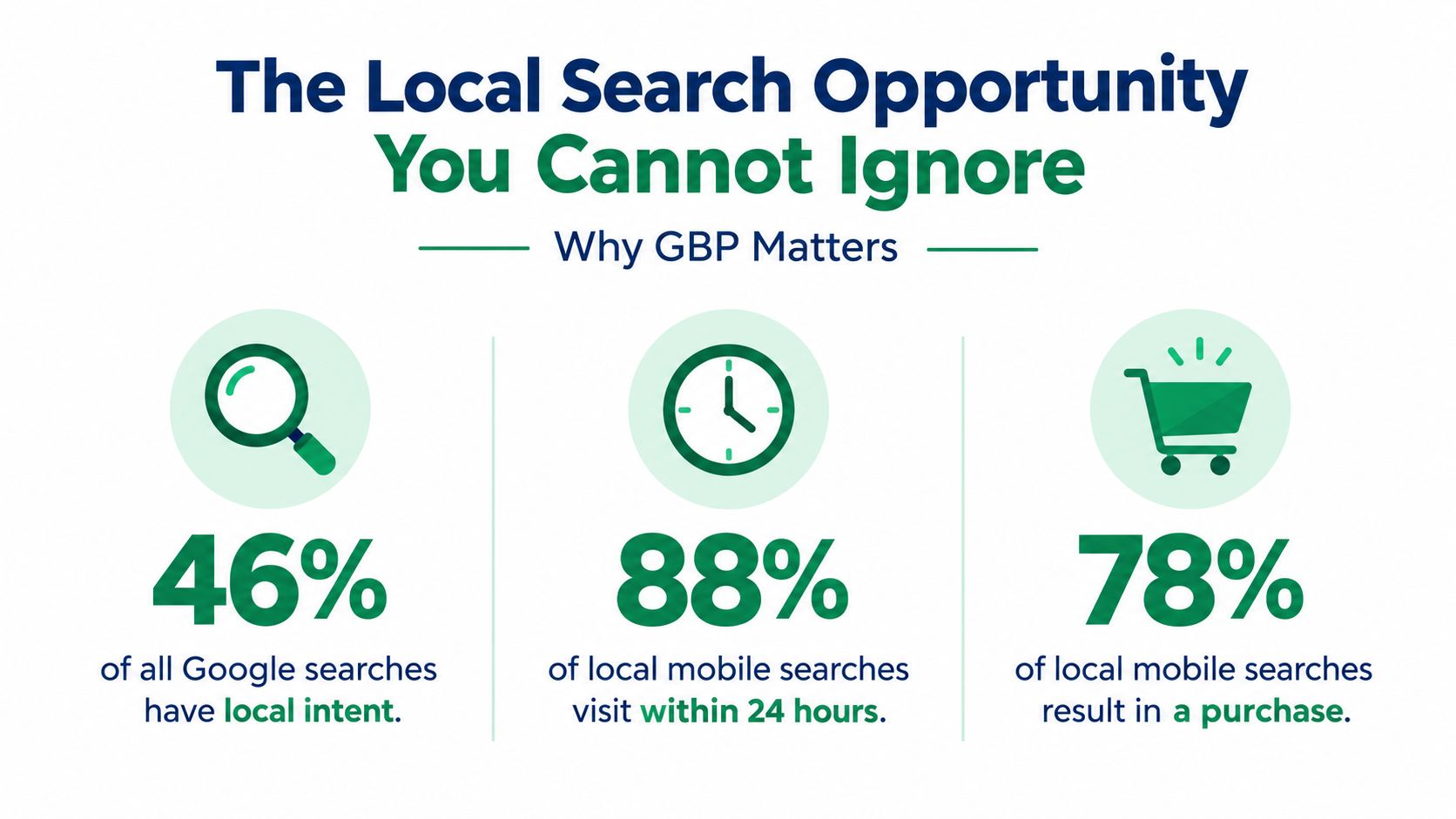
46% of all Google searches have local intent, and 76% of people who perform a local search visit a physical location within 24 hours. That makes Google Business Profile one of the highest-impact assets for any business competing for nearby customers.
A profile can put your business in front of people who are already looking for what you sell, answer practical questions before they visit, and turn discovery into website visits, calls, direction requests, or bookings. But its role has expanded beyond a map listing. Google Business Profile is becoming a structured data layer that Google's AI systems use to decide which local businesses to mention, recommend, and connect with customer actions.
The Local Search Opportunity You Cannot Ignore
Local search captures people close to taking action. Someone searching for “emergency plumber near me,” “coffee shop open now,” or “dentist in [city]” usually isn't researching a broad topic. They're trying to identify a suitable business, confirm the details, and decide what to do next.
The scale of that behavior is substantial. 46% of all Google searches have local intent, and 76% of people who perform a local search visit a physical location within 24 hours, according to recent Google Business Profile statistics. Those figures explain why a business can lose meaningful demand even when its website performs well in ordinary organic results.
Where nearby customers make decisions
The Local Pack and Google Maps often appear before traditional website results for location-based searches. Users can see your hours, address, phone number, directions, services, photos, and reviews without opening your site. Your profile therefore acts as both a visibility asset and a decision page.
A website may explain your expertise in detail, but the profile answers urgent questions faster:
- Can I reach you? The address and direction function reduce friction for in-person visits.
- Can I contact you? A visible phone option gives high-intent users a direct path to your team.
- Are you open? Accurate hours help people decide whether to visit now or later.
- Should I trust you? Reviews and photos provide social and visual evidence before the first interaction.
That's why Google Business Profile isn't optional for most local operators. It places your business inside the surfaces customers use when proximity and convenience matter. A neglected profile can leave the searcher with incomplete information, while a maintained profile gives Google and the customer a clearer reason to select you.
How Google Uses Your Profile to Rank Local Results
Google describes local ranking through three primary ideas: relevance, distance, and prominence. Its official explanation of local results also makes clear that the Business Profile supplies important categories, attributes, services, hours, and location signals.
Think of the profile as a structured introduction between your business and Google. If you run a bicycle repair shop but leave your services vague, Google has less precise information to match against searches such as “bike tire repair” or “bicycle service near me.” If you select a category that doesn't accurately describe the business, you create a weaker match before reviews or website content even enter the picture.
Relevance is about fit
Relevance asks whether your business appears to satisfy the searcher's need. Categories establish the broad identity of the business. Services and attributes add detail. Hours help Google understand when the business can meet a time-sensitive need.
For example, a restaurant profile with accurate dining attributes and current hours gives Google clearer information than a listing with only a name and phone number. The more complete the entity description, the easier it is to connect a query with a real offering.
Distance narrows the field
Distance reflects how close a business is to the searcher or the location included in the query. You can't use profile edits to make a location physically closer, but you can make the address and service-area information accurate. That prevents confusion about where customers can receive service.
Prominence reflects public confidence
Prominence considers how established and well-known a business appears in the local ecosystem. Reviews, mentions, and the strength of the business's overall presence contribute to that picture. Your profile doesn't operate in isolation, but it gives Google a central, verifiable place to interpret the business.
For a broader practical checklist, review these local SEO tips from Growth 4 Trades. The central lesson is simple: don't treat categories, services, attributes, and hours as administrative fields. They're the vocabulary Google uses to understand when your business belongs in a local result.
Turning Searches Into Customer Actions
Visibility matters only when customers can do something with it. Google Business Profile shortens the path between finding a business and contacting it because the main actions are built into the search experience.
A user may discover a profile, read a review, check the hours, request directions, call the business, or visit the website without navigating through several pages. That makes GBP a conversion channel, not merely a branding surface.
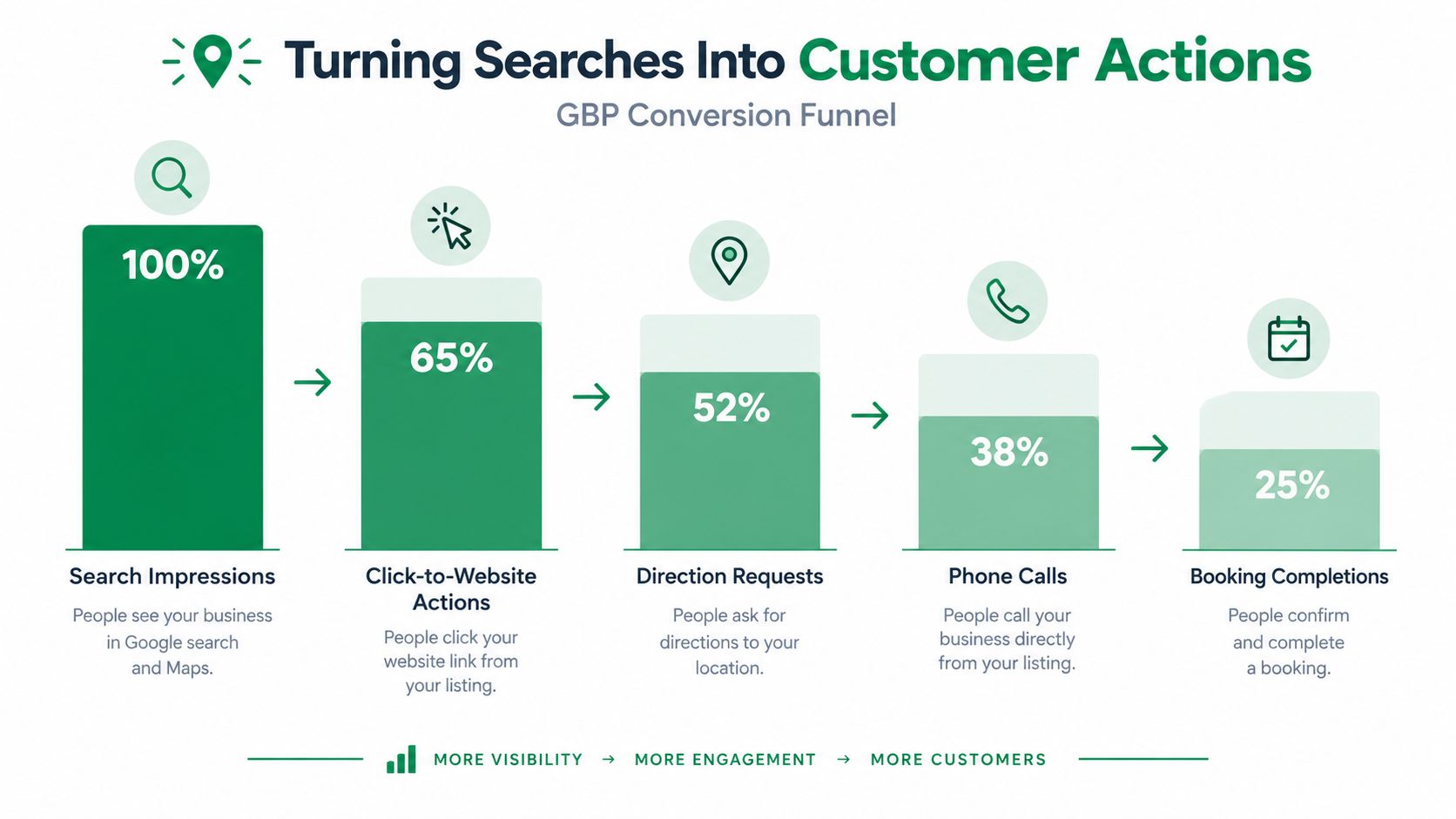
A 2024 BirdEye-based summary reported that 48% of GBP interactions were website visits, 34% were direction requests, and 17% were phone calls. The same local SEO statistics summary reported that verified businesses receive over 21,643 views per year and around 595 calls annually.
These figures describe different customer paths, not a guaranteed outcome for every business. They do show why profile reporting should focus on actions rather than impressions alone.
Match the action to the business model
A service-area electrician may value phone calls more than website sessions. A restaurant may care about direction requests, hours-related visits, and menu engagement. A clinic may prioritize appointment pathways and calls from prospective patients.
Your profile should make the preferred action obvious:
- Phone-first businesses: Keep the primary phone number current and make sure calls reach the right team.
- Visit-first businesses: Maintain the address, opening hours, parking details, and direction information.
- Website-led businesses: Link to the most useful destination, such as a service page or booking page, rather than a generic homepage.
- Appointment-led businesses: Make the booking route easy to find and keep service information aligned with what customers can schedule.
Reputation affects whether people take those actions. A strong profile may earn visibility, but unclear services, stale photos, unanswered reviews, or incorrect hours can stop the customer at the decision stage. Businesses that want a deeper explanation of that trust layer can explore reputation management for local businesses.
The Hidden Cost of an Incomplete Profile in the AI Era
Many business owners still think about GBP as a pin on a map. That model is outdated. Google's AI experiences can reuse profile information to answer local questions, recommend businesses, and trigger actions, so incomplete data may reduce visibility in AI-generated answers as well as in Maps and Search, as described in this guide to Google Business Profile and AI search.

The important question is no longer only, “Will my business rank in the Local Pack?” It's also, “Will Google have enough reliable information to mention my business at all?”
AI systems need structured answers
A person can read a long services page and infer that a company offers same-day appliance repair. A machine-generated answer needs clearer signals. Categories, services, hours, attributes, photos, reviews, and location details provide structured evidence that helps Google evaluate whether a business fits the request.
Suppose a user asks for a nearby business that offers wheelchair access, accepts appointments, and opens early. If those details aren't represented accurately in the profile, Google has less basis for including the business in a recommendation. The problem isn't necessarily poor service. It's poor machine readability.
Accuracy becomes an operating responsibility
AI visibility also makes stale information more costly. A profile that lists old hours, discontinued services, or an incorrect phone number can create a bad customer experience when Google surfaces that information directly in an answer or action button.
That changes the economics of optimization. Initial setup still matters, but maintenance determines whether the profile remains useful. Businesses with several locations or broad service areas need ownership rules, review processes, and a reliable way to detect changes rather than relying on occasional manual checks.
For a deeper look at the practical implications, see this guide on how to optimize for AI search. The goal isn't to write for an abstract algorithm. It's to keep the business entity complete, current, and easy for Google to interpret.
Building and Maintaining a High-Performance Profile
A strong profile starts with control. Claim and verify the listing, then treat every field as information a customer or search system might use. Verification establishes that the business can manage its presence, while accurate content gives Google a dependable entity to evaluate.
Start with the fields that define the business
Choose the most accurate primary category available. Add relevant services instead of assuming that Google or customers will infer them from the business name. Complete attributes that describe meaningful customer needs, and keep regular and special hours current.
Then review the customer-facing details:
- Business identity: Check the name, address, phone number, and website for consistency.
- Service coverage: Describe where a service-area business works without implying a storefront customers can't visit.
- Visual proof: Upload authentic exterior, interior, product, team, or work photos that reflect the current experience.
- Customer questions: Monitor questions and answers so important information doesn't remain unaddressed.
- Review activity: Ask for genuine feedback, respond professionally, and use recurring complaints as operational input.
A large-scale analysis of 16,098 Google Business Profiles found that review count was the strongest measured local ranking factor, while categories and attributes were among the most actionable completeness variables, according to Localo's analysis of local SEO ranking factors. That doesn't mean businesses should chase reviews without improving service. It means review acquisition and response deserve a defined process.
Make maintenance part of the workflow
Assign ownership for profile edits, review responses, holiday hours, photo updates, and performance checks. Multi-location teams can use a shared naming convention and approval process, while smaller businesses can add these tasks to the same calendar used for marketing and operations.
Use a local success guide from Machine Marketing for additional optimization ideas, then measure what happens through Google Business Profile analytics. A directory such as AI Tools for Local SEO can also help teams compare software for profile audits, review management, reporting, and other local workflows.
Your Next Steps for Local Search Success
Google Business Profile matters because it connects three systems that local businesses need to manage together:
- Discovery: Your profile helps Google understand where you operate and what you offer.
- Trust: Reviews, photos, attributes, and complete information help customers assess the business.
- Action: Searchers can visit your website, request directions, call, or follow a booking path directly from the profile.
The deeper reason GBP is important is its role as a machine-readable business record. Google uses it to interpret relevance, distance, and prominence in local results. Its AI experiences can also reuse that information when answering questions and recommending businesses. A profile that exists but lacks accurate services, attributes, hours, or evidence of customer activity isn't doing the full job.
Practical rule: Treat your profile as a living operational asset, not a one-time listing.
Start with an audit. Confirm ownership and verification, correct the business details, select the most precise category, add services and attributes, update hours, review photos, and create a process for requesting and answering reviews. Then track the actions that matter to your business, such as calls, website visits, direction requests, or bookings.
If your team has limited capacity, prioritize accuracy and the customer actions closest to revenue before adding optional activity. For multi-location businesses, document responsibilities and use centralized monitoring so one outdated location doesn't undermine trust.
Claim your Google Business Profile today, verify every customer-facing detail, and schedule a recurring review of hours, services, photos, attributes, and reviews. Then compare profile actions with your real leads and visits so your local SEO work reflects business outcomes, not just search visibility.