Your rankings still look fine. Traffic might even look stable at a glance. But when you ask ChatGPT, Perplexity, Gemini, or Google's AI results for the best dentist, lawyer, roofer, or med spa in town, your brand barely shows up. Or it appears, but only as a passing mention under a competitor. Sometimes the answer is worse than that. Wrong phone number, wrong service area, stale positioning.
That's where a lot of local teams are right now.
Most advice on how to optimize for AI search is too generic to be useful. It treats AI visibility like one more SEO checklist. Add schema. Write FAQs. Publish more content. That work helps, but it misses the first question that matters. What exactly is failing? Are you absent, present but not recommended, or being described incorrectly?
That diagnostic split changes the whole playbook. If you're absent, you need discoverability and corroboration. If you're mentioned but never chosen, you need stronger authority signals and better recommendation evidence. If the AI gets basic facts wrong, you have an entity and data consistency problem. Those are different jobs. They shouldn't get the same fix.
Why AI Search Changes the Local SEO Game
AI search is no longer a side channel. It's a distinct discovery layer sitting above and around the traditional SERP. One 2026 market summary says AI-driven search rose from under 10% of interactions in 2023 to 30% by 2026, and it also reports that AI search referrals reached 0.9% of total visits in March 2026, up 5x year-over-year from 0.18% (Sedestral market share summary).
That matters because local discovery doesn't start and end with ten blue links anymore. A user can ask for “best emergency dentist near me open Saturday,” get a synthesized answer, and never visit a category page, directory, or even your website. Another 2026 summary reports that 60% of searches now end without a click, AI search referral traffic grew 527% year-over-year, and Google AI Overviews reduce click-through rates by an average of 39.8% (Slate AI SEO statistics).
What still matters
A lot of classic SEO still holds.
- Intent matching still wins: Your page still has to answer the query better than weaker alternatives.
- Authority still compounds: Links, reviews, brand mentions, and expert signals still shape trust.
- Technical hygiene still matters: Crawlable pages, clean internal links, and fast, readable layouts still help discovery.
- Local relevance still decides close calls: Service area clarity, location specificity, and Google Business Profile alignment still matter.
If your local SEO foundation is weak, AI visibility won't save you.
What's genuinely different
AI systems don't just rank pages. They extract, summarize, compare, and recommend. That creates three retrieval patterns local teams need to understand:
| Signal | Classic Local SEO | AI Search |
|---|---|---|
| Primary goal | Rank a page or profile | Get cited, summarized, or recommended |
| Query handling | Keyword and intent matching | Conversational rewrite plus retrieval |
| Winning asset | Strong page and GBP presence | Strong page, strong entity data, strong third-party corroboration |
| User action | Click through to compare | Accept answer, refine prompt, or click a cited source |
| Success metric | Rankings, traffic, leads | Presence in answers, citations, recommendation share, assisted leads |
The three surfaces you're really optimizing
First is knowledge-panel style entity retrieval. That's where the engine leans on structured business facts, listings, and well-known entity records.
Second is third-party citation retrieval. Directories, editorial roundups, review platforms, associations, and local news influence whether your brand gets mentioned at all.
Third is on-page extraction. That's when the model pulls a concise answer or business fact directly from your site.
Practical rule: If your team tracks rankings but doesn't track whether AI systems cite or recommend your locations, you're missing a separate visibility KPI.
If you want a grounded primer focused on local implementation, this guide on AI search visibility for small businesses is worth reading because it frames AI visibility as an operational local SEO problem, not just a content-formatting exercise.
Diagnose Your AI Visibility Before You Optimize
Stop publishing “AI-optimized” pages until you know why your brand isn't surfacing.
The most useful shift I've seen is treating AI visibility as a failure-mode diagnosis problem. Recent guidance argues that brands should classify whether they're absent, present but not recommended, or misdescribed before choosing tactics, instead of treating AI search like one broad optimization bucket (Omnius GEO trends report).
The three states
A dentist can have solid location pages and still be absent from prompts like “best emergency toothache clinic near me.” That usually means weak third-party corroboration, thin emergency-service language, or poor entity association around the specific need.
A plumber might be present but not recommended. The model knows the brand exists, but it keeps recommending competitors first. That usually points to softer authority signals. Better reviews, stronger service proof, more comparison-page mentions, or clearer differentiation can move that.
A law firm can be misdescribed. The answer mentions the right brand with the wrong phone number, an old practice area emphasis, or a stale office status. That's usually a listings, data consistency, or entity merge problem.
Use this asset when you audit your own pages and location content:
Run a simple prompt audit
Use ten prompts for each priority location. Keep them buyer-intent driven. Don't just test your brand name.
Try prompt types like these:
- Best-of prompt: best pediatric dentist in [city]
- Urgency prompt: emergency plumber open now in [suburb]
- Comparison prompt: top family law firms for custody cases in [city]
- Budget prompt: affordable HVAC repair near [area]
- Trust prompt: most reviewed med spa in [city]
- Service-specific prompt: Invisalign provider near [location]
- Geo-variant prompt: roofer serving [neighborhood]
- Question prompt: who should I call for same-day garage door repair in [city]
- Problem prompt: where to go for severe tooth pain on Sunday in [city]
- Recommendation prompt: which local accountant is best for small business tax help in [city]
Run those across ChatGPT, Perplexity, Gemini, and Google's AI results. Score each response three ways:
- Mentioned: Is the brand named at all?
- Recommended: Is it framed as a top choice or merely listed?
- Described accurately: Are the facts, services, and location details correct?
Brands waste months “optimizing for AI” when the actual issue is simpler. They either aren't in the source ecosystem, they aren't trusted enough to be recommended, or their entity data is messy.
For teams that never benchmarked before AI summaries started taking more SERP real estate, this pre-overviews performance snapshot is a useful reminder to document your baseline before changing reporting expectations.
Build Citation-Ready Content on Your Own Pages
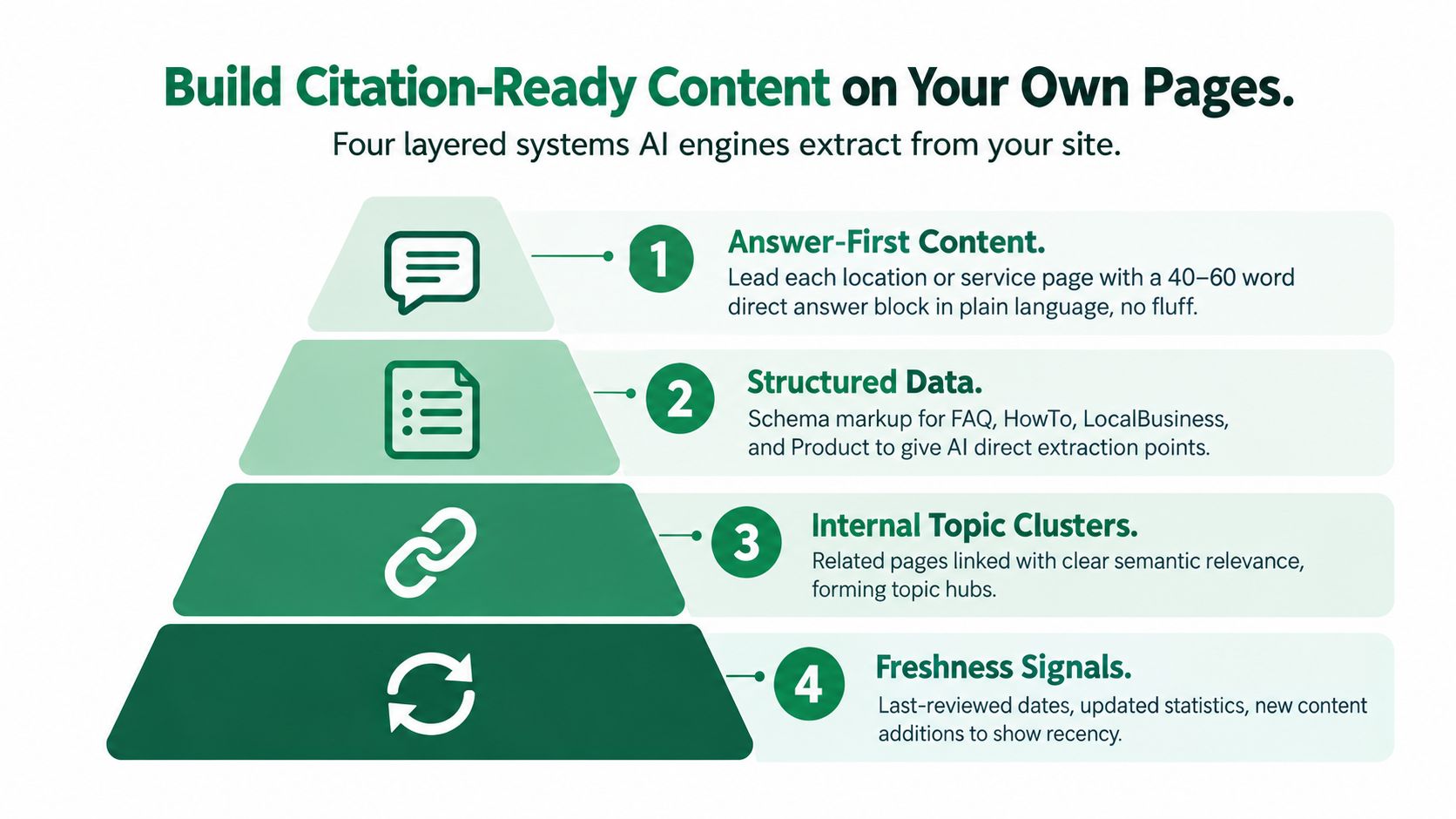
On-site AI optimization works best when you treat the page like an extraction source, not a brochure. The job isn't to sound polished. The job is to make the right answer easy to pull, easy to verify, and hard to confuse with another entity.
Lead with direct answers
Every important location page and service page should open with a short answer block in plain language. Keep it tight. A local HVAC page doesn't need a cinematic brand paragraph. It needs a direct explanation of what the business does, where it serves, and why that page is relevant.
Example opening for a location page:
Emergency AC repair in Mesa is available for homeowners who need same-day diagnosis, after-hours service, and repair for central air, heat pumps, and ductless systems. Our Mesa team serves nearby neighborhoods, offers scheduled appointments, and handles both residential and light commercial units.
That kind of block gives retrieval systems something clean to extract. It also helps humans immediately confirm they're in the right place.
If you want examples of formatting pages so AI systems can pull cleaner summaries, SemDash's piece on structured answers for AI Overviews is one of the better practical references.
Lock down entity clarity
A surprising amount of AI confusion comes from basic entity mess.
For a single-location business, your site should make these facts painfully obvious:
- Canonical business name: Use one version everywhere.
- Primary location details: Address, phone, hours, and service area should match your public listings.
- Service language: Use the same core phrasing across homepage, service pages, GBP, and key directory profiles.
- Location relationships: If you have multiple offices, each one needs its own page and its own clearly labeled details.
For a three-location dermatology group, don't bury office distinctions in tabs or accordions. Give each office a unique URL, unique local intro, unique doctor details where relevant, and explicit page-level location facts.
This is also where clean citation architecture matters. If you're tightening NAP and off-site consistency at the same time, this guide to local business citation management is a practical companion.
Add schema, but don't hide behind schema
Use Organization, LocalBusiness, Service, FAQPage, HowTo, and BreadcrumbList where appropriate. Validate the JSON-LD. Make sure the schema reflects what the page says.
Then remember the uncomfortable part. Schema doesn't rescue weak content.
A wall of markup attached to a vague page won't fix extraction problems. The inverse is also true. A beautifully written page with no markup forces the engine to infer too much. The best outcomes come when on-page answers and structured data reinforce each other.
Build internal topic clusters
AI systems respond well when your site shows depth around a service area. Don't leave your “water heater repair” page floating alone. Link it to installation, maintenance, troubleshooting, emergency repair, financing, and the matching location pages. Use descriptive anchor text, not generic “learn more” links.
A useful internal pattern looks like this:
- Hub page: City + primary service
- Supporting page: Specific problem or treatment
- Location page: Office or service area proof
- FAQ page: Common objections and process questions
That structure helps both retrieval and trust. It says, “this business really does this work,” instead of “this business published one keyword page.”
Harden Your Local Signals and Google Business Profile
For local brands, AI systems often verify the easy surfaces first. That means your Google Business Profile, core directories, reviews, and location pages carry more weight than many teams realize.
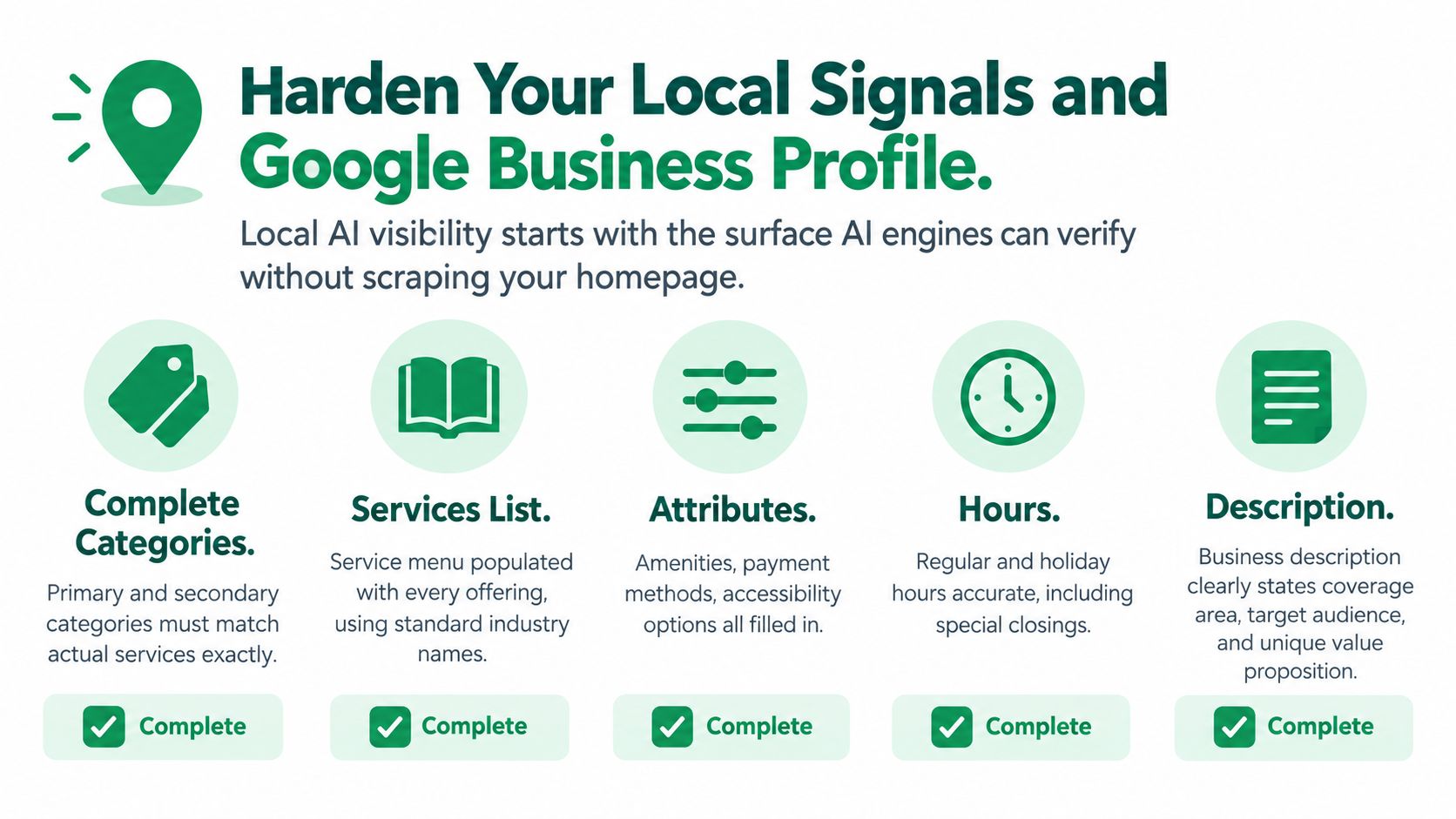
Start with Google Business Profile completeness
Your GBP should read like a clean business record, not a half-finished profile someone set up years ago.
Focus on these fields first:
- Categories: Primary and secondary categories should reflect real services, not vanity positioning.
- Services: Populate the service list with standard names buyers use.
- Attributes: Accessibility, payment methods, amenities, and business features help engines confirm specifics.
- Hours: Regular and holiday hours need active maintenance.
- Description: Write a concise description that states location, audience, coverage area, and core services.
A good use of AI here is drafting and normalization, not blind publishing. Prompt an AI assistant with your real service menu, city names, and competitor category set. Then review every suggestion manually before updating GBP.
If your team needs a workflow for categories, service fields, and profile maintenance, this walkthrough on how to optimize Google Business Profile is a useful operations reference.
Fix NAP drift before it becomes an AI hallucination
Misdescriptions often start with old listings, mismatched suite numbers, alternate phone numbers, or outdated categories. Audit your most visible directories first. Don't just check whether you exist. Check whether the same business is being described the same way.
A simple AI-assisted prompt for internal use:
Audit these business listings for name, address, phone, hours, and category mismatches. Flag any variation that could cause a search engine or AI system to treat them as separate entities.
That kind of pass catches a lot of preventable confusion.
Reviews and Q&A do more than persuade humans
Reviews tell AI systems what customers repeatedly associate with your brand. If every review talks about “friendly staff” but none mention implants, emergency visits, or same-day repairs, the model has less evidence for those recommendation contexts.
For a five-location dental group, I'd rather have review and Q&A coverage that mirrors real patient-intent queries than a generic stream of reputation fluff. Ask for reviews in ways that naturally surface service detail. Use Q&A to answer practical local questions like parking, sedation, weekend appointments, and insurance types.
This visual is a good reminder that AI visibility needs to be measured, not guessed:
Map local fields to AI citation patterns
| GBP or local signal | What it helps confirm in AI results |
|---|---|
| Category selection | What type of business you are |
| Service list | What jobs or treatments you actually offer |
| Hours | Whether you fit urgent or time-sensitive queries |
| Reviews | Whether customers validate service claims |
| Q&A content | Whether practical concerns are answered clearly |
| Location page | Whether the office or service area is real and specific |
Earn Mentions in the Sources AI Engines Already Read
This is the half of AI visibility underfunded.
A lot of brands are trying to solve an off-site trust problem with on-site rewrites. That won't hold for long. Recent AI-search playbooks stress that visibility often depends on whether your brand appears in the third-party sources AI systems already cite, including directories, listicles, forums, and comparison pages (Profound on AI search content strategies).
Where to earn corroboration
| Source Tier | Example Surfaces | Acquisition Tactic | Typical Effort |
|---|---|---|---|
| Earned media and news | Local news, trade publications, city magazines | Pitch expert commentary, local trend stories, seasonal service insights | Medium to high |
| Authoritative directories and aggregators | Industry associations, niche directories, review platforms | Complete profiles, standardize descriptions, add service detail | Low to medium |
| Community sources | Reddit, Quora, niche forums, neighborhood communities | Answer real questions through subject matter experts, not brand spam | Medium |
| Structured knowledge bases | Wikidata, Crunchbase, business databases | Clean up entity fields and make brand facts consistent | Medium |
What actually works
For local businesses, the easiest wins are usually niche directories and editorial roundups tied to a real category. A family law firm should care whether it appears in “best family law firms in [city]” lists, local bar association profiles, and city-specific legal directories. A med spa should care about treatment comparison pages, local beauty roundups, and well-maintained profile pages on trusted review platforms.
Community mentions matter too, but they have to be earned. If your technicians, attorneys, or practice managers can answer real questions in a way that's useful without sounding scripted, those mentions create corroboration that doesn't live only on your domain.
Field note: AI systems don't need your brand mentioned everywhere. They need your brand mentioned consistently in the places they already trust for the kind of question being asked.
Keep the entity description stable
This part gets overlooked. If one source calls you “Downtown Phoenix Injury Lawyers,” another uses “DPIL Group,” and another lists you as a general practice firm with an old office location, you're feeding confusion into the retrieval layer.
Use one consistent core description:
- Business name
- Primary category
- Main city or service region
- Primary services in plain language
That consistency helps external citations reinforce each other instead of fragmenting your entity footprint.
Measure AI Visibility Like You Measure Rankings
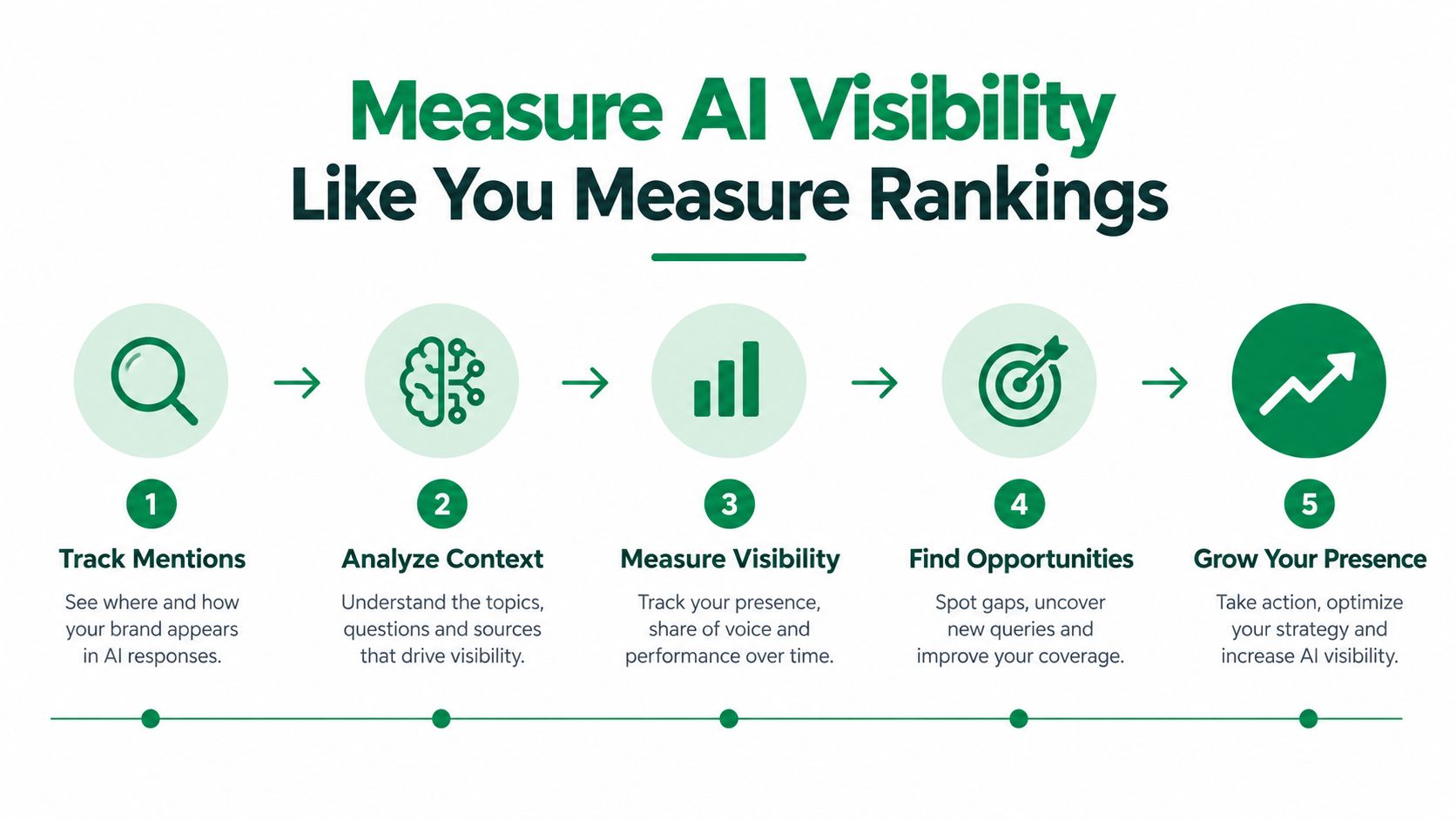
Most local reporting still waits for traffic or lead drops before anyone investigates. That's too late for AI search. By then, you may have been missing from key answer surfaces for weeks.
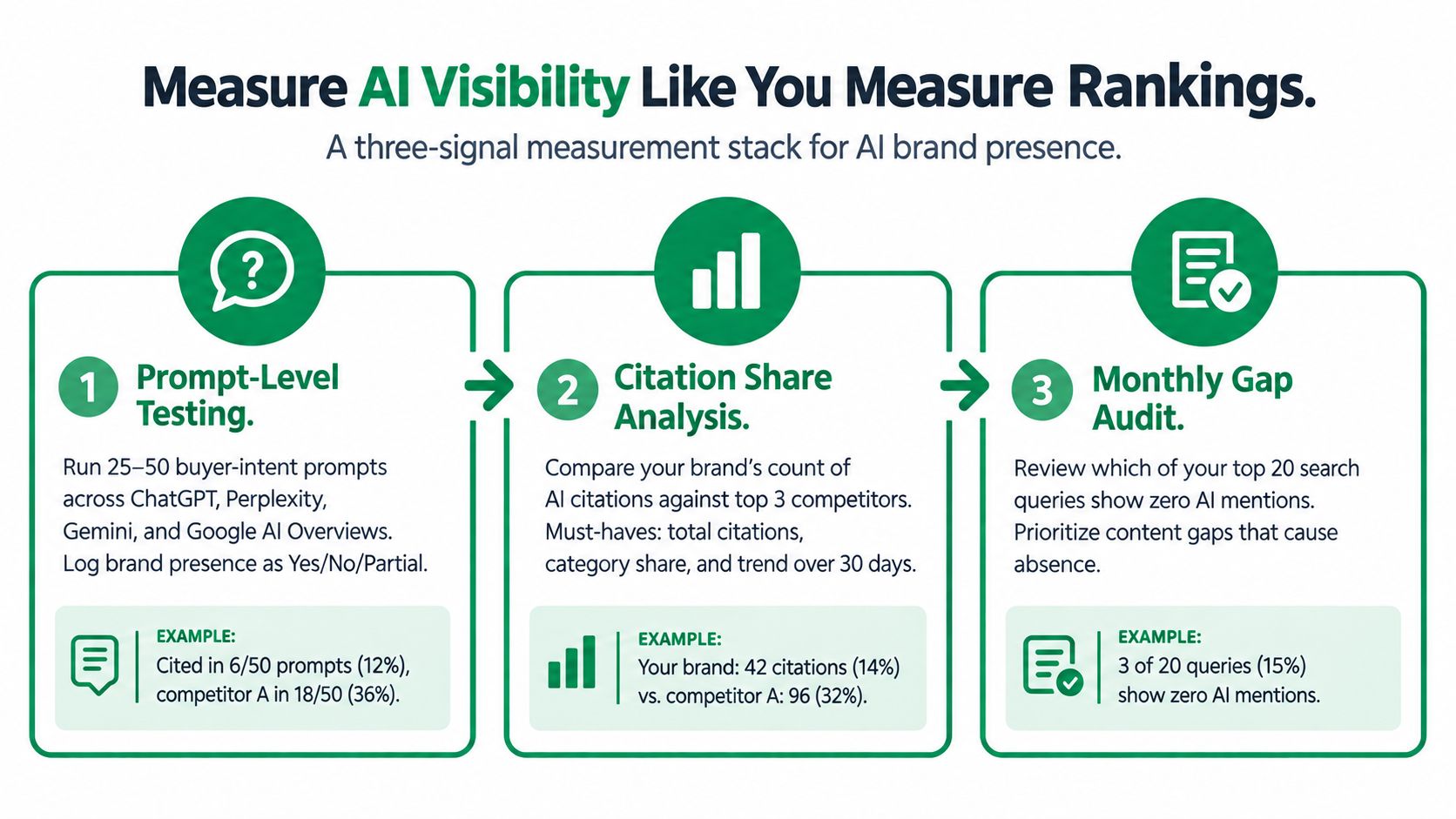
Build a three-layer measurement stack
Start with prompt-level testing. Run a fixed prompt set every week for your highest-value services and locations. Keep the wording stable enough to compare week over week.
Then add citation share analysis. Count which brands and sources appear most often across your prompt set. You can do this with a spreadsheet or with tools like Otterly, Profound, and Peec. The exact stack matters less than the habit.
Finally, watch referral and source logs. The visible answer may produce fewer clicks, but cited sources and AI interfaces still leave traces when users decide to visit.
If you're choosing tooling for this layer, this roundup of the best AI rank tracker options is a practical place to compare what each platform can and can't monitor.
Use a reporting rhythm that catches drift
A simple cadence works well:
- Weekly: Prompt sweep for priority services and locations
- Monthly: Source audit for lost mentions, stale listings, and competitor gains
- Quarterly: Full benchmark across markets, competitors, and recommendation patterns
Track columns like these in a sheet:
- Prompt
- Platform
- Location tested
- Mentioned yes or no
- Recommended yes or no
- Accuracy issues
- Sources cited
- Competitors cited
- Follow-up ticket owner
- Resolution date
A practical early check catches problems like a lost Yelp mention, a broken directory profile, or a stale location page that can remove your brand from recommendation prompts before organic rankings show obvious pain.
Know when to open a remediation ticket
Don't wait for a quarterly review if you see any of these:
- A brand disappears from prompts where it had been consistently present
- Wrong business facts show up across more than one AI platform
- Competitor citation share jumps in a service category you care about
- Key third-party source pages change and no longer include your brand
- Location-page accuracy breaks after a move, merge, rebrand, or phone update
The teams that adapt fastest treat AI visibility loss like rank loss. They investigate the source ecosystem, fix the entity problem, and re-test quickly.
Your First 30 Days and Common Questions
A workable rollout doesn't need a giant steering committee. It needs sequence.
A practical 30-day plan
Week 1
Owner: SEO lead or marketing manager.
Deliverable: prompt audit across priority services and locations, scored by absent, present but not recommended, or misdescribed.
Exit criterion: every priority location has a baseline visibility sheet.
Week 2
Owner: content lead plus web manager.
Deliverable: answer-first rewrites on top location and service pages, plus schema cleanup and entity standardization.
Exit criterion: core landing pages give direct extractable answers and match business facts.
Week 3
Owner: local SEO specialist or ops manager.
Deliverable: GBP completion pass, listings consistency audit, review-request updates, and Q&A additions.
Exit criterion: the main local data surfaces are aligned and current.
Week 4
Owner: outreach or digital PR lead.
Deliverable: directory fixes, comparison-page outreach, local editorial pitches, and recurring measurement cadence.
Exit criterion: off-site citation work is active and weekly reporting is live.
Common questions
Does AI optimization replace traditional SEO
No. It sits on top of it. If your site, links, reviews, and local relevance are weak, AI systems have less reason to trust or retrieve you.
How long until citation gains show up
On-site fixes can affect extraction fairly quickly. Off-site trust work usually takes longer because it depends on other platforms updating, publishing, or being re-crawled.
Can you buy placements in LLM answers
Sometimes platforms test sponsored experiences around AI products, but the recommendation layer still depends heavily on underlying source trust. Paid media can support demand capture, but it doesn't replace citation work.
Is GEO or AEO actually different from SEO
Yes and no. The foundations overlap, but the operating metric changes from rank alone to citation, recommendation, and description quality. That changes how you audit and prioritize work.
How should multi-location brands choose where to start
Start with locations that already rank, convert, and have enough operational stability to support cleanup. Don't spread effort across every market at once if half the profiles, listings, and pages are still inconsistent.
If you're building your stack for this work, AI Tools for Local SEO is a useful place to compare platforms for citations, GBP workflows, local content, review management, and AI visibility tracking.