The popular advice is to “check your Google ranking” as though one number describes local visibility. It doesn't. A manual result from one address can hide weaker coverage across the rest of your service area, while a keyword tracker may show a useful trend without explaining where customers see you.
A reliable Google My Business rank checker should match the measurement problem you're trying to solve. Geo-grid scans sample searches from multiple points and reveal coverage patterns. Keyword-based Map Pack tracking follows repeatable queries over time. Local Finder tracking shows broader listing visibility, while organic monitoring covers the website results around the profile. Google's own Business Profile performance guidance also frames local measurement around searches, views, calls, directions, website clicks, messages, bookings, and other interactions, not rank position alone.
The tools below are compared by geographic accuracy, keyword depth, GBP operations, reporting, scalability, and scan-credit control. If your first priority is to get found on Google Maps, start with the tools that explain area-level visibility rather than producing a single rank number.
1. GMBMantra
GMBMantra is the strongest fit when Google Business Profile management and geographic visibility need to live in one workflow. Its central advantage is the combination of Maps and Local Pack rank tracking with visual heatmaps. Instead of asking only whether a profile ranks, you can inspect where visibility is strong, where it weakens, and which parts of a service area deserve attention.
That distinction matters because Google says local results depend on relevance, distance, and prominence. A single search location can therefore produce a misleading impression of market coverage. A heatmap exposes the pattern. It can show a business performing well around its address while losing visibility farther away, or reveal a competitor appearing consistently in areas where the tracked profile is absent.
Best for GBP operations at scale
GMBMantra goes beyond measurement. It combines AI-generated Google Business Profile posts, automated review responses, Q&A management, multi-location support, and agency reporting. That makes it more operational than a tracker that only records positions. Teams can connect an observed visibility problem with the profile activity and reputation work that may help address it.
The platform is particularly relevant for agencies and multi-location operators that need a shared view of local search performance. Google's official performance dashboard now exposes several engagement actions, so rank data should be read alongside calls, directions, clicks, and other interactions rather than treated as a final verdict. GMBMantra's focused workflow makes that relationship easier to manage than a collection of disconnected tools.
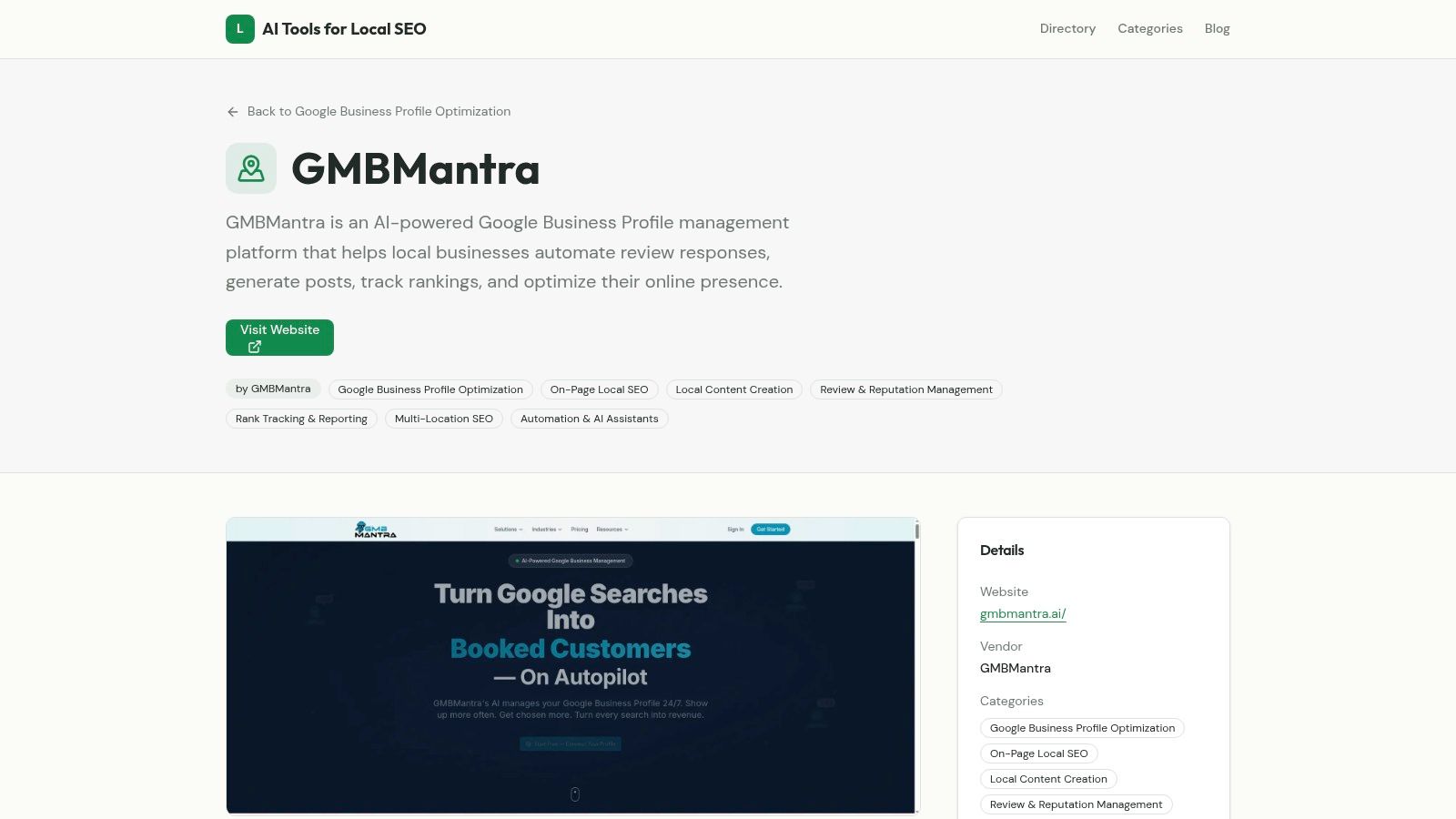
The limitation is equally clear. GMBMantra is primarily a Google Business Profile platform, not a complete citation, on-page SEO, backlink, or broader organic search suite. Advanced tracking, larger location sets, and deeper integrations may require paid tiers. Any heatmap also reflects its sampling design, so grid size, scan frequency, tracked keywords, and location settings should be checked before comparing results.
Practical rule: Use the heatmap to find the problem area, then use profile actions and performance data to decide what to investigate next.
2. BrightLocal Local Search Grid
BrightLocal is a mature local SEO platform built around the needs of agencies and local businesses that want geo-grid rank tracking plus citations, reviews, audits, and reporting. Its Local Search Grid visualizes Google Business Profile visibility across selected points, turning a vague local ranking question into a coverage map.
The scheduled scan and historical comparison features make it useful for monitoring change rather than relying on occasional manual searches. Client dashboards and shareable reports are also a practical advantage when an agency needs to explain local performance without sending a client into a complex interface.
Where it solves the measurement problem
BrightLocal works best when the decision is not just “What position did this profile hold today?” but “Is visibility improving throughout the target area, and can I show that clearly?” The grid can expose uneven coverage, while the surrounding suite gives teams places to investigate citations, reviews, and audit findings.
That breadth can also be a drawback. If you only need a focused rank checker, the wider platform may feel like more software than necessary. Grid usage is credit-sensitive at scale, so recurring scans across many profiles and keywords require deliberate planning. A broad scan may reveal more geographic detail, but it also consumes more measurement capacity.
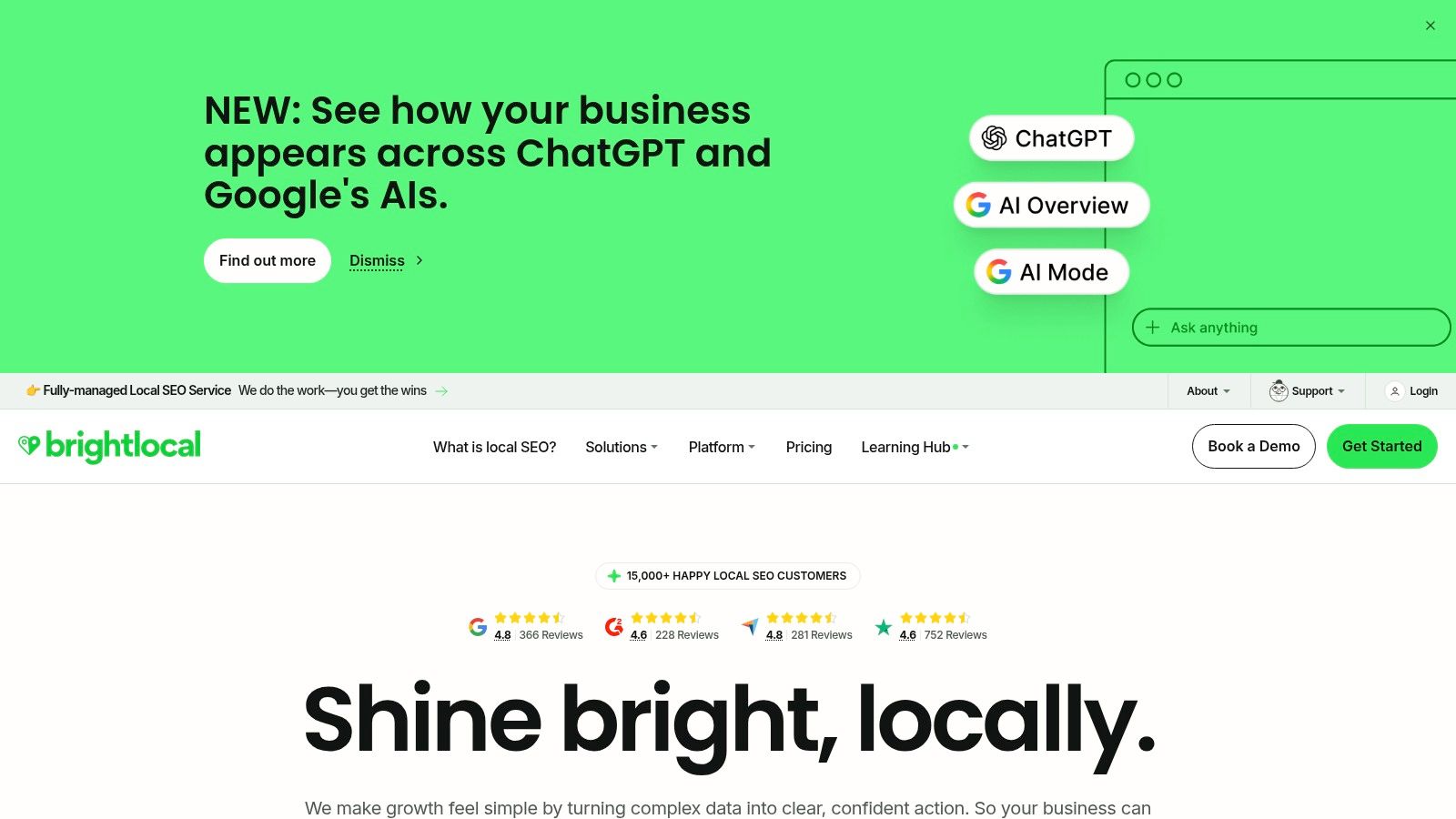
Choose BrightLocal when client-ready reporting and adjacent local SEO workflows matter as much as the grid itself. Choose a narrower tool when your team already has separate systems for audits, citations, and reviews and wants tighter control over rank-scan spend.
3. Whitespark Local Ranking Grids and Local Rank Tracker
Whitespark separates two useful measurement jobs. Local Ranking Grids show geographic coverage through heatmaps, while Local Rank Tracker follows keywords across the local pack, Google Maps, and organic results. That separation gives experienced local SEO teams more control over whether they need a spatial diagnosis, a trendline, or both.
The grid product supports scans up to 13 by 13 points, and it can track visibility and average-rank scores with competitor overlays. It also tracks through position 100 on grid scans, which helps identify listings that are present but far outside the most visible results. Those capabilities are documented in Whitespark's Local Ranking Grids product information.
A strong choice for competitor interpretation
Whitespark's practical strength is clarity. A map can show where a competitor overlaps your coverage, where your profile leads, and where neither business performs well. That's more actionable than a universal rank because it distinguishes a competitive problem from a market or relevance problem.
White-label share links and PNG exports support client communication, while API and MCP access can help teams connect grid data to their own reporting workflows. The trade-off is that the grids and tracker are separate products or subscriptions. Agencies also need to plan credit consumption when they increase scan frequency, expand locations, or add keywords.
A rank trend tells you whether a query changed. A grid tells you where the change happened.
Whitespark is best for local SEO professionals who want both geographic diagnosis and conventional rank tracking. It's less convenient for buyers who want one bundled GBP management platform, but it's more adaptable when measurement requirements differ by client or location.
4. Local Falcon
Local Falcon focuses almost entirely on the geographic visibility problem. It's a dedicated GBP geo-grid rank tracker that charges by map pin and scan, giving agencies direct control over how much geographic sampling they purchase and how often they repeat it.
That model is useful when the team wants precise experimentation. You can choose a grid size, define scan intervals, compare competitors, and export reports without paying for a large suite of unrelated local marketing functions. The resulting heatmap can reveal dead zones that a single location-based query hides.
The value of explicit scan economics
Per-scan pricing makes the cost of a measurement decision visible. A small diagnostic scan and a recurring multi-location monitoring program are different commitments, and Local Falcon's credit model encourages teams to treat them that way. Before setting a frequent schedule, decide which keywords represent actual services, which locations matter commercially, and whether every scan needs competitor comparisons.
The limitation is that the same flexibility creates administrative work. Credit usage must be monitored as locations, keywords, grid points, and scan frequency grow. Local Falcon also has a narrower feature set beyond rank tracking, so profile publishing, review operations, or broader SEO audits may need separate tools.
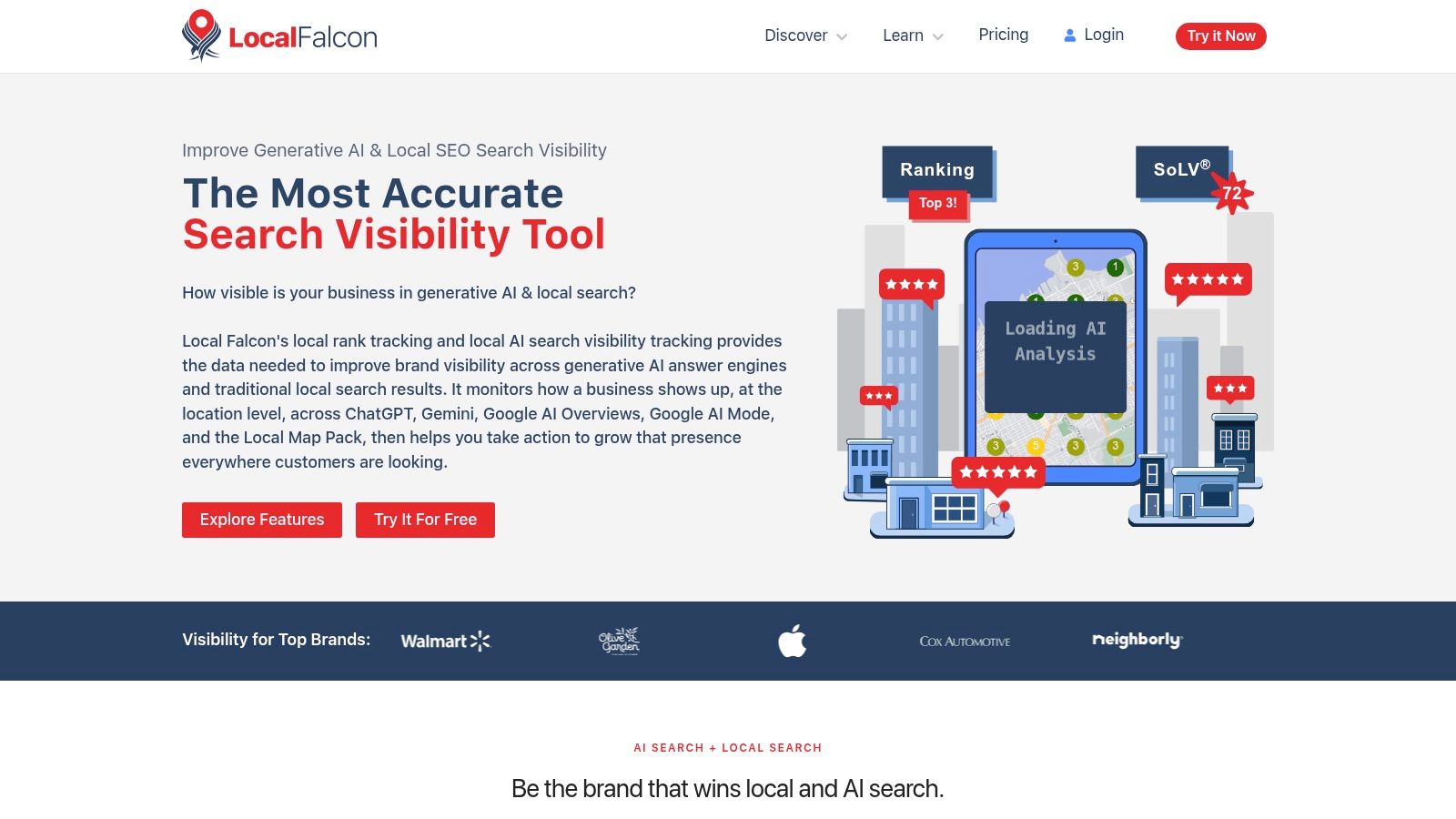
Local Falcon is a strong choice for teams that want granular map evidence and transparent per-scan control. Its own local SERP tracking guidance is useful context for teams deciding whether they need map sampling or ordinary keyword monitoring.
5. Local Viking and Local Brand Manager
Local Viking combines Google Business Profile operations with two forms of visibility measurement, keyword-based local tracking and GeoGrid scans. That combination suits agencies and multi-location teams that don't want profile publishing, scheduling, reporting, and rank monitoring scattered across separate systems.
The platform supports multi-location organization, recurring monitoring through a credit system, scheduled content, and reporting. Keyword tracking can cover local, Maps, and organic results, while GeoGrid scans answer the more specific question of where a profile appears across an area.
Useful for operational teams
Local Viking is more than a position dashboard. Teams can schedule GBP content and organize locations while maintaining a measurement workflow around recurring scans. That's valuable when the people responsible for profile updates also need to see whether local visibility changes after those updates.
The weakness is the credit math. New users may find it less intuitive to predict how scan volume translates into ongoing usage, especially when they monitor several locations and keywords. Standalone trackers can feel simpler for teams that only want ranking data, while Local Viking is more compelling when operational tasks are part of the same process.
Agencies planning high-volume monitoring should define a scan policy before adoption. The bulk rank tracking guidance can help frame which queries deserve continuous tracking and which should be reserved for periodic diagnostic scans.
6. SE Ranking Local and Map Rank Tracker
SE Ranking is the logical choice when local visibility and traditional SEO need to share one reporting environment. Its Local and Map Rank Tracker monitors GBP results alongside organic positions, while the wider platform includes site audits, backlink analysis, and keyword research.
That breadth changes the core trade-off. SE Ranking may not provide the same depth of dense geographic sampling as a dedicated grid-native tool, but it can reduce the need to reconcile local and organic reports from separate systems. Teams working on location pages, technical issues, links, and map visibility can connect those workstreams in one account.
Best for mixed local and organic reporting
The tracker supports location and device granularity, top-100 position tracking, API access, and white-label reporting on higher tiers. Those features make it practical for agencies that present local pack findings alongside website rankings and broader SEO work.
Plan limits matter. Map and grid usage depend on the selected plan and keyword allotments, so buyers should test how many locations, keywords, devices, and scan intervals their workflow requires. A tool that looks cost-effective for a small project can become restrictive if the team expects dense grids across a large location set.
SE Ranking fits mixed SEO teams better than specialists whose only question is neighborhood-level map coverage. If the main decision is “Which blocks are weak for this profile?”, a dedicated geo-grid platform will usually provide a more direct answer. If the decision is “How are local rankings and location pages performing together?”, SE Ranking has the stronger operational logic.
7. Nightwatch
Nightwatch approaches local measurement as a precise rank-tracking problem. It supports local pack and organic monitoring with targeting by city, ZIP code, and coordinates, alongside segmentation, scheduled reporting, and shareable dashboards.
That granularity makes it useful when a team needs repeatable query tracking from defined locations but doesn't require a full GBP management suite. Instead of treating “local” as one setting, Nightwatch lets the user specify the search context more carefully, which is important because proximity can change the result set.
Clean reporting without broader local utilities
Nightwatch's main advantage is focus. Agencies can segment data by location or campaign and distribute reports through dashboards rather than building manual spreadsheets from search observations. Its pricing is presented as predictable and transparent, which helps teams forecast tracking usage as they add projects.
The limitation follows directly from that focus. Nightwatch is not positioned as a complete local SEO suite, so it offers fewer niche utilities for citations, profile operations, or reputation management than all-in-one platforms. It also emphasizes tracking and visibility rather than heatmap-first geographic diagnosis.
Choose Nightwatch when the reporting question is “How is this keyword performing from these defined local targets over time?” Choose a grid-native product when the more important question is “What does coverage look like between the target points?” Those are related questions, but they aren't interchangeable.
8. AccuRanker
AccuRanker is built for teams that manage substantial keyword portfolios and need fast, dependable rank data. It supports Local Pack and Map Pack tracking with precise location settings, while its reporting and integration options serve agencies and enterprise SEO teams.
The platform's strength is trend monitoring at scale. Data Studio integration, share-of-voice metrics, scheduled reporting, and large-scale keyword management make it suitable when stakeholders want a consistent view of local and organic visibility across many tracked queries.
Strong tracker, limited heatmap role
AccuRanker isn't a dedicated geo-grid heatmap tool. That distinction should guide the purchase. A keyword-based tracker can show whether a chosen query rises or falls from a selected location, but it won't necessarily show the full spatial pattern between sampled points. Teams investigating neighborhood-level gaps may need a separate grid system.
Higher-tier plans can provide fast refreshes and on-demand updates, but larger volumes can cost more than SMB-focused tracking options. Buyers should assess how often they genuinely need fresh data instead of assuming that maximum refresh speed improves every decision.
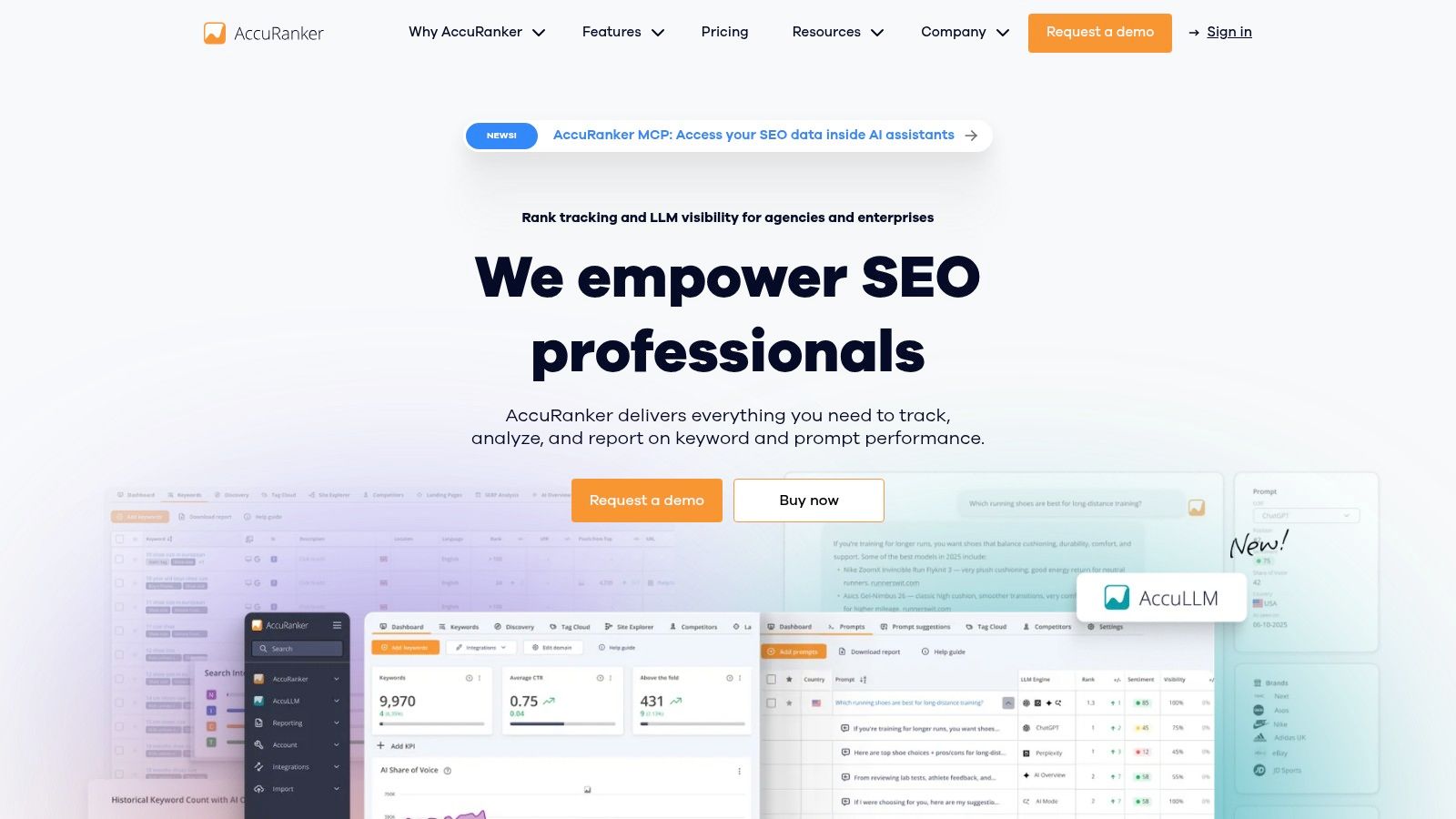
AccuRanker suits teams whose priority is reliable keyword trend data and enterprise-friendly reporting. The AI rank tracker directory provides additional context for comparing it with tools that place more emphasis on geographic heatmaps or GBP operations.
9. ProRankTracker
ProRankTracker covers organic, local pack, Local Finder, and video results, making it one of the broader rank-monitoring choices in this list. For GBP measurement, it tracks both the visible three-pack and deeper Local Finder results, which gives agencies a wider view than a tool focused only on the first local result block.
The platform supports multi-location and multi-language tracking, scheduled checks, on-demand refreshes depending on plan, white-label reporting, and client logins. Those features make it practical for agencies managing many accounts that need consistent delivery rather than a heatmap-heavy investigative workflow.
Reporting depth over visual mapping
ProRankTracker's interface leans analytical. It is better suited to teams that want tables, trends, reports, and client access than to users who expect a map to immediately reveal directional coverage patterns. Its reporting center is a strong fit for recurring agency communication, especially when clients need access to several result types.
That focus also marks its limitation. Geo-grid visualization is less central than it is in grid-native tools, so a business trying to identify weak blocks or compare coverage across a service area may find the output less intuitive. A Local Finder result can show that a listing exists deeper in the results, but it doesn't by itself explain the geographic shape of visibility.
ProRankTracker is the better choice when the measurement problem is broad SERP coverage and client reporting. It's less suitable when the central deliverable is a visual local heatmap that guides area-specific optimization.
10. Localo
Localo is designed for SMBs that want rank tracking connected to practical Google Business Profile improvement tasks. Its Local Rank Tracker uses an interactive Position Map to simulate searches from multiple points, while competitor overlays and result previews help users interpret what appears at each point.
The platform also includes keyword suggestions, search-volume guidance, GBP performance analytics, and guided weekly tasks. That combination makes the tool less intimidating for owners and managers who need a clear next action rather than a large collection of raw ranking fields.
Accessible workflow, fewer advanced controls
Localo's main strength is usability. A business can move from seeing weak map coverage to reviewing suggested profile tasks without assembling a separate operational process. The Position Map also keeps the central local question visible: where does the profile appear across town, not just at the business address?
Plan limits constrain grid size and keyword volume, and the platform is less flexible than credit-based tools for teams that want highly customized scanning. Its ecosystem is also smaller than older all-in-one local SEO suites. Those limits may not matter to a single business, but they become important for agencies or brands managing complex location portfolios.
Localo fits the measurement problem of “Show me where I'm weak and tell me what to work on next.” It isn't the obvious choice for deep API-driven reporting or very large-scale scanning, but its guided workflow can be more useful than a technically powerful tracker that leaves the user to interpret every result.
Top 10 Google My Business Rank Checkers Comparison
| Tool | Core features | Unique selling point | Best for | Pricing model |
|---|---|---|---|---|
| GMBMantra | GBP manager, Maps/Local Pack rank tracking, heatmaps, AI posts & review responses, multi-location reporting | Geo-heatmap visualizations + AI automation tailored to GBP workflows | SMBs & agencies focused on Google Business Profile | Subscription with paid tiers; advanced multi-location features gated |
| BrightLocal | Local Search Grid heatmaps, citations, audits, reviews, shareable reports | Mature all-in-one local SEO platform with client-ready reporting | Agencies & local businesses needing a full local SEO suite | SaaS subscription; grid scans consume credits on some plans |
| Whitespark | Local Ranking Grids + Local Rank Tracker, competitor overlays, API/white-label exports | Strong competitor insights and clear, shareable grid visuals | Local SEO professionals and agencies | Separate product subscriptions; credit-based scans for grids |
| Local Falcon | Dedicated geo-grid rank tracker, customizable grids, competitor overlays, exports | Precise per-pin scanning with transparent per-scan measurement | Agencies needing granular, per-location map insights | Credit/pay-per-pin model; monitor usage for scale |
| Local Viking (Local Brand Manager) | GeoGrid + keyword tracking, scheduling, GBP content posting, multi-location management | Combines GBP operations and rank tracking in one platform for scale | Agencies managing many locations and GBP workflows | Subscription with credit system for GeoGrid scans |
| SE Ranking | Local & Map rank tracking, position tracking to top‑100, API, site audits & SEO tools | Cost-effective combo of local + traditional SEO toolset | Teams that need both local and broader SEO functionality | Tiered subscription; grid usage/keywords limited by plan |
| Nightwatch | Local pack & organic rank tracking, city/ZIP/coordinate targeting, dashboards | Accurate local tracking with modern reporting and transparent pricing | Agencies/teams focused on precise tracking and reporting | Predictable, tiered subscription plans |
| AccuRanker | Fast local & map rank tracking, on-demand refreshes, Data Studio & enterprise integrations | High-speed, reliable tracking for large-scale keyword sets | Enterprises and agencies needing fast, large-scale tracking | Usage/volume-based pricing; higher cost at scale |
| ProRankTracker | GBP Local Pack & Local Finder tracking, daily/on-demand checks, white-label reports | Strong daily coverage and agency-friendly reporting/clients access | Agencies managing many clients with white-label needs | Subscription plans with tiered checks and white-label options |
| Localo | Local Rank Tracker with interactive "Position Map", competitor overlays, GBP guidance/tasks | SMB-friendly onboarding and actionable GBP optimization guidance | Small businesses wanting guided, hands-on GBP improvements | Subscription with plan limits on grids/keywords |
Match the Tracker to the Decision You Need to Make
The best Google My Business rank checker isn't the one with the longest feature list. It's the one that answers the decision in front of you without creating more measurement noise than your team can use.
Choose a dedicated geo-grid tool when area-level visibility is the priority. GMBMantra, BrightLocal Local Search Grid, Whitespark Local Ranking Grids, and Local Falcon are the clearest choices when you need to see coverage across neighborhoods, compare competitors by point, or identify areas where a profile disappears. A heatmap is more useful than a single rank position when proximity creates different results across the same city. The grid doesn't prove why visibility changed, but it shows where to investigate.
Choose a keyword-based tracker when repeatable trend monitoring matters most. Nightwatch, AccuRanker, and ProRankTracker are stronger when you need stable query histories, defined location settings, scheduled reports, or broad result-type coverage. Whitespark and Local Viking also combine keyword tracking with grids, giving teams both trendlines and geographic context.
Choose an integrated GBP platform when the people measuring visibility also manage posts, reviews, Q&A, scheduling, and locations. GMBMantra, Local Viking, and Localo connect rank observations to operational tasks. That matters because Google's Business Profile performance reporting includes actions such as calls, directions, website clicks, messages, bookings, and searches. A stable position with weak engagement may point to a profile-quality, offer, category, review, or demand issue rather than a ranking issue alone.
Choose a broader SEO suite when local and organic reporting must share one workflow. SE Ranking is the clearest fit here, while BrightLocal supports teams that also need local audits, citations, and reviews. Broader platforms reduce tool switching, but they may provide less specialized control over dense geographic sampling.
Before committing, test the actual operating model:
- Location settings: Confirm whether the tool tracks by address, city, ZIP code, coordinates, or grid points.
- Sampling depth: Check how many points a scan covers and whether the map reveals coverage gaps or only reports an average.
- Keyword design: Separate core services from weak or experimental queries. More tracked terms aren't automatically more useful.
- Scan frequency: Match recurring scans to the decisions you make. Frequent scans can consume credits without changing your action plan.
- Competitor comparisons: Verify whether competitors appear at each point, in trend reports, or only in selected views.
- Reporting workflow: Test exports, dashboards, white-label options, client logins, API access, and performance-data connections.
- Plan limits: Review credits, keyword allotments, locations, refresh options, grid sizes, and integration restrictions before scaling.
A 2025 Semrush benchmark on local SEO reported that 69% of local businesses use SEO tools or keyword-tracking software, while 67% have never completed a technical SEO audit and 58% don't optimize for local search. Those figures point to a practical gap: tracking adoption doesn't guarantee that teams interpret the data correctly or act on it.
For discovery, AI Tools for Local SEO organizes software by workflow categories including rank tracking and reporting, Google Business Profile optimization, multi-location SEO, reputation management, technical SEO, and agency operations. Use it to compare tools by the job they perform, then validate scan limits and reporting behavior in a real test project before moving your locations into a long-term plan.