A local business can collect hundreds of reviews, survey comments, support messages, and call notes without knowing what customers want fixed. The owner sees recurring complaints about waits, confusing booking, or inconsistent service, while the marketing team sees star ratings and a monthly dashboard. Both are looking at the same customer experience, but neither has a reliable way to connect the comments to a decision.
That's the central challenge in how to analyze customer feedback. Reading comments one by one creates anecdotes. Tracking scores alone removes context. A useful system combines structured metrics, qualitative coding, topic-level sentiment, human validation, and clear operational ownership. The result is a repeatable feedback loop that helps a local business improve service, protect its reputation, and make better decisions about visibility and retention.
Why Customer Feedback Analysis Matters for Local Businesses
A neighborhood clinic might receive positive comments about its staff while customers repeatedly mention difficult parking. A home-services company might earn strong ratings for workmanship but lose goodwill because appointments start late. A restaurant might attract praise for food quality and criticism for slow ordering. An average rating can hide all three patterns.
Customer feedback analysis turns those scattered observations into measurable signals. The most effective workflow combines quantitative metrics with qualitative coding. Teams can use CSAT, NPS, and CES alongside open comments to compare customer segments, track changes over time, and understand the reasons behind a score. SimpleSat's guide to customer feedback data describes a practical sequence that includes sentiment categories, word-frequency analysis, and thematic analysis.

What a structured process reveals
Start with the full workflow:
- Gather: Bring together reviews, surveys, questions, social comments, calls, and frontline notes.
- Clean: Remove duplicates, spam, incomplete records, and inconsistent labels.
- Categorize: Apply consistent fields for topic, sentiment, location, service, and urgency.
- Analyze: Combine scores, frequency patterns, themes, and topic-level sentiment.
- Prioritize: Separate issues that are frequent from issues that are merely loud.
- Act: Assign owners, fix the operational cause, and respond appropriately.
- Measure: Check whether the issue declines and whether customer experience signals improve.
This structure also supports local reputation work. Reviews often contain language about services, neighborhoods, staff, wait times, and customer expectations. Those details can help a team understand what customers value and where the business experience fails, although feedback analysis should never become a shortcut for manipulating review content or manufacturing positive sentiment.
Why silence creates a misleading picture
Dissatisfied customers don't always complain directly. One frequently cited benchmark says businesses hear from only 4% of dissatisfied customers, and for every customer who complains, 26 others don't voice their feelings, according to InMoment's customer survey statistics. That means a complaint log is not a complete list of problems. It's a record of the customers who chose to speak.
Practical rule: Treat silence as missing data, not proof of satisfaction.
Review management helps businesses monitor, respond to, and learn from public customer commentary. If the distinction between replying to reviews and managing the broader reputation process isn't clear, this explanation of what is review management offers useful context. The important point is that analysis must feed service improvement, not stop at a response template or a dashboard export.
Gathering Feedback Across Every Local Touchpoint
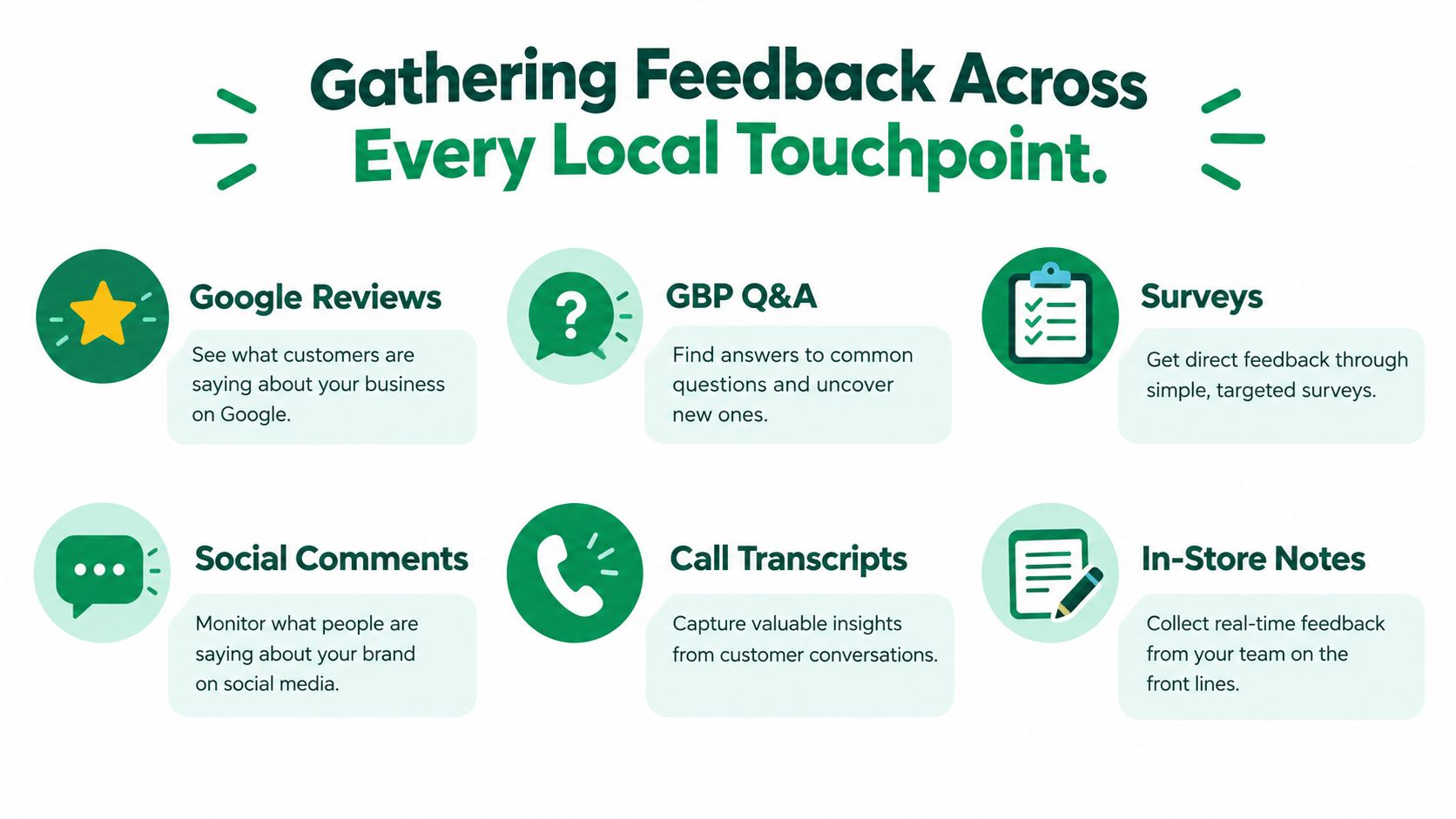
A survey-only program gives you answers from people who agreed to complete a survey. Local customers also express themselves through public reviews, questions, social posts, phone calls, and conversations with staff. Build the inventory before choosing an analysis tool.
Create a local feedback inventory
List each source, the type of information it contains, and who owns access to it:
- Google reviews: Public reactions to the complete customer experience, often with service-specific details.
- GBP Q&A: Questions that reveal confusion about services, accessibility, hours, pricing, or policies.
- Surveys: Structured ratings plus open text that can be tied to a transaction or interaction.
- Social comments and direct messages: Immediate reactions, recurring questions, and public frustration.
- Call transcripts: Spoken descriptions of intent, urgency, objections, and unresolved problems.
- In-store notes: Observations from receptionists, sales staff, technicians, and managers who hear unfiltered concerns.
For review requests, keep the language neutral and make the process easy. A useful resource on how to ask for a review can help teams design requests that invite honest feedback rather than pressure customers toward a particular rating.
Make surveys short and representative
A survey should answer a specific operational question. Ask about the interaction while it's still fresh, then provide one focused open-text prompt such as, “What would have made this visit easier?” Avoid combining unrelated questions about staff, pricing, scheduling, and product quality in one long form.
Survey response quality varies sharply with design and audience. The average email survey response rate is about 24.8%, motivated and well-executed surveys can exceed 85%, and poor targeting can push response rates below 2%, as reported by InMoment's survey benchmark discussion. These figures aren't a promise for your business. They show why targeting, timing, brevity, and a clear sampling plan matter.
Use a consistent collection window, but don't rely only on quarterly pulses. Continuous listening across channels can reveal problems between formal survey cycles. A survey might identify dissatisfaction after an appointment, while call transcripts and reviews show that the same issue affects people who never responded to the survey.
Centralize without erasing source context
A spreadsheet can work for a small operation if every row uses the same fields. Larger teams need a central feedback record with the original text, source, timestamp, location, service, customer segment when available, rating, and action status.
Keep the source visible. A three-star Google review, an internal call note, and a post-visit survey response may describe similar frustration, but they carry different privacy, response, and escalation requirements. Consolidation should make patterns easier to see, not flatten important context.
Cleaning and Categorizing Feedback Before You Analyze
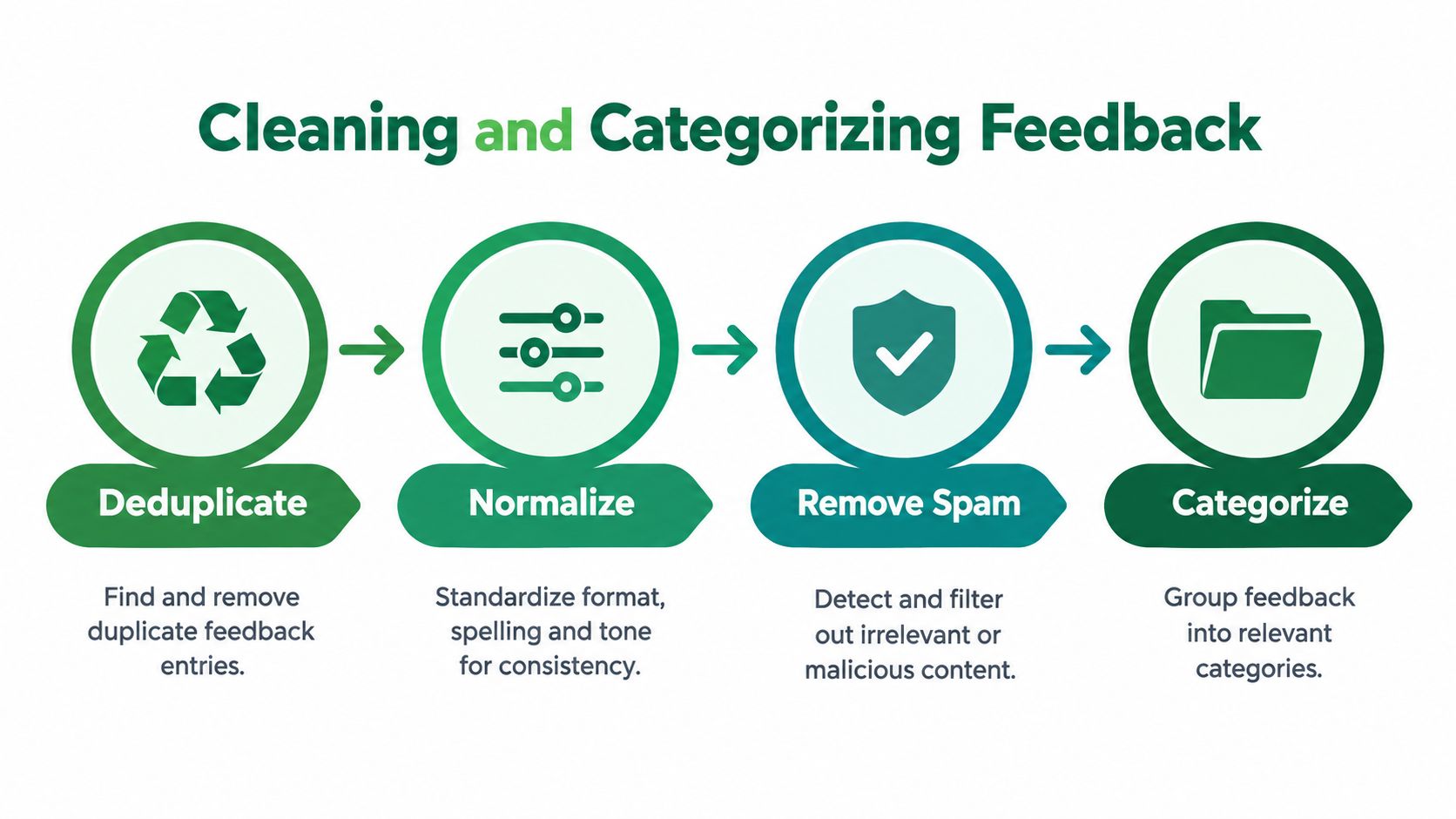
A review says the staff were friendly, the wait was long, and nobody explained the delay. An AI summary that labels the whole comment “positive” or “negative” hides the operational work required. Clean the record first, then preserve each topic, sentiment, and follow-up need separately.
Make every record traceable
Before analysis, run a consistent cleaning pass:
- Deduplicate: Match repeated imports, copied reviews, and one interaction recorded in multiple systems.
- Normalize: Standardize dates, location names, service labels, rating formats, and channel names.
- Remove spam: Separate promotional content, irrelevant comments, automated messages, and text that does not describe a customer experience.
- Preserve the original: Keep the unedited comment beside any cleaned or translated version so a reviewer can audit the decision.
Keep legitimate criticism, including angry or unclear comments. Remove irrelevant and duplicated records, not inconvenient feedback. If a comment cannot be interpreted confidently, mark it for human review rather than forcing a clean label.
Use a small taxonomy that supports action
A local business rarely needs a sprawling classification system. Use fields that help someone assign ownership and decide what happens next:
| Field | Examples |
|---|---|
| Location | Store, neighborhood, service area |
| Journey stage | Discovery, booking, arrival, service, payment, follow-up |
| Topic | Wait time, staff, price, cleanliness, availability, communication |
| Sentiment | Positive, negative, neutral, mixed |
| Urgency | Routine, important, immediate escalation |
| Entity | Staff member, service, product, competitor, location |
| Action status | Unassigned, investigating, in progress, resolved |
Allow multiple tags per comment. “The technician was excellent, but I waited all afternoon and couldn't get an update” contains positive staff sentiment, negative scheduling sentiment, and a communication problem. Reducing it to one negative label creates a noisy trend and gives the operations team less to fix.
Test AI labels before trusting volume
Review a sample from each important topic manually. Compare the labels across reviewers, especially for mixed comments, local slang, short phrases, and industry-specific wording. Topic-level sentiment is more useful than an overall score, but automation still needs boundaries and escalation rules.
McKinsey's guidance on conversational analytics emphasizes combining themes, experience signals, and entity recognition. It also describes how word-based systems can misclassify language. A phrase such as “not very happy” may be labeled incorrectly if the system reacts to “very happy” without reading the sentence context. McKinsey's analysis of the value of the human voice provides a useful reference for designing this validation step.
Finally, connect labels to an owner and Action status. A clean taxonomy has value only when a recurring complaint reaches the person who can investigate it, change the process, and record the outcome.
How to Run Qualitative and Quantitative Analysis That Actually Reveals Trends
A satisfaction score may look healthy while customers repeatedly complain about appointment availability. A low score may come from one exceptional incident rather than a widespread process failure. Use quantitative measures to locate the pattern, then read the comments to establish what happened and why.
Track CSAT, NPS, and CES by location, service, journey stage, and time period. Compare each score with its accompanying text. The useful question is not whether satisfaction rose or fell. It is which part of the experience changed, for whom, and whether the operation can act on it.
Start with the topic, not the overall mood
Overall sentiment is too blunt for local operations. Assign sentiment to each meaningful aspect of a comment:
“The front desk was welcoming, but the appointment started late and the invoice was confusing.”
This comment contains positive staff sentiment, negative punctuality sentiment, and negative or mixed billing sentiment. Topic-level analysis gives a manager a repairable issue instead of a vague instruction to improve the customer experience.
Combine three lenses:
- Thematic analysis: Which subjects recur across comments?
- Experience signals: Is the customer describing sentiment, effort, urgency, or churn risk?
- Entity recognition: Which staff member, service, product, competitor, or location is mentioned?
Word frequency helps discover possible themes. It cannot establish meaning. A frequent term may appear in praise, sarcasm, a complaint, or an unrelated context, so treat word clouds as a starting point rather than evidence.
Let automation sort volume, then validate meaning
A recent study reported a fine-tuned DistilBERT model reaching F1 0.9587 on consumer reviews, while other experiments reported accuracy ranging from about 77% to 98.68%, depending on the dataset and model design, as documented in this MDPI study on customer-feedback classification. These results describe specific evaluation settings. They do not guarantee that an automated tool will interpret local reviews correctly.
Real feedback includes sarcasm, abbreviations, mixed intent, and multiple topics in one sentence. Validate performance by theme with precision and recall, not only a headline accuracy score. Have a person review edge cases, rare complaints, escalations, and classifications that will trigger a public response or operational change.
McKinsey's guidance on conversational analytics recommends combining themes, experience signals, and entity recognition. It also explains how word-based systems can misread context. “Not very happy,” for example, may be classified incorrectly if a system reacts to “very happy” without interpreting the full sentence. McKinsey's analysis of the value of the human voice offers a useful reference for setting review boundaries and escalation rules.
Match the method to the decision
| Business question | Best method | What it reveals | Watch out for |
|---|---|---|---|
| What are customers discussing most? | Word frequency plus thematic coding | Recurring language and topics | Frequent words lack context |
| Which service elements create frustration? | Topic-level sentiment | Strengths and weaknesses by issue | Overall sentiment hides mixed experiences |
| Did a recent process change help? | Trend comparison over time | Movement in scores and complaint themes | Seasonal or channel effects |
| Which locations need attention? | Segmentation by location and journey stage | Localized operational patterns | Averages can conceal branch differences |
| Can automation be trusted for this label? | Human validation with precision and recall | Classification quality by theme | Headline accuracy can hide weak rare-class performance |
For a local reputation workflow, review sentiment analysis adds practical guidance on interpreting review themes. The output should be a defensible operating insight, such as: “Customers value staff expertise, but booking communication is the dominant friction point at this location.” That statement is useful because a team can assign it, test a change, and check whether the same complaint declines.
Prioritizing Issues and Closing the Feedback Loop
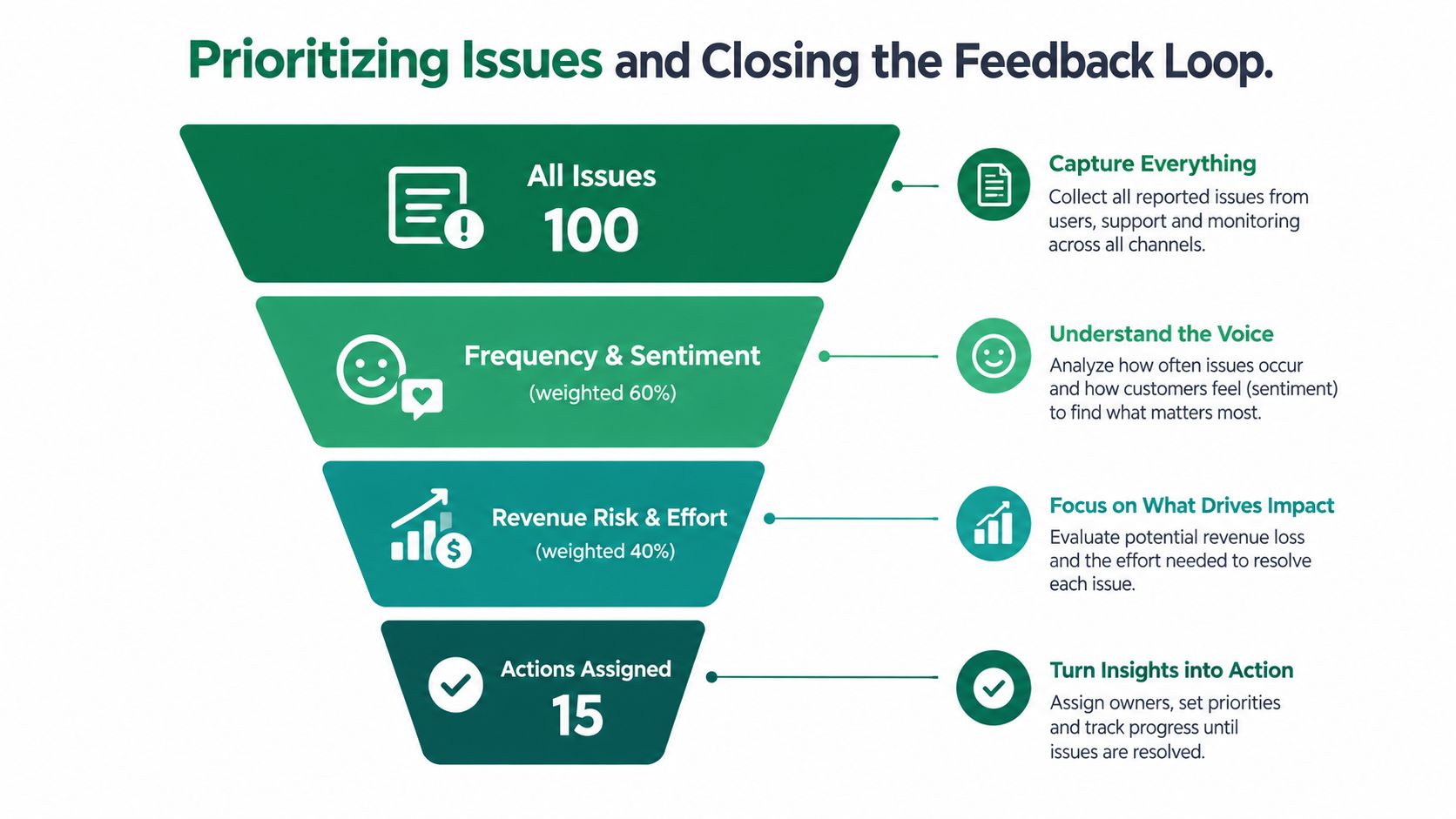
A dashboard can display ten problems while the team still lacks a clear Monday-morning decision. Prioritization converts analysis into assigned work. Start with the customer issue, then test four questions: how often it appears, how much harm it causes, what risk it creates, and whether the business can correct it with available resources.
Use topic-level sentiment rather than one overall score. A location may receive positive reviews about staff expertise and negative feedback about booking communication in the same interaction. AI can surface that split quickly, but noisy sentiment labels still need human validation, especially when sarcasm, mixed experiences, or a rare safety concern is involved.
Turn a theme into an operating decision
An issue register should capture the evidence and the decision, not just a topic label. Record its frequency across relevant channels, sentiment strength, effect on bookings or repeat visits, operational effort, and evidence quality. Confirm whether the pattern appears across independent sources or comes from one unusual comment.
Frequency cannot be the only filter. A rare privacy or safety concern may require immediate escalation, while a frequent preference with little customer impact can wait. Have an analyst or manager review high-priority AI classifications before assigning work. That small control prevents a polished dashboard from turning an ambiguous comment into the wrong operational response.
Assign one owner, one next action, and one review date. “Improve communication” is too vague. “Add an appointment-confirmation message that explains arrival timing and who to contact if the schedule changes” gives a scheduler or location manager something to complete and test.
Marketing can monitor review themes and correct inaccurate customer-facing information. It should not own a staffing or scheduling problem that another team must fix.
The action gap remains a practical business problem. A 2026 benchmark reported that 52% of digital leaders had no formal process for acting on feedback, while 56% of consumers said they had left a brand that kept ignoring their input, according to the Business Insider report on the customer listening gap. The operational lesson is direct: analysis creates customer value only after someone changes a process or communicates a meaningful response.
Close the loop with evidence
Externally, acknowledge the customer without promising an outcome the business cannot deliver. Respond publicly when appropriate, move sensitive details to a private channel, and explain the improvement after it exists. Do not argue with a review or offer compensation in exchange for editing it.
Internally, bring the pattern to employees who encounter it. A receptionist may explain why booking feels confusing, while a technician may identify a delay that starts before the appointment. End the discussion with a process adjustment, an owner, and a way to verify whether the complaint declines.
The Sift AI feedback loop approach offers a useful comparison for connecting collection, ownership, communication, and follow-through. The strongest loop is the one the team can maintain consistently.
Measuring Impact and Scaling Your Feedback System With AI
A feedback system is working when it changes decisions and the customer experience shows evidence of that change. Track the issue that prompted the intervention, not just a general satisfaction score. If the team changed appointment reminders, monitor comments about scheduling and communication. If staff training addressed handoffs, review feedback tied to that journey stage.
Build a small operating scorecard
A useful report can include:
- Theme movement: Whether the volume and tone of a priority topic change after an intervention.
- Metric movement: Whether CSAT, NPS, or CES changes for the affected segment.
- Resolution behavior: Whether owners complete assigned actions and document outcomes.
- Repeat complaints: Whether the same root cause continues across channels.
- Customer communication: Whether the business acknowledged important feedback and explained relevant changes.
Keep source context and review examples in the report. Leaders need the trend, while frontline teams need the language that shows what customers experienced.
Use AI for scale, not authority
AI can help import data, tag topics, summarize clusters, identify unusual changes, and route records to owners. It can also process a broader set of interactions than manual random call sampling, which one industry source says can capture less than 2% of interactions, as discussed in the MDPI research linked earlier. Broader capture improves coverage, but it doesn't make interpretation automatically correct.
Recent summaries note that sentiment systems can exceed 96% accuracy on clean benchmark text, while performance drops on real comments containing sarcasm, mixed intent, and multiple topics, according to Epignosis Insights' discussion of AI-powered sentiment analysis. Use automation to propose labels and summaries. Keep people responsible for taxonomy changes, edge-case review, escalation, and prioritization.
A practical scaling checklist is simple:
- Audit: Confirm every major local touchpoint feeds the system.
- Standardize: Keep labels, locations, services, and action statuses consistent.
- Automate: Route repetitive tagging and summarization to an appropriate tool.
- Review: Check precision, recall, and edge cases by important theme.
- Act: Assign owners and record the operational change.
- Recheck: Compare later feedback with the original issue.
Teams looking to evaluate automation for reputation workflows can review AI review management, but the tool should serve the process, not replace judgment. To strengthen your local operation, audit your feedback sources this week, choose one recurring issue, assign a named owner, and document the change in a shared tracker. If you need help comparing AI options for reviews, local search, and reporting, explore AI Tools for Local SEO at ai-tools-for-local-seo.com and build a stack around the feedback loop your team can run.