Run the same business through three local citation checkers and you'll often get three different error counts. One may flag a missing directory, another may treat a formatting variation as an inconsistency, and a third may surface a duplicate that the others missed. None is automatically wrong. Each tool has its own publisher database, matching logic, crawl timing, and definition of a fixable listing.
That's why this comparison ranks ten options by their role in a cleanup workflow. The important questions are practical: What does the tool audit? Does it monitor changes over time? Can it push or submit fixes? Where does its directory coverage stop? A local citations checker should help you decide what to repair first, not just produce a large error number.
Accurate listings matter because customers use them to decide whether to call, visit, or contact a business. A 2024 consumer study found that 82% searched for addresses or directions, 76% searched for operating hours, 75% searched for contact information, and 74% searched for a business website (Local Search Consumer Behavior Study 2024). Use the list below to match the checker to the work you need done.
1. AI Tools for Local Listings & Citations
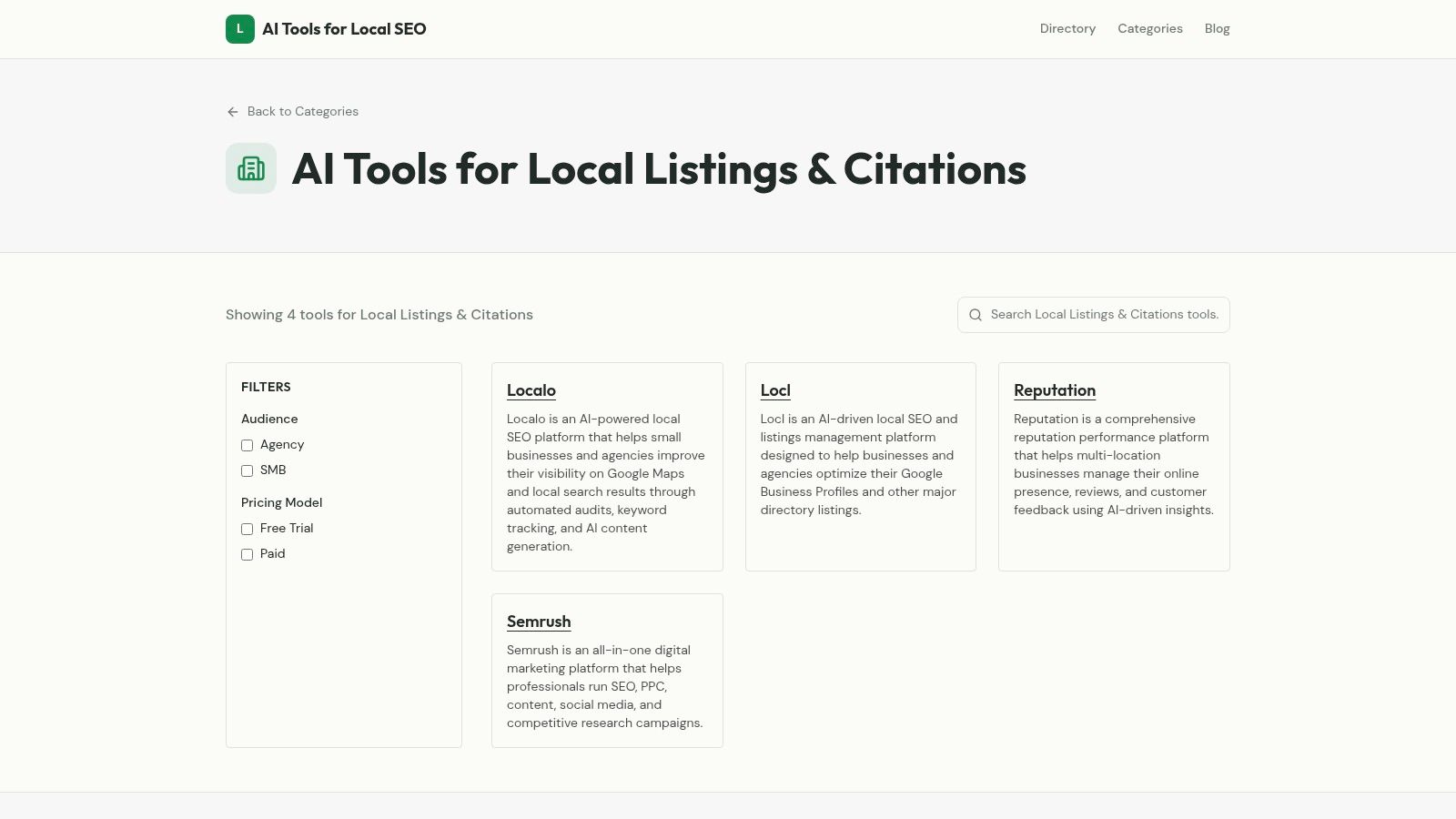
The AI Tools for Local Listings & Citations directory is a useful starting point when you're still deciding what kind of local citation checker belongs in your stack. It curates tools such as Localo, Locl, Reputation, and Semrush, then summarizes how they approach listing audits, citation monitoring, and NAP consistency.
That focus saves time during vendor discovery. Instead of comparing unrelated rank trackers, review platforms, and content systems, you can begin with products tied directly to local listings. The summaries also help separate three jobs that vendors often blur together: finding errors, watching for new errors, and correcting records.
Good for shortlisting, not final procurement
The directory works best as a practical shortlist. It can help an agency identify a specialist tool for citation cleanup, then find a broader platform for Google Business Profile work, reviews, reporting, or multi-location operations. That's especially useful when one product doesn't handle every part of the workflow well.
The limitation is depth. Entries are concise, so you won't get a complete view of pricing, publisher-level coverage, API restrictions, duplicate suppression processes, or how quickly updates propagate. You'll still need to test a live location and read the vendor's current documentation before buying.
Practical rule: Treat a curated directory as a discovery layer. Verify coverage and correction workflows on real listings before you treat a score as evidence of clean data.
The category is also valuable because it reflects how local SEO work is changing. A citation audit increasingly sits beside profile optimization, review management, and reporting rather than operating as an isolated task. For a broader explanation of how citation management fits into a repeatable workflow, see this guide to citation management tools.
Choose this resource when you need to compare categories and vendors quickly. Don't choose it as a substitute for a listing-by-listing verification pass.
2. Whitespark Local Citation Finder
Whitespark remains one of the clearest choices when the job is citation research rather than general marketing automation. Its Local Citation Finder looks for existing business listings, identifies inconsistencies, and discovers citation opportunities through competitor research. That last capability matters when your cleanup is complete and you need a defensible list of relevant directories to pursue.
The tool is especially strong for practitioners who want to understand why a competitor appears in local results. You can investigate the sources attached to competing businesses instead of submitting blindly to every directory that accepts a listing. For background on the distinction between a citation and other local SEO signals, this explanation of what local citations are provides useful context.
Best for research and controlled cleanup
Whitespark monitors existing citations and can flag NAP inconsistencies, while exportable reports make it easier to hand findings to a client or internal operations team. Its manual citation-building and cleanup services add a remediation path without forcing you into a broad all-in-one platform.
That flexibility is also the trade-off. Whitespark won't replace a full review-management suite, location-page platform, or enterprise listings network. You'll often need to decide whether your team will make corrections manually or pay for the one-time service.
- Audit: Strong citation discovery, NAP checking, and competitor gap analysis.
- Monitor: Useful for tracking existing citations, but it's not positioned as a complete reputation or listings operating system.
- Fix: Manual work or pay-once citation-building and cleanup services.
- Coverage limit: Its value is concentrated in citation research, not every local marketing function.
Whitespark suits a consultant auditing one location, an agency building a citation plan, or a business that wants control over each submission. It's less suitable when the main requirement is centralized syncing across a large location portfolio.
3. BrightLocal Citation Tracker and Citation Builder
BrightLocal combines two distinct workflows. Citation Tracker audits live listings, identifies NAP errors and duplicates, and maps competitor citations. Citation Builder then provides pay-per-listing manual submissions or updates, which means you can use the remediation service without committing every client to a broad subscription.
That split is practical. A checker tells you that a listing is wrong, but the business still needs someone to claim, update, verify, or remove it. BrightLocal gives agencies a way to keep the audit and the fix connected, while retaining the option to work through the platform's reports.
Useful for agency delivery
White-label reporting is one of the stronger operational features. Agencies can turn listing findings into client-ready deliverables rather than sending raw directory exports. Competitor citation gap analysis also helps prioritize new opportunities after the obvious errors are resolved.
The pricing structure requires attention. Citation Builder uses per-site costs, and bulk credits can reduce the unit price, but the platform plan is shown as price on request. That makes it harder to estimate the complete cost before you know how many locations, reports, and citation updates a client will need.
BrightLocal is a good fit when you need both diagnosis and outsourced execution. It's less compelling if you only want a lightweight one-time scan.
The directory-by-directory workflow can feel confusing at first, particularly when subscription features and manual citation credits are evaluated together. Before purchase, run a sample location, identify which listings are editable, and separate the cost of monitoring from the cost of correcting records.
4. Semrush Local Listings Management
A common scenario is this: the listings scan shows inconsistent business data, but the key question is whether the tool can do more than flag the mess. Semrush Local is strongest when local citation work sits inside a broader SEO operation and the team wants one place to audit, monitor, and update location data.
The free scan is useful as a first pass. It can generate a PDF report and surface issues such as missing information, duplicates, and whether a listing appears controllable. The paid product moves further into execution by centralizing business data, syncing updates across partner directories, and suppressing some duplicate records where the integration allows it.
That distinction matters in cleanup work.
Semrush is less of a citation-first specialist than Whitespark or BrightLocal. It works better as a listings layer inside an existing Semrush setup, especially for teams already handling technical SEO, keyword research, and reporting there. For multi-location businesses, the API also makes the platform easier to connect with internal systems or repeated update processes.
Coverage is where buyers need to read the details closely. Semrush describes a network across major maps, voice, and review platforms, with 70 or more U.S. sources and more than 150 worldwide on the Semrush Local Listings Management product page. In practice, network size is not the same as edit access. Some directories support direct changes. Others are better treated as scan-only or partial-distribution sources, depending on the location and field.
Pricing can also change the fit. Full use requires a paid Semrush plan plus a per-location add-on, so the free checker is a diagnostic tool, not a full citation cleanup service.
Used in the right workflow, Semrush covers four jobs reasonably well: it audits listing issues, monitors them over time, pushes some fixes through partner connections, and gives large teams a cleaner operating model. If you only need one-time citation cleanup, it can feel heavier and more expensive than a specialist tool.
5. Yext Business Listings Scan
Yext starts with a public Business Scan that checks listing presence and accuracy. The customer platform goes further by distributing structured location data through a broad publisher network, making it a natural fit for brands that need centralized governance across many branches.
The important distinction is between scanning and ongoing synchronization. A public scan can help sales teams or marketers identify visible listing problems. A paid Yext workflow is designed to push approved business data to connected publishers and manage updates through enterprise processes.
A strong enterprise governance option
Yext's direct publisher integrations are its main strength. Multi-location teams can maintain a controlled record for names, addresses, phone numbers, hours, categories, and other structured fields, then distribute changes rather than asking local managers to update every platform independently.
That model comes with a commercial dependency. Pricing is sales-led and can be premium for small accounts. Some directories may also revert after an active sync contract ends, so you need to understand what remains under your control when the subscription is no longer active.
The underlying issue is data consistency. Customers use online sources heavily for local business decisions, and Google says its listing system can draw on publicly available information, including content crawled from a business's official website (Pew Internet local business research). A centralized source helps, but it doesn't eliminate the need to inspect published profiles.
For teams managing franchises, retail networks, or service brands, Yext can reduce repetitive location-level work. For a single business, the platform may be more infrastructure than you need. This overview of name, address, and phone number consistency explains the core data problem Yext is designed to govern.
6. Uberall Listings Management
A common cleanup scenario looks like this: headquarters needs to fix hours, duplicates, and verification problems across many locations, in more than one market, without chasing local managers for every edit. Uberall Listings is built for that kind of job. It gives central teams one place to manage core listing data, review duplicate issues, track verification, and run quality checks across connected publishers.
What stands out in practice is its role in an ongoing workflow. Uberall is less about finding every obscure citation opportunity and more about governing the listings you can actively manage. Teams can validate addresses against Google, monitor whether profiles are verified, and connect listings data with review and performance reporting. That makes it useful when citation accuracy is tied to broader customer experience operations.
Uberall says it covers more than 150 global directories and voice assistants. For enterprise brands with international footprints, that reach matters. It is also where the trade-off starts. Coverage breadth does not mean identical control across every publisher, field, or country, so teams still need to test which updates pass through in their target markets.
For smaller businesses, the gap is simpler. If the job is a one-time audit or a short cleanup of a few inconsistent profiles, Uberall can be more system than you need. Pricing is not published, so the key test is whether your team needs monitoring and distribution over time, not just a report.
- Audit: Duplicate detection, verification checks, address validation, and listing quality review
- Monitor: Strong fit for recurring multi-location oversight
- Fix: Pushes approved updates to connected endpoints
- Coverage limit: Publisher and field support vary by market and integration
7. Synup Presence
Synup Presence takes a pragmatic approach to listings operations. It checks publisher eligibility, shows location-level scan and synchronization status, and surfaces connection problems such as an unverified Google Business Profile. That status visibility is often more useful than a simple “healthy” score.
For multi-location teams, the difference matters. A listing can exist and still be disconnected, unverified, outdated, or unable to receive updates. Synup's operational view helps staff identify which location needs attention rather than treating the entire account as one record.
A status-first workflow
Synup also provides alerts for verification and connection issues, along with multi-location reporting and AI-enhanced insights. Those features support recurring hygiene work, especially when local managers, agencies, and central marketing teams share responsibility for business data.
The limitation is that Synup's standalone checker experience is narrower than some competing platforms. Public pricing is limited and most plans are sold through a sales process, which makes small-account comparisons less transparent.
Use Synup when the central question is, “Which locations are connected, synchronized, and operationally healthy?” Use a citation-first research tool when the question is, “Where are our competitors listed, and which local directories are we missing?”
A useful report should show the location, publisher, field, current value, expected value, connection status, and next action. A single aggregate score can't replace that evidence.
Synup is a sensible choice for organizations standardizing listings hygiene across branches. It's harder to justify when you need deep competitor citation research or highly transparent self-serve pricing.
8. Birdeye Listings AI and Scan Verifier
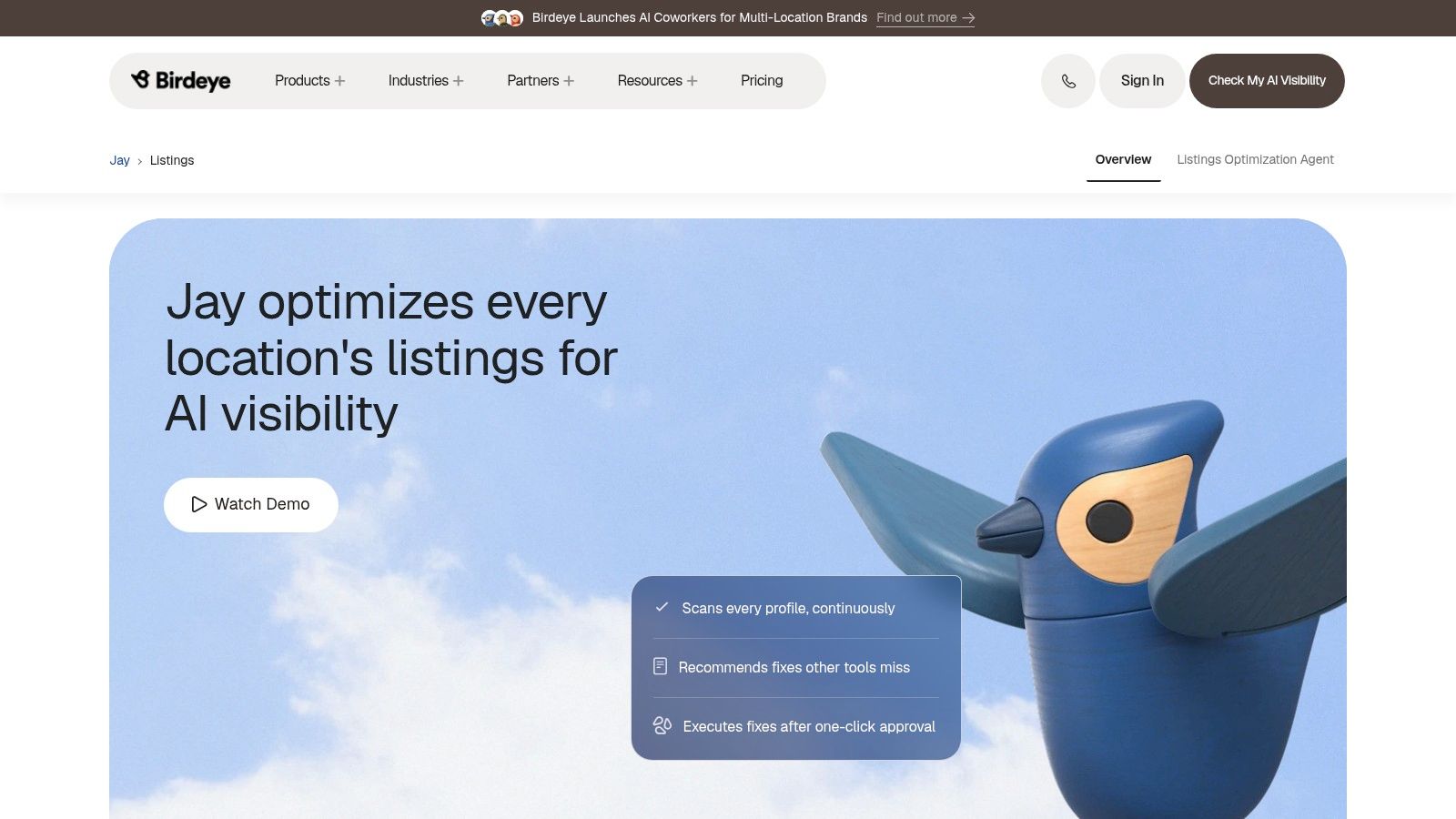
A common cleanup scenario looks like this: the Google profile is fine, reviews are flowing, but a scan still turns up old hours, category drift, or contact mismatches on secondary platforms. Birdeye Listings is built for that kind of workflow. It audits listing accuracy across platforms such as Google, Facebook, Apple, Yelp, and Bing, then flags discrepancies, suggests corrections, and supports approved updates.
What stands out is the Listings Verifier. In practice, that matters because a useful checker should tell you which field is wrong, not just mark a profile as incomplete. Birdeye is better suited to teams that need to review hours, categories, descriptions, and contact data at the field level, then route fixes through an existing operating process.
That makes it a practical fit for businesses already using Birdeye for reviews and customer experience. One system can cover scan results, listing tasks, and reputation work, which cuts down tool switching for operations teams. Agencies and channel partners also get white-label scan workflows, so the product can support prospecting and reporting without forcing a separate citation tool into the stack.
The trade-off is coverage. Birdeye works better as a listings and reputation suite than as a citation-first discovery tool. If your job is to find every niche directory, compare publisher breadth across markets, or map missing citations against competitors, its scan coverage will feel narrower than the widest listings networks. Pricing is also less transparent than self-serve tools, since cost changes by plan and location count.
Analysts behind the Local Search Consumer Behavior Study 2024 found that 99% of respondents used Google Search and/or Google Maps for local business information, up from 95% in 2022. That supports Birdeye's focus on the platforms that drive the most customer actions, but it does not remove the need to verify what happens beyond Google.
Choose Birdeye when the cleanup workflow sits inside reviews, listings, and customer experience. Choose a citation specialist when discovery breadth matters more than operational convenience.
9. Advice Local Online Visibility Report
A common agency scenario is simple. A prospect wants to know why its local visibility looks uneven, and the sales team needs something faster than a manual citation audit. Advice Local fits that stage of the workflow well because its white-labeled Online Visibility Report is built to surface listing gaps, NAP inconsistencies, and duplicate records in a client-facing format.
That focus matters.
Some citation checkers are better at discovery. Advice Local is better at turning an initial scan into a sales conversation, then carrying that account into managed reporting if the client signs. If you run cleanup work for multiple locations, that handoff from prospecting to recurring reporting is useful because the same platform can show what was found and what later improved on claimed and optimized listings.
The trade-off shows up once the job shifts from diagnosis to hands-on remediation. The report can tell you where visibility problems exist, but it does not give the same self-serve, directory-by-directory feel that a practitioner gets from tools built for forensic citation work first. Pricing is also sales-led, so it is harder to judge fit before a demo.
Ask for a sample report before you commit. Check which sources are scanned, which fields are compared, whether duplicates are only flagged or also resolved, and how the platform distinguishes a detected issue from a confirmed correction over time.
Used in a cleanup workflow, Advice Local is strongest as an agency-facing audit and monitoring layer. It helps with audit and monitoring, can support fixes through managed citation work, and is less convincing when you need deep coverage analysis or full control over every directory from a self-serve dashboard.
10. Vendasta Snapshot Report
Vendasta Snapshot is broader than a citation-only checker. It produces an automated needs-assessment report covering listing presence and accuracy alongside reviews, social profiles, the website, and AI visibility. That makes it useful for agencies that need to benchmark a prospect before recommending a larger marketing program.
Its strength is sales intelligence. A snapshot can quickly show where a business's online presence appears incomplete or inconsistent, then connect those gaps to resellable services and white-label reporting. Email delivery and agency-oriented presentation support repeatable prospect workflows.
Use it to qualify, not to finish the cleanup
Vendasta's broader scope is also its main limitation. A general online-presence score won't necessarily tell you which directory should be treated as authoritative, whether a duplicate can be removed, or whether a correction has propagated to the published profile. Those details matter when the work moves from diagnosis to remediation.
The AI visibility component is directionally useful because citation accuracy and assistant discoverability are no longer identical problems. Research on local search behavior found that 73% of a representative panel began its most recent local-business search on mobile, 52% started with Google Search, 9% with Google Maps, and three-quarters used more than one channel (BrightLocal consumer search behavior research). A broad snapshot can identify the need for investigation, but it can't replace source-level verification.
Vendasta is a good choice for agencies selling local marketing packages at scale. It's not the best standalone local citations checker for a practitioner who needs detailed directory corrections and evidence of propagation.
Top 10 Local Citation Checkers, Comparison
| Tool | Core features | Key benefits | Target audience | Pricing & entry |
|---|---|---|---|---|
| AI Tools for Local Listings & Citations (Directory Page) | Curated listings, short summaries, links to vendors | Speeds discovery, maps tools to local workflows | Local businesses, agencies, marketers | Free directory; tool details/pricing on vendor sites |
| Whitespark, Local Citation Finder | Citation discovery, competitor gaps, monitoring, exports | Deep citation-first research, clear reports | Local SEO consultants & agencies | À la carte pricing, pay-for services |
| BrightLocal, Citation Tracker + Builder | Live citation audit, duplicate detection, pay-per-listing Builder, white-label exports | Audit + remediation in one flow, agency reporting | Agencies, SMBs managing multiple locations | Pay-per-site Builder; platform pricing on request |
| Semrush Local, Listings Management | Free listings scan, sync & suppression, API, broad directory coverage | Integrates with Semrush SEO workflow, automation via API | SEO teams, agencies, multi-location brands | Free scan; full features need Semrush plan + add-on |
| Yext, Business Listings Scan | Public Business Scan, broad publisher integrations, enterprise reporting | Enterprise-scale updates & governance | Large brands, multi-location enterprises | Sales-led pricing, premium for small accounts |
| Uberall, Listings Management | Centralized updates to maps/voice, duplicate suppression, AI analytics | Strong voice & international coverage, verification workflows | Multi-location retail, restaurants, chains | Contact sales; best value at scale |
| Synup, Presence (Listings) | Publisher eligibility lookup, scan & sync status, alerts, AI insights | Operational status checks, simple hygiene workflows | Multi-location teams and agencies | Sales-led pricing, limited public details |
| Birdeye, Listings AI + Scan/Verifier | Listing score, field-level discrepancy detection, update orchestration | Verifier workflows, integrated with reviews/reputation | Agencies and SMBs needing reputation + listings | Pricing varies by plan/location, not fully public |
| Advice Local, Online Visibility Report | White-labeled scan widget, NAP/duplicate scoring, monthly reporting | Turnkey lead-gen and branded audits for agencies | Agencies and resellers | Free white-labeled reports; platform pricing via sales |
| Vendasta, Snapshot Report (Listings) | Automated multi-channel audit, AI visibility score, white-label reports | Quick prospect benchmarking, resellable reporting | Agencies using Vendasta platform | Requires Vendasta subscription; sales-led pricing |
Matching Each Checker to the Job at Hand
Choose by the job, not the brand. A citation-first tool is usually the better choice for a one-time audit of conflicting NAP data, competitor source discovery, and a carefully documented cleanup plan. A monitoring platform makes more sense for multi-location accounts where hours, verification states, duplicates, and publisher connections need attention after the initial repair.
Manual submission services still have a place. They're useful when a duplicate requires hands-on ownership work, when a directory doesn't expose a reliable sync path, or when you want a controlled one-time cleanup instead of an ongoing contract. Automated distribution is faster, but it can't guarantee that every publisher will preserve the update permanently.
The tools also differ in what they consider an error. One may flag formatting, another may prioritize missing fields, and another may focus on whether it controls the listing. Don't compare scores without comparing the underlying evidence.
A practical selection process looks like this:
- Test live listings first: Run a free scan or trial on a representative business, not a perfect demo location.
- Log every mismatch: Record the directory, field, published value, canonical value, last verification date, and correction status.
- Separate detection from control: Confirm whether the tool only reports a problem or can directly update, suppress, or remove the listing.
- Check coverage by market: A platform that works well in one country or business category may have limited publisher depth elsewhere.
- Verify the published fix: Open the live profile after correction. An accepted submission isn't the same as a visible, durable update.
Consumer behavior supports this level of care. In one U.S. study, 47% said they'd look for another business when an online profile said a business was open but they found it closed (SOCI 2024 Consumer Behavior Index). That's why stale hours deserve a higher priority than harmless formatting differences.
AI-era discovery adds another check. Consumers can find a business through assistants and generated recommendations, but a citation audit still needs to test whether the business is described correctly, not merely whether its name and phone number match. If your listings are accurate but assistants omit a service, misstate availability, or merge two locations, you have an entity-consistency problem that a basic NAP report may not reveal.
For broader planning, use this guide to local SEO pricing and packaging when turning citation cleanup, monitoring, and reporting into a client-facing service. Start with a sample scan, verify the actual correction path, and commit only after the tool proves it can maintain the data your customers rely on.