Only 1.16% of Google first-page results were free of SERP features, meaning enhanced elements now appear on almost every results page. For local businesses, ranking first no longer guarantees a click, because AI Overviews, local packs, videos, images, and People Also Ask can all compete for the same searcher.
The practical consequence is straightforward: new SERP features are now the search environment, not an optional layer to monitor later. A local SEO strategy that tracks rankings without recording which features appear beside them is measuring position while missing the distribution of attention.
The Reality of Modern Search Results
The figure of 1.16% changes the way marketers should define a search result. Semrush-based reporting cited by Backlinko's SERP feature analysis found that only 1.16% of Google first-page results had no SERP features. A separate 2024 measurement placed the no-feature share at 1.53%, pointing to the same conclusion: enhanced elements are nearly universal.
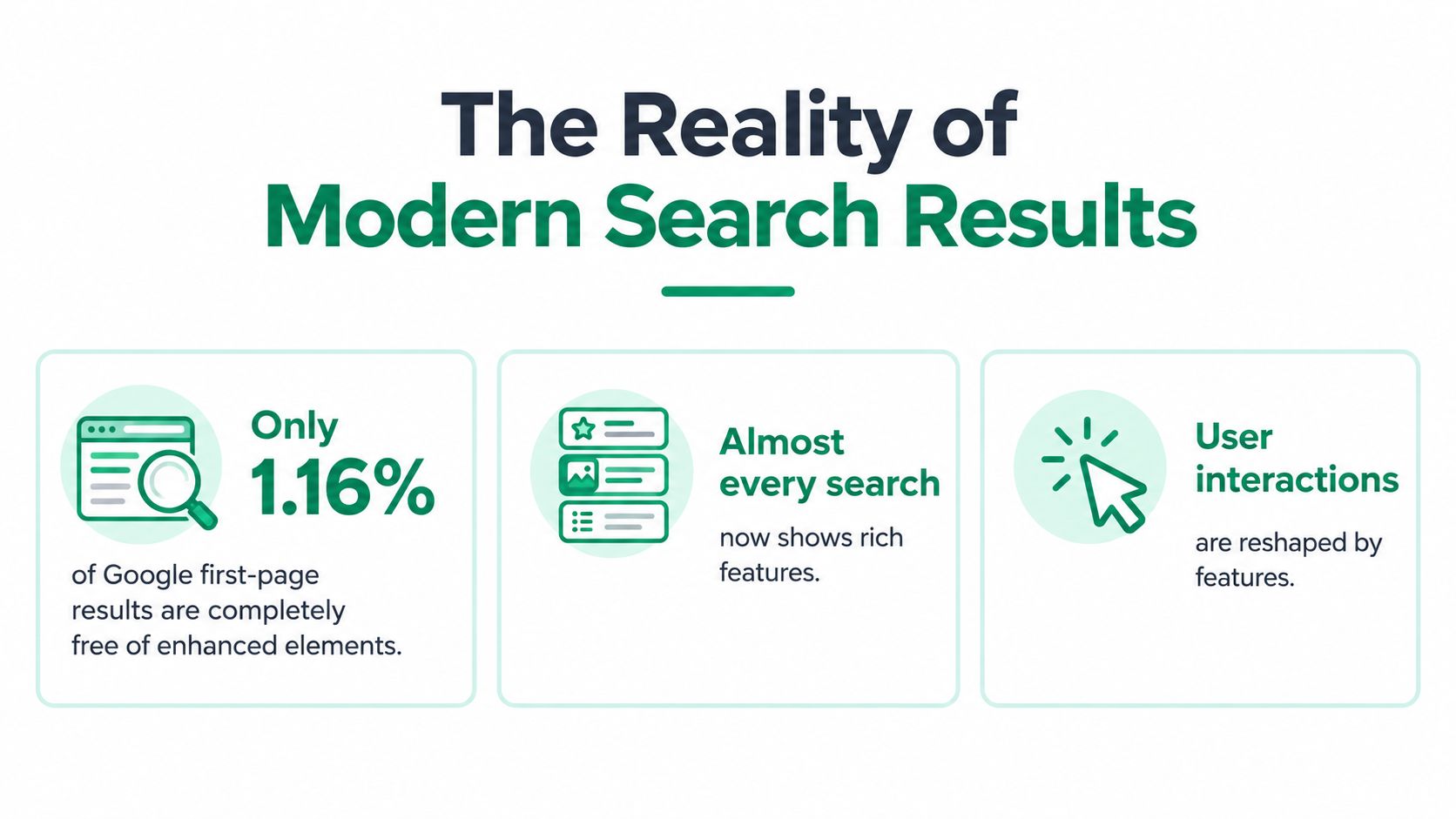
The visible page may still contain familiar organic listings, but users encounter those listings alongside navigational links, questions, images, videos, local businesses, and AI-generated summaries. The same reporting lists sitelinks on 95.54% of queries, People Also Ask on 67.79%, images on 50.63%, and video on 46.65%. AI Overviews appeared in more than 30% of searches by March 2026, according to that reporting.
Ranking is only one visibility signal
A first-place organic result can sit below an AI answer, beneath a local pack, or beside a visual module that answers the query without a site visit. This doesn't make ranking irrelevant. It changes what ranking means.
For a local company, visibility now has several layers:
- Eligibility: Can Google include the business in a local pack, image result, video result, FAQ-style answer, or AI-generated response?
- Prominence: How much screen space does the feature occupy relative to the organic listing?
- Interaction: Does the feature encourage a click, a call, a direction request, an expansion, or no website visit at all?
- Persistence: Does the feature appear consistently across locations, devices, and query variations?
The 67,000-keyword study covering more than 40 U.S. e-commerce domains, 24 million SERP views, and 6 million clicks found that 24 SERP features materially changed organic click-through rate. Its models predicted CTR significantly better when feature presence was included than when they relied on ranking alone, as documented in this cross-website SERP feature study.
Practical rule: Treat a keyword's SERP layout as part of its ranking data. Position without context is an incomplete diagnosis.
For local teams, this means reporting should pair rank with feature ownership. A business might rank well for a service query yet lose the most valuable interaction to the local pack, a video carousel, or an AI summary. The central task isn't only to reach the first position. It's to understand which result types shape the searcher's next action.
How SERP Features Evolved
Google's current results page is the product of a long redesign, not one sudden AI launch. Academic analysis of Google's SERPs found that Top Stories first appeared in 2004, local packs were already present by 2010, knowledge panels appeared in 2012, and featured snippets arrived in 2014. AI-written summary layers began appearing at the top of many results pages in 2024, according to the same academic analysis of Google search results.
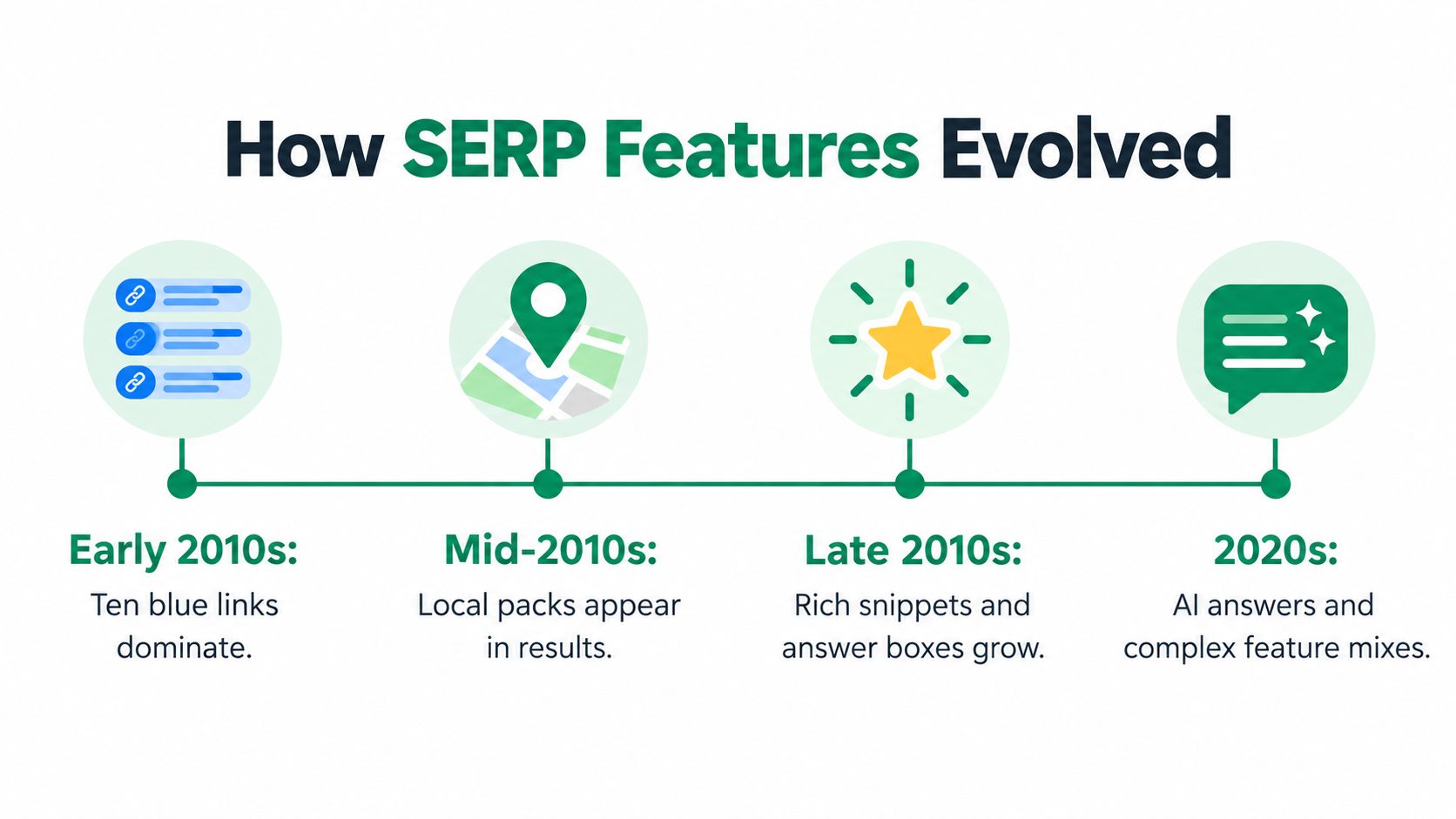
That sequence reveals a useful pattern. Google first added formats that answered particular needs, then layered those formats into a broader interface that identifies entities, locations, freshness, and direct answers. The transition from ten blue links to answer-first search happened through repeated feature additions.
A sequence of intent delivery
The historical milestones map closely to different search intents:
- Freshness: Top Stories gave news queries a prominent way to surface recent reporting.
- Local intent: Local packs placed nearby businesses and location information directly in results.
- Entity understanding: Knowledge panels made organizations, people, places, and concepts more identifiable.
- Question answering: Featured snippets extracted concise responses from pages.
- Synthesis: AI summaries began combining information into a generated response with supporting sources.
Local SEO teams often describe AI Overviews as if they created the first serious threat to organic listings. The larger shift began earlier. Each new feature reduced the page's dependence on standard links and increased the value of being eligible for a specialized result type.
The strategic implication
Google has progressively moved more interpretation onto the results page. A user can discover a business category, compare options, view images, read questions, and identify local providers before visiting a website. The website still matters, but it increasingly competes within a result ecosystem rather than appearing in isolation.
That makes adaptation continuous. A business shouldn't build one “SERP feature strategy” and consider the work complete. It needs a repeatable process that identifies which formats appear for its own queries, determines what information Google uses to populate them, and updates the relevant assets as the interface changes.
The most durable response isn't chasing every visual experiment. It's building strong, consistent signals across business details, local relevance, useful content, media, and structured information. Those assets can support several result types at once, even as Google changes their presentation.
The Hidden Cost of Feature Stacking
A crowded SERP can suppress clicks even when a page holds the first organic position. Independent CTR research found that AI Overviews alone reduced position-one CTR by 36%, while AI Overviews combined with a local pack, product grids, People Also Ask, and videos reduced position-one CTR by up to 99%, according to Advanced Web Ranking's organic CTR research.
The important variable isn't just whether one feature appears. It's the combination. An AI Overview can satisfy an informational need, a local pack can present businesses with phone and direction actions, People Also Ask can answer follow-up questions, and video can capture attention through a different format. Each module changes the path to the organic result.
Why rank reports can mislead
Suppose a local service page moves from position three to position one. A conventional report calls that a win. But if the same query gains an AI Overview, local pack, video block, and People Also Ask module, the page may receive fewer clicks despite its improved rank.
That doesn't mean the ranking improvement had no value. The page may still support brand recognition, citations, assisted conversions, or later searches. It does mean the team needs to separate ranking performance from click opportunity.
A useful monitoring record should capture:
- Organic position: Where the page ranks among standard listings.
- Feature inventory: Which modules appear above, below, or alongside it.
- Feature ownership: Whether the business, a competitor, or a third party appears in each module.
- Search intent: Whether the query asks for information, comparison, a nearby provider, or an immediate action.
- Observed change: Whether the feature combination differs from the previous observation.
A first-place ranking on a heavily stacked SERP can represent authority without representing traffic.
This is why teams should compare clicks and impressions with the actual page layout. A fall in organic CTR may reflect stronger competition from features rather than a ranking failure. Conversely, a stable ranking with declining impressions may indicate that Google is changing which result types it displays for the query.
Turning feature combinations into decisions
Feature stacking becomes actionable when the team assigns a response to each pattern. If local packs dominate service queries, improve local relevance and Business Profile completeness. If videos appear consistently, assess whether demonstrations, testimonials, or process explanations deserve video treatment. If AI summaries appear on question-led queries, structure concise answers and support them with clear evidence.
For a broader view of how much search activity can be distributed across enhanced result types, compare the share of searches covered by SERP features. The point isn't to chase every module. It's to identify which combinations create the largest gap between rank visibility and actual user interaction.
Why Local SERPs Vary by Market
A local SERP isn't a universal template. The feature mix can change with the city, business category, device, query wording, and local intent. The 2026 local SERP study mapped 53,900 local results pages across 250 U.S. cities and 49 local business types, showing that local search is highly heterogeneous rather than uniform, as reported by Synup's local SERP research.

A plumber, law firm, restaurant, and medical practice may all target location-modified searches, yet Google can assemble different result pages for each. The underlying reason is intent. “Emergency plumber near me” signals immediate local action, while “how to choose a plumber” may invite an informational answer, video, or AI summary before a provider listing.
The same keyword can carry different opportunity
Multi-location teams often make a costly assumption: if a feature appears in one market, it should appear in every market. That assumption produces weak reporting and poorly prioritized optimization.
A better comparison separates three dimensions:
| Dimension | Question to answer |
|---|---|
| Geography | Does the feature appear consistently across target cities? |
| Vertical | Does the business category trigger local, visual, shopping, or answer formats? |
| Intent | Does the query favor a provider, an explanation, a comparison, or an immediate action? |
Broader 2026 coverage indicates that Google shows 37 distinct SERP features in the U.S., including AI Overviews, AI Mode, People Also Ask, Local Pack, video, and shopping elements. That breadth reinforces the need to monitor actual result pages instead of applying a national average to every branch.
Build local baselines
Each priority market needs its own baseline. Record the recurring features for core services, branded searches, nearby searches, and informational questions. Then compare the business's presence within those features, not just its organic ranking.
For a franchise or agency, this creates a more useful operating model. One city may need local pack improvements, another may need stronger location-page relevance, and a third may have an opportunity in video or question-led content. The strategy becomes a set of market-specific responses rather than one generic checklist.
Automating SERP Feature Detection
Manual checks work for a small list of terms, but they break down when a team tracks many locations, devices, languages, and service categories. Automation should answer three questions repeatedly: which features appeared, how did the combination change, and where does the business or competitor appear?
A practical workflow can be built with a rank tracker, SERP API, spreadsheet or database, and an AI analysis layer.
Step one, define the observation set
Start with a controlled keyword list. Group terms by location, service, brand, competitor, and intent. Include variations that signal different actions, such as “near me,” city-modified services, cost questions, opening-hours searches, and comparison queries.
Store the search context with every keyword:
- Location: City or service area used for the observation.
- Device: Desktop or mobile environment.
- Intent: Informational, local discovery, comparison, or transaction.
- Priority: Business impact and strategic importance.
- Landing page: The page intended to satisfy the query.
Without this context, an AI system can detect features but cannot explain their business significance.
Step two, collect structured SERP observations
Use a tracking system that records more than position. A suitable setup should capture local pack presence, featured snippets, image packs, video results, People Also Ask, AI summaries, site links, and other visible modules. The local SERP tracking workflow provides a useful model for treating feature visibility as a recurring measurement rather than a one-time audit.
Save each observation with a timestamp and a normalized feature label. Avoid storing only screenshots. Screenshots help human review, but structured labels make it possible to calculate changes, group queries, and trigger alerts.
Step three, let AI classify the combinations
An AI assistant can turn raw observations into categories such as:
- Local opportunity: A local pack appears, but the business is absent.
- Organic suppression: Several modules occupy the space above the target listing.
- Content opportunity: People Also Ask or AI answers reveal questions the site doesn't address clearly.
- Media opportunity: Images or videos recur for the intent.
- Competitor displacement: A competitor owns the feature that most directly supports the searcher's action.
Give the system fixed definitions and examples from your own data. Ask it to explain its classification using the observed feature labels, not assumptions about why Google displayed them.
Step four, create change alerts
Alerts should focus on meaningful events. Notify the team when a local pack first appears for a priority query, when the business disappears from a feature it previously owned, when AI summaries begin appearing across a query cluster, or when a competitor replaces the business in a local result.
Don't alert on every minor layout change. Excessive notifications train teams to ignore the system. Use priority levels based on commercial intent, market importance, and the visibility of the lost feature.
Step five, connect features to outcomes
Join SERP observations with Search Console clicks, impressions, CTR, conversions, calls, and direction requests where available. The analysis shouldn't claim that a feature caused every performance change. It should identify whether a traffic shift coincided with a different result layout and then prompt a human review.
AI is most useful here as a pattern detector. It can scan thousands of rows for recurring combinations, but an SEO specialist should decide whether the recommended response is technical, editorial, local, or measurement-related.
Optimizing for Visibility and AI Answers
Optimization starts with the feature patterns found in the target market. A local business shouldn't add every possible schema type or create FAQ blocks just because those formats exist. It should strengthen the signals that correspond to the features its customers encounter in practice.
Make local identity unambiguous
Use accurate, consistent business information across the website and Google Business Profile. The local business entity should have a clear name, address or service-area description, phone number, opening information, and relevant service categories. Don't create location pages that add city names without adding useful local detail.
Structured data can help search engines interpret the page. Use appropriate LocalBusiness subtypes and connect the markup to visible, accurate content. Include service information, area served, contact details, and relationships to the organization where those details are genuinely supported on the page.
Schema doesn't guarantee a rich result. Its role is to make important facts machine-readable and reduce ambiguity between the business, its locations, and its services.
Match content to the questions behind AI answers
AI-generated summaries often respond to questions that sit one step above a service query. A searcher may ask about symptoms, selection criteria, preparation, pricing factors, timelines, or what to expect before choosing a provider.
Build pages that answer those questions directly:
- Lead with the answer: Put a concise, accurate response near the relevant heading.
- Add decision context: Explain exceptions, limitations, and situations that change the recommendation.
- Show local relevance: Mention service areas, availability, regulations, or operating conditions only when they're accurate.
- Support claims: Link to authoritative references where the topic requires evidence, especially for health, legal, or financial information.
- Keep sections independent: Each heading should answer one recognizable question without forcing the reader through unrelated copy.
The objective isn't to write for a machine at the expense of people. Clear structure helps users scan, helps crawlers interpret the page, and gives answer systems distinct passages to evaluate. For teams building a wider process around this work, these AI visibility resources offer additional context on improving discoverability in generated answers.
Strengthen the Google Business Profile
The Business Profile supports local discovery features, so treat it as an active information source rather than a directory entry. Select the most accurate primary category, add relevant services, maintain current hours, publish useful updates, and respond to reviews with specific information.
Reviews shouldn't be treated as a keyword insertion exercise. Responses should address the customer's actual experience, clarify service details where appropriate, and demonstrate that the business is active and accountable.
Photos also deserve attention when image results appear frequently. Use clear, authentic images that represent the location, team, work, products, or customer experience. Keep the visual assets aligned with the business identity and the page content.
Design for citations and actions
A page can appear in an AI answer and still fail to generate a useful next step. Make the source page easy to verify and easy to act on. Place important facts in visible text, use descriptive headings, maintain strong internal links, and provide clear contact or booking paths.
Use this guide to optimizing for AI search as part of a broader workflow that connects content structure with local signals. The focus should remain on accuracy, first-hand usefulness, and clear entity information, not on forcing a particular phrase into every section.
Finally, review performance by feature combination. Track whether the business appears in the local pack, whether its pages are cited or surfaced around AI answers, whether media results attract engagement, and whether branded searches increase after visibility improves. The strongest strategy is iterative: observe the local SERP, improve the relevant asset, measure the resulting interactions, and adjust when the feature mix changes.
Run a feature-aware audit for your priority locations this week. Export the queries that matter most, record their current SERP combinations, identify where competitors occupy local or enhanced results, and assign each gap to a concrete action across your Business Profile, location pages, structured data, content, or media. For teams managing multiple markets, evaluate AI Tools for Local SEO as one option for discovering local SEO software and organizing workflows across research, optimization, monitoring, and reporting.