82% of consumers now read an AI-generated review summary before individual reviews, and 23% rely on that summary alone, according to Digital Applied's 2026 reputation playbook. That changes the operating model for every agency managing client reputation. Manual checks of Google, Trustpilot, social platforms, and directories can't reliably shape a first impression that an algorithm has already condensed.
Reputation management for agencies now requires two systems working together. The first monitors reviews, listings, mentions, sentiment, and response obligations. The second turns that evidence into clear, specific, consistent signals that both customers and AI systems can understand. Agencies that treat online reputation as occasional cleanup will struggle. Agencies that build repeatable workflows can make reputation a managed growth function.
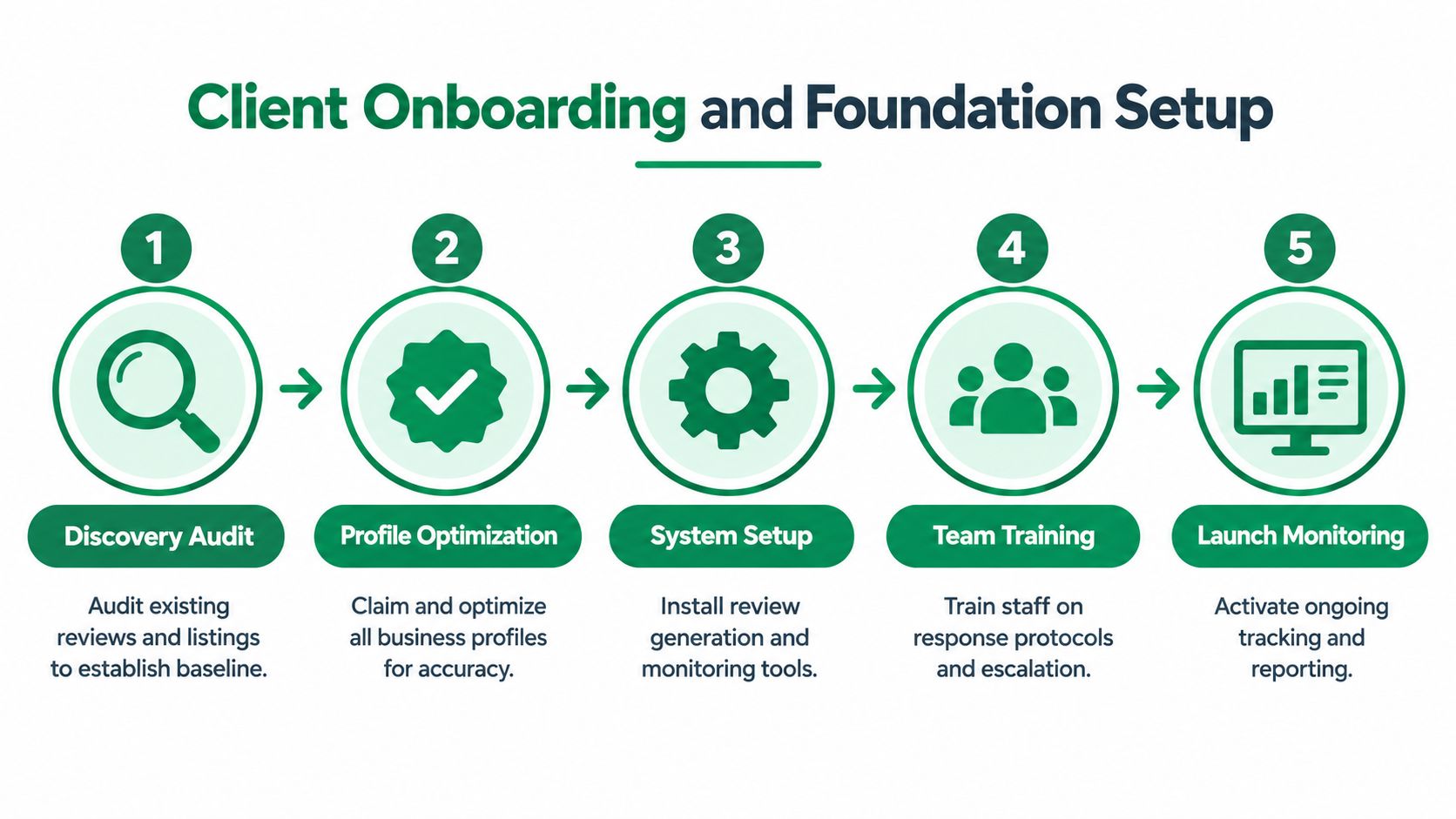
Client Onboarding and Foundation Setup
The first client meeting should produce more than access credentials. It should establish the baseline, decision rights, response voice, escalation rules, and measurement plan that govern the account.
Start with a discovery audit. Search the brand, senior staff where relevant, primary services, and each location across Google Business Profile, industry directories, social networks, review platforms, maps, and branded search results. Record duplicate listings, incorrect hours, outdated descriptions, inconsistent contact details, unresolved complaints, review velocity, recurring themes, and ownership status. A tool account can collect data, but it can't decide which inaccuracies create commercial risk or which complaints require a client-side fix.
Build the operating foundation
Claim and verify the profiles that matter, then correct the source information before asking for more reviews. A new review campaign won't compensate for a wrong phone number, an abandoned profile, or a location page that contradicts the listing.
Create a brand voice guide with the client. Include:
- Tone: Define whether the brand sounds warm, clinical, direct, formal, or conversational.
- Approved language: List preferred terms for apologies, refunds, delays, service failures, and follow-up.
- Boundaries: Identify claims staff can't make, private information they must never disclose, and topics requiring approval.
- Escalation rules: Assign owners for safety concerns, legal threats, discrimination allegations, staff complaints, and high-visibility posts.
- Examples: Rewrite sample positive, neutral, and negative responses until the client approves the voice.
Practical rule: A monitoring platform tells you that a review arrived. The voice guide tells your team what the brand is allowed to sound like.
Install monitoring only after the workflow is agreed. Connect review sources, listings, social listening, inboxes, and reporting destinations. Then test alerts with sample events, confirm permissions, and document what happens when a notification fails. For multi-location clients, create location-level ownership without allowing every local manager to improvise policy.
Set success metrics during onboarding. Track response rate, median first-response time, unresolved complaint count, review volume, rating movement, sentiment themes, listing accuracy, and operational issues behind recurring criticism. Avoid promising guaranteed rankings or instant removal. Define what the agency controls, what the client must approve, and what external platforms determine.
Scaling Review Generation Workflows
Review generation works best as a service-delivery trigger, not a quarterly marketing task. The agency should connect the request to a moment when the customer has enough context to give an honest opinion, such as a completed appointment, delivered order, resolved support ticket, or finished project milestone.
Use timing, channel, and follow-up as separate decisions
Timing comes first. Ask soon enough that the experience is fresh, but not before the client has completed the promised service. For a service business, the trigger might be marked job completion. For a subscription company, it might follow a successful support resolution. If the client can't identify a credible satisfaction moment, fix the customer journey before automating requests.
Channel selection should follow customer behavior. Email works well when the client already uses email receipts or account messages. SMS can be effective for time-sensitive local services, but it needs clear consent and an easy path to opt out. In-app prompts belong inside an existing product experience, where the request feels connected to the action the customer just completed.
A simple message has three parts: identify the completed interaction, ask for an honest review, and provide one clear destination. Avoid leading customers toward a positive rating or offering rewards tied to favorable sentiment. Agencies should also avoid sending every customer to multiple platforms in one message, since friction lowers completion and may create unnatural activity patterns.
A sustainable review program asks for feedback consistently. It doesn't manufacture approval.
Automate reminders without creating pressure
Use one initial request and a restrained follow-up sequence. The reminder should acknowledge that the customer may have missed the first message, not imply that a review is owed. Stop the sequence when the customer responds, opts out, or raises a complaint. Route complaints into a service recovery path instead of repeatedly asking for public feedback.
Multi-location accounts need central governance with local relevance. Keep the core copy, compliance rules, tracking fields, and approval process consistent. Allow approved local details, such as the branch name, service category, staff role, or neighborhood, so the request doesn't read like a national template pasted into every market.
Before selecting software, compare integrations, location controls, consent handling, review-source coverage, response permissions, audit logs, and reporting exports. Agencies evaluating the stack can find the right reputation platform, then compare its capabilities against the client's CRM, booking system, point-of-sale data, or support platform. The guide to asking for a review can help the account team refine language without turning the request into a scripted sales pitch.
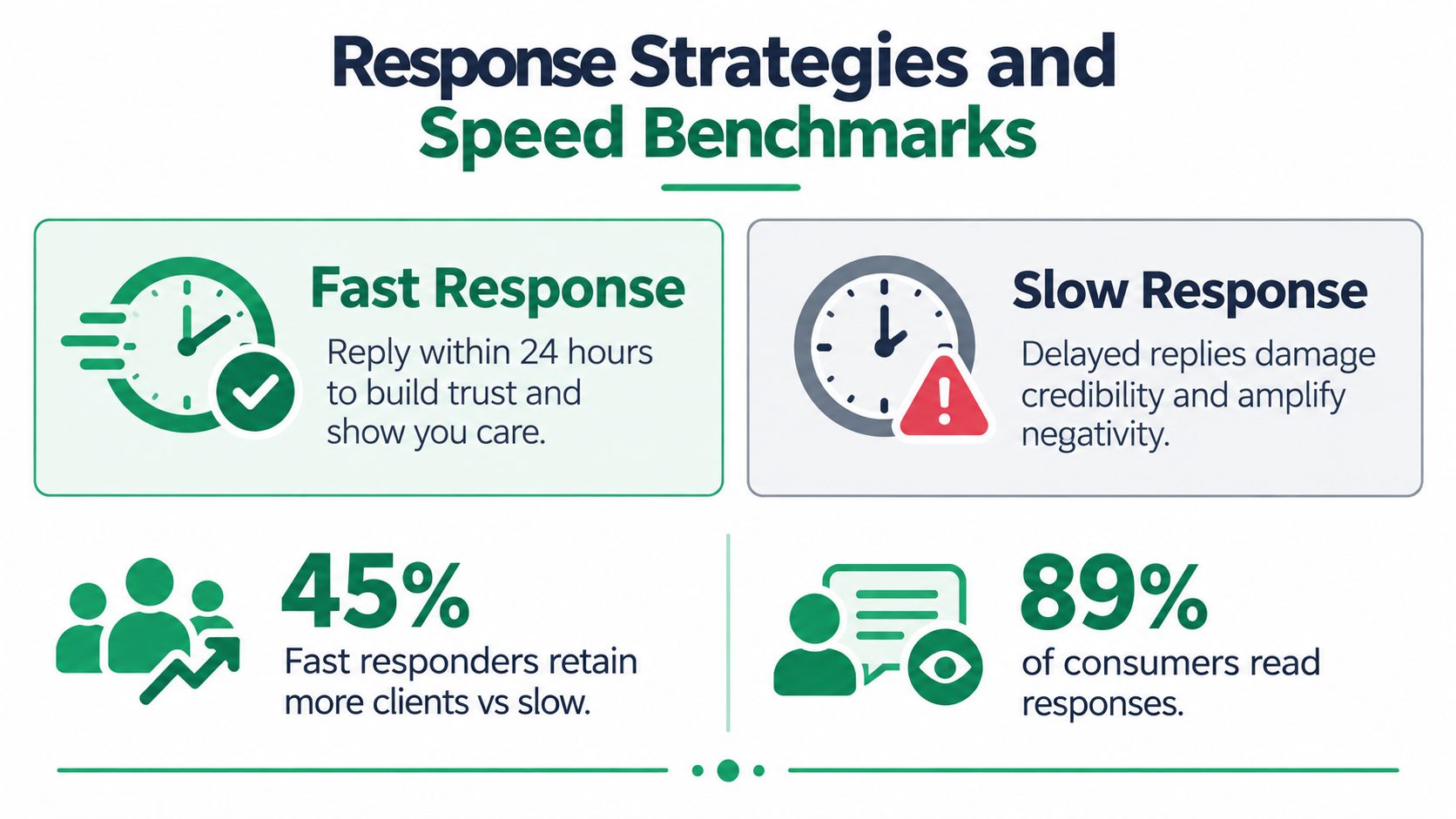
Response Strategies and Speed Benchmarks
Review response speed is an operational promise, not a writing preference. 89% of consumers expect businesses to respond to reviews, and 80% expect a reply to a negative review within 24 hours, according to SearchLab's 2026 online review statistics. Yet only 36% to 37% of businesses actively respond, leaving a clear execution gap for agencies that can maintain dependable coverage.
The 24-hour SLA should be treated as an outer limit for a meaningful public acknowledgement, not permission to wait until the deadline. Detect new reviews in near real time, classify them by sentiment and risk, and route urgent cases to a senior operator. A quick, accurate acknowledgement protects trust better than a fast generic paragraph that ignores the complaint.
Match the response to the facts
For a genuine service failure, use an accommodative response. Acknowledge the experience, accept responsibility where the facts support it, offer a concrete next step, and invite private follow-up. Management-response research summarized by WorldMetrics distinguishes accommodative responses from defensive ones, with accommodative language generally better suited to de-escalation and accountability.
A practical structure looks like this:
- Routine positive review: Thank the customer, mention a specific detail, and reinforce the behavior the team wants to repeat.
- Neutral or mixed review: Appreciate the feedback, address the concern directly, and explain how the client will follow up.
- Genuine negative experience: Apologize for the outcome, state the remedy or next action, and move private details away from the public thread.
- Factual dispute: Avoid admitting an event that records contradict. State the narrow correction, protect personal information, and invite direct contact for verification.
- Safety, discrimination, or legal allegation: Acknowledge receipt without debating the facts publicly, escalate immediately, preserve records, and use approved counsel or senior communications support.
A response shouldn't repeat sensitive details, blame the reviewer, or promise a remedy the client hasn't authorized. Drafting tools can suggest structure, but a human editor must check accuracy, tone, privacy, and whether the reply sounds like the actual business. The practical guide to responding to reviews offers additional response guidance for agency teams.
Measure the queue, not just the copy
Track response rate, median first-response time, time to escalation, resolution status, reopened complaints, and recurring root causes. Review these by location and operator. A high response rate with poor resolution quality is not success. Neither is a fast reply that leaves the same operational defect generating new complaints.
Crisis Management and Negative Feedback Protocols
Not every negative review deserves a crisis call. Treating every complaint as an emergency overwhelms the account team, delays serious cases, and trains clients to ignore alerts.
Use a tiered matrix with clear ownership:
| Level | Typical signal | Agency action |
|---|---|---|
| Routine | Isolated dissatisfaction with no safety, legal, or reputational trigger | Respond through the approved workflow and log the theme |
| Serious | Repeated complaint, staff conduct allegation, privacy concern, or factual dispute with wider visibility | Escalate to the account lead, confirm facts, and coordinate a senior-approved response |
| Crisis | Viral spread, coordinated attack, credible safety allegation, legal threat, regulator interest, or major media attention | Activate the crisis lead, preserve evidence, establish one spokesperson, and move to incident communications |
Protect the client and the agency
The first crisis action is containment, not argument. Freeze unsupervised replies, capture screenshots and timestamps, export relevant records, and identify which claims are verified. Create a single incident log with owners, approvals, decisions, and outstanding questions. That record protects continuity when several people work across time zones and provides a defensible history if legal or regulatory review follows.
Move the conversation offline when personal data, account details, refunds, staff records, or safety information are involved. Keep the public response visible enough to show that the business has acknowledged the issue, but don't turn the review thread into a customer-service transcript.
False accusations still require careful handling. Don't label a reviewer a liar in public. State what can be verified, ask for direct contact, report only content that violates platform rules, and avoid promises of deletion. For coordinated attacks, compare timestamps, language patterns, account behavior, and platform spread before making a public allegation.

Agencies without legal, media, or platform expertise should bring in qualified specialists rather than improvise. Resources such as proven brand reputation protection for Meta can help teams think through platform-specific protection, but the client's counsel should direct legal decisions.
After the incident, keep monitoring active. Review sentiment themes, response compliance, unresolved cases, search visibility, and new review patterns. Recovery means fixing the cause, communicating the correction, and showing consistent behavior over time.
Pricing Models and Service Packaging
Pricing should reflect workload, risk, location complexity, and the level of judgment the agency supplies. A low fee can become unprofitable when every review requires bespoke approval. A high fee is difficult to defend when the scope is limited to forwarding alerts.
The mature agency market supports recurring retainers. 45% of online reputation management agencies charge $1,000 to $5,000 per month for basic services, according to Review42's ORM statistics summary. Use that benchmark as context, not as a universal rate card. Industry, geography, crisis exposure, platform count, and approval requirements all change the cost to serve.
| Model | Best For | Pros | Cons |
|---|---|---|---|
| Flat monthly retainer | A single brand with stable review and monitoring volume | Predictable revenue, simple budgeting, easier staffing | Scope can expand silently unless volume and approval limits are explicit |
| Per-location pricing | Franchises, clinics, branches, and service-area networks | Connects fee to operational complexity and local profiles | Clients may resist paying for inactive locations or uneven demand |
| Project fee | Audits, profile cleanup, crisis preparation, or recovery planning | Clear deliverable and finite commitment | Revenue ends before ongoing behavior is established |
| Performance-based component | Clients with reliable conversion and revenue attribution | Aligns incentives around outcomes | Attribution is contested, and the agency can't control platform decisions or operational failures |
| Hybrid package | Teams needing ongoing monitoring plus specialized projects | Balances predictable service with flexible expansion | Requires careful reporting to prevent double-counting work |
Package the service in layers. A foundation tier can cover monitoring, profile accuracy, review requests, and approved responses. A growth tier can add sentiment analysis, local SEO coordination, location-level reporting, and customer feedback loops. A risk tier can include crisis readiness, senior escalation, search result strategy, and executive communications.
Define boundaries in the statement of work. Specify platforms, locations, response hours, approval windows, review volume assumptions, reporting cadence, revision limits, crisis exclusions, third-party costs, and client responsibilities. Sell measurable process improvements, rating movement, review recency, visibility, and operational insight. Don't guarantee removal, rankings, or revenue lifts that depend on external platforms and client execution.
AI Integration and Future-Proofing Workflows
AI-generated summaries can turn dozens of reviews into a single first impression. Agencies must therefore manage the evidence behind that narrative, not polish individual replies. As noted in the introduction, summaries may shape decisions before customers read the source reviews. Audit which attributes the summary surfaces for each client, including recurring complaints, service strengths, recency, and response behavior.
Design for machine-readable consistency
Use AI to cluster themes across platforms, flag unusual sentiment changes, identify unanswered reviews, and draft response options. Keep human approval for allegations, refunds, safety issues, legal language, identity-sensitive complaints, and anything that could expose private information. The trade-off is clear: automation expands coverage, while review gates protect judgment and client trust.
Set an editorial standard built on specific facts. A response that names the service issue, acknowledges the customer's stated experience, and explains the next step gives readers and summarization systems clearer material than “We value your feedback and strive for excellence.”
Monitor the summary itself as a separate workflow. Record the attributes it associates with the brand, compare them with the review corpus, and investigate mismatches. If an AI answer repeatedly describes slow service, changing response language will not fix the source problem. The client must address the operational cause and collect authentic, recent feedback that reflects the corrected experience.
The AI review management workflow offers a model for mapping automation to human approval. Agencies evaluating software can examine Sight AI for founders and SEOs alongside monitoring, listening, and reporting platforms. AI Tools for Local SEO also catalogs review and reputation management tools, including solutions for multi-location feedback and visibility workflows.
The operating model is AI for detection and prioritization, humans for judgment, clients for operational correction. Document those handoffs, assign owners, and log exceptions. Agencies that preserve this division can increase coverage without giving every client the same synthetic voice.
Reporting, KPIs, and Client Retention
A strong monthly report explains what changed, why it changed, and what the client should do next. Start with a concise scorecard covering response rate, median first-response time, review volume, rating movement, sentiment themes, unresolved cases, and listing accuracy. Add platform and location breakdowns so one strong branch doesn't hide a deteriorating one.
The narrative matters. Show a sample of recurring complaints, connect each theme to an operational owner, and document which recommendations the client accepted. If a service fix preceded a shift in sentiment, describe the sequence without claiming causation the data can't prove. Revenue impact should use the client's own analytics and attribution rules, not an invented lift.
A practical quarterly review checklist
- Baseline: Compare current reputation signals with the onboarding audit.
- Execution: Confirm whether the team met response, escalation, and review-request obligations.
- Insight: Identify the complaint themes or service attributes appearing most often.
- Decision: Recommend a specific change to messaging, staffing, profile content, customer experience, or monitoring.
- Expansion: Add services only when the data reveals a clear need, such as listing cleanup, local SEO support, crisis preparation, or multi-location governance.
Automate data collection and visualization where possible, but keep commentary human. Clients retain agencies that turn dashboards into decisions. The next phase of reputation management for agencies will combine continuous monitoring, AI-assisted interpretation, and disciplined human oversight. Build that system now, document its limits, and make every recommendation traceable to evidence.
Audit your current client accounts this week. Confirm that each one has an approved voice guide, monitored profiles, response ownership, escalation rules, review-request triggers, and a KPI baseline. Then run a live test from new review detection through client approval and reporting. If any step depends on a person remembering what to do, replace that dependency with a documented workflow and contact your team to turn reputation management into a scalable agency service.