You've checked the businesses you compete with in town, exported a competitor keyword report, and ended up with a spreadsheet full of terms that don't match the searches your customers make. Some belong to national publishers. Others trigger no local results at all. A few look promising until you notice that the ranking pages serve a different city, service area, or intent.
Local competitor keyword research only works when it starts with the search results your customers see. The useful question isn't just which keywords another business ranks for. It's which domains appear for relevant searches in a specific market, what local intent those searches reveal, and how you can apply the findings to pages, Google Business Profile assets, and location-level measurement.
Identifying True Local Search Competitors
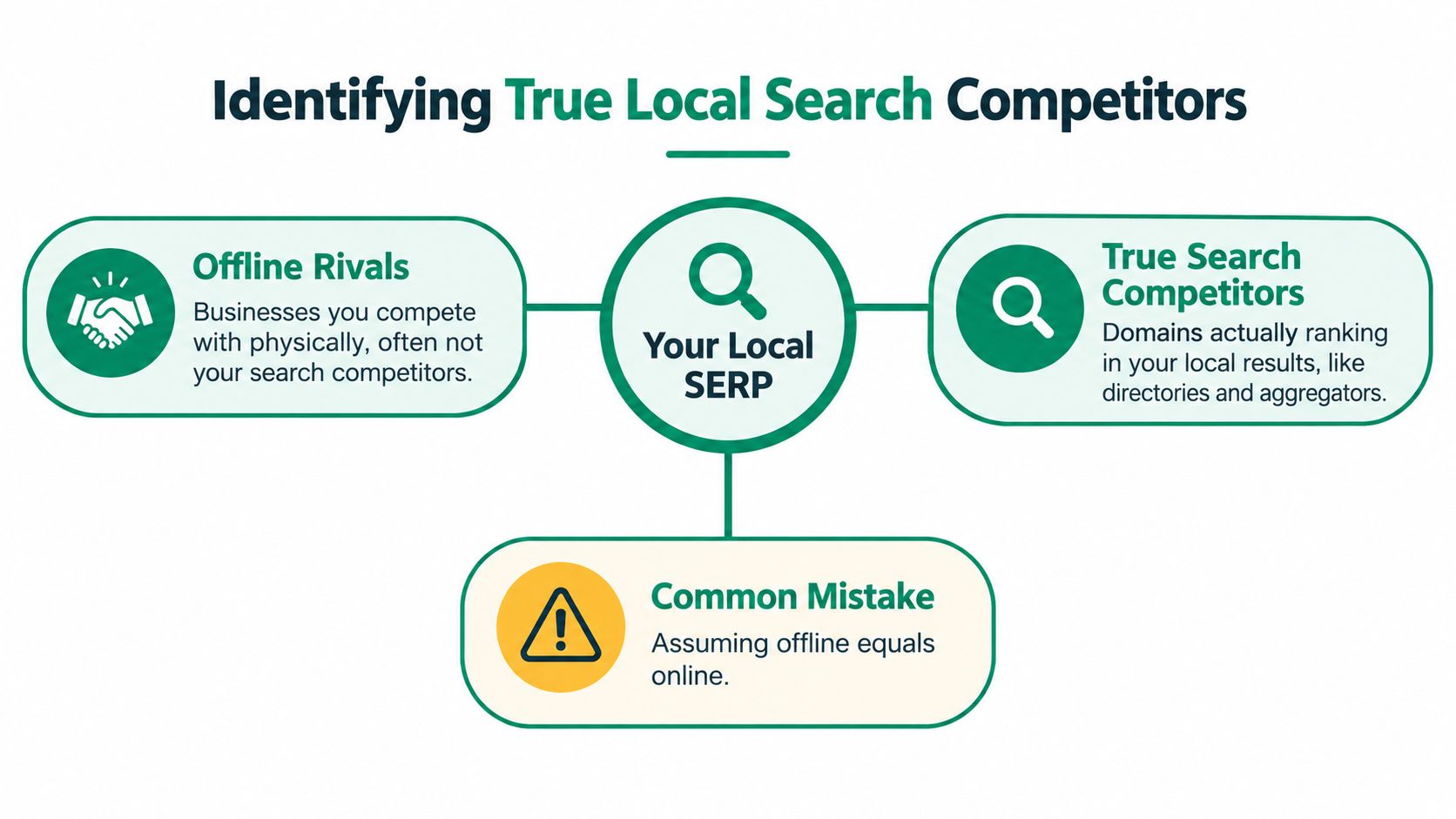
Most local businesses begin with the wrong comparison set. They list nearby companies that sell similar services, then assume those businesses are their main SEO competitors. That can be useful for market research, but it doesn't tell you who is taking visibility from you in Google.
A business rival may have a strong physical presence and weak search visibility. Meanwhile, a regional directory, national aggregator, niche provider, or local publication may appear repeatedly above your service page. For SEO, true competitors are the domains consistently ranking for the searches you want to own. This distinction is also emphasized in guidance on local Maps SEO, where map visibility and organic relevance need to be assessed in the context of the actual local results.
Start with a small set of commercially important searches. Include service terms, service-plus-city terms, neighborhood variants, and queries that reflect urgent action. Search them from the relevant location, record the domains appearing in the organic results and local pack, and note whether the same domains recur.
Build a baseline that reflects local visibility
A useful baseline should contain more than a list of ranking positions. Record:
- Ranking keyword coverage: Which relevant queries produce visibility for your domain and for each recurring competitor?
- Estimated local traffic: Use the same platform and location settings consistently. Treat estimates as directional, not as verified visits.
- SERP feature capture: Note local pack appearances, featured snippets, map results, review elements, and other results that can reduce clicks to traditional pages.
- Page type: Identify whether the ranking URL is a service page, location page, directory listing, article, or Google Business Profile result.
- Market consistency: Check whether the domain appears across the same city, region, or neighborhood searches.
Repeated presence across positions 1 to 10 is more informative than one isolated ranking snapshot. Competitive research guidance recommends benchmarking against 3 to 5 organic competitors and tracking changes in keyword count, estimated traffic, domain authority, and SERP feature capture over time. SE Ranking's keyword research guidance also highlights why rank counts alone can be misleading when zero-click results, featured snippets, and AI-generated answers affect the opportunity to earn a visit.
Practical rule: If a domain appears repeatedly for your priority local queries, include it in the analysis even if you've never heard of the brand offline.
Separate competitors by result type. A directory that dominates “service near me” searches may require a listings and category strategy, while a direct rival with strong city pages calls for page architecture and content comparison. Don't force both into one undifferentiated competitor list. Their visibility comes from different assets, so your response should differ too.
Building a Local Keyword Gap Analysis Workflow
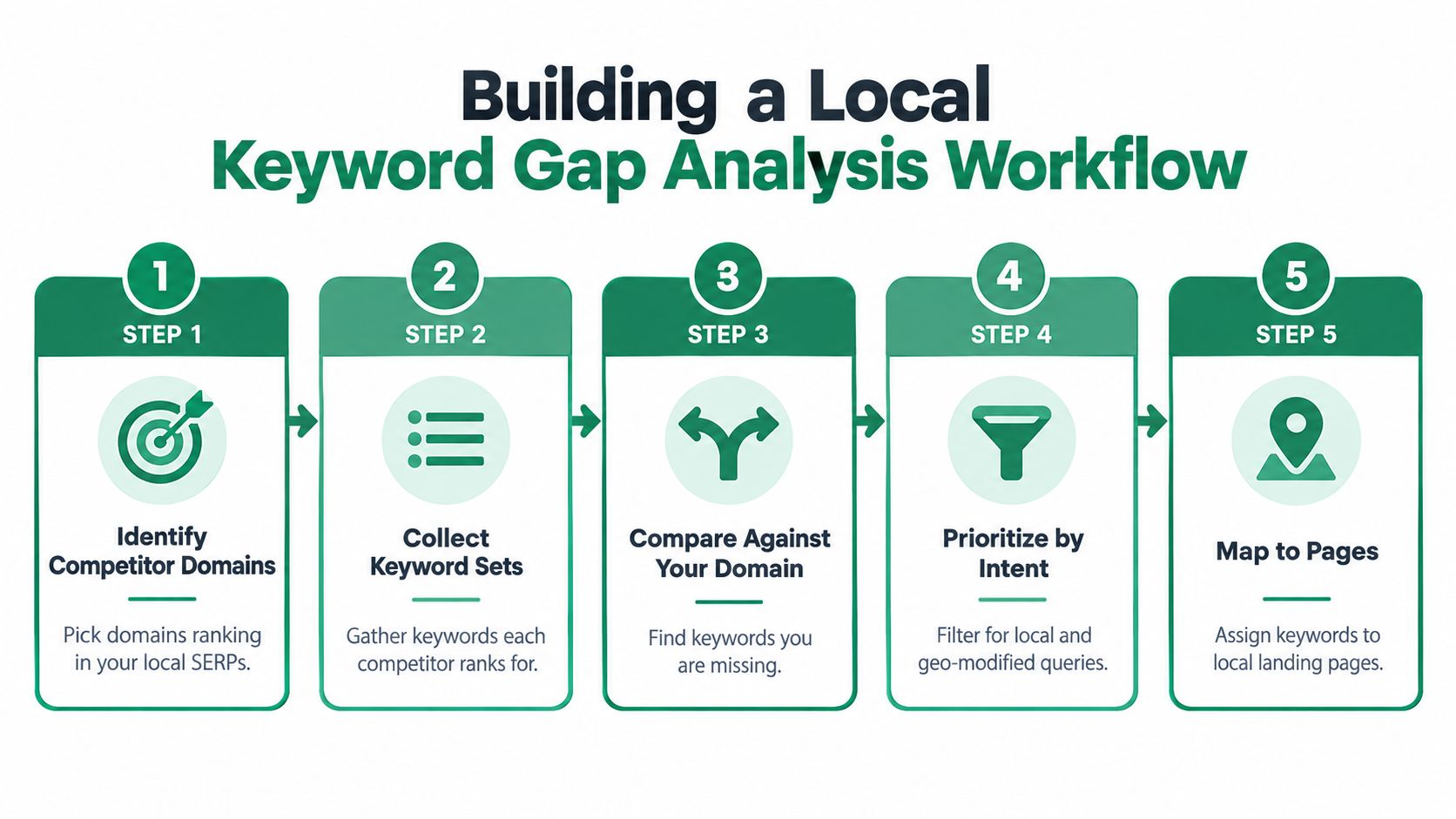
Once the comparison set reflects real SERPs, use a controlled gap workflow. The purpose isn't to collect every keyword competitors rank for. It's to find relevant queries where your business has a credible path to visibility and a clear destination for the traffic.
Use two to four competitor domains in the first comparison. A smaller set keeps the results interpretable, while a larger set can introduce unrelated topics and national pages. The workflow below is deliberately strict.
Start with clean inputs
Confirm that each competitor represents the same market and search intent. Do not compare a local plumber's domain with a national DIY publisher only because both rank for a broad plumbing query. Include the national result only if it repeatedly affects the local SERP and offers a useful content benchmark.
Export ranking keywords for your domain and each competitor. Keep the fields needed for decisions:
- Keyword and location: Preserve city, region, neighborhood, and service-area wording.
- Current rank: Record the latest position for every domain.
- Search volume: Use localized or market-specific settings where the tool supports them.
- Keyword difficulty: Keep the metric from the same platform so comparisons remain consistent.
- Intent and page type: Label the query as service, location, informational, comparison, navigation, or urgent action.
- Competitor URL: This shows whether the gap belongs on a service page, location page, blog resource, or profile-related asset.
If you want a broader explanation of the mechanics behind this process, how to find keyword gaps is a useful supporting resource. The important local adjustment is to validate every exported term against the market where you operate.
Apply position filters before reviewing opportunities
Filter for queries where competitors rank in positions 1 to 20 while your site is absent or ranks below position 20. This removes many weak overlaps and focuses attention on gaps with demonstrated competitive visibility.
Then apply three tests:
- Local relevance: Does the query describe a service you offer in the target area?
- Business relevance: Can the search lead to a call, visit, booking, quote request, or another meaningful action?
- Attainability: Does the difficulty, page quality, and SERP composition make the opportunity realistic?
The strongest priorities usually combine lower keyword difficulty, clear local intent, and business relevance. Search volume matters, but a lower-volume service query can be more valuable than a broad term that attracts people outside your service area.
Group before you create
A missing keyword isn't automatically a new-page brief. Cluster close variants by topic and intent, then map each cluster to an existing or planned URL. A service page might cover several closely related formulations, while a city page should focus on the location and the services available there.
The output should be a short implementation list, not an enormous export. Mark each opportunity as optimize an existing page, create a new local page, improve GBP coverage, support with internal links, or discard. This classification is what turns competitor research into a usable production plan. For localized research methods and market-specific workflows, the localized keyword research guide provides additional context.
Filtering for Geo-Modifiers and Local Intent
A national keyword list can hide the opportunities that matter most to a local operator. Local research needs a geographic matrix, because the same service can produce different competitors, language, and conversion intent across cities and neighborhoods.
Create separate views for city, region, neighborhood, and service-area boundaries. A multi-location brand shouldn't combine every market into one keyword pool. Run the comparison separately for each location, then identify patterns that can be standardized without creating duplicate or thin pages.
Read explicit and implicit geography
Explicit geo-modifiers include a city, district, postal area, or nearby landmark. They're easy to filter because the place name appears in the query. Implicit local intent is more subtle. Searches such as “dentist,” “emergency locksmith,” or “coffee shop near me” may trigger local results based on the searcher's location even when no place name appears.
For every candidate keyword, inspect the live SERP rather than relying only on the wording. If the result includes a local pack, map listings, nearby businesses, or location-specific pages, classify it as local intent. If the results are dominated by national explanations or ecommerce pages, it may belong in a different content stream.
Local intent is a SERP behavior, not just a phrase containing a city name.
Build the matrix around the customer's route
A practical matrix can include:
| Dimension | What to record |
|---|---|
| Market | City, region, neighborhood, or service area |
| Language | Local language, spelling, terminology, and service wording |
| Service | Core service, variant, emergency need, or specialty |
| Intent | Call now, request a quote, visit, compare, or learn |
| SERP type | Local pack, organic pages, directories, maps, or mixed results |
| Destination | GBP, service page, location page, or supporting content |
Regional language differences deserve close attention. Customers may use different names for the same service in neighboring markets, and a translated term may not carry the same commercial meaning. Check local autocomplete suggestions, internal search data, call notes, and the wording used in reviews. Do not manufacture awkward geo-modified copy just to match an export.
For a one-location business, this matrix can stay compact. The priority is separating neighborhood demand from citywide demand and service-area limits. For a multi-location brand, each market needs its own competitor set, rank view, and landing-page decisions. Global guidance similarly recommends repeating gap analysis by region and language instead of treating international data as one combined list.

The final filter is service-area truth. A competitor may rank for a nearby town that you don't serve, while a local directory may rank for an area you do serve but fail to convert. Keep both observations, but only assign a page or GBP asset when the business can fulfill the demand.
Applying Competitor Insights to Local Pages and GBP
Keyword research becomes useful when every opportunity has a destination and an owner. A competitor's ranking term might belong in a location page title, a service section, a GBP service entry, or nowhere at all. The correct placement depends on intent, not on how often the phrase appears in the export.
Map terms to the right local asset
Use the page type already succeeding in the SERP as your first clue. If competitors rank service pages for a city-plus-service query, improve or create the equivalent service page. If location pages dominate, build a useful location page with genuine local information rather than copying the same template across every market.
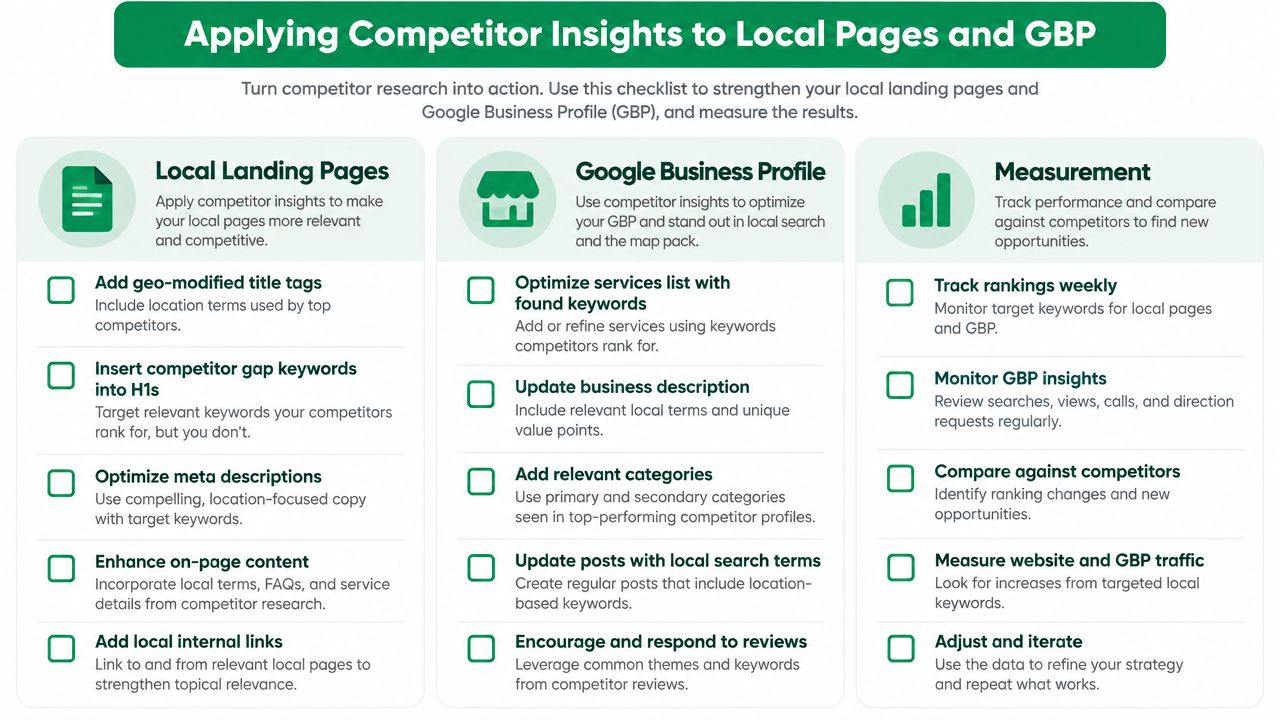
For an existing local landing page, review:
- Title tag: Include the primary service and location naturally.
- H1: Match the page's main intent without turning it into a keyword list.
- Opening copy: Confirm the service, area served, and customer problem early.
- Service sections: Add closely related gap terms where they clarify the offer.
- Internal links: Connect the location page to relevant services and nearby markets.
- Structured data: Use accurate local business and service information that reflects the page.
- Conversion elements: Make phone, booking, directions, and service-area details easy to find.
Don't copy a competitor's wording or create doorway pages for every town. Local pages need distinct value, such as service availability, access details, area-specific proof, staff information, or relevant local questions.
Use GBP as a supporting surface
Google Business Profile content should describe the actual business, not act as a keyword dump. Add discovered services to the services list only when you provide them. Use the business description to explain your offer and service area in plain language, then use posts to highlight timely services, locations, appointments, or customer questions.
A simple deployment pattern works well:
- Service keyword: Add it to the relevant GBP service category and the matching website page.
- Geo-modified query: Reflect the area in the profile's legitimate service coverage and in the relevant location page.
- Question-based gap: Turn the question into a helpful post or FAQ section, then link to the page that answers it.
- Urgent intent: Make contact options and availability prominent rather than burying them in copy.
Reviews require care. You can ask customers to describe the service they received and the area served, but don't script or pressure them into inserting exact keywords. Authentic language is more useful than manufactured repetition, and review requests should comply with platform policies.
Measure the deployment, not just the export
Track the target queries by location and page type. Compare organic positions, local pack visibility, GBP interactions, calls, direction requests, and form submissions where those data are available. Keep the original competitor and SERP notes, because a ranking change may reflect a broader result-page shift rather than a page-specific improvement.
Paid search can add another layer of intent evidence. For a separate view of how to interpret rival advertising terms and landing pages, consult this guide to analyzing rival Google Ads keywords. Use paid data as a supporting signal, not proof that an organic page should target every advertised phrase.
Choosing the Right Tooling Stack for Local Research
Local competitor research rarely depends on one platform. Enterprise SEO suites are strong at broad keyword databases, domain comparisons, and historical reporting. Local tools are better at grid-based visibility, profile monitoring, review workflows, and market-level details. The right stack combines capabilities instead of expecting one dashboard to answer every question.
Match the tool to the decision
| Research need | Useful tool category | What to verify |
|---|---|---|
| Organic competitor discovery | Enterprise SEO platform or SERP database | Country, city, device, and current ranking data |
| Local pack tracking | Local rank tracker or grid tool | Searcher points, map results, and proximity variation |
| Keyword gaps | Keyword gap or content gap platform | Competitor filters, rank thresholds, KD, and volume |
| GBP monitoring | Profile management platform | Categories, services, posts, questions, and insights |
| Citations and listings | Local listings software | Market coverage, duplicate handling, and consistency |
| Reviews | Reputation platform | Location-level monitoring and response workflows |
| Reporting | Dashboard or warehouse layer | Consistent naming, dates, and location segmentation |
Traditional platforms work well when you need to compare domains and export ranking keywords. They often become less useful when you need to understand how visibility changes across a city grid or between neighboring locations. Specialized local tools make those differences easier to see, but they may provide less depth for broad organic content research.
Preserve data quality during automation
Automation helps collect competitor rankings, keyword difficulty, search volume, and URLs, but it can also produce stale or mismatched exports. Build a repeatable enrichment process that checks the market, language, device, date, and ranking type before a keyword reaches your strategy sheet.
A workable stack might pair a domain research platform with a local grid tracker, GBP management software, and a spreadsheet or reporting layer. Use consistent location names and URL conventions so a multi-location team can compare like with like. If you're evaluating automated workflows, Yalc AI SEO automation offers useful background on where AI can assist with repetitive SEO tasks, while human review remains necessary for intent and local accuracy.
AI Tools for Local SEO is another directory option for discovering software across categories such as keyword research, GBP optimization, listings, reviews, rank tracking, and multi-location SEO. Its local keyword research tools directory can help teams compare tools designed for local workflows rather than relying only on general SEO platforms.
Choose the least complicated stack that answers your operating questions. A small business may need a rank tracker, GBP workflow, and a disciplined spreadsheet. A franchise team needs location-level permissions, shared taxonomies, automated reporting, and safeguards against publishing incorrect information across profiles.
Common Local SEO Competitor Research Mistakes
The most expensive mistake is treating the export as the strategy. A gap tool can show that another domain ranks for a term you don't target, but it can't decide whether the term belongs on an existing page, a new location page, a GBP asset, or no asset at all.
Giving every missing keyword its own URL
Local sites often have limited authority and a finite number of genuinely useful topics. Creating separate pages for every close variation can split internal links, duplicate the same information, and make it unclear which URL should rank. Group related terms by intent, then strengthen one authoritative page when the SERP supports that approach.
A new page is justified when the query represents a distinct service, location, audience, or customer need. A separate page usually isn't justified when only the word order changes or the location is outside your real service area.
Using too many competitors
A single gap report with a long list of domains creates false positives. National publishers, directories, agencies, and unrelated businesses may rank for broad terms, but their presence doesn't mean you should copy their content model.
The practical workflow is to compare two to four domains for an actionable gap analysis, while benchmarking three to five recurring organic competitors for broader monitoring. Keep competitor groups organized by market and result type. This prevents a directory's ranking pattern from distorting the priorities for a direct local rival.
Measuring rank counts without SERP behavior
Rank counts can improve while clicks remain limited. Local packs, featured snippets, answer panels, and AI-generated answers can satisfy a search without sending a visitor to the ranking page. Record the SERP features alongside positions and review whether the query supports a meaningful action.
A ranking is an opportunity indicator, not a business outcome.
Ignoring missing data and stale exports
An exported list without current rank, difficulty, volume, location, and URL context is hard to prioritize. Refresh the fields before assigning work, and record the date and search settings. Otherwise, the team may spend time pursuing a gap that has disappeared or never applied to the target market.
Confusing competitor tactics with transferable strategy
A competitor may use a page structure, category, or review pattern that works because of factors you can't reproduce. Study the underlying intent and customer need instead of copying surface details. Your implementation should remain accurate, useful, and consistent with the services and locations you provide.
Audit the process after each research cycle. Remove irrelevant domains, merge overlapping page targets, verify local availability, and assign each remaining opportunity to a page, profile action, or measurement task. That's how competitor keyword research moves from a spreadsheet exercise to a focused local growth system.
Start with your top local services and markets, search them from the locations you serve, and record the domains that repeatedly appear. Then compare your site against a focused competitor set, filter for actionable gaps, map each cluster to a real page or GBP asset, and track the resulting visibility and enquiries. If your locations, competitors, and keyword data are difficult to organize, visit AI Tools for Local SEO to evaluate local-focused software for research, GBP management, listings, reviews, and reporting.