63.6% of consumers check reviews on Google before visiting a business, and 94% will avoid a business after reading a bad review. Review management turns those public opinions into an operating system for earning trust, responding to concerns, and converting local searches into enquiries.
A prospective customer may discover your business through a map result, compare your rating with nearby competitors, and read the latest written comments before visiting your website. They aren't only judging the service you provide. They're judging how consistently you deliver it, how you handle mistakes, and whether your public responses sound like a real person.
That makes review management more than a marketing task. It connects customer experience, local SEO, sales, and daily operations. A strong system helps you earn authentic feedback, spot recurring problems, respond with care, and use customer language to improve the business.
Defining Review Management for Local Growth
A customer searches for a local plumber, dentist, restaurant, or contractor. Before calling, they filter the options by rating, skim recent comments, and look for signs that the business is reliable. If your profile contains unanswered complaints or old reviews, a competitor can win the job without offering a better service.
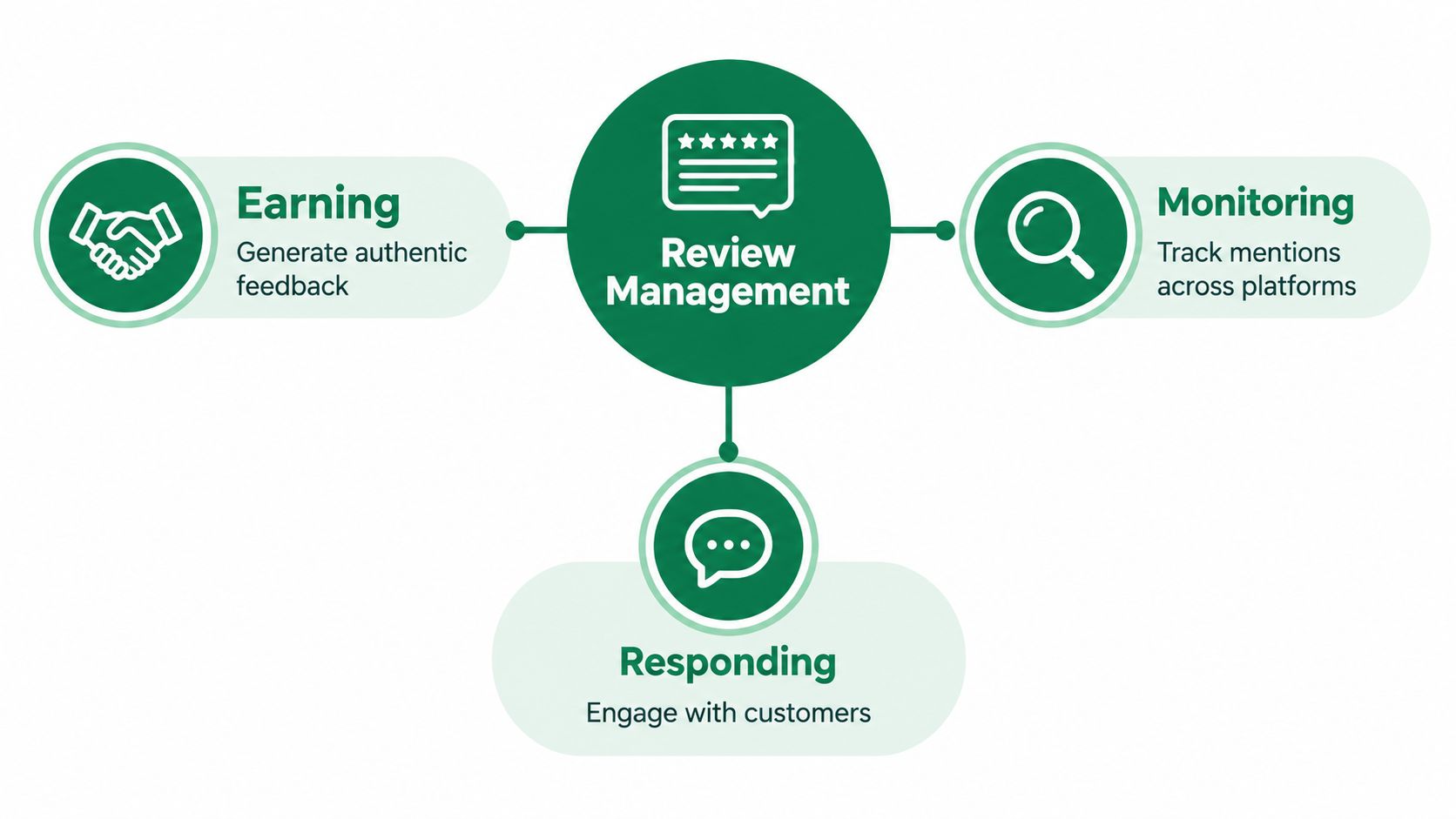
Review management is the systematic process of earning, monitoring, analyzing, and responding to customer feedback across Google, Yelp, industry directories, and other relevant platforms. It isn't the same as asking everyone for a five-star rating. The aim is to create a trustworthy record of customer experiences and show future buyers that your team pays attention.
A 2026 ConsumerAffairs analysis reported that 77% of Americans consider reviews important, one in three won't buy without reading them, and about 80% have avoided a purchase after reading reviews. In local searches, ReviewTrackers reported that 63.6% of consumers check Google reviews before visiting a business, while 94% say a bad review has convinced them to avoid a business. These figures are compiled in ConsumerAffairs' review statistics analysis.
Passive reputation versus active management
A passive reputation is whatever customers happen to find. You might have excellent service, but that quality stays invisible if happy customers never leave feedback. Meanwhile, a small number of negative reviews can dominate the profile because nobody has built a broader, more current picture.
Active management follows a repeatable loop:
- Earn feedback: Ask customers for honest reviews after a meaningful interaction.
- Monitor mentions: Track new reviews, ratings, recurring topics, and suspicious activity.
- Respond publicly: Thank customers, acknowledge concerns, and explain the next step when something goes wrong.
- Improve operations: Share patterns with the people who can fix the underlying issue.
The fourth step matters because reviews aren't only promotional material. They can reveal unclear pricing, missed appointments, slow communication, confusing instructions, or staff members who consistently earn praise. Treat the review profile as a public-facing service report.
Practical rule: Don't manage reviews as if you're polishing a shop window. Manage them as if you're listening at the front desk while every future customer is watching.
For a local business competing in crowded search results, a structured process can help you stop losing jobs to competitors online by making reputation activity part of the customer journey rather than an occasional marketing chore. Google has also confirmed that review management and responses affect local search visibility, so your replies support both trust and discoverability.
The Review Generation Funnel
Most businesses don't have a customer enthusiasm problem. They have a follow-through problem. BrightLocal's 2025 Local Consumer Review Survey found that 96% of consumers are open to writing a business review, but only 29% did so during the past year. The gap exists between willingness and action, and a review-generation funnel closes that gap.
Think of the funnel as a sequence of small decisions. A customer must remember the interaction, feel satisfied enough to respond, notice your request, reach the correct review page, and complete the form. Every unnecessary step reduces the chance that the customer finishes.
The same BrightLocal survey found that 42% of consumers trust reviews as much as personal recommendations, while 63% would lose trust in a business after mostly negative written reviews. The funnel therefore needs to produce a steady, credible mix of feedback, not a sudden burst of generic requests. See the BrightLocal Local Consumer Review Survey for the underlying findings.
Build the funnel around customer moments
First, identify satisfied customers. Look for clear signals such as a completed service, a repeat purchase, positive survey feedback, a thank-you message, or a customer who praises a team member directly. Don't rely on memory. Add a simple trigger to your CRM, booking system, point-of-sale workflow, or support process.
Next, ask at the right time. A home-service company might request feedback after the customer confirms that the work is complete. A clinic might send a request after the appointment. A restaurant could ask shortly after the meal. The best timing depends on when the customer has enough distance to judge the experience but can still remember the details.
Then, remove friction. Send one direct link to the relevant review destination, explain that honest feedback is welcome, and make the request easy to complete on a phone. Useful review request guidance can help teams write messages that sound natural instead of forcing customers through a complicated process.
Ask for detail, not praise
A request such as “Please leave us a five-star review” focuses on the score and can make the interaction feel manufactured. A better prompt invites the customer to describe the part of the experience that helped them.
Try questions such as:
- Experience: What part of the service worked especially well for you?
- Outcome: What problem did the service help you solve?
- People: Was there a team member who made the experience easier?
- Decision support: What would you tell someone considering this service?
These prompts don't script the customer's opinion. They make a blank text box less intimidating. Resources for businesses that want to boost social proof with review requests can help turn those prompts into email and SMS templates.
Finally, monitor the responses. If several customers mention the same problem, route that pattern to the relevant manager. If mostly negative feedback appears in a short period, investigate the operational cause before sending more requests. Review generation should strengthen the customer experience, not hide a service failure.
Response Strategies That Drive Bookings
A review response is a public demonstration of how your business behaves after the transaction. The original reviewer sees it, but so do future customers who are deciding whether to call. A fast, specific reply can make a complaint look contained and a compliment feel sincerely appreciated.
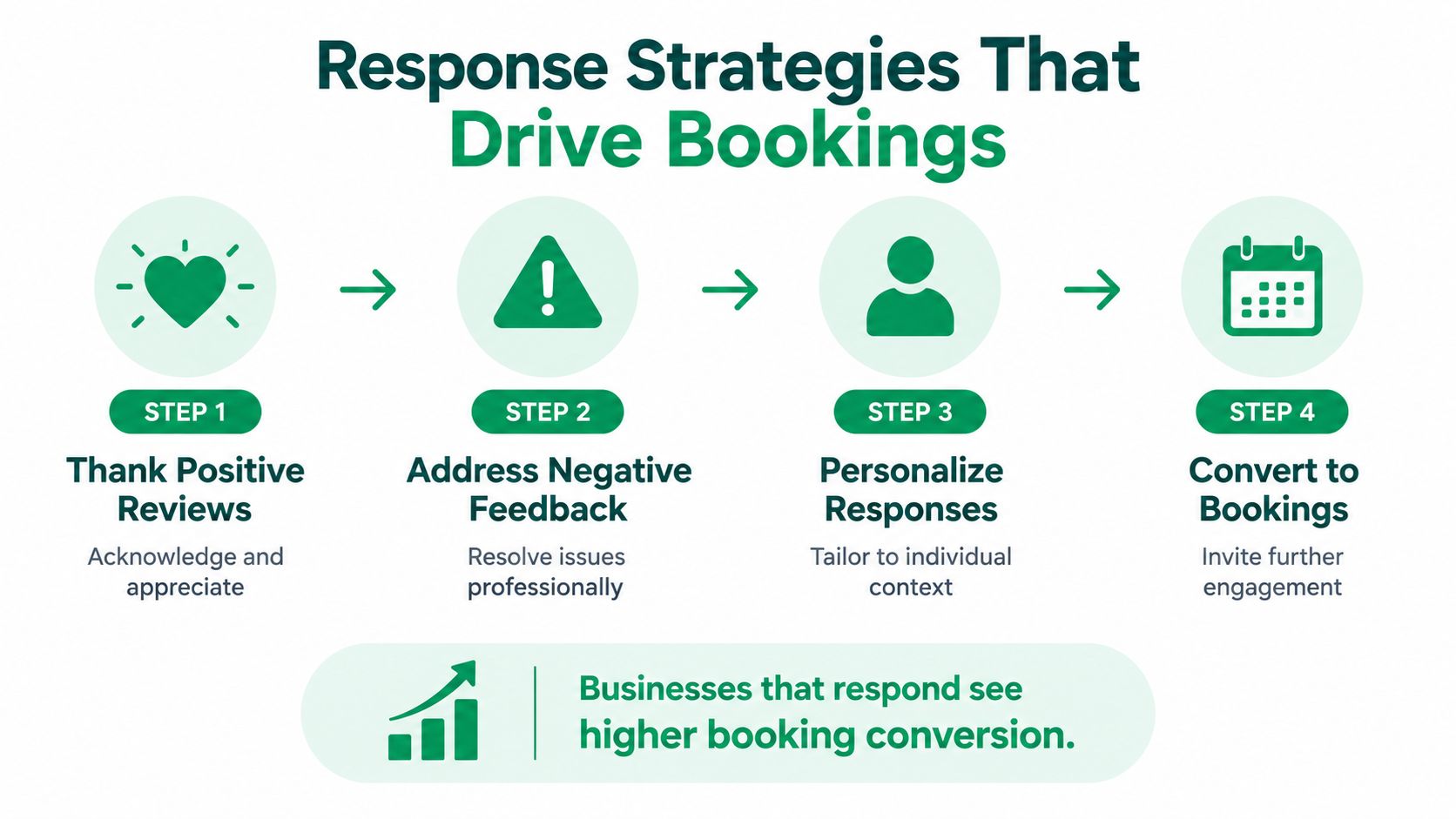
BrightLocal reports that review responses are an important factor for 46% of local consumers, and consumers are twice as likely to use a business that responds to all reviews than one that responds to none. The same reporting cites a benchmark in which businesses responding to more than 75% of reviews received 12% more contact requests or bookings from their Google Business Profile than similar businesses responding to fewer than 25%. The details are available in BrightLocal's guide to responding to online reviews.
Use a response workflow, not improvisation
Start by routing every new review into a shared queue. Assign ownership by location, platform, and risk level. A simple process might look like this:
- Acknowledge positive feedback. Thank the customer and mention one specific detail from the review. “We're glad the installation team explained the controls clearly” is more credible than “Thanks for your feedback.”
- Classify the concern. Separate routine dissatisfaction, service recovery, safety issues, privacy concerns, and allegations of misconduct. Sensitive categories need a trained owner, not a public debate.
- Respond with context. Apologize for the experience where appropriate, avoid excuses, and explain what action the customer can take next. Don't disclose personal information or argue about private details in public.
- Continue privately. Offer a direct contact route for account-specific resolution, then record the outcome internally. Never promise a review change in exchange for compensation or service.
- Close the loop. Share recurring themes with operations, training, scheduling, or product teams.
A positive review doesn't require a long paragraph. A negative review shouldn't receive a defensive essay. The reply should be proportionate, human, and useful to someone who has never visited your business.
Set service levels for response speed
Create a response schedule that your team can sustainably maintain. A single-location owner might review alerts at the start and end of each working day. A multi-location operator may need a central inbox, local approvers, and escalation rules for high-risk complaints.
Track four operational questions:
- Coverage: Did someone respond to the review?
- Speed: How long did the first response take?
- Quality: Did the reply address the specific issue?
- Resolution: Did the complaint reach the right person internally?
A response-rate target has little value if employees copy the same sentence onto every review. Quality control should include periodic sampling, tone checks, and feedback from branch managers. For practical examples, use this guide on how to respond to reviews as a starting point, then adapt the process to your brand voice.
The Quality Over Quantity Paradox
A large review count can look reassuring, but volume alone doesn't tell a customer what it feels like to buy from you. A profile filled with short comments such as “Great service” gives less decision-making information than a smaller collection of detailed reviews that describe the problem, the process, and the result.
A 2025 survey summarized by Yelp found that 88% of review readers trust written reviews more than star ratings alone. A separate 2025 consumer report found that 94% of Americans place some degree of trust in local business reviews, but only 19% completely trust them. The findings, available through GatherUp's review trust report, reveal a useful tension. People consult reviews, but they examine them skeptically.
Specific writing creates believable evidence
Readers look for details that help them compare your business with their own situation. A review that mentions a technician's arrival communication, a restaurant's handling of an allergy request, or a retailer's approach to a return gives future customers something concrete to evaluate.
Your request should encourage that specificity without dictating the conclusion. Ask what the customer needed, what happened during the interaction, and which outcome mattered most. Don't provide a script that asks customers to repeat your marketing language. Scripted praise can make a real review sound artificial.
The same principle applies to responses. Referencing a genuine detail shows that your team read the comment. It also gives searchers useful context about the business, such as the types of services you provide, the questions you answer, or the standards you prioritize.
Protect credibility while growing volume
Never buy reviews, submit reviews for customers, or pressure staff and partners to create feedback. Those shortcuts may inflate the profile temporarily, but they undermine the trust that makes reviews valuable. They can also create platform-policy problems and make suspicious patterns easier to detect.
Use a quality checklist before launching a review campaign:
- Authentic source: The reviewer had a real interaction with the business.
- Independent wording: The customer chose their own language.
- Useful detail: The review describes an experience, not just a score.
- Balanced invitation: The request welcomes honest feedback rather than demanding praise.
- Consistent timing: Customers receive the prompt as part of a normal service workflow.
The objective isn't to collect the highest possible number of comments. It's to build a current, varied, and believable record that helps a stranger decide with confidence.
Using AI to Scale and Protect Reputation
Manual review management works when one person handles a modest number of locations and platforms. It becomes fragile when reviews arrive across many profiles, languages, and service categories. AI can help with the repetitive parts, but it shouldn't become the final authority on sensitive customer situations.
Industry reporting notes that AI and automation handle 42% of review responses in some large-scale datasets. Trustpilot reported that improved AI systems helped remove 90% of detected fake reviews in its 2025 Trust Report. Those figures show two sides of the change. Automation can increase capacity and help platforms detect manipulation, but businesses still need governance to keep their own responses accurate and human. The source is Trustpilot's 2025 Trust Report.
Compare manual and AI-assisted workflows
| Task | Manual approach | AI-assisted approach |
|---|---|---|
| Detection | Staff check platforms individually | A monitoring system gathers new reviews and flags changes |
| Triage | An employee reads every comment in sequence | AI classifies sentiment, topic, location, and urgency |
| Drafting | Staff write each response from scratch | AI suggests a draft using approved tone and business context |
| Approval | A manager reviews the completed reply | A human approves, edits, or escalates the suggested response |
| Learning | Patterns are discussed periodically | Topic and sentiment summaries reveal recurring issues faster |
The safest division of labor is clear. Let AI identify, organize, summarize, translate, and draft. Keep humans responsible for allegations, refunds, safety concerns, legal threats, discrimination claims, privacy matters, and any response that could materially affect the customer relationship.
Create rules before you automate
An AI tool needs a response policy, not just a prompt. Define the tone, prohibited claims, escalation categories, approved contact routes, and circumstances in which the system must stop and request human review. Store examples of strong responses so the tool can follow your standards without copying the same sentence repeatedly.
A manager should also audit generated replies for four risks:
- False certainty: The draft promises an action the business hasn't approved.
- Generic language: The reply could apply to any company or customer.
- Privacy exposure: It repeats personal details in a public forum.
- Missed emotion: It answers the factual issue but ignores the customer's frustration.
A 2026 consumer survey cited in the same Trustpilot reporting found that 97% of consumers read reviews before purchasing and 41% always read them. As review reading becomes routine, your team needs enough capacity to monitor and respond without sacrificing judgment. Businesses exploring AI review management can use the technology as a controlled layer inside the workflow, rather than handing over the brand voice completely.
Building Your Review Management Playbook
A practical playbook turns good intentions into scheduled work. Start with the customer journey, then assign each activity to a person, tool, or team.
Your operating checklist
- Claim profiles: Verify and complete Google Business Profile, Yelp, and relevant industry listings.
- Request feedback: Trigger an email or SMS after service completion, using a direct review link and an honest prompt.
- Respond daily: Review new feedback, answer routine comments, and escalate sensitive complaints.
- Review sentiment weekly: Group recurring praise and complaints by location, service, employee, and customer journey stage.
- Check authenticity: Investigate unusual bursts, duplicate language, or reviews that don't match known transactions.
- Improve the operation: Give managers a short list of issues to fix and positive behaviors to reinforce.
Track response rate, average response time, review volume, and star-rating trend. Pair those reputation metrics with business outcomes such as calls, direction requests, bookings, and completed enquiries, so the team can see whether better management is helping customers take the next step.
Use a shared dashboard or customer feedback system to combine public reviews with internal survey comments. A guide to feedback tools for product teams can help you evaluate ways to organize that broader feedback loop.
Review management isn't a one-time cleanup. It works as a continuous cycle: deliver a good experience, request honest feedback, respond thoughtfully, identify patterns, and improve the service. Start this week by assigning one owner, scheduling the first daily review check, and rewriting your review request to invite a specific customer detail.
Make review management part of your next team meeting. Audit every active profile, identify unanswered reviews, choose one response owner, and create a post-service request that customers can complete without friction. Consistent execution will help your business appear more trustworthy when local buyers compare their options.