A business lead is a person or organization with demonstrated interest and potential fit to become a paying customer, but only qualified leads with budget, authority, need, and timing drive revenue. Organizations generate about 1,877 leads per month on average, while average B2B cost per lead is about $198–$200, so knowing which contacts deserve attention matters. Martal's lead-generation benchmarks also report that roughly 79–80% of marketing leads never become customers, which makes clear definitions essential.
A local business can feel busy and still lack a workable lead system. A plumber may receive a call from someone asking for an emergency repair, a website form from a homeowner comparing prices, and a message from a property manager planning work for several buildings. All three are contacts. They aren't necessarily equal opportunities.
The difference affects who gets called first, how marketing performance is judged, and whether sales time goes toward people who can buy. This guide explains what is a business lead, how lead types change as intent becomes clearer, how to qualify behavior and fit, and how local teams can connect search activity to revenue.
Introduction Why Every Local Business Needs to Understand Leads
At 9 a.m., a dental clinic manager opens the inbox to three new inquiries. One person asks whether the clinic accepts a particular insurance plan. Another requests an appointment next week. A third submits only a name and email address. Without a shared rule, the front desk cannot tell which inquiry deserves immediate attention, which needs follow-up, or which may not fit the clinic.
The same problem appears across local businesses. A Google Business Profile call, quote request, review response, walk-in conversation, and service-page download enter through different channels. Counting every interaction as a lead can make reports look healthy while staff pursue low-intent contacts. Counting only completed forms misses buying signals in calls, replies, direct messages, and research involving several people at one account.
Lead generation also carries a real cost. Average B2B cost per lead is around $198–$200, according to industry lead-generation benchmarks. A local business does not need to chase volume at any cost. It needs a definition that connects each captured opportunity to an appropriate follow-up path.
Practical rule: A contact enters your records. A lead earns attention through demonstrated interest or meaningful fit. A qualified lead earns sales priority.
For a home-service company, qualification may combine service-area match, requested job, urgency, and a quote conversation. A franchise may also need to identify the right location, while a larger property account may involve an owner, manager, and purchasing contact. These signals belong to one opportunity, even when they arrive through separate channels. If you are building a stronger system to attract qualified home service customers, separate capture from qualification rather than treating every inquiry as sales-ready.
The useful question is whether the interaction, account, behavior, and buying context together show a realistic opportunity. That approach gives local teams a clearer way to score fit, intent, and follow-up priority.
What a Business Lead Really Means Beyond a Contact
A property manager calls about recurring maintenance, while a facilities coordinator has already reviewed your service page. Each interaction belongs to the same potential account. Together, they may show more buying intent than one completed form.
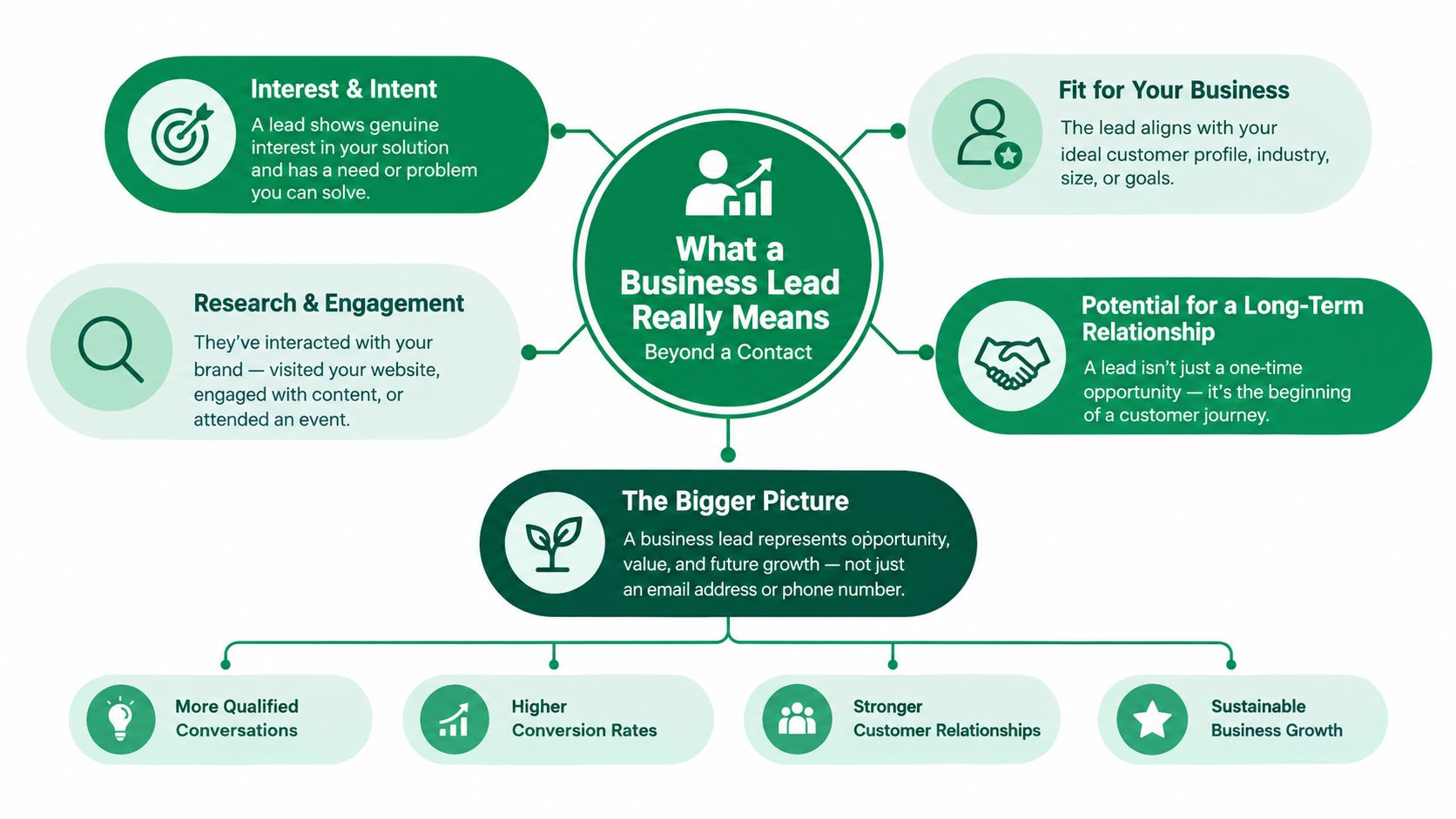
A business lead is a person or organization that shows relevant interest and has a plausible fit for a company's offer. Two signals support that definition:
- Interest, shown through an action, reply, call, or conversation.
- Fit, shown by a relevant problem, service area, location, role, or account profile.
A name in a spreadsheet is a contact, not automatically a useful lead. Someone who visits a local restaurant's menu once may be browsing, gathering information, or looking for a job. Someone who asks whether the restaurant can cater a specific event has created a clearer opportunity, even without submitting a form.
Contact, lead, and qualified lead
A local showroom offers a simple comparison. A passerby at the window belongs to the audience. A visitor who asks about delivery has shown interest. A visitor who explains the product needed, confirms the service area, and requests a proposal has supplied stronger evidence for sales follow-up.
The same progression applies online:
- A contact is identifiable information or a recorded interaction.
- A lead combines that contact with relevant interest or potential customer fit.
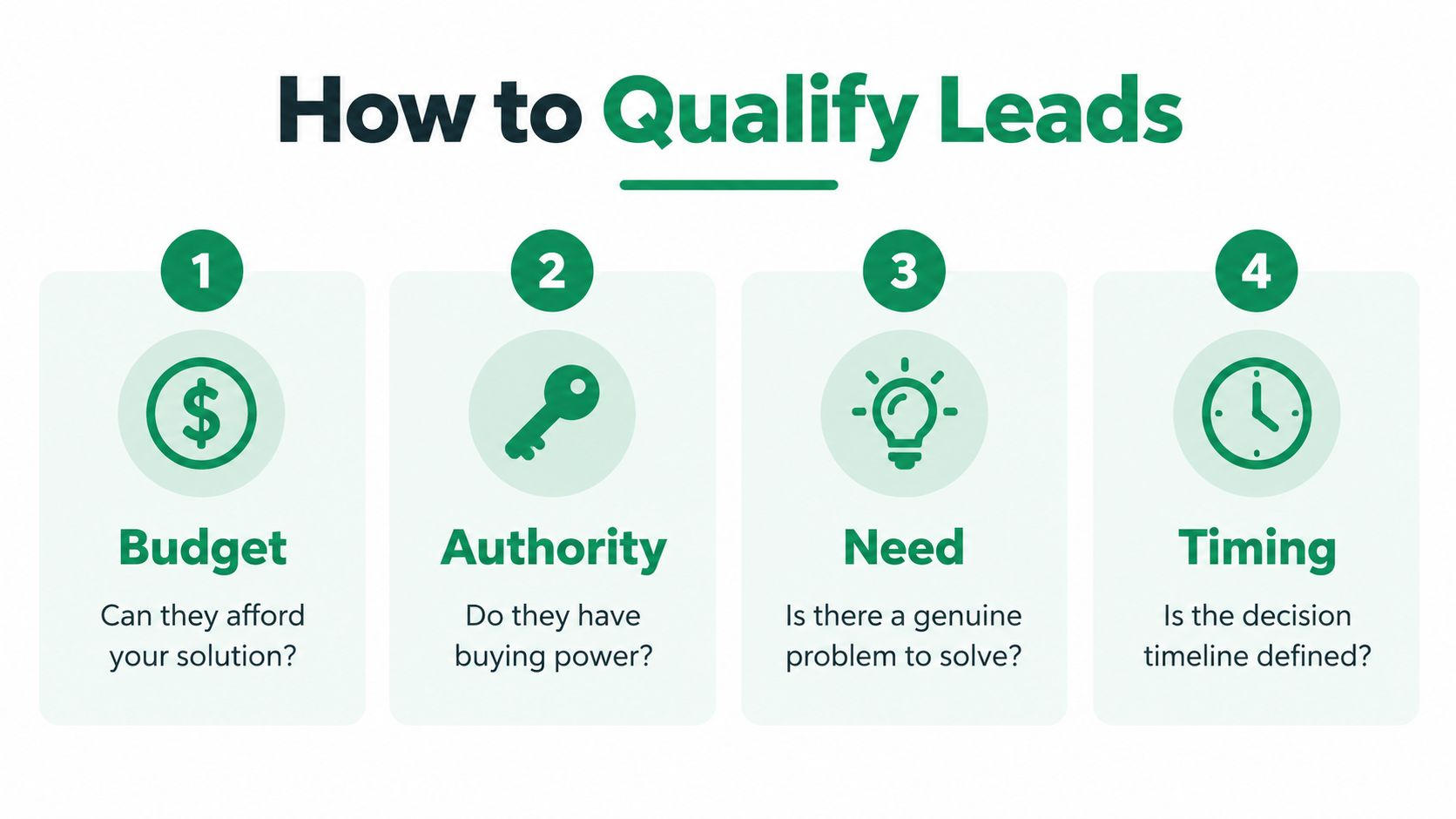
- A qualified lead passes a practical check for budget, authority, need, and timing.
Qualification does not promise a purchase. It gives the team a reasonable basis for deciding whether sales effort is appropriate. Amplitude's guide to qualified leads explains qualification as a fit-and-affordability filter, including whether the prospect has a genuine need and can pay for a solution.
Why local leads need an account-level view
One contact can represent a wider buying group. A store manager may research a service, a franchise owner may approve spending, and a regional operator may compare vendors across locations. Treating each person as a separate lead can hide the account's actual progress.
Review an inquiry through three layers:
- Person: Who interacted, and what role do they have?
- Account: Which business, location, franchise, or property do they represent?
- Signals: What did the account do across calls, pages, replies, reviews, and conversations?
This view helps local teams score behavior, fit, and intent together. A form source may generate volume but little relevance. Separate calls, page visits, and replies from several stakeholders may look minor individually, yet point to coordinated research when connected to one franchise or property account.
A lead is therefore a multi-signal opportunity, not a single form field. The stronger the signals are, the better they align with the account, role, and buying context, and the clearer the next action becomes. Each interaction should add context to the opportunity record rather than create an isolated name.
Main Types of Business Leads You Will Encounter
A local business may receive a call from a homeowner, a quote request from a franchise manager, and a referral from a partner on the same day. These contacts belong to different lead types, but the labels are working categories, not permanent identities. One opportunity can begin as inbound, show enough engagement to become an MQL, and reach SQL status after sales confirms the need.
| Lead Type | Typical Source | Intent Signal | Owner and Next Step |
|---|---|---|---|
| Inbound lead | Search, local landing page, Google Business Profile, content, call | The prospect finds the business while researching a need | Marketing records context and routes relevant inquiries |
| Outbound lead | Prospecting email, direct outreach, networking, local partnerships | The business identifies a possible fit before the prospect asks for help | Sales checks relevance and starts a conversation |
| Marketing qualified lead, or MQL | Repeated content engagement, service-page activity, event interaction, or useful form submission | Interest and fit support structured nurture or review | Marketing checks the agreed threshold and sends it for sales assessment |
| Sales qualified lead, or SQL | Sales conversation, quote request, confirmed need, or buying discussion | The prospect has a problem worth solving and is ready for a commercial conversation | Sales confirms qualification and advances the opportunity |
| Referral lead | Existing customer, partner, professional network, or community recommendation | Trust comes through the referrer, while fit still requires checking | The assigned owner responds promptly and records the source |
| Local lead | Location-specific search, phone call, direction request, walk-in, or area page | The prospect appears connected to the service area or physical location | The local team confirms geography, availability, and need |
A form submission is a contact event. A lead is the connected opportunity behind the activity. For account-level review, record three details together: the person and role, the business or location represented, and the signals gathered across calls, page visits, replies, reviews, and conversations.
That structure matters for franchises and multi-stakeholder purchases. A store manager may research a service, an owner may approve spending, and a regional operator may compare providers. Counting each person separately can hide coordinated research. Several modest actions tied to one franchise or property may show more intent than one isolated form.
An MQL means marketing has gathered enough evidence for review, not that sales should accept it automatically. An SQL means sales has accepted the conversation as commercially relevant, not that the account will become a customer.
Search wording adds another signal. General advice often indicates early research, while a service-and-location phrase may suggest stronger intent. A guide to high-intent keywords can help local teams organize these signals without treating every keyword as equal buying readiness.
The label only helps when it leads to an owner and action. An unanswered inbound inquiry can stall, a referral sent to the wrong branch can vanish, and a local lead outside the service area can waste time and budget. Track behavior, fit, and intent together, then assign the next action to the right team.
How the Lead Lifecycle Moves From Interest to Customer
A local business can receive a quote request in the morning, a phone call at lunch, and a review-page visit that evening from people connected to one franchise account. Those actions form a journey, not three unrelated contacts. The lead lifecycle tracks how interest becomes evidence, how evidence earns a response, and how a qualified account becomes a customer.
The stages in practical order
Visitor to lead begins when an anonymous interaction becomes identifiable or commercially meaningful. A call, quote request, appointment inquiry, reply, or account signal tied to a target organization can qualify. A form is one route, not the definition.
Lead to MQL occurs when available evidence points to a relevant problem and reasonable fit. For example, a local roofing company may value a service-area match paired with a detailed project inquiry more than a generic newsletter signup.
MQL to SQL requires sales acceptance. A team member reviews the context, confirms relevance, and decides whether direct outreach makes sense. Marketing and sales should define this gate before campaigns begin.
SQL to opportunity means the conversation has become a defined commercial possibility. The team understands the need, proposed service, participating stakeholders, and likely next action. For franchise and multi-location accounts, the record should connect each person to the same business or location so coordinated research is not split into separate leads.
Opportunity to customer follows a proposal, appointment, booking, contract, or purchase. Keep the original source attached to the account because it shows which local touchpoints create worthwhile conversations.
B2B buyers often research extensively before speaking with a seller. Industry lead-generation research reports that buyers may avoid seller contact until roughly two-thirds of their buying journey. Search content, service pages, reviews, and nurturing therefore support early-stage progress, even when no form has been submitted.
Response time changes the value of a captured inquiry. Contacting a lead within 5 minutes can produce conversion rates 8× to 9× higher than slower follow-up, according to Martal's lead-response data. A local team needs an owner, an alert, accurate contact details, and a useful first response. That simple system keeps promising account signals from going cold.
How to Qualify Leads and Separate Real Opportunities
Qualification protects sales time by asking whether an inquiry deserves progression. Start with the four practical questions: budget, authority, need, and timing. The answers don't have to be exact. They need to be clear enough to distinguish a plausible opportunity from casual interest.
Fit comes before enthusiasm
A prospect can be highly engaged and still be a poor fit. Check service area, business type, location, project size, role, and requested solution before allowing repeated page visits or content downloads to dominate the score.
For a franchise network, combine person-level and account-level information. A store manager may provide useful operational detail but lack purchasing authority. A regional operator may not have submitted the inquiry but could control the decision. Both signals belong in the account record.
Behavior fills in the gaps
Not every lead submits a form, and not every form submission demonstrates buying intent. Useful first-party signals can include:
- Pricing activity: A visit to pricing, service packages, or quote pages indicates stronger commercial curiosity than a general blog visit.
- Conversation behavior: A reply, phone discussion, direct message, or question about availability creates context that a pageview cannot.
- Engagement depth: Several relevant interactions across service pages, FAQs, reviews, and booking content can support a lead assessment.
- Account participation: Activity from multiple people at one franchise, business, or location may signal a shared buying process.
Use a simple scoring model if the team is small. Give more weight to fit and direct intent, reduce priority when the service area is wrong or the inquiry is unrelated, and let recent behavior matter more than old activity. In privacy-constrained environments, rely on information the prospect gives the business and on transparent, consent-aware first-party interactions. Growform's explanation of lead scoring offers further context for turning qualification criteria into a working process.
AI can help organize signals, summarize conversations, and flag likely priority accounts, but it shouldn't replace human review. A model that can't explain why it raised or lowered priority creates a new source of confusion. Keep the criteria visible, test them against sales outcomes, and adjust them when the team repeatedly accepts or rejects the same kinds of inquiries.
Metrics That Show Whether Your Leads Drive Revenue
Lead volume answers only one question, how many opportunities entered the system. Revenue reporting needs to show what happened afterward. A local marketing manager should be able to see whether visitors became identifiable leads, whether those leads were accepted, and whether accepted leads created genuine opportunities.
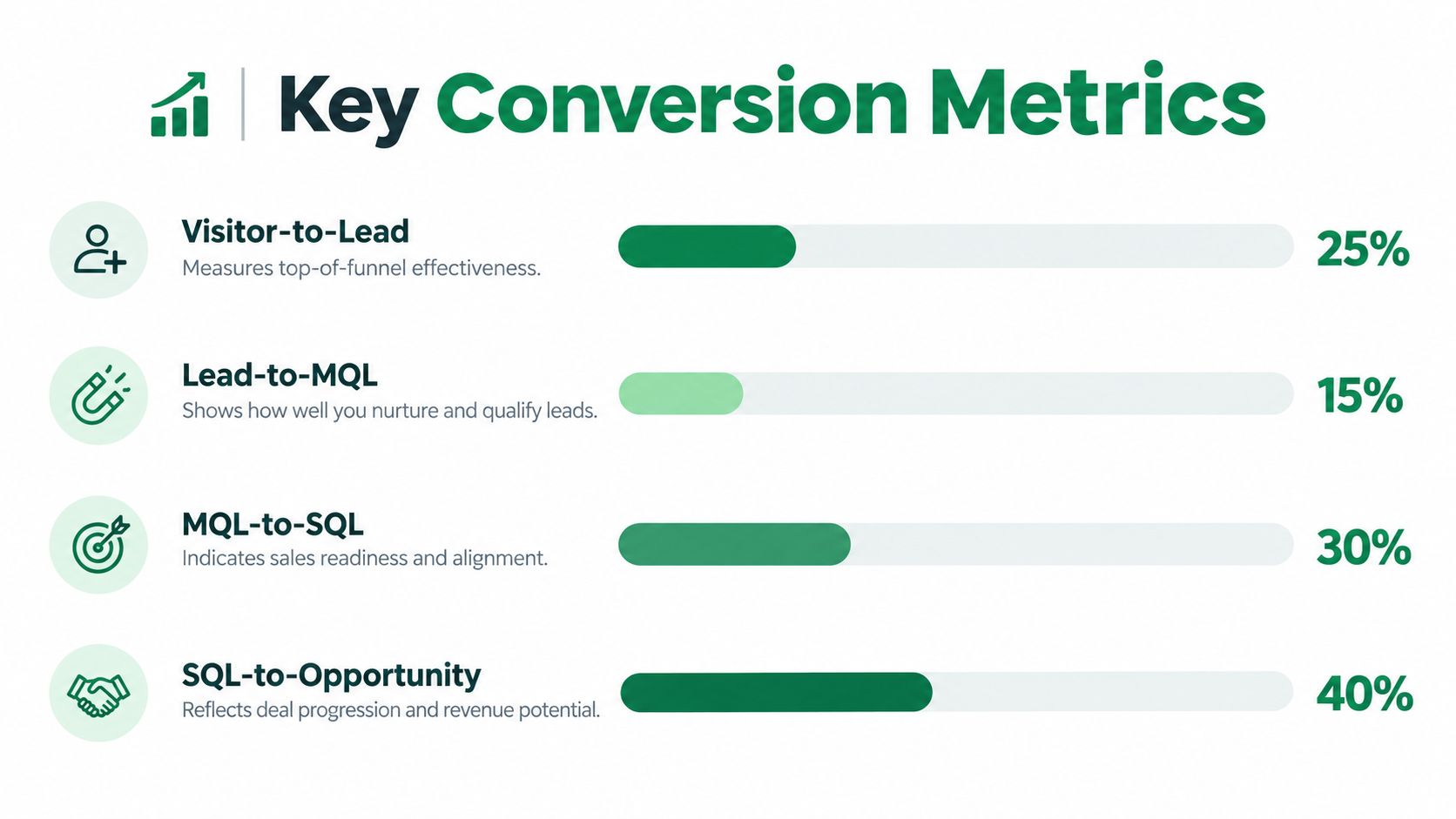
Track the funnel as connected rates:
- Visitor-to-lead: Shows whether pages, calls, and local search paths create identifiable action.
- Lead-to-MQL: Shows whether captured contacts have enough fit and engagement for marketing qualification.
- MQL-to-SQL: Shows whether sales accepts the quality of marketing-qualified inquiries.
- SQL-to-opportunity: Shows whether accepted conversations develop into defined commercial possibilities.
Recent industry data places overall lead conversion at about 5.13% across multiple industries, while typical B2B visitor-to-lead conversion sits near 2% to 5%. The same lead-generation benchmark source describes MQL-to-SQL conversion as often being in the low double digits, with SQL-to-opportunity materially higher after sales acceptance. Treat these as directional benchmarks, not promises for a specific business.
Measure volume and efficiency separately
A landing-page improvement may increase the number of inquiries without improving the number of qualified opportunities. Better scoring and routing may reduce the apparent lead count while helping sales spend more time on relevant conversations. Those are different wins, and the dashboard should keep them separate.
Track source with enough detail to compare meaningful paths. For local SEO, that might include:
- Google Business Profile calls and messages
- Location or service pages
- Organic search queries
- Referral partners
- Direct traffic and branded searches
- Branch or franchise location
Also record response time, assigned location, qualification result, opportunity status, and closed revenue where possible. A source that generates many contacts but few accepted opportunities needs a different fix from a source that creates strong opportunities but suffers from slow follow-up.
For landing pages, use a focused review of conversion optimization for local traffic. Improve the path that turns relevant visitors into conversations, then review whether the resulting inquiries match the ideal customer profile.
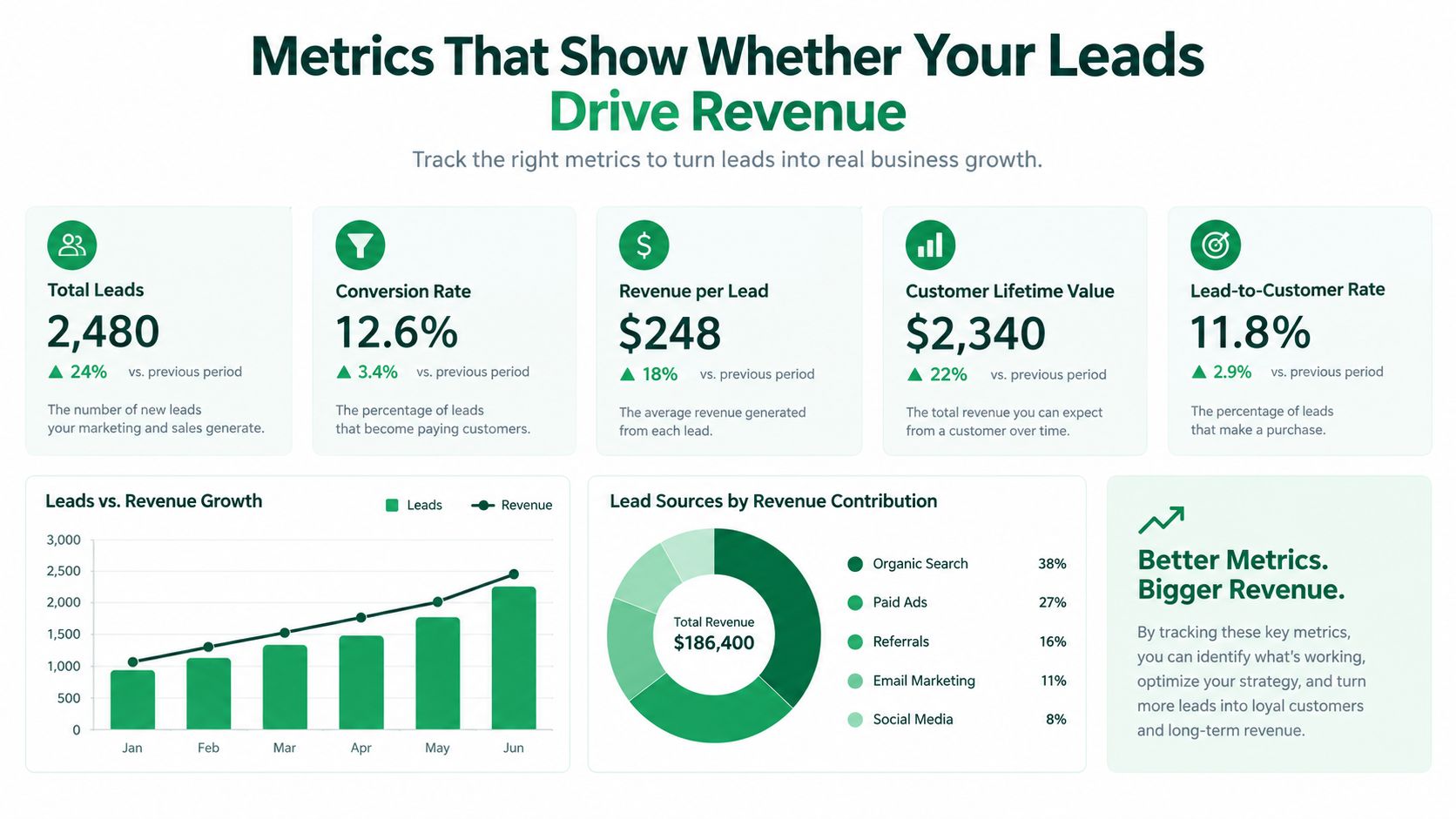
Reporting habit: Never celebrate lead volume without checking acceptance, opportunity creation, and the quality of the accounts behind it.
Local Business Examples and Next Steps With AI Tools
A plumber, dental clinic, restaurant, and franchise can all generate leads, but their strongest signals differ.
A plumber should prioritize service area, emergency status, job type, property ownership, and a request for availability or pricing. A dental clinic may weigh appointment intent, treatment type, insurance questions, and location. A restaurant may separate a casual menu visitor from someone asking about catering capacity, date, guest needs, and booking terms. A franchise team should connect each inquiry to the relevant location while also looking for activity from owners, managers, and regional decision-makers.
Use this operating checklist:
- List every capture point. Include calls, messages, forms, booking tools, walk-ins, referrals, review conversations, and meaningful account activity.
- Define the minimum lead standard. State what counts as interest, what counts as fit, and what information sales needs before follow-up.
- Add account context. Record location, branch, franchise relationship, role, service area, and other details that affect routing.
- Create a priority model. Weight direct buying signals and strong fit above passive engagement, then document disqualifying conditions.
- Set ownership. Every qualified inquiry needs a person or team responsible for the next action.
- Review outcomes. Compare sources by qualified leads, accepted leads, opportunities, and customers, not raw submissions alone.
AI tools can support this workflow by summarizing calls, identifying missing qualification details, organizing Google Business Profile activity, monitoring rankings, managing reviews, and routing inquiries across locations. Choose tools based on the work your team needs, then connect their output to a CRM or shared operating record.
For a broader local workflow, review local business lead generation strategies and adapt the ideas to your service area, staffing, and sales process. The best system isn't the one with the most automation. It's the one that helps the right person respond to the right opportunity with enough context to be useful.
What is a business lead in practical terms? It's a potential customer opportunity supported by fit, intent, and observable signals. Audit your capture points this week, write your qualification rules, and use the AI Tools for Local SEO directory to find tools for Google Business Profile optimization, listings, review management, rank tracking, and local marketing automation. Build the system around qualified opportunities, then measure whether those opportunities become revenue.
Start your audit today. List your last ten inquiries, classify each as contact, lead, qualified lead, or opportunity, and record the signal that supports the decision. Then choose one local SEO or automation tool from AI Tools for Local SEO to improve capture, routing, or follow-up before your next reporting cycle.