Have you ever wondered why two businesses with similar service and similar prices can get very different results, because one business understands how to handle reviews and the other treats them like an inbox chore? That gap is the whole story behind review management. It's not just about collecting praise, it's about running a system that shapes trust, local visibility, and the decision to walk through your door.
Introduction, Why Reviews Are the New Word of Mouth
Why do two local businesses with similar prices and service levels end up with very different results? The answer often sits in their reviews. Customers still ask friends and family for advice, but they also check Google and other review platforms before they decide. That is why review management has moved from a background task to part of the operating system of a local business.
The scale of that shift is hard to miss. More than 99% of American consumers read online reviews before buying, reviews influence 93% of purchasing decisions, and people read an average of 10 reviews before trusting a business (Capital One Shopping research on online reviews). Trust is more layered than a simple star rating, too. Some consumers trust online reviews as much as personal recommendations, and many trust reviews more when the feedback looks mixed instead of perfectly polished.

For a local business, that means the job is bigger than asking for praise. Review management means requesting feedback, monitoring several platforms, answering quickly, and keeping a profile that feels credible to customers and readable to search engines. It works like the front desk for your reputation. If it is active and organized, people feel confident moving ahead. If it is slow or neglected, hesitation grows, and that shows up in clicks, calls, and bookings.
Practical rule: if reviews shape buying decisions, review management is the system that keeps those decisions working in your favor without making your profile look fake.
Defining Review Management and Its Core Components
Review management is the system behind how a business receives, monitors, interprets, and responds to customer feedback. Moz describes it as a plan for getting alerts on new reviews, responding to all reviews, and collecting sentiment so the business can improve its processes and syndicate review content across important website pages (Moz local reviews). That framing matters because it moves the topic out of customer-service-only territory and into operations.
A good way to think about it is like a radar system. Radar doesn't just detect a signal, it helps operators decide what needs attention, what's normal, and what needs an immediate response. Review management works the same way for local businesses, because it surfaces service issues, reputation risks, and recurring themes before they drag down ratings.
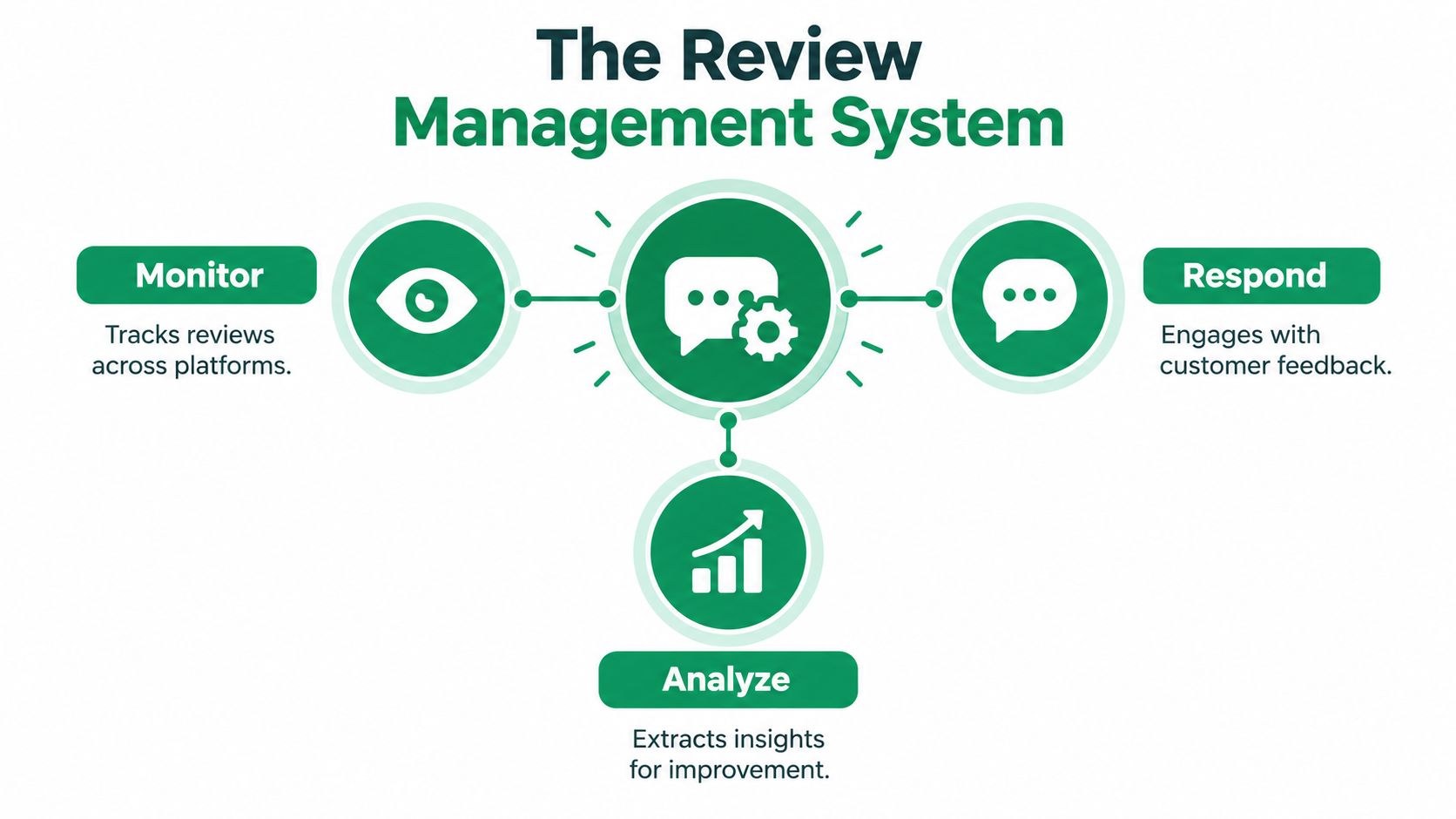
The four pieces that make the system work
A practical review workflow usually includes proactive review generation, multi-platform monitoring, timely response, and sentiment analysis. Those parts work together, because asking for reviews without monitoring them leaves blind spots, and monitoring without response leaves trust on the table.
- Proactive generation: ask recent customers for feedback while the experience is still fresh.
- Platform coverage: track where people leave reviews, not just the one site you check most often.
- Response workflow: route reviews to the right person, especially when the issue needs escalation.
- Sentiment analysis: identify repeated praise or complaints, then turn that into operational fixes.
That structure becomes especially important when people expect real engagement from the business itself. If you want a practical breakdown of how to ask for feedback without sounding pushy, this guide on how to ask for a review is a useful companion. And if you're comparing software names and case examples, the Drivebot reviews article is a good reference point for how review tools are evaluated in practice.
The Local SEO Connection, How Reviews Drive Visibility
Reviews matter for local SEO because search platforms use them as signals of trust and relevance, not just as public comments. A 2023 study on local search platforms found that reviews are incorporated into ranking factors across Google, Bing, and Yelp, and that they also affect how information is presented to searchers in local results (SearchLab local SEO statistics). That means the review profile a customer sees can shape visibility before they ever visit your site.
The part many business owners miss is that the search impact is not only about raw volume. Review recency, consistency, and distribution matter because platforms use those signals to judge whether a business is active and relevant. If reviews arrive in a steady pattern and responses stay current, the profile feels alive. If reviews come in bursts and then go quiet, the profile looks less dependable.
What to optimize first
A better sequence is simple. First, make it easy for recent customers to leave feedback. Second, track every platform where your customers post. Third, respond consistently so the profile doesn't look abandoned. Fourth, review whether certain locations, services, or staff members keep triggering similar comments.
Search visibility improves when review work becomes a routine, not a campaign.
For a broader view of how local ranking signals fit together, the internal guide on local search ranking factors helps place reviews in context. The practical takeaway is that review management supports discovery, but it does so by improving the credibility signals search engines and customers both rely on.
Real-World Examples, Review Management in Action
A multi-location franchise faces a simple problem that turns messy fast, each branch creates its own feedback trail. If one location replies quickly and another ignores complaints, customers see two different brands even though the logo is the same. Centralized dashboards help here because managers can monitor reviews by location, assign responses, and spot recurring service failures before they spread across the whole network.

A bakery and a solo professional need different systems
A neighborhood bakery usually needs a lighter setup. The owner may just need alerts, a simple response template, and a habit of asking happy customers for feedback after pickup or delivery. A solo consultant, on the other hand, may care more about tone, lead quality, and the specific topics people mention in reviews, because those comments influence whether future prospects trust them.
The difference is scale, not principle. Both businesses need to know where reviews land, who answers them, and what the feedback says about operations. The bakery might discover that a recurring complaint about pickup timing points to a staffing issue. The consultant might notice that clients keep praising responsiveness, which is worth reinforcing in follow-up messaging.
A useful way to judge the system is by asking one question, does the review flow help the business improve, or does it just collect stars? If it helps the team fix problems, the workflow is doing real work. If it only creates a nice-looking profile, the system is incomplete.
Key Metrics and Common Challenges to Watch
The first metric most businesses should care about is response coverage. If reviews are coming in and nobody is replying, the profile sends a weak signal to future customers. The next metric is response time, because delay often reads as indifference even when the business meant well.
The metrics that reveal whether the system is healthy
A strong review program usually tracks review velocity, sentiment trends, and issue categories. Review velocity tells you whether fresh feedback is arriving steadily. Sentiment trends show whether the profile is drifting better or worse over time. Issue categories reveal whether complaints are about the same operational problem, such as wait time, billing confusion, or staff handoff.
The challenge is that many teams treat all reviews as separate events. That's where they miss the pattern. A single complaint can be noise, but repeated comments usually point to a process problem.
Another pressure point is response expectation. A 2026 consumer study found that 89% of consumers expect business owners to respond to reviews, up from 81% the year before, which means reply management has become a standard expectation, not a courtesy (ReviewTrackers customer reviews stats). Businesses also worry about fake or misleading reviews, especially when reputation is part of the buying decision. That concern is getting more attention as review ecosystems spread across more platforms and discovery channels.
Operational reality: a slow or inconsistent response doesn't just leave a comment unanswered, it leaves a pattern for the next shopper to interpret.
The smartest teams build escalation rules. If a review mentions fraud, safety, or repeated service failure, it should not sit in a generic inbox. It needs routing, ownership, and a decision on whether the issue should trigger an internal fix.
Choosing the Right Approach, Manual vs AI-Powered Tools
Can your team keep up with every review by hand?
Manual review management works when volume is low. Someone checks each platform, logs in, copies the review, drafts a reply, and maybe tags the issue in a spreadsheet. It feels personal, like handling each customer at the counter, but the time cost rises fast as the business grows or adds locations.
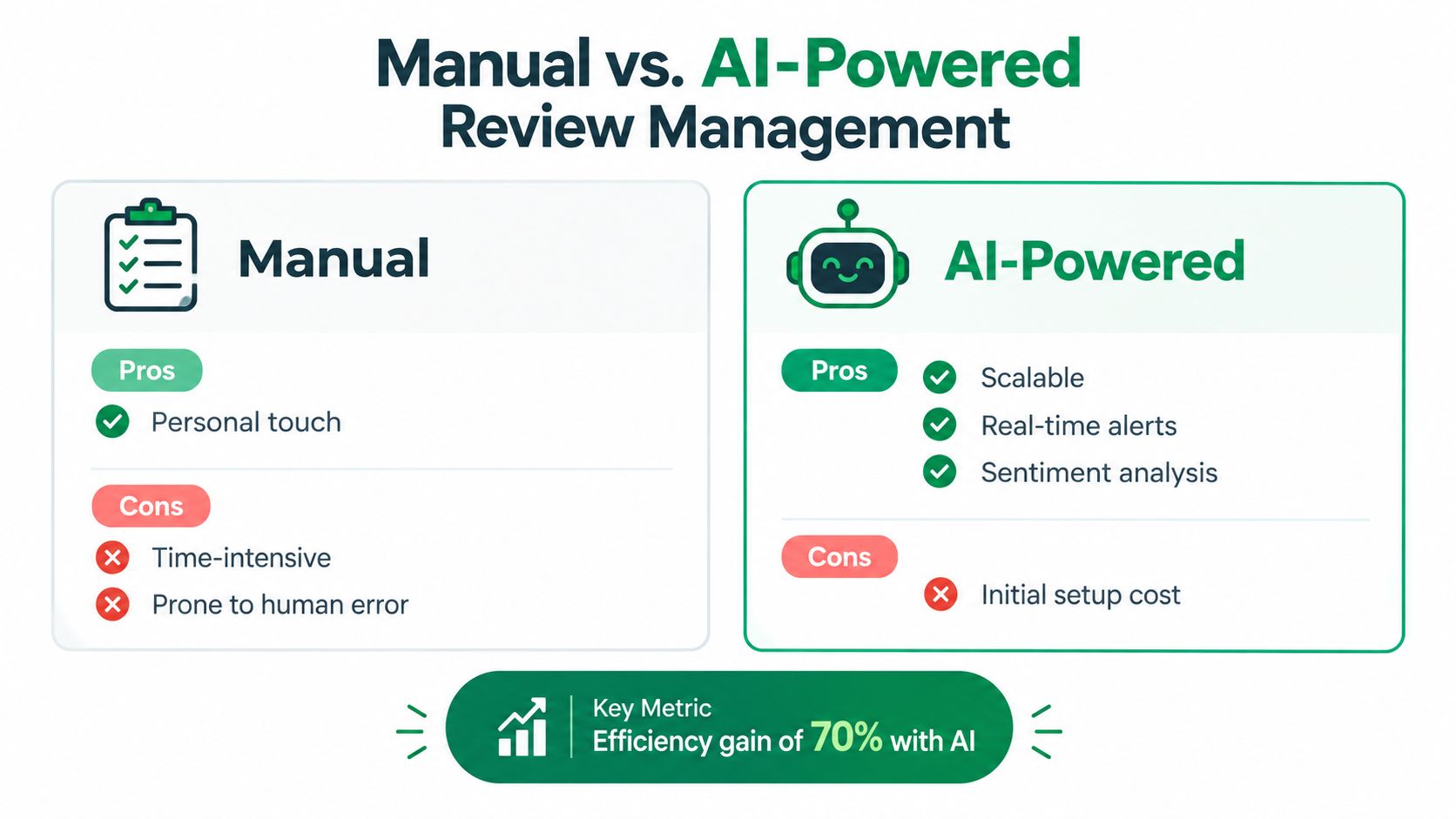
What each approach is good at
Manual workflows give a business full human control and highly specific replies. They work well when staff have time to read each review carefully, but they break down when people are busy, inconsistent, or checking too few platforms. AI-assisted tools are better for alerts, sentiment sorting, and helping teams move faster across many reviews at once. For a workflow comparison, see this guide to AI review management.
- Manual: best for low volume and highly personalized replies.
- AI-powered: better for scale, fast alerts, and pattern detection.
- Hybrid: often the most realistic choice, because humans still need to approve sensitive replies.
A wider ecosystem has grown around this work. The directory at AI Tools for Local SEO organizes review and reputation management tools for local businesses, agencies, and multi-location teams, which makes comparison easier without starting from scratch. If you want a closer look at automation use cases, the AI review management guide is a useful next read.
The question is whether your team can respond quickly, keep tone consistent, and monitor enough platforms without missing important feedback. If the answer is no, automation is not a luxury. It is the part of the process that keeps the system dependable.
Conclusion, Building a Sustainable Review Management System
Review management is an operating system for trust. It connects feedback collection, platform monitoring, thoughtful responses, and pattern recognition into one repeatable process. When that process is steady, it supports local search visibility, improves customer confidence, and helps the business catch problems early.
The most important shift is moving from chasing reviews to managing freshness, response quality, and consistency. That's what turns feedback into a real business asset instead of a scattered pile of comments. Businesses that do this well treat reviews as an ongoing input to operations, not a once-a-week reputation task.
If you want stronger local visibility and fewer reputation surprises, start by tightening your review workflow this week. Pick one owner, one monitoring routine, and one response standard, then build from there.