The best local SEO stack usually isn't the platform with the longest feature list. That's the popular buying advice, and it breaks down fast in real work. A single-location business often needs tight control over listings, reviews, and Google Business Profile activity. An agency needs repeatable audits, client reporting, and geo-grid tracking across many service areas. A franchise team needs permissions, governance, and location-level workflows that won't create chaos.
That difference matters because local search is now a high-intent channel. Industry reporting collected in 2026 notes that 46% of Google searches have local intent, while 97% of consumers search online to find local businesses. If your stack can't keep business data current and visible where people choose, broad feature coverage won't save it.
The better way to compare local SEO tools is by stack-building decisions. Start with discovery. Then decide whether you need an all-in-one platform, a specialist geo-grid tracker, a reputation workflow layer, or a true enterprise multi-location system. That also lines up with how buyers work. Independent operator data suggests 58% of businesses still don't optimize for local search, while 69% use SEO tools or keyword tracking software. In other words, plenty of teams buy tools before they solve the workflow.
This directory is organized around that reality. It focuses on workflow fit, modularity, integration implications, pricing visibility, and the limitations that show up once the trial period ends.
1. AI Tools for Local SEO
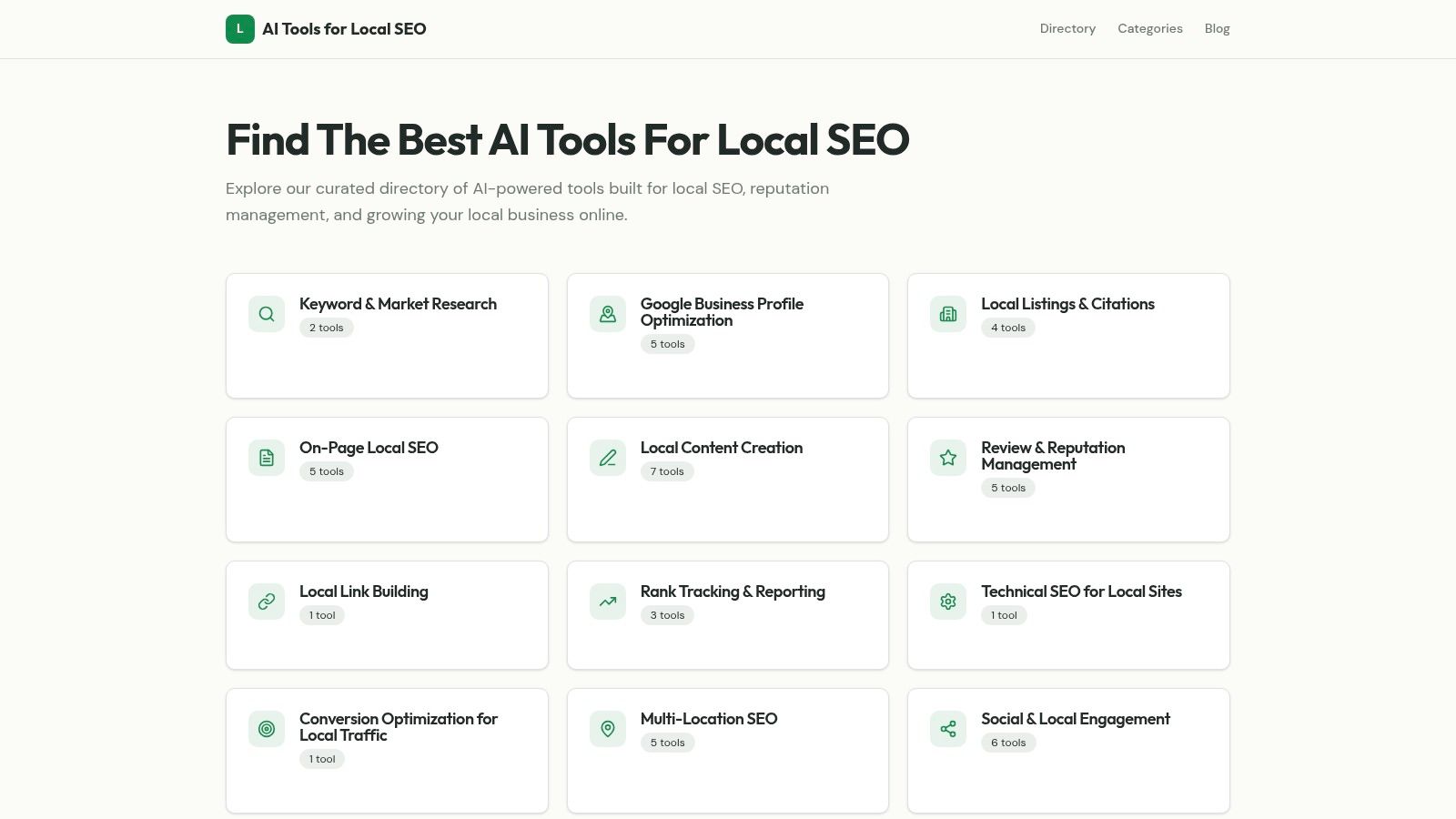
The first local SEO tool many teams need is not a platform. It is a way to sort the market before they buy overlapping software.
AI Tools for Local SEO fits that discovery job. It is a focused directory for local search, GBP workflows, reviews, citations, content, reporting, and automation. That matters because a consultant comparing geo-grid trackers has different criteria than a franchise team shortlisting review software or a single-location business looking for GBP help.
Its structure is the practical advantage. Instead of ranking everything in one mixed list, the site groups products by the job they perform: research, GBP optimization, listings and citations, local content, review management, rank tracking, multi-location operations, analytics, agency workflows, and AI assistants. That makes stack-building easier because you can start with the bottleneck. If your issue is slow review response, you look at reputation tools. If your issue is coverage gaps in service-area tracking, you start with rank tracking and geo-grid products.
This directory does not replace execution software. It replaces the messy research phase that usually happens across search results, Reddit threads, bookmarked vendor pages, and broad AI marketplaces that barely filter for local SEO. Teams that are still deciding between point solutions and an all-in-one platform will get the most value here. The site's guide to AI SEO tools comparison is useful once you have a shortlist and need a wider buying framework.
The trade-off is straightforward. A directory helps you identify candidates, but it will not show how cleanly a tool fits your existing reporting stack, CRM, or client approval process. Pricing depth also depends on the vendor page. In daily work, that means the directory is best used as the top of the funnel for tool selection, not the final decision point.
- Best fit: Consultants, small agencies, in-house marketers, and owners building a local SEO stack for the first time.
- Primary job: Tool discovery by workflow category rather than generic popularity.
- What it replaces: Manual vendor research, scattered shortlists, and broad AI directories with weak local filtering.
- Operational limit: Vendor evaluation still happens off-platform, especially for integrations, pricing details, and support quality.
One useful side effect is category discovery. Teams that start by looking for listing software often find adjacent tools they need more, such as review response systems, GBP post assistance, or local content tools. If you also need a broader martech view outside local SEO, this guide can help compare AI tools for marketing teams.
2. BrightLocal
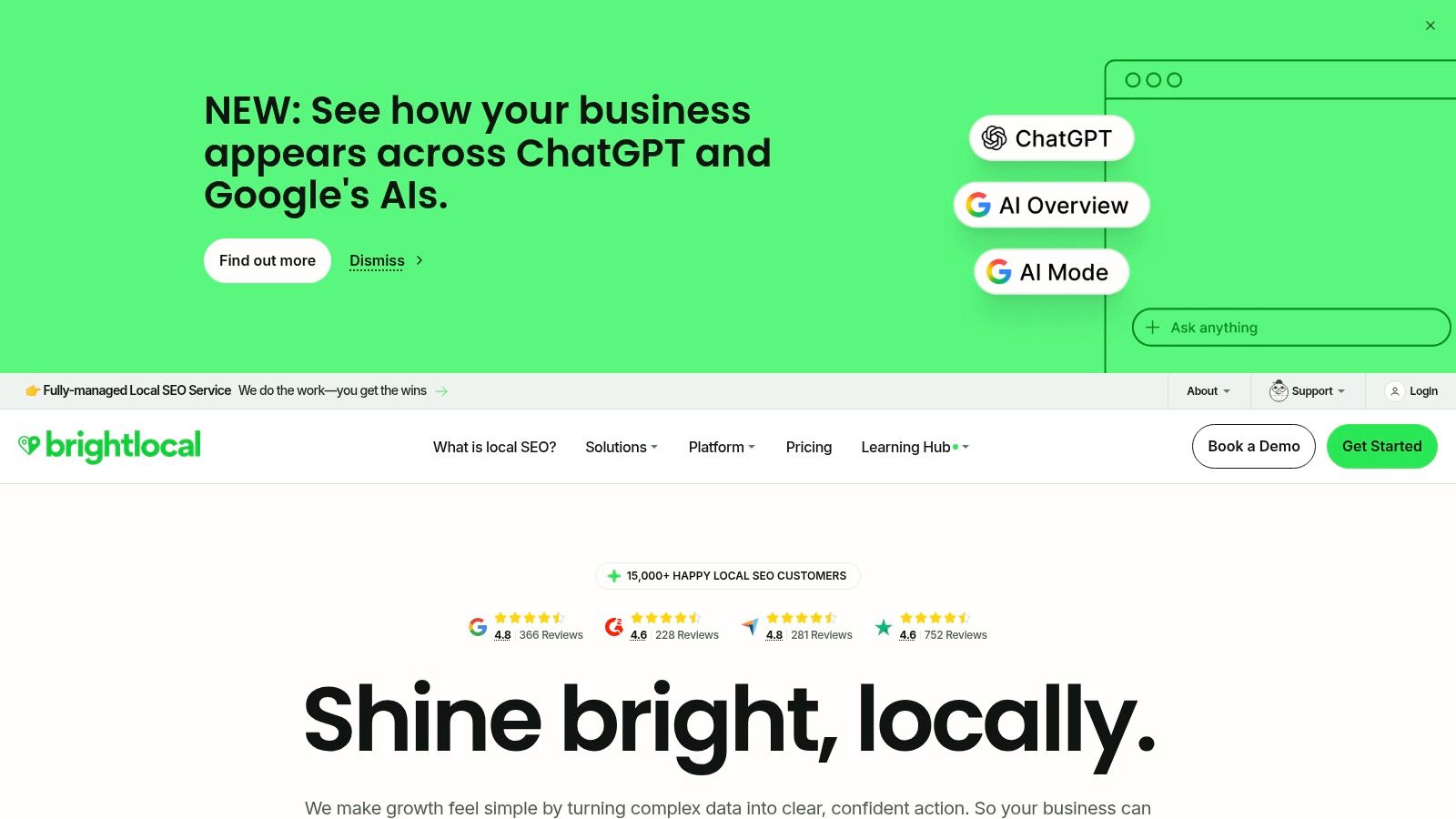
BrightLocal fits the middle of a local SEO stack well. It is usually the tool I consider after discovery and before a team commits to a larger platform, because it covers the daily operating jobs that small businesses and agencies repeat: rank tracking, listings work, review monitoring, audits, and client reporting.
That matters because many local SEO stacks break down at the handoff layer. One tool finds ranking problems, another tracks citations, a third handles reports, and someone still ends up reconciling everything in a spreadsheet. BrightLocal reduces that admin load without forcing a multi-location brand into enterprise software it does not need yet.
The strongest use case is practical, not flashy. A consultant managing 10 clients, or a marketing team with 5 to 30 locations, can use BrightLocal as the local operations hub while keeping broader SEO research in another system. It replaces a surprising amount of glue work.
A few trade-offs show up quickly in real use. BrightLocal is broad, but it is not the deepest option in every category. Teams that care most about geo-grid diagnostics may still want a specialist tracker. Teams with heavy review-response workflows or strict CRM routing may outgrow it. And once account complexity rises, custom-plan pricing can make side-by-side budgeting less tidy than the entry plans suggest.
One part BrightLocal handles well is citations. The pay-as-you-go model suits businesses that want cleanup or distribution help without committing to another recurring tool just to maintain baseline listing coverage. For buyers comparing that job across vendors, this guide to best citation management software is a useful companion.
Use BrightLocal if the bottleneck is operational coordination across rankings, listings, audits, and reports. Look elsewhere first if the bottleneck is enterprise governance, advanced geo-grid analysis, or reputation automation at scale.
- Best fit: Consultants, small agencies, and in-house teams managing a few to a few dozen locations.
- Primary job: Centralize day-to-day local SEO operations without building a patchwork workflow.
- What it replaces: Separate local audit tools, citation spreadsheets, lightweight reporting dashboards, and some standalone listing workflows.
- Integration implication: Works best alongside another platform for broader SEO research, CRM automation, or enterprise analytics.
- Limit in daily use: Breadth is strong, but specialist depth and large-scale workflow control taper off as location count and reporting complexity increase.
3. Whitespark
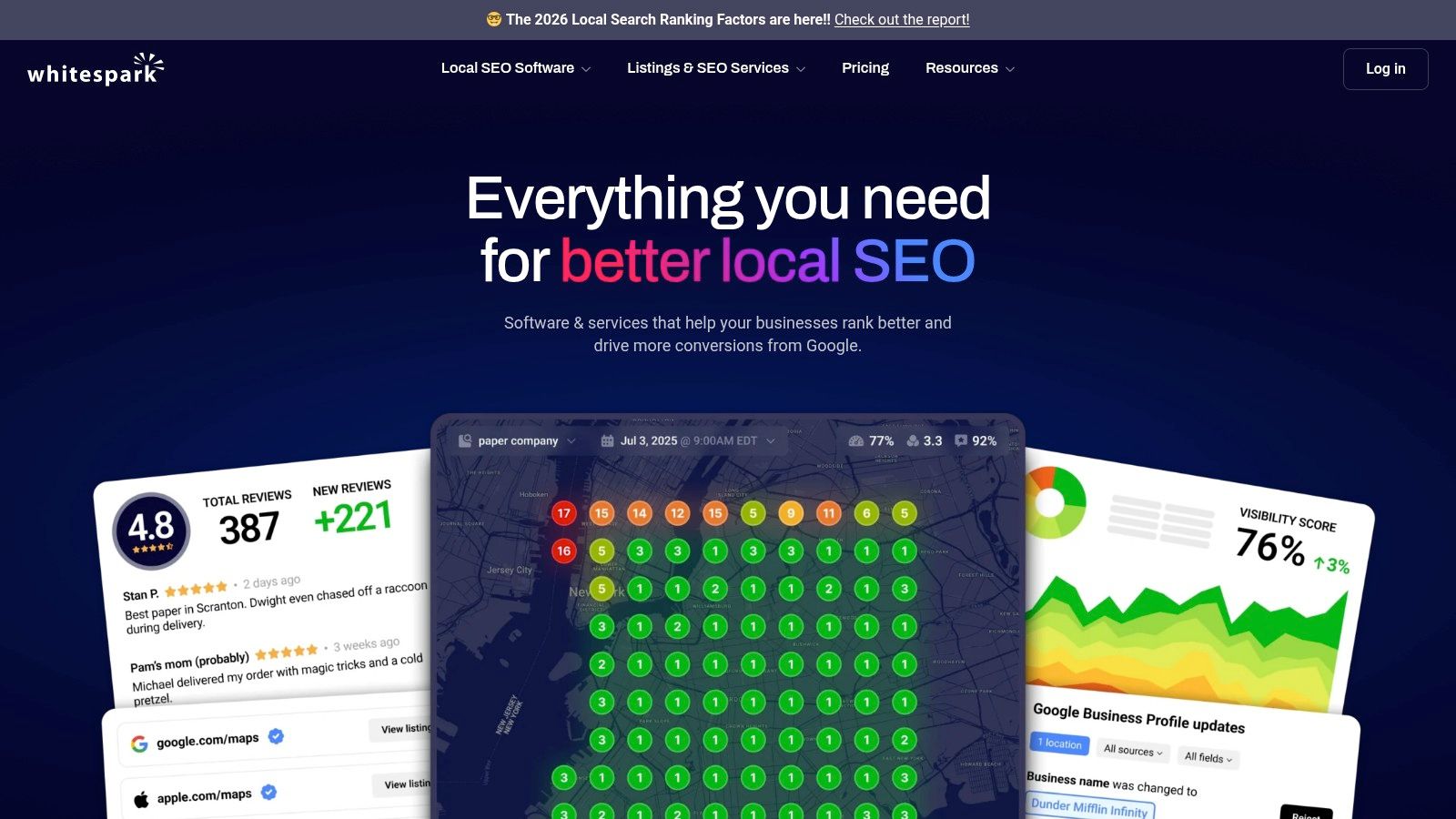
Whitespark fits earlier in a local SEO stack than some buyers expect. I usually see teams reach for it when the problem is not reporting or dashboard consolidation, but local discovery: which citations are missing, where duplicates still exist, and how map visibility changes across a service area.
That distinction matters.
Whitespark works best as a specialist layer you add on purpose. Citation Finder, rank tracking, geo-grid views, and reputation tools can be bought separately, so a consultant can solve one bottleneck without inheriting a larger platform. For a small agency, that often replaces spreadsheets, manual citation audits, and weak map-pack checks. For a multi-location brand that wants one login, one billing model, and one reporting system, the same modular setup can feel fragmented.
The citation side is where Whitespark still earns a place in many stacks. Teams that care about listing accuracy and cleanup quality often prefer a tool built around that job, especially if they want one-time work or selective ongoing maintenance instead of an always-on distribution contract. The practical upside is control. The practical cost is that you still need to decide what handles reviews, client reporting, and broader SEO research elsewhere.
Geo-grid tracking is the other strong reason to buy it. If your day-to-day local work depends on seeing rank variation block by block, Whitespark gives useful visibility without forcing you into a full suite. That said, once reporting needs become client-facing and frequent, or once location count climbs, some teams end up pairing it with another platform just to keep operations cleaner.
I would choose Whitespark for a team that already knows its process and wants better local diagnostics than a generalist platform usually provides.
- Best fit: Consultants, focused local agencies, and in-house teams solving specific local SEO jobs rather than buying a full operations suite.
- Primary job: Find citation gaps, track local rankings with more precision, and support cleanup work with less manual checking.
- What it replaces: Citation audit spreadsheets, basic rank trackers, and ad hoc local visibility checks.
- Integration implication: Usually works alongside another system for SEO research, client reporting, CRM workflow, or review operations.
- Limit in daily use: Flexibility is high, but stack coordination becomes the team's responsibility as you add more locations, users, and reporting expectations.
4. Semrush Local
Semrush Local is usually a stack decision, not a pure local SEO decision. It fits best when the same team already uses Semrush for research, technical audits, competitor tracking, or executive reporting and wants local execution in that same workflow.
That changes what the product replaces.
Instead of stitching together one tool for listings, another for GBP posting, another for review monitoring, and a separate reporting layer, Semrush Local pulls several of those jobs into the platform many marketers already log into daily. For an in-house team with one marketer handling both organic search and local visibility, that consolidation saves time. For a local-first agency that needs tighter citation control or heavier geo-grid usage, the trade-off can be less favorable.
Why consolidation wins
Semrush Local is strongest as an add-on for teams that want fewer handoffs. Listings management, GBP posting, review workflows, and map visibility tracking sit close to the broader Semrush reporting environment, so local performance is easier to discuss alongside site traffic, keyword movement, and audit issues.
The limit shows up in cost structure and depth.
If geo-grid tracking is the main reason to buy, the credit model can become restrictive as scan frequency, service areas, or location count increase. If listings accuracy and local research are the main jobs, specialist tools may still offer more control. Semrush Local works best when local is one operating layer inside a broader search program, not when every local workflow depends on maximum depth from a single module.
I would put it in front of two kinds of buyers: in-house teams consolidating their search stack, and agencies that already report from Semrush and want fewer moving parts for smaller local accounts.
- Best fit: In-house marketers, hybrid SEO teams, and agencies already standardized on Semrush.
- Primary job: Combine local listings, GBP activity, reviews, and map-rank checks with existing SEO research and reporting.
- What it replaces: A basic local tool stack spread across multiple vendors, especially for teams already paying for core Semrush.
- Integration implication: Works best when Semrush is already the reporting and research hub. Otherwise you may be adding a platform to avoid buying a more focused one.
- Limit in daily use: Geo-grid credits and specialist depth can become constraints once local tracking volume or process complexity grows.
5. Moz Local
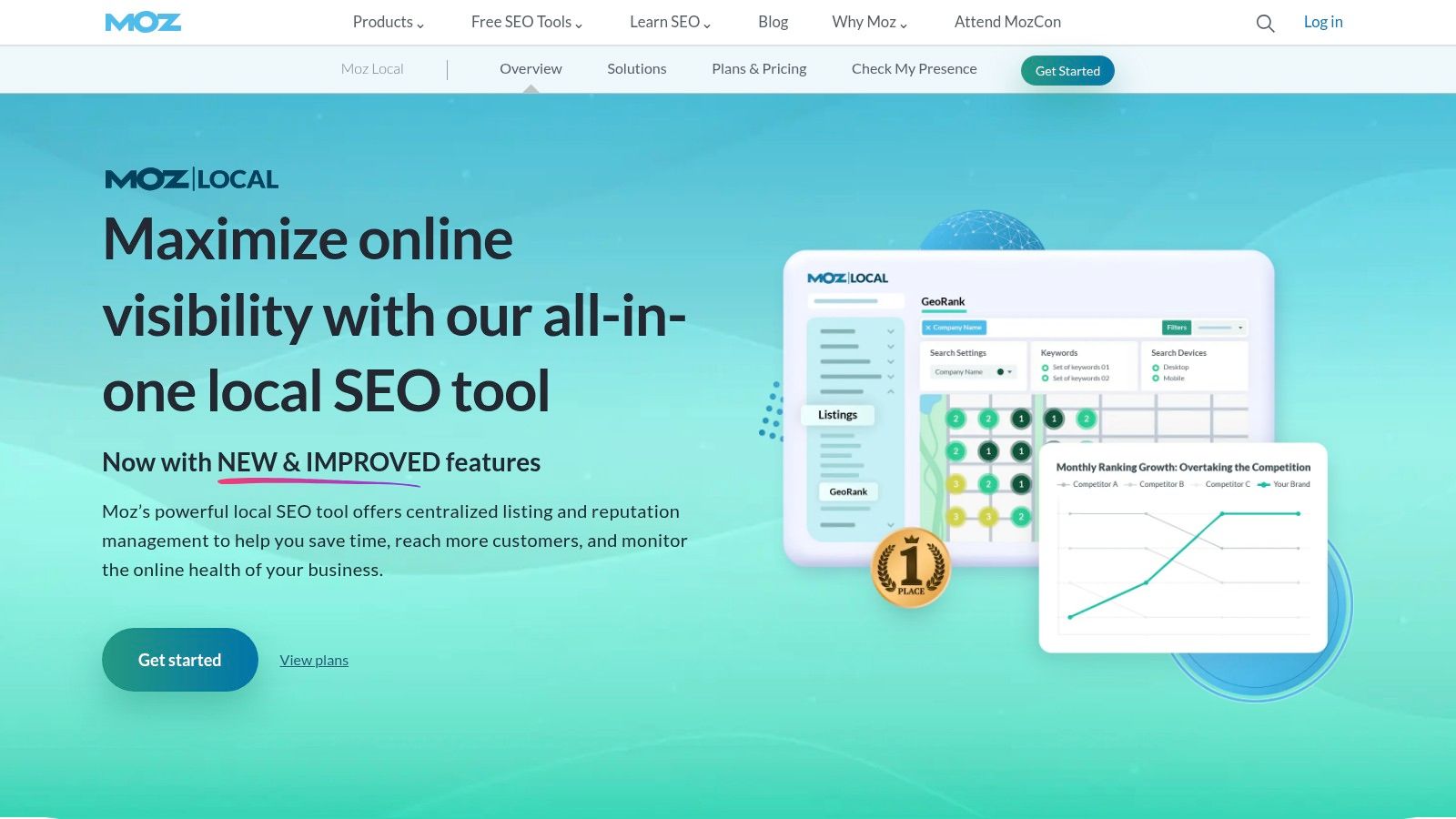
Moz Local usually enters the conversation after a team decides it does not need an enterprise control system, but is tired of stitching together separate tools for listings, reviews, and basic local publishing. That makes it less of a pure ranking tool and more of an operations tool for local presence management.
I would shortlist it for regional brands, service businesses with several locations, and marketing teams where local SEO is part of the job, not the whole job.
The appeal is straightforward. Moz Local covers the recurring maintenance work that creates drag in day-to-day local SEO: keeping core business data aligned, watching reviews, publishing updates, and giving non-specialists a dashboard they can use without much training. If the main bottleneck is coordination rather than advanced analysis, that matters more than having every specialist feature.
Its place in a stack is pretty clear. Moz Local can replace a lightweight listings vendor, a separate review monitor, and some manual GBP posting routines. It is less convincing as a replacement for specialist rank tracking or deeper citation and audit work. Teams that care about precise local pack movement by neighborhood will still end up pairing it with a geo-grid product.
There is also a practical trade-off here. Convenience is strong, but control has limits. For a business with 5 to 50 locations and a fairly stable operating model, that trade usually works. For agencies handling varied client demands, or for brands with heavy approval workflows and strict data governance, the platform can start to feel narrow.
A useful test is to ask who will live in the software each week. If that answer is a marketing generalist, franchise support lead, or location manager, Moz Local fits better than a more technical platform. If the answer is a local SEO specialist trying to diagnose ranking gaps market by market, it probably stays in the stack as maintenance software rather than becoming the system of record.
- Best fit: Regional multi-location businesses, franchise support teams, and marketers who need local operations in one manageable interface.
- Primary job: Maintain listings accuracy, monitor reviews, and handle light GBP or local publishing tasks.
- What it replaces: Separate basic tools for listings management, review monitoring, and routine posting.
- Integration implication: Works best as the local operations layer for teams that already use another platform for research, reporting, or advanced rank tracking.
- Limit in daily use: Specialist depth is limited once teams need detailed geo-grid analysis, heavier governance controls, or more customized agency workflows.
6. Yext
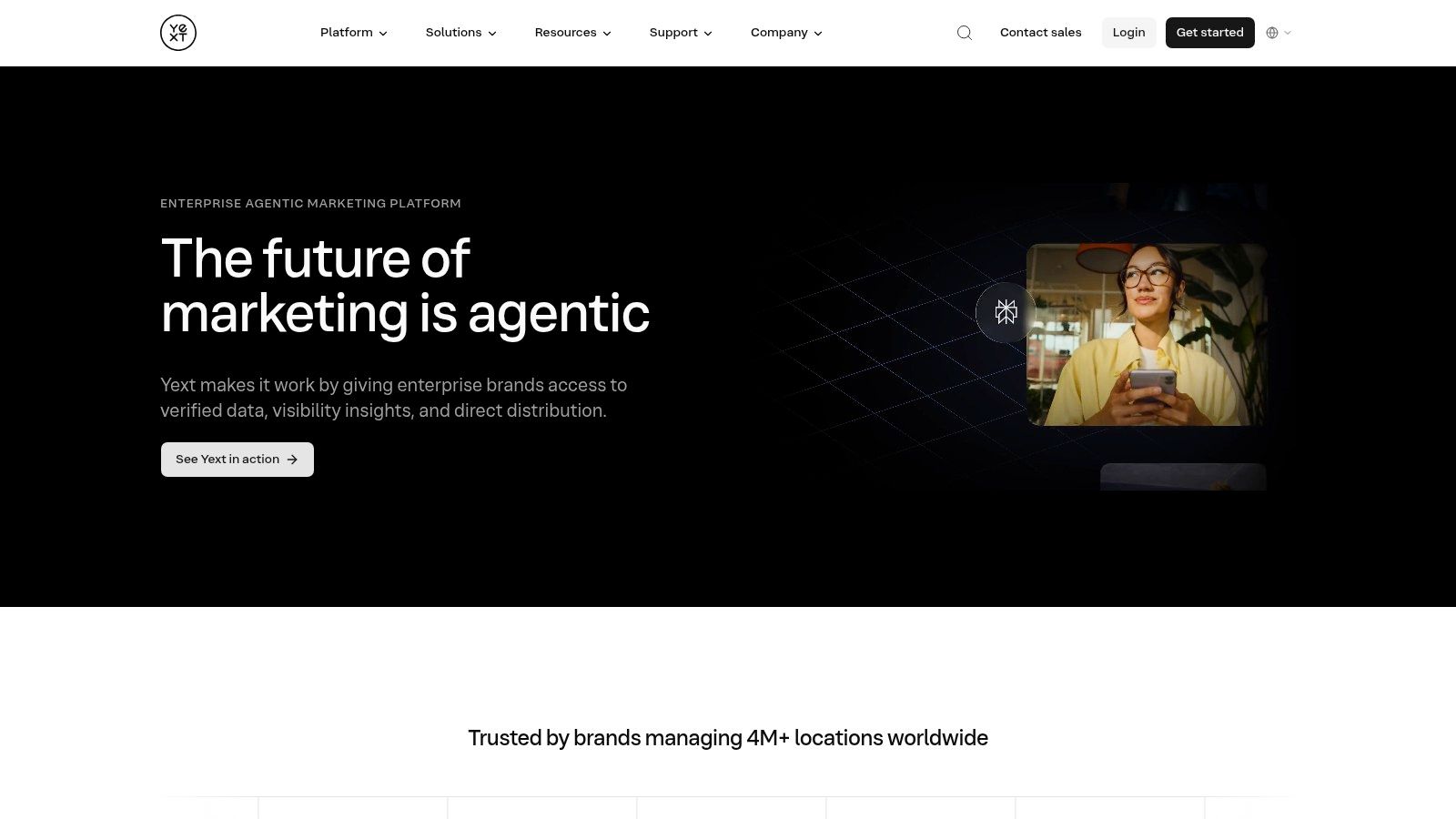
Yext fits the stack at the point where local SEO stops being a location marketing task and starts acting like a distributed data management problem. The buying trigger is usually operational: too many locations, too many hands editing business data, too many systems that can drift out of sync.
That distinction matters because Yext is rarely the tool a local specialist buys for diagnosis. It is the platform a central team buys to control what can be published, where it goes, who approved it, and how quickly changes can be pushed across a large footprint.
For day-to-day work, that means Yext often becomes the source-of-truth layer in the stack. Store hours, holiday updates, department data, local pages, review routing, and publisher sync can live in one governed system instead of being spread across spreadsheets, emails, and platform logins. If a brand already has internal databases or location management systems, the integration question becomes a real part of the evaluation, not an afterthought.
The trade-off is straightforward. Yext helps large organizations reduce inconsistency and approval chaos. It does not replace the specialist tools teams still use for market-level rank analysis, geo-grid testing, or deeper local SEO investigation.
A practical way to judge fit is to look at failure mode. If the recurring problem is bad citations, slow update rollouts, conflicting edits, or compliance risk across many locations, Yext earns its place. If the recurring problem is understanding why one location underperforms in the map pack, Yext will sit beside other tools rather than replacing them.
Use Yext if your local stack needs control first.
- Best fit: Enterprise brands, franchises, healthcare groups, financial services firms, and other multi-location teams with approval rules or compliance pressure.
- Primary job in the stack: Centralize and distribute location data, reviews, local pages, and account controls across a large network.
- What it replaces: Manual publisher coordination, fragmented location records, and ad hoc update workflows spread across multiple teams.
- Integration implication: Best suited to organizations that already have CRM, store locator, internal database, or IT support involved in local operations.
- Limit in daily use: It can feel heavy for small teams, and it usually needs to be paired with separate tools for discovery, diagnostics, and geo-grid rank tracking.
7. Uberall
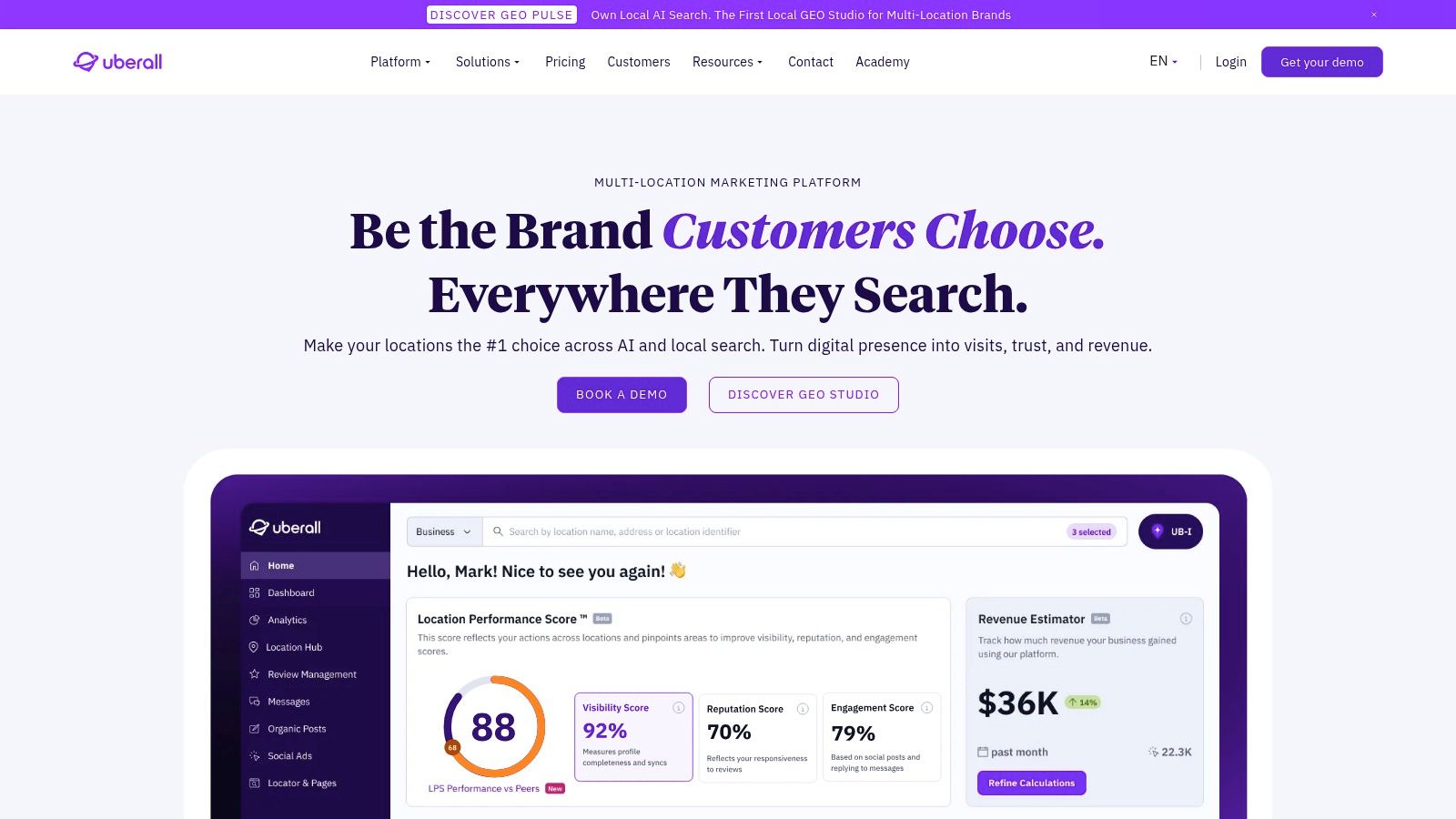
Uberall earns attention when the local SEO problem is operational drift across a distributed network. The platform is built for teams that need location data, review activity, local pages, store locator content, and user permissions managed in one system, with clearer accountability around who changed what and what still needs action.
That distinction matters in practice.
Some multi-location brands do not fail because they lack another rank tracker. They fail because field teams, regional managers, agencies, and corporate marketing all touch local presence without a clean process. Uberall fits that environment better than lighter listing tools because the product is designed around execution controls, not just data submission.
Its strongest use case sits between simple listings software and heavier enterprise stacks. Franchises, retail chains, automotive groups, and service networks can use it to standardize location presence without building quite as much internal process around the platform as some larger systems require. In day-to-day work, that usually means fewer manual follow-ups, cleaner approval flows, and better visibility into location-level exceptions.
The trade-off is adoption overhead. A single-location business or even a small agency with a short client roster will rarely get enough value from the administrative layer to justify the setup effort and cost conversation. Uberall starts to make sense when many people are involved, locations share templates but still need local control, and reporting has to serve both headquarters and operators in the field.
A practical way to evaluate fit is to ask what work you want the platform to replace.
If the current mess is scattered spreadsheets, inconsistent location records, unclear ownership, and review response duties spread across multiple teams, Uberall can consolidate that work. If the main question is why one branch dropped in the map pack this week, you will still need specialist diagnostic tools alongside it.
- Best fit: Distributed brands, franchise systems, and multi-location service businesses that need stronger process control across local teams.
- Primary job in the stack: Manage listings, reviews, local pages, store locators, and user permissions in a shared operating system for location presence.
- What it replaces: Manual coordination across local managers, agency partners, and central marketing teams using separate tools and spreadsheets.
- Integration implication: Best suited to organizations that already treat local SEO as an operating function tied to brand, customer experience, and location data management.
- Limit in daily use: It is less useful for small teams, and it does not remove the need for separate tools for geo-grid tracking, local rank diagnostics, or deeper market analysis.
8. SOCi
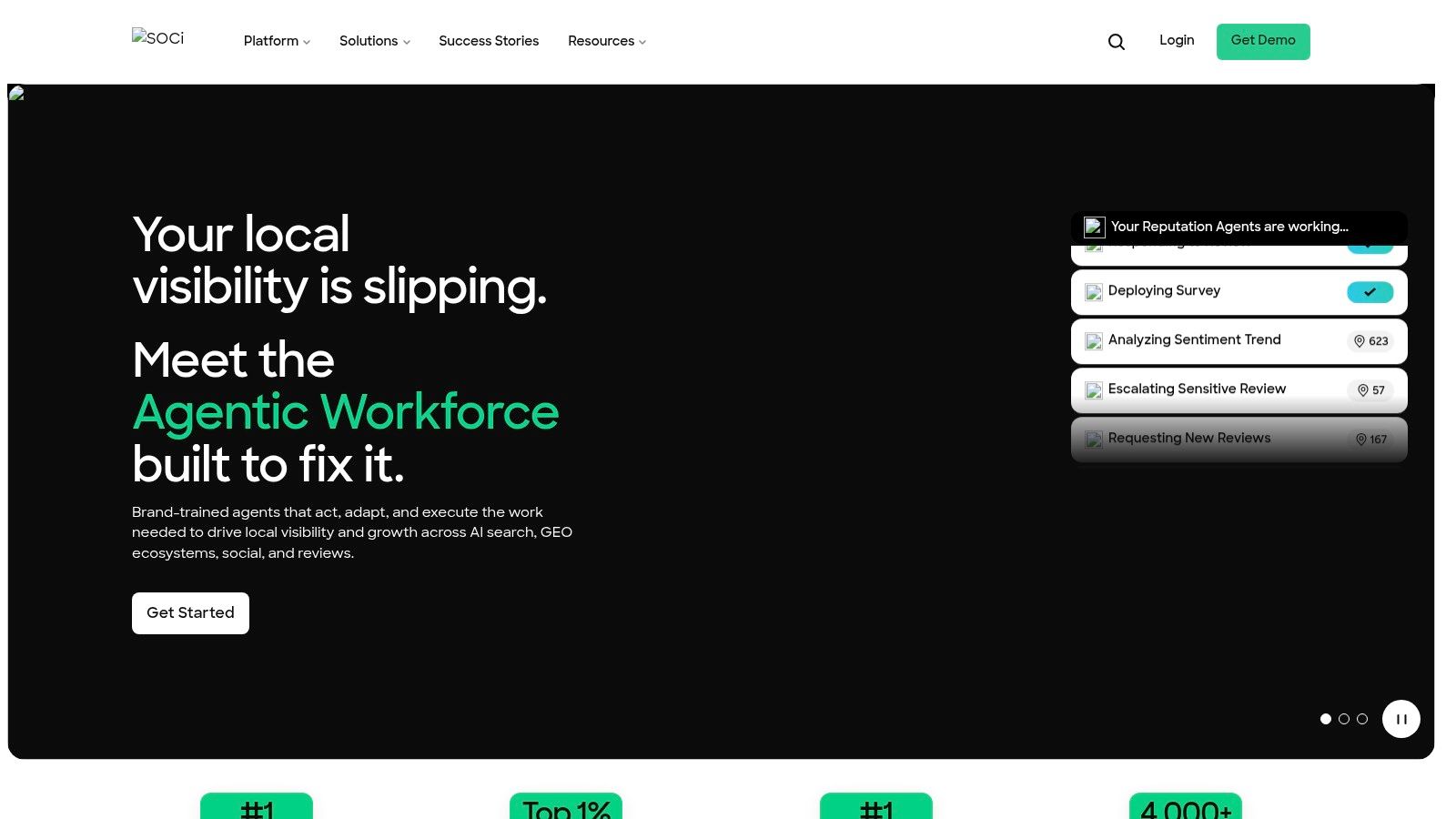
SOCi fits the part of the stack where local SEO stops being a channel problem and becomes an operating model problem. Teams usually reach for it after lighter listings or review tools start breaking under approval chains, brand rules, and the realities of hundreds or thousands of locations.
The practical appeal is consolidation with controls. SOCi pulls listings, reviews, social publishing, and AI-assisted content into one system built for distributed brands. For a franchise group or enterprise brand team, that can replace a messy mix of separate social schedulers, review inboxes, listings vendors, and manual approval workflows.
The AI layer matters less than the governance behind it.
That is the buying decision. If local managers need help producing location-level posts, responses, and updates without going off-brand, SOCi has a clear place. If the harder problem is local rank diagnosis, geo-grid visibility, or competitive map pack analysis, SOCi will not replace the specialist tools used for that work.
Its integration implications are broader than they look at first glance. A platform like this works best when location data, permissions, brand standards, and customer response workflows already have named owners. Without that structure, teams often buy the software before they settle basic process questions, then blame the platform for friction that came from the org chart.
A simple fit test helps. Ask what work your team wants to remove from the week. If the answer is approval bottlenecks, inconsistent local posting, scattered review handling, and poor coordination between corporate and field teams, SOCi is a serious option. If the answer is "we need to know why Dallas lost map pack coverage for one service line," keep a diagnostic tool beside it.
- Best fit: Franchise systems, retail chains, and other multi-location brands with centralized standards and local operators.
- Primary job in the stack: Run governed local marketing workflows across listings, reviews, social, and AI-assisted location content.
- What it replaces: Separate local social tools, review management software, and fragmented approval processes spread across teams.
- Integration implication: Strongest in organizations that already treat local presence management as a shared function across brand, operations, and customer experience.
- Limit in daily use: Heavier than smaller teams need, and still incomplete for geo-grid tracking, local rank forensics, and deeper competitive analysis.
9. Birdeye
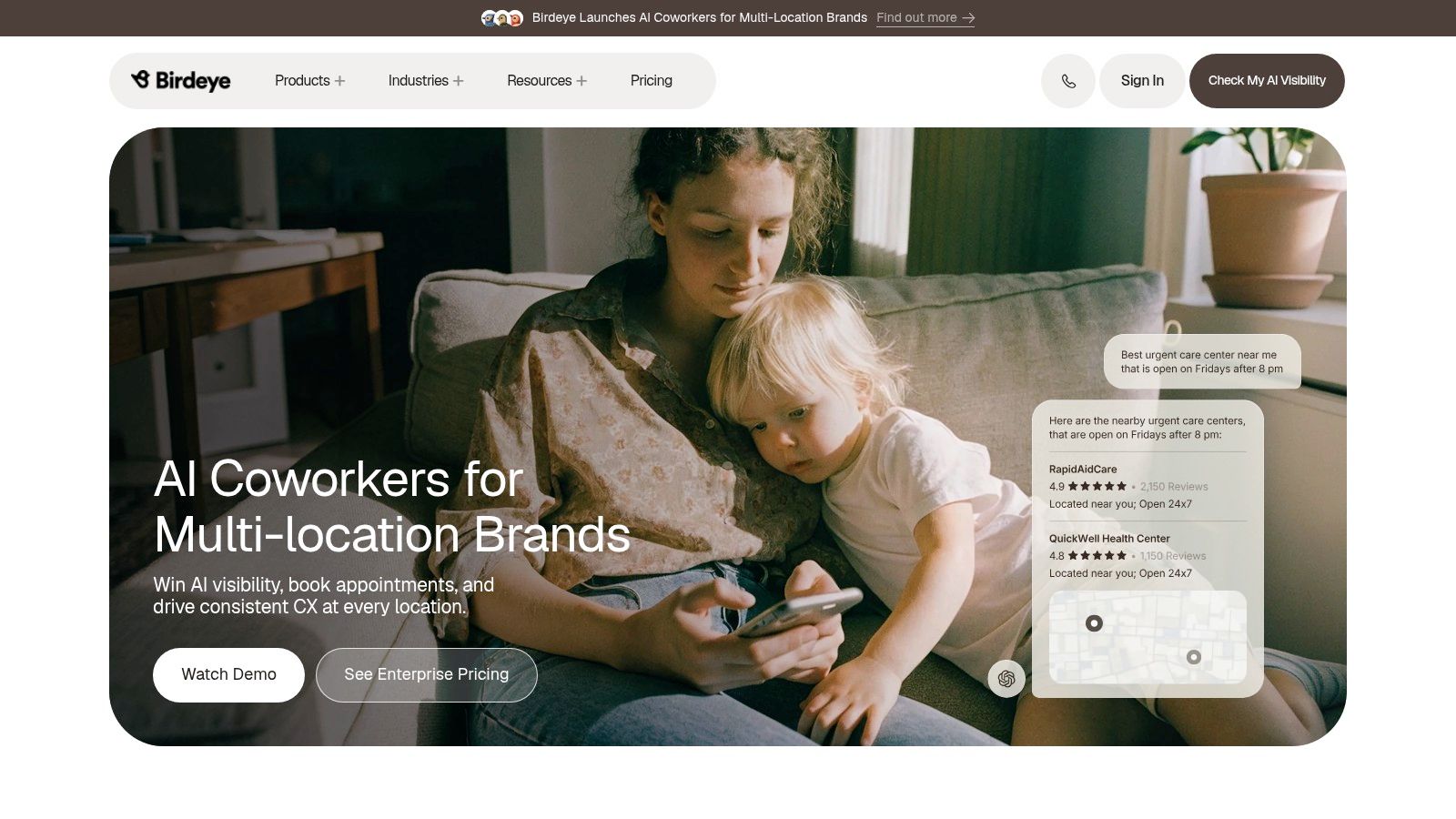
Birdeye fits the stack when the main local SEO problem is not discovery, ranking diagnostics, or citation cleanup. It fits when locations struggle to generate trust at scale, respond to customers on time, and turn Google Business Profile activity into booked appointments or signed leads.
That distinction matters. A dental group, med spa chain, or home services brand can lose far more revenue from weak review velocity and slow response handling than from imperfect local rank tracking. In those cases, Birdeye covers work that would otherwise sit across a review tool, webchat product, feedback system, and a lighter listings monitor.
The trade-off is clear in daily use. Birdeye gives customer experience and reputation operations more weight than pure local search forensics.
Teams usually benefit most when they already have enough visibility into rankings and listings health, but review collection, inbox management, and location-level follow-up are still messy. If the bottleneck is "our branch managers do not ask for reviews consistently" or "nobody owns responses across 40 locations," Birdeye can remove a lot of manual coordination. If the bottleneck is duplicate listings, citation repair, or map-pack share by neighborhood, another tool needs to sit beside it.
A practical way to judge fit is to look at what Birdeye would replace in your week:
- Review request and response software
- Basic messaging or webchat tools tied to local conversion
- Manual customer feedback routing across locations
- Lightweight listings oversight for brands that do not need heavy citation workflow
That replacement logic is why Birdeye often lands well with regional service brands and multi-location operators that treat reputation as an operating system, not a reporting line item.
For a small business with one or two locations, it can be more platform than necessary. For a marketing team that reports heavily on local ranking movement, competitor gaps, and service-area coverage, it is incomplete on its own. But for organizations where review generation, response governance, and customer communication directly affect local lead flow, Birdeye earns its place in the stack.
10. Local Falcon
A lot of local SEO platforms claim rank tracking. Very few show the operating problem. Visibility in the map pack is uneven, and Local Falcon makes that obvious fast.
Local Falcon belongs in the specialist layer of a local stack, not the platform layer. Its job is narrow and useful: map a business's ranking across a grid so teams can see where performance holds, where it drops, and how coverage shifts by street, suburb, or service area. For agencies, that often replaces spreadsheet-based spot checks and one-off searches from different locations. For in-house teams, it usually answers a more practical question: are weak results tied to distance, category relevance, competition, or an issue inside the GBP itself?
That distinction matters because Local Falcon does not try to manage listings, reviews, citations, or local pages. Teams still need other software for those jobs. What it adds is location-level evidence. If a broader platform says rankings are stable while leads from one side of town fall off, Local Falcon is often the tool that explains the mismatch.
The trade-off is operational, not conceptual. Credit-based pricing works well for consultants running focused diagnostics, but it can get expensive if a multi-location brand scans dense grids across many keywords every week. Reporting is also strongest when someone on the team knows how to interpret local ranking patterns instead of treating every red cell as a crisis.
A simple fit test is to ask what gap exists in the current stack.
If the bottleneck is "we need one dashboard for listings, reviews, and reporting," Local Falcon is too narrow. If the bottleneck is "we do not know where we appear in the map pack across the city," it is one of the clearest tools available. It is especially useful for SABs, competitive metros, and any campaign where proximity shapes outcomes more than average ranking snapshots suggest.
Teams comparing specialist tracking options may also want a broader look at the best AI rank tracker tools for local visibility monitoring.
Local Falcon fits best beside an all-in-one platform, not in place of one. That is why agencies, consultants, and advanced local teams keep it in the stack even after they already have reporting, listings management, and review software covered.
Top 10 Local SEO Tools, Quick Comparison
| Tool | Core features | Unique selling points | Target audience | Pricing |
|---|---|---|---|---|
| AI Tools for Local SEO | Curated directory by local-SEO category; tool counts; vendor links | Local-first curation; end-to-end coverage; surfaces emerging AI tools; speeds vendor discovery | Local businesses, agencies, consultants assembling tool stacks | Directory only, vendor pricing varies (follow links) |
| BrightLocal | Audits, local rank tracking (geo-grid), listings, GBP workflows, reviews, AI insights | All-in-one local platform; pay-as-you-go Citation Builder; API access; transparent citation ownership | SMBs & agencies needing centralized local workflows | Subscription with custom-plan flow; pay-as-you-go citation options |
| Whitespark | Citation finder, local rank tracker, ranking grids, reputation builder, listings services | Modular à‑la‑carte tools; transparent per-tool pricing; one-time citation packages you own | Consultants & agencies preferring modular tools and ownership | Tool-based pricing; visible & one-time package options |
| Semrush Local | GBP automation (AI agent), AI posts/replies, listing management, Map Rank Tracker credits | Tight Semrush integration for research/reporting; straightforward per-location model | Teams already using Semrush wanting integrated local workflows | Per-location pricing; credit-based geo-tracking |
| Moz Local | Auto-sync listings, review monitoring, Local Grid, social calendar & templated posts | Consolidates listings, reviews, and social in an accessible UI | Businesses needing centralized oversight for multiple locations | Package-based; public pricing limited (contact/compare) |
| Yext | Listings, reviews, Pages, Social, analytics; deep publisher integrations & governance | Enterprise-grade integrations, governance, operational alerts | Enterprises, franchises, regulated industries | Sales-led pricing (quote; enterprise) |
| Uberall | Location data management, listings, reviews, local pages/store locators, analytics | Designed for multi-location governance, labels, operational alerts and docs | Franchises and enterprises needing unified location management | Request-a-quote (sales-led) |
| SOCi | AI “Genius” agents, listings/local pages, social, reviews, 140+ integrations, governance | AI-driven location automation for distributed brands; broad integrations | Multi-location brands, franchises, enterprise agencies | Sales-led pricing (enterprise-focused) |
| Birdeye | Centralized reviews, AI-assisted replies, Listings AI, local landing pages, messaging/webchat | Deep review operations + indexed local pages and messaging for CX-driven programs | Reputation-led teams in healthcare, services, retail | Sales-led pricing (not publicly posted) |
| Local Falcon | Geo-grid rank tracking, shareable map visualizations, scheduled scans, AI suggestions | Best-in-class localized ranking visualizations; easy stack integration | Agencies and teams needing precise map-pack visibility | Credit-based plans with scheduled-scan credits |
Build Around the Bottleneck, Not the Brand
The right stack often starts with fewer local SEO tools than expected. The trick is choosing the smallest capable stack that fixes the bottleneck you have.
Start with the operational constraint. If your business information is inconsistent across the web, prioritize listings and citation control. If rankings look fine but leads are weak, review volume and response quality may be the bigger issue. If clients keep asking why one neighborhood performs better than another, add a geo-grid layer before you buy another suite. If your brand manages many locations, permissions and governance matter more than feature count.
A practical selection order usually looks like this:
- Citation accuracy first: Choose BrightLocal, Whitespark, Moz Local, or an enterprise platform if location data is fragmented.
- GBP execution first: Favor platforms with posting, profile management, freshness workflows, and review response support.
- Reputation operations first: Birdeye or similar reputation-led systems make sense when response management is consuming staff time.
- Geo-grid visibility first: Add Local Falcon or another specialist when map-pack reporting is too shallow.
- Multi-location governance first: Shortlist Yext, Uberall, or SOCi when approvals, permissions, and scale are the challenge.
Projected market growth supports being selective, not impulsive. The local SEO software market is projected to grow from USD 9.12 billion in 2025 to USD 19.36 billion by 2031, with cloud deployment at 67.45% share and SMEs representing 60.14% of market share in 2025. There's no shortage of vendors. The shortage is clear stack design.
Before you standardize on anything, test the details buyers often skip:
- Export and ownership terms: Can you keep citation data, reports, and assets if you leave?
- Credit limits: Will geo-grid scans or AI actions become expensive once usage rises?
- Integrations: Does the tool fit your CRM, reporting stack, GBP workflows, and agency process?
- Permissions: Can local managers, clients, and corporate teams work without stepping on each other?
- Pricing visibility: Is the affordable entry tier enough for your location count and reporting needs?
Use AI Tools for Local SEO as the discovery layer for that process. It helps you narrow the field by job to be done, which is exactly how local SEO stacks should be built. It doesn't replace vendor due diligence, but it does save time and keeps you focused on tools that match local workflows instead of generic SEO software. If your local strategy also depends on retention and word of mouth, this example of barbershop growth with ViralRef shows how closely reputation and local acquisition can overlap.