97% of consumers read online reviews for local businesses, making reputation management online a critical operational discipline. Local businesses need to monitor the right platforms, respond quickly and specifically, and turn customer feedback into service improvements.
That changes the role of reputation management. It isn't a passive task reserved for a public relations team after a bad review appears. It sits inside the customer journey, local SEO workflow, and day-to-day service operation. A potential customer may encounter your Google Business Profile, a review on another platform, a social comment, or an AI-generated summary before they ever visit your website.
The practical question isn't whether your business has reviews. It's whether your team can see the full conversation, understand what it means, and respond while the feedback still influences a decision.
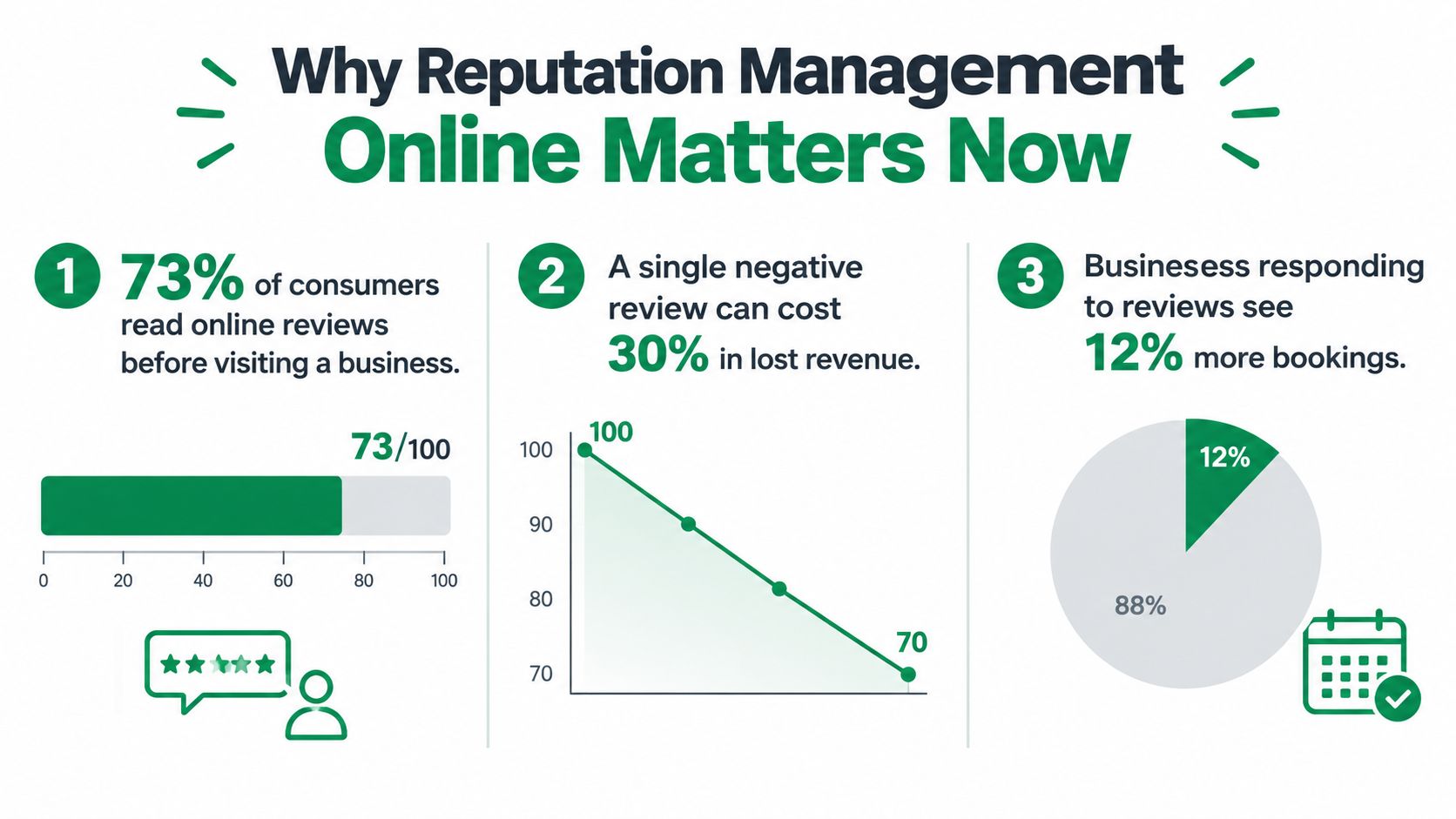
Why Reputation Management Online Matters Now
The current review environment makes reputation a conversion issue, not merely a branding concern. Survey-based reporting found that 97% of consumers read reviews for local businesses, while 41% always read reviews when researching a business. The same reporting says 80% are less likely to buy a product without ratings or reviews, and 90% consider how recently a review was written (World Metrics reports these review behavior findings).
Those figures create an operational requirement. A business can have an excellent service, accurate opening hours, and a well-optimized website, but still lose the customer if its visible feedback looks neglected, outdated, or one-sided. Buyers use reviews to reduce uncertainty. They want evidence that the business delivers consistently, handles problems responsibly, and remains active.
The shift is especially important for local SEO. Review content sits close to the moment of choice, often beside the business name, location, category, contact details, and directions. A neglected review profile can weaken confidence even when the underlying business is sound. Conversely, a thoughtful response can demonstrate care to people who never become customers.
From review volume to operational quality
Many businesses still treat review generation as the main objective. More genuine feedback helps, but volume alone doesn't explain how customers perceive a company. Recency, response behavior, sentiment diversity, and platform coverage give prospects a more realistic picture.
A profile containing only enthusiastic praise can look less credible than a profile showing mixed experiences alongside calm, specific responses. A recent complaint that receives no answer may carry more weight than older positive feedback. A review on a platform nobody internally monitors can expose a gap that isn't visible in the main dashboard.
The important distinction is between having a reputation and managing reputation. Every local business has an online reputation, whether its owner watches it or not. Management means assigning ownership, defining response standards, recording recurring complaints, and making sure the public record reflects how the business operates.
Practical rule: Treat every public review as both a customer interaction and a piece of market intelligence.
This mindset also prepares businesses for AI-mediated discovery. Consumers may encounter summaries of review sentiment before reading individual comments, so clear, specific, and current feedback has value beyond the original review page. Reputation management online now requires businesses to make accurate information easy for both people and systems to interpret.
Core Components of Effective Online Reputation Management
Effective reputation management online has several moving parts. Star ratings matter, but they don't tell a prospective customer whether the business listens, resolves issues, or keeps its service consistent. A useful system combines monitoring, interpretation, response, review generation, and operational follow-through.
Response behavior is part of the trust signal
Review responses show prospects how the business behaves under public scrutiny. Research cited by CX Network found that 45.1% of consumers consider whether brands respond to reviews, while only 20.5% trust a brand with exclusively positive reviews (CX Network covers these response and trust findings).
That doesn't mean a business should manufacture criticism or treat negative feedback as good news. It means that visible engagement can make a review profile feel more credible. A response should acknowledge the customer's experience, address the specific issue, and offer a sensible next step. Generic lines such as “We're sorry you feel this way” often signal that nobody examined the complaint.
Response speed matters because the review remains visible while the customer is deciding. The same source reports that 53% of customers expect a response to a negative review within a week, while operational guidance commonly recommends aiming for a reply within 24 to 48 hours. A fast reply isn't enough on its own, but a delayed reply can make a solvable issue look like an accepted pattern.
Coverage must match the customer journey
A local business should identify every platform where customers can discuss it, not only the profile that receives the most internal attention. Depending on the sector, that may include Google Business Profile, Yelp, Facebook, TripAdvisor, industry directories, social networks, and location-specific forums.
The monitoring gap is substantial. A 2026 industry report found that 55% of businesses monitor only two or three review platforms, while fewer than a quarter track four or five and very few cover six or more (Local Impact documents the multichannel monitoring gap). This creates a dangerous blind spot for multi-location businesses, where different branches may attract feedback on different sites.
A practical reputation dashboard should show:
- Platform coverage: Which sites collect reviews, comments, questions, or complaints?
- Location ownership: Which person handles each branch or service area?
- Response status: Which items are new, acknowledged, resolved, or awaiting follow-up?
- Recurring themes: Are customers mentioning delays, unclear pricing, staff conduct, access, or product quality?
- Escalation triggers: Which complaints require a manager, legal review, or direct customer-care intervention?
Review generation also needs restraint. Businesses should make it easy for customers to leave honest feedback at a natural point after an appointment, purchase, or delivery. They shouldn't pressure customers to leave only positive reviews, hide negative feedback, or create incentives that breach platform policies.
For broader operational guidance, expert tips for your reputation can help teams build a more complete approach around monitoring, responses, and customer feedback. The useful principle is simple: ask for authentic feedback, respond to all meaningful feedback, and use patterns to improve the service behind the profile.
The Reputation Management Workflow for Local Businesses
A workable workflow doesn't require a large team on day one. It requires a named owner, a shared record, and clear rules for what happens when feedback arrives. The process below works manually for a small business and can later support software automation.
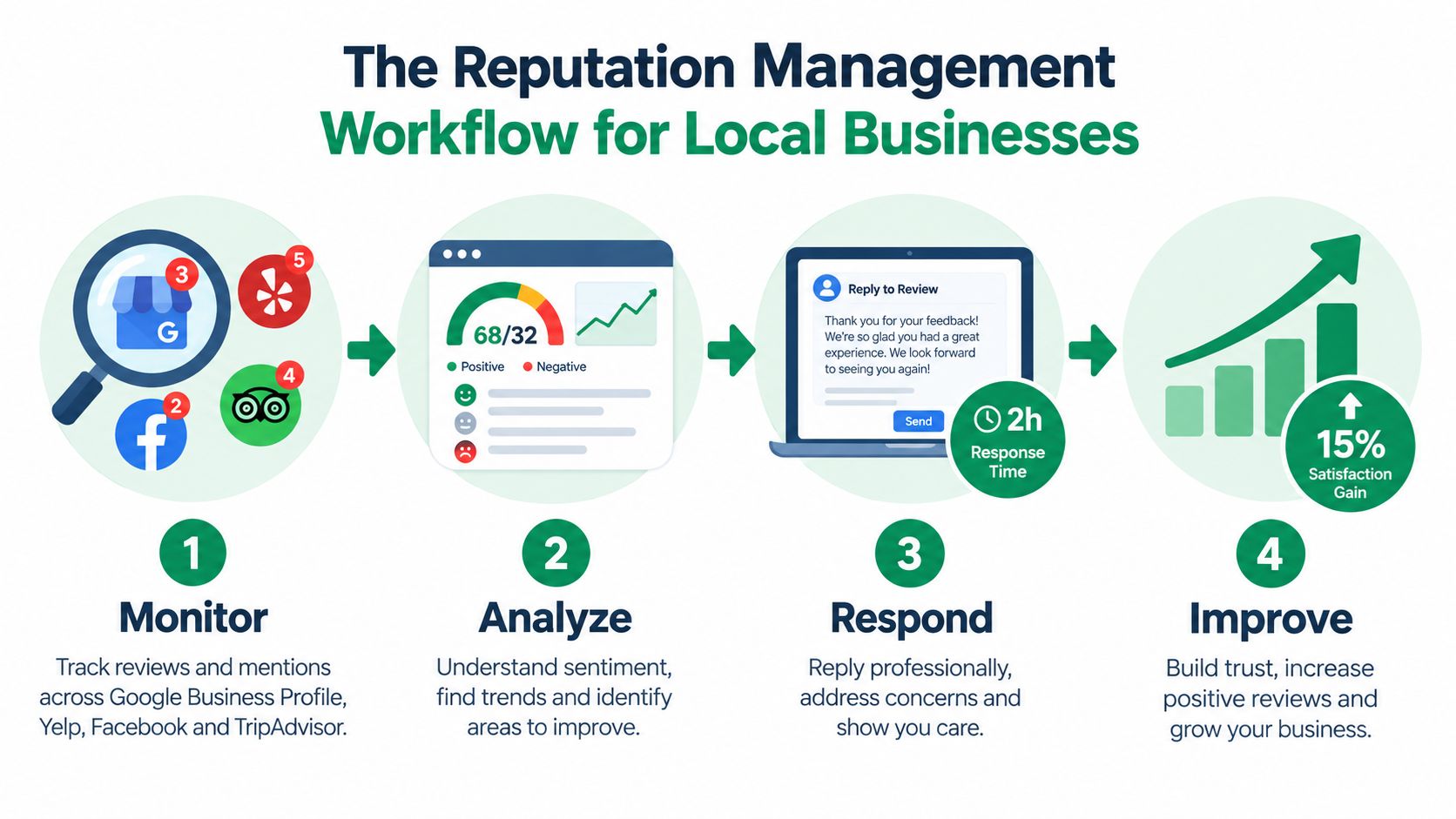
1. Monitor every meaningful channel
Start with a platform and location inventory. Search the business name, branch names, phone numbers, service names, and common misspellings. Record where customers can review or mention the business, then check whether the company controls the profile and receives notifications.
The multichannel problem is easy to underestimate. The Local Impact report identifies coordination across teams and locations as a leading challenge, so a single-location workflow won't translate neatly to a franchise or regional service brand. A central sheet can be enough initially, provided every row has a platform, location, owner, date, sentiment, action, and status.
Businesses can also use the review management workflow described for local SEO teams as a reference when deciding what to centralize and what to assign locally.
2. Classify the feedback before replying
Don't treat every review as a writing task. First decide whether it is a routine compliment, a service complaint, a factual correction, a safety concern, a privacy issue, or a likely policy violation.
Look for repetition. Several complaints about the same appointment delay may reveal a scheduling problem. Several comments about confusing prices may indicate that the website, booking flow, and staff explanations need to align. Sentiment analysis can help sort large volumes, but a manager still needs to interpret context and decide what the business should change.
3. Respond with speed and specificity
Create response guidelines, not rigid scripts. The person replying should know the brand tone, the issues that require escalation, and when to move a conversation into a private channel. A strong public response usually does four things:
- Acknowledges the experience without arguing about the customer's emotions.
- Addresses the specific point instead of repeating a generic apology.
- States the next step when the business can investigate or correct the issue.
- Protects privacy by avoiding personal details in the public thread.
AI can draft a first version, but a human should check names, facts, promises, and tone before publishing. A fast, inaccurate answer damages trust more efficiently than no answer.
4. Generate feedback without gating it
Ask customers at a relevant moment, such as after a completed service or delivered order. Use a direct review link, a follow-up message, or an in-store prompt, but invite honest feedback rather than steering only satisfied customers toward public platforms.
The report cited earlier notes that customers often forget to leave reviews. That makes timing and convenience more useful than repeated pressure. A reminder should be easy to understand, optional, and connected to the actual interaction.
5. Handle unusual or high-risk cases separately
A suspicious review shouldn't trigger an aggressive public argument. Preserve the evidence, compare it with platform policies, report it through the correct process, and publish a short factual reply if prospective customers need context. Don't accuse a reviewer of fraud without evidence.
For a service failure affecting several customers, use a crisis protocol. Assign one decision-maker, prepare consistent facts, pause improvised replies, and document what the business is doing to fix the underlying issue. Reputation management fails when five employees publish five conflicting explanations.
AI Tools That Transform Reputation Management
Traditional reputation management relies on manual searches, email notifications, spreadsheets, and individually written replies. That approach can work for a small business with limited review volume, but it becomes fragile when the company has several locations or platforms. Important feedback gets missed, duplicate issues are counted separately, and managers spend time copying information between systems.
AI tools are most useful when they reduce that administrative load without removing human accountability.
Where automation earns its place
A practical tool stack can support four jobs:
| Reputation task | Manual approach | AI-assisted approach |
|---|---|---|
| Monitoring | Check each platform separately | Consolidate alerts and new feedback |
| Classification | Read and label every item | Group themes and flag urgent language |
| Response drafting | Write from scratch | Suggest a draft using the review context |
| Reporting | Build summaries manually | Surface recurring issues by location and period |
The value isn't a promise that software will solve reputation by itself. The value is shorter time to detection, better consistency, and clearer prioritization. A tool can identify that several reviews mention waiting times, but an operations manager must determine whether staffing, scheduling, or communication caused the problem.
Sentiment classification also needs supervision. Sarcasm, local expressions, mixed reviews, and industry-specific language can confuse automated systems. Treat AI labels as triage signals, not final judgments. High-risk complaints should go to a person immediately.
For teams evaluating broader automation, AI operations with Truespeak provides useful context on how AI agents can support operational workflows while leaving decisions and oversight with people. That distinction matters in reputation work because a public reply carries the business's name and can remain visible long after the original interaction.
Choosing tools by operational complexity
A single-location business may need alerts, response templates, and a simple issue log. A multi-location brand needs permissions, branch-level ownership, approval workflows, reporting, and a way to compare recurring themes without losing local context.
A directory such as AI Tools for Local SEO can help teams compare software categories that include review management, local listings, Google Business Profile workflows, reporting, and multi-location SEO. The selection criteria should come from the workflow, not from the length of a feature list.
Use automation for repetitive work:
- Collecting feedback: Bring reviews and mentions into one working view.
- Prioritizing risk: Flag urgent complaints, repeated issues, and unanswered items.
- Drafting replies: Produce a starting point that a responsible employee edits.
- Finding patterns: Group complaints by location, service, product, or operational cause.
- Preparing reports: Show response status and recurring themes to managers.
Keep human control over apologies, compensation, allegations, safety issues, legal matters, and any reply that could create a public commitment. You can explore the distinction between automation and human review in AI review management for local businesses.
Real-World Reputation Management Success Example
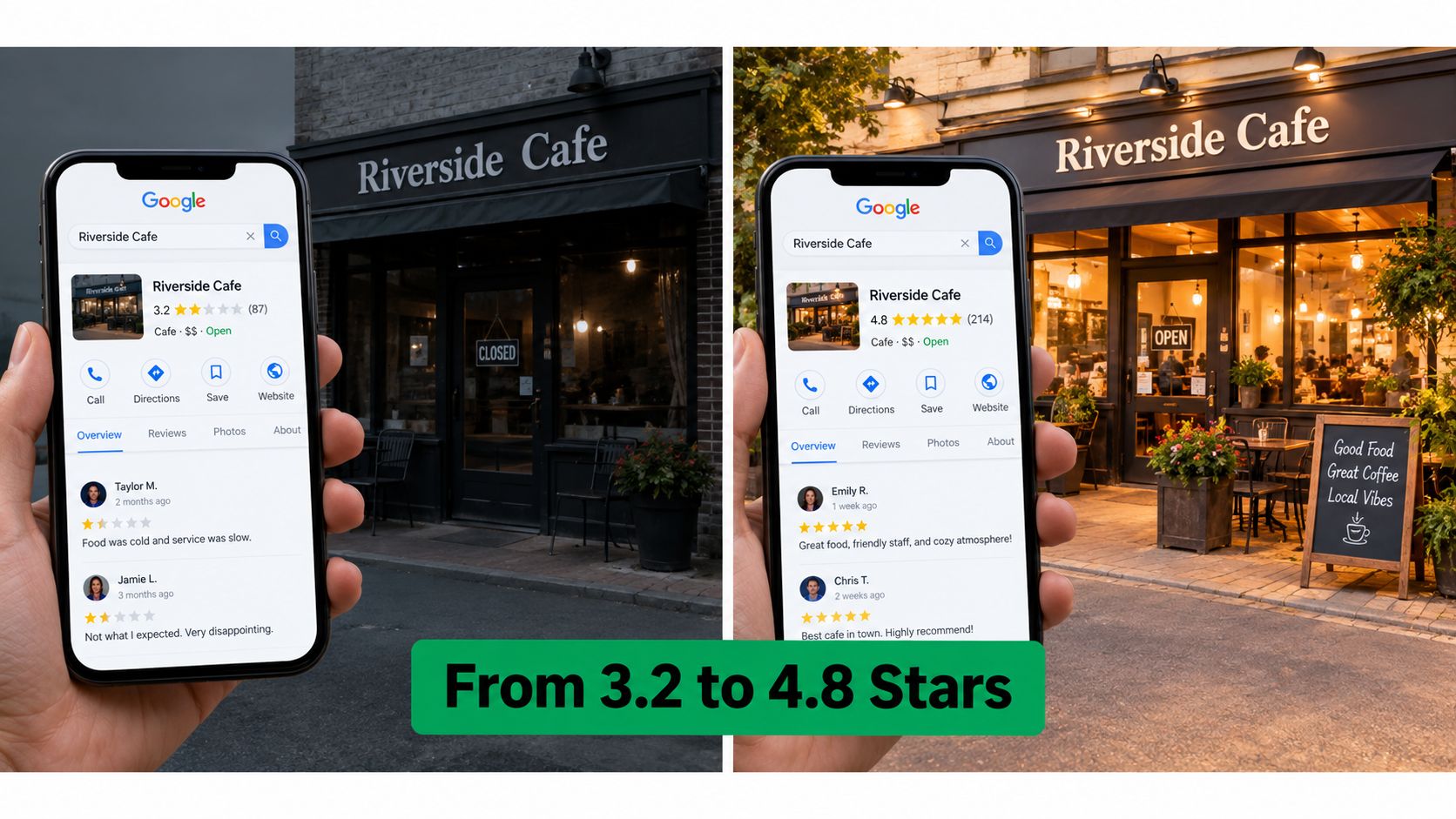
Consider a representative multi-location home services business that discovers its reputation process is fragmented. Each branch checks its main Google profile, but nobody owns industry directories or social comments. Managers respond when they notice a review, so some replies appear quickly while others remain unanswered. The business has no shared way to identify whether complaints come from scheduling, technician communication, billing, or the service itself.
The first improvement isn't a new slogan or a request for more five-star ratings. The team builds a location-by-platform inventory, assigns an owner for each queue, and records every review in a common system. Managers then categorize feedback by issue and escalate complaints that require a service investigation.
What the team changes
The response policy uses flexible guidance. Positive reviews receive a personal thank-you that refers to the customer's experience. Negative reviews receive an acknowledgment, a specific explanation where appropriate, and a private route for resolving account details. Staff members stop arguing publicly and stop promising outcomes they can't guarantee.
The business also changes how it requests feedback. Customers receive a straightforward invitation after the service is complete, with no instruction to leave a particular rating. Branch managers review recurring themes during operational meetings, so reputation data influences staffing, scheduling, training, and customer communication.
AI helps consolidate platforms, group similar complaints, and prepare draft replies. It doesn't publish automatically. A manager checks every response for accuracy and makes sure the wording reflects the capabilities of the branch.
The trade-offs are part of the result
This kind of change creates extra work at the start. Staff must agree on ownership, managers need training, and the company may uncover service problems it previously ignored. A centralized workflow can also feel less personal if branch teams aren't allowed to add local context.
The advantage is control. The business can see where feedback originates, separate isolated incidents from repeated failures, and demonstrate active customer care across locations. It can also turn recurring complaints into operational projects instead of treating each review as a disconnected event.
The example is intentionally representative, not a claim about a specific company's measured performance. Businesses assessing similar programs can use reputation management examples for local SEO to compare possible workflows, but they should set their own baseline before promising outcomes.
Useful baseline questions include:
- Which platforms and locations are currently monitored?
- How many reviews have no response?
- Which complaints repeat across branches?
- Who approves sensitive responses?
- How does the team know whether a service change reduced the issue?
Connecting Reputation Management to Local SEO Performance
Reputation management online supports local SEO because it shapes what people see near a search result and what systems can understand about the business. Reviews add language about services, customer experiences, locations, and recurring strengths or weaknesses. Responses add another layer of publicly visible context.
That doesn't make every review a ranking tactic. Businesses shouldn't force keywords into replies or write for an algorithm instead of a customer. The stronger approach is to deliver a good service, make honest feedback easy, respond clearly, and keep business information consistent across profiles.
The signals to connect
Recency matters because an old review may not describe the current business. The review behavior data cited earlier shows that customers pay attention to how recently feedback was written, so a review program needs a steady, ethical reminder process rather than a one-time campaign.
Response quality affects how prospects interpret criticism. A calm, specific answer can show that the business is active and accountable. A copy-pasted reply can make the interaction feel automated, particularly when potential customers compare several local providers.
Sentiment diversity creates credibility. A profile with different experiences and visible responses may give a more realistic impression than one that appears unnaturally perfect. The objective isn't to hide legitimate criticism. It's to resolve the cause and show future customers how the company handles it.
Platform coverage protects the accuracy of the picture. If a business monitors only its preferred profile, it may miss feedback that customers and AI systems still encounter elsewhere. Multi-location brands should report by branch as well as across the entire organization.
Track a compact set of operational metrics:
- Unanswered review count, separated by platform and location.
- Response time, especially for negative or urgent feedback.
- Recurring complaint themes, linked to an internal owner.
- Review recency, showing whether feedback reflects current service.
- Platform coverage, including profiles that need verification or ownership.
- Resolution status, distinguishing a public reply from an actual service fix.
The metric that matters most is not the number of replies. It's whether the business learns from feedback and changes the experience customers describe.
AI-mediated discovery makes structure and accuracy more important. Keep location pages, service descriptions, contact details, policies, and frequently asked questions consistent. Write responses that identify the actual issue rather than relying on vague reassurance. Clear information gives customers and automated systems less room to misinterpret the business.
Start today with an audit of your brand name, locations, main services, and review platforms. Assign one person to monitor each queue, set a response standard, document recurring complaints, and create an honest review request for completed customer interactions. Then review the workflow regularly, because reputation isn't a profile you finish optimizing. It's an operating system for trust.
Choose one location or branch and complete the first audit this week. List every platform where customers can discuss the business, assign response ownership, review the latest unanswered feedback, and turn the most repeated complaint into a specific service improvement.