The best agency stack is rarely one tool. The popular advice says to choose the broadest platform and consolidate everything under a single subscription, but that approach can leave an agency paying for features its team barely uses while still lacking the controls needed for local operations, fast rank checks, or client-level governance.
The better question is operational: which job must the software perform, for which clients, and at what scale? National SEO accounts need deep keyword, competitor, technical, and backlink research. Local and franchise accounts need location-level tracking, listings control, review workflows, and safeguards against cross-client data errors. Reporting-heavy retainers need branded dashboards, permissions, scheduled delivery, and integrations with GA4 and Google Search Console. Automation introduces another layer, including APIs, webhooks, task handoffs, and visibility beyond traditional blue-link rankings.
That distinction matters in a rapidly expanding category. One market estimate values global SEO software at USD 74.6 billion in 2024 and projects USD 154.6 billion by 2030, a 13.5% CAGR from 2025 to 2030 (Grand View Research's SEO software market analysis). Agencies therefore need an operating layer, not just a keyword database. This comparison evaluates each platform by its primary agency job, best-fit client profile, workflow role, integrations, pricing considerations, implementation friction, and trade-offs. If you're also evaluating tools for WordPress sites, use this guide to compare WordPress SEO tools.
1. Semrush
Best for: Core SEO research and broad campaign management
Website: Semrush
Semrush is the strongest single-vendor option for agencies that want one broad research and visibility environment. Its role starts before a contract is signed, with Keyword Overview, Competitor Research, Backlink Analytics, and Site Audit, then continues into Position Tracking, content work, and client reporting. That breadth makes it useful for agencies managing mixed portfolios, especially when one client needs competitive research and another needs technical monitoring.
The agency workflow is straightforward. An account manager can create projects, connect GA4 and Google Search Console, monitor tracked positions, and schedule PDF or online reports for recurring retainers. Semrush One tiers also extend into AI-assisted analysis and tracking beyond traditional Google results, which is relevant as agencies assess visibility across newer search experiences. Agency-oriented listings and lead-generation components can support prospecting, but they're separate considerations from the core SEO subscription.
Why agencies choose it
Semrush's central advantage is dataset breadth. Research, auditing, rank tracking, content, competitive analysis, and reporting sit close together, so teams can reduce the number of separate point solutions they maintain. That can simplify onboarding and internal training, particularly when several specialists need access to the same client projects.
Operational fit: Choose Semrush as the core when your agency values broad research coverage more than deep specialization in one local or reporting workflow.
The limitation is commercial and architectural. Tiers, usage limits, and agency add-ons can make the final subscription harder to model than the headline plan suggests. Agency Partners and lead-generation functions should be evaluated separately from the research stack, because an agency may need the latter without needing the former. Semrush is also broad enough to create training friction. A team should define which modules are part of its standard delivery process before granting access across every account.
2. Ahrefs
Best for: Backlink intelligence and competitive research
Website: Ahrefs
Ahrefs earns its place when an agency's strategy depends on understanding why competitors earn visibility, particularly through backlinks, content coverage, and organic search positioning. Site Explorer gives strategists a detailed environment for examining link profiles and organic data, while Keywords Explorer supports topic and query research. Site Audit and Rank Tracker add execution and monitoring, but Ahrefs' clearest agency job remains research depth.
Content teams can use Content Explorer and Web Explorer to identify ideas, publishers, and digital PR opportunities. Those outputs can then move into a client brief, outreach workflow, or reporting system through CSV exports. Ahrefs also supports a Looker Studio connector, which gives agencies a path to build custom dashboards rather than relying on a fully native branded reporting layer.
Where it fits in an agency stack
Ahrefs works well as the research engine behind a modular stack. An agency might use it for competitor and backlink analysis, pair it with a local specialist for Google Business Profile and citation operations, and send selected metrics into Looker Studio or AgencyAnalytics for client delivery. That division keeps research depth separate from presentation and location management.
The tool also suits teams that want analysts to work directly with exported data. CSV access is useful when a strategist needs to blend link findings with CRM records, content inventories, or an internal opportunity model. The trade-off is that custom reporting becomes the agency's responsibility.
The reporting limitation
Ahrefs doesn't provide fully white-labeled report delivery inside the platform in the same way a dedicated reporting product does. Agencies therefore need to budget implementation time for exports, Looker Studio connectors, or a third-party dashboard. Per-seat and usage-based costs also deserve close review as team access and client activity expand.
Practical rule: Buy Ahrefs for the questions your strategists need to answer, not because it can technically replace every other system.
That distinction prevents a common mistake. A high-quality backlink index doesn't automatically provide local listing governance, client portals, or portfolio-level workflow controls. Ahrefs is a powerful evidence source, but it's usually not the complete agency operating system.
3. Moz Pro and Moz Local
Best for: Combining traditional SEO with local listings
Websites: Moz Pro and Moz Local
Moz works best when an agency needs to separate two service lines without making the client experience confusing. Moz Pro handles keyword research, site crawling, link analysis, campaign tracking, and reporting exports. Moz Local handles business listing distribution, listing consistency, and review monitoring. Together, they form a practical stack for agencies serving local businesses that still need conventional technical and organic SEO.
That separation is a strength rather than a weakness. A local campaign often has two distinct operating rhythms. The SEO team may work on site structure, content, and rankings, while a local operations team manages business data and reviews. Keeping those functions visible makes ownership clearer and helps an agency explain which deliverables belong to which retainer component.
Best-fit client profile
Moz Pro and Moz Local suit agencies with mixed local portfolios, such as service businesses, professional practices, and brands with several branches. Moz's established Domain Authority and Page Authority metrics can also make reporting more accessible for clients who don't want raw backlink exports or technical crawl data.
Moz Local's value increases when listing distribution and review monitoring are recurring responsibilities. The platform can support a repeatable local maintenance process, but agencies should examine whether the required local capabilities are included in the selected tier. Advanced or more immediate local functions may require higher Moz Local plans.
The principal trade-off is data depth. In some niches, agencies may find Moz's backlink or SERP coverage less extensive than leading rivals. That doesn't make the platform unsuitable, but it changes how it should be positioned. Moz is a sensible choice for clarity, familiar metrics, and a clean split between traditional SEO and local operations. It may not be the best research source for a highly competitive digital PR or link intelligence program.
Before purchase, map the workflow rather than comparing feature names. Decide whether Moz Pro will be the research core, whether Moz Local will own listings and reviews, and where final client reports will live. If those responsibilities remain undefined, the two-product combination can create another silo instead of a coherent delivery system.
4. BrightLocal
Best for: Local SEO execution and client reporting
Website: BrightLocal
BrightLocal is built around the daily work local SEO agencies deliver. Its strongest role is not broad national keyword research. It's the operational layer for Google Business Profile audits, citation management, local grid rank tracking, review monitoring, and white-label reporting.
That focus makes BrightLocal a natural fit for agencies whose portfolio consists mainly of local businesses. A strategist can inspect GBP performance, identify listing issues, track rankings across a geographic grid, monitor reviews, and present the results in branded dashboards. The platform's recurring local tasks also support standardized retainers, where the agency needs to repeat similar work across many accounts without rebuilding the process each month.
Why it stands out for local delivery
Local rankings vary by searcher location, so a single citywide position can hide meaningful differences between neighborhoods. Grid tracking gives agencies a more useful operational view of geographic coverage. Citation audits and building workflows then connect visibility problems to business information that the team can correct or manage.
BrightLocal also offers a practical reporting advantage. White-label reports and client dashboards reduce the need to construct a presentation layer from scratch, which matters when local deliverables must be explained to nontechnical business owners.
Local workflow test: Ask whether the platform can move your team from audit, to task, to verification, to client explanation without forcing analysts into several unrelated systems.
Limitations and implementation friction
BrightLocal's focus creates its main limitation. Agencies that also need deep backlink research, broad competitor intelligence, or complex national content planning will still need a core platform such as Semrush, Ahrefs, SE Ranking, or Serpstat. BrightLocal should usually be treated as the local execution specialist, not the only SEO database.
Cost modeling also requires care. Per-location pricing can become significant when an agency manages many small clients or large location footprints. Citation services may initially be difficult to understand because software access and service-based work are separate purchasing decisions. Build a location inventory, identify which tasks are automated, and separate software fees from citation fulfillment before presenting the stack to finance or clients.
5. Whitespark
Best for: Expert-led citation work and local rank tracking
Website: Whitespark
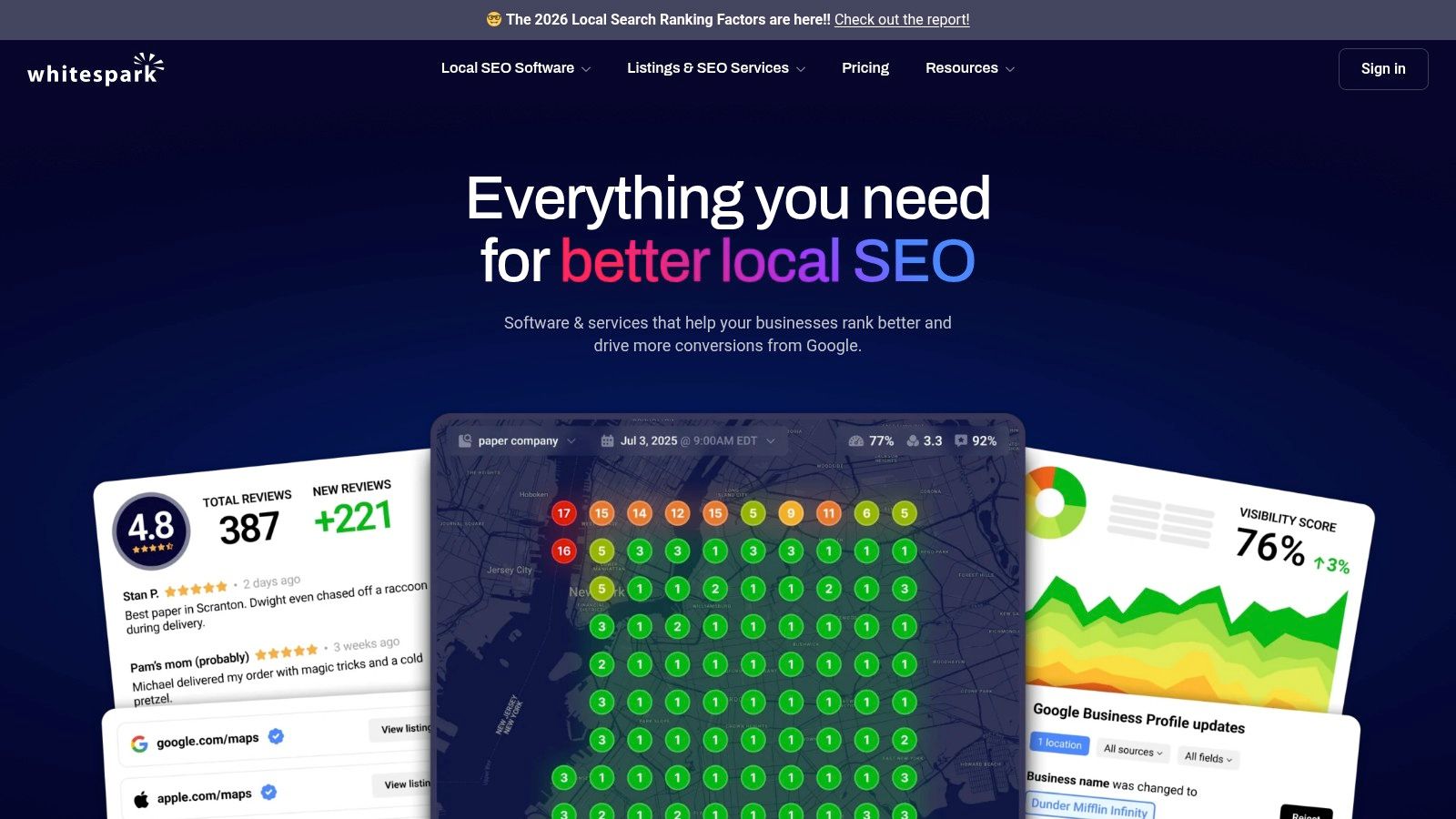
Whitespark is for agencies that don't want local SEO reduced to a software dashboard. Its strongest job is specialist local operations, especially citation building and cleanup, local rank tracking, geo-grid visualization, and review workflows. The platform also provides a Citation Finder to uncover opportunities that an agency can evaluate as part of a broader local strategy.
The distinction between Whitespark and BrightLocal is important. BrightLocal is often easier to frame as a local SEO suite for recurring agency delivery. Whitespark is more naturally suited to expert-led work, where an agency wants access to focused tools and may resell or commission human-verified citation services for clients.
A complement, not a replacement
Whitespark doesn't try to replace a broad SEO platform. It won't serve as the central source for large-scale keyword research, competitor analysis, or a full technical SEO program. That narrower scope is useful when the agency already has a research core and needs a high-signal local component.
The Local Rank Tracker supports maps and organic tracking, while grid visualizations help teams examine local visibility across a service area. Reputation Builder adds review generation and monitoring, which can connect local search work to customer experience operations.
For agencies, the main commercial question is whether local services are sold as a standardized product or as expert-managed projects. Done-for-you citation work can be valuable for clients that lack internal capacity, but services priced by location or project can increase the cost of scaling. The agency needs a clear fulfillment model before it bundles the work into a fixed retainer.
Best use: Pair Whitespark with a broad research platform when citation quality and local expertise matter more than having every function inside one interface.
That stack can be more honest than an all-in-one promise. The research platform answers strategic questions, Whitespark handles specialized local work, and a reporting layer translates outcomes into client language. The agency retains control over which system owns each task, rather than forcing one product to perform jobs it wasn't designed to handle.
6. AgencyAnalytics
Best for: White-label reporting and client dashboards
Website: AgencyAnalytics
AgencyAnalytics solves a problem that research platforms often leave unfinished: turning scattered campaign data into a client-facing reporting system. It centralizes SEO, PPC, social, GBP, advertising, and analytics metrics through 80+ integrations, including GA4, GSC, GBP, advertising platforms, and rank trackers. The value is operational, not diagnostic. AgencyAnalytics is a reporting layer rather than an SEO data source.
A typical agency can create templates, connect campaign sources, configure permissions, add annotations, and schedule PDF reports or live dashboards. Client portals let nontechnical stakeholders view a controlled version of performance data without entering the underlying SEO platforms. That separation helps agencies protect account structure while still giving clients visibility.
Why reporting deserves its own platform
Many agencies treat reporting as the final step after strategy and execution. In practice, reporting has its own data model. Different clients use different goals, conversion actions, locations, and channels. A dedicated system lets the agency standardize the presentation while preserving campaign-specific metrics.
The platform also supports multi-channel views, which is useful when a client judges SEO alongside paid search, social, or lead-generation activity. A report can therefore show the relationship between visibility, traffic, goals, and campaign annotations without asking an account manager to assemble screenshots manually.
For agencies evaluating white-label SEO dashboards, the central implementation question is data ownership. Decide which platform is the source of truth for rankings, which system owns conversions, and how often each connector refreshes. A polished dashboard can still mislead clients if the agency hasn't documented those definitions.
The trade-off
AgencyAnalytics cannot create the underlying backlink index, crawl a site as a primary auditor, or replace a dedicated local listing platform. Its quality depends on the connected systems and on the agency's template design. Advanced customization may take setup time, especially when different services require different KPIs.
Use it when client delivery is the bottleneck. Don't buy it expecting the reporting layer to compensate for weak data sources or unclear campaign governance.
7. SE Ranking
Best for: Affordable all-in-one agency operations
Website: SE Ranking
SE Ranking is a strong candidate for agencies that need a practical core platform without making the deepest possible backlink dataset the main buying criterion. It combines daily rank tracking, local and map results, Share of Voice, keyword and competitor research, backlink analysis, Site Audit, on-page checking, and change monitoring.
Its agency value comes from how those modules work together. A team can create projects for multiple clients, monitor rankings, audit technical issues, and connect GA4, GSC, Looker Studio, or API-based workflows. Agency Pack options and API or MCP access make it relevant for teams that want to extend the platform rather than rely only on native screens.
The price-to-workflow argument
SE Ranking is often more attractive when an agency values scalable limits and broad coverage over premium specialization. That doesn't mean it eliminates the need for judgment. Analysts still need to validate ranking data, interpret audits, and decide which research findings become client tasks.
The platform can serve as the center of a smaller stack. An agency might use SE Ranking for campaigns and reporting, then add BrightLocal or Whitespark for specialized local work. A larger agency could connect it to AgencyAnalytics when the native reporting workflow doesn't match its client portal requirements.
SE Ranking's own plan structure is a moving target. Plan names and add-ons changed in 2026, so agencies should verify current project, keyword, API, user, and reporting limits before migrating. Treat the pricing page as a configuration document, not a simple monthly fee.
Buying test: Run one representative national account and one local account through the proposed plan. Check limits at the project, keyword, user, export, and integration levels before committing the whole portfolio.
The principal limitation is research depth in certain backlink niches. Agencies conducting highly specialized link intelligence may prefer Ahrefs or Semrush as a companion. For many small and mid-sized agencies, however, SE Ranking's combination of breadth, reporting, and add-on flexibility can make it a sensible operating core.
8. Serpstat
Best for: Price-conscious research and API-driven workflows
Website: Serpstat
Serpstat suits agencies that want broad SEO functionality and enough technical access to build their own workflows. Its modules cover keyword and domain research, paid and organic search analysis, backlink exploration, Site Audit, regional rank tracking, clustering, and API access.
That combination makes Serpstat especially relevant for data tinkerers. An agency can pull research into an internal dashboard, use API outputs to trigger custom automations, or combine ranking and audit data with its own client database. The product doesn't need to be the final presentation layer if the agency already has Looker Studio, AgencyAnalytics, or an in-house reporting environment.
The right type of agency
Serpstat is a reasonable core for small to mid-sized agencies that prioritize breadth and cost control. It can support discovery, audits, ranking work, and custom reporting without requiring a separate tool for every basic SEO task.
The trade-off appears in the details. Data depth can lag behind top-tier rivals in some datasets, and the interface may require more learning than a narrowly focused tracker. Module structure and usage limits also need documentation because an agency's theoretical feature access doesn't guarantee sufficient capacity for every client workflow.
A good implementation starts with a defined API use case. Don't buy API access merely because it sounds useful. Specify which data will be pulled, where it will be stored, how often it will refresh, and who owns the resulting dashboard. If no one maintains that pipeline, the agency may pay for a capability that never becomes part of delivery.
Serpstat also works well as a modular research component. Pair it with a dedicated local platform for listings and reviews, or with AccuRanker when ranking speed and refresh control are more important than broad research. That combination may be more efficient than forcing Serpstat to serve every account type.
The platform's limitation is therefore manageable, provided the agency acknowledges it. Serpstat is not necessarily the deepest source in every category, but its breadth and API orientation can support a customized operating model.
9. AccuRanker
Best for: Fast, high-volume rank tracking and reporting
Website: AccuRanker
AccuRanker is the specialist choice for agencies whose clients ask one recurring question: where do we rank right now, and what changed? The platform focuses on rank tracking, SERP feature insights, visibility metrics, landing-page mapping, alerts, white-label reports, and integrations with GA4, GSC, and Looker Studio.
That focus is valuable for agencies managing large keyword sets or reporting-sensitive retainers. On-demand refreshes give teams a way to investigate ranking changes without waiting for the next scheduled check. SERP feature and AI search tracking research can also broaden the monitoring brief beyond traditional position numbers.
When a dedicated tracker makes sense
A broad SEO suite may already include rank tracking, but that doesn't mean its refresh behavior, reporting controls, or alerting fits every agency. AccuRanker becomes more compelling when ranking data is the product the client sees most often, or when account managers need quick confirmation during an algorithm, competitor, or local volatility event.
“A rank tracker is not a strategy platform. It's an evidence and monitoring layer.”
That boundary prevents overbuying. AccuRanker doesn't replace keyword research, backlink analysis, or technical auditing. An agency adopting it will still need a research core and, for local portfolios, a platform that handles listings, reviews, and location operations.
The pricing consideration is specialization. A premium rank tracker can be justified when timely data supports a high-value reporting workflow, but it may be unnecessary for a small account with limited monitoring requirements. Model costs around keyword volume, search engines, locations, refresh needs, seats, exports, and report recipients rather than selecting the tool from its accuracy claims alone.
AccuRanker also needs a measurement definition. Share of voice, visibility, SERP features, and landing-page mapping can enrich a report, but they shouldn't replace business outcomes. Connect ranking changes to GSC, GA4, goals, and documented client actions so the tracker informs decisions instead of producing another isolated scorecard.
Agencies comparing AI rank trackers should also ask whether AI visibility is a core deliverable or an experimental monitoring layer. The answer determines whether the added tracking scope belongs in every client report or only in internal research.
10. Yext
Best for: Multi-location governance and centralized local presence
Website: Yext
Yext fits agencies whose main job is controlling local data across complex location networks, franchise systems, or enterprise programs. Its role is governance, rather than rank tracking. The platform centralizes business information, distributes listings across publisher networks, manages reviews, supports location pages, and reports on local presence activity.
Yext describes coverage across 200+ publishers and partners, with near-real-time update capabilities in its platform materials. That reach matters when an agency must coordinate information across many locations instead of making manual edits in separate publisher accounts. The agency should still verify that the relevant publishers, markets, and fields are covered before committing.
Why governance changes the buying decision
Multi-location SEO creates operational risks that a feature list can hide. An incorrect address, outdated opening hour, inconsistent service description, or unauthorized edit can affect several locations at once. Yext's connectors and knowledge graph give agencies a central source for business data, approval rules, and controlled publishing.
Reviews and local pages can follow the same operating model. That consolidation may reduce handoffs between listing, reputation, and location-content teams. It depends on client participation, though. The client must agree on shared data standards and approval procedures across locations, rather than using Yext as an optional dashboard for a few branches.
Smaller accounts may find the trade-offs difficult to justify. Pricing is generally custom or quote-based, and the platform can exceed the needs of one local business or a limited location set. Implementation also requires defined ownership: who maintains source data, who approves changes, how exceptions are recorded, and how the workflow handles openings, closures, relocations, or service changes.
For category context, agencies can compare citation management software, then test Yext against a representative client's publisher coverage, approval process, review requirements, and location-page workflow.
Yext is the strongest fit on this list when the agency's central problem is control across a large footprint. It does not replace research, technical auditing, or rank monitoring. A practical stack may pair Yext with a research platform and a dedicated tracker, using each tool for the agency job it performs best. Its value emerges when the cost of inconsistent local data exceeds the complexity of enterprise implementation.
Top 10 Agency SEO Management Tools Comparison
| Tool | Core focus / Key features | Best for / Target audience | Unique selling point (USP) | Pricing / Value |
|---|---|---|---|---|
| Semrush (Semrush One + Agency tools) | Site audit, keyword & backlink research, position tracking, GA4/GSC integrations, AI analysis | Full-service agencies needing an all-in-one visibility stack + client reporting | Broad dataset and integrated client/lead-gen add-ons | Higher-tier pricing, add-ons can increase cost |
| Ahrefs | Industry-leading backlink index, Keywords Explorer, Site Explorer, rank tracker, exports | Agencies focused on backlink/competitive intelligence and content research | Best-in-class backlink data and crawling | Mid–high pricing, per-seat/usage costs can be high |
| Moz Pro + Moz Local | Keyword Explorer, Site Crawl, Link Explorer; Local listings sync & review monitoring | Agencies combining traditional SEO retainers with local listings management | Clear separation of SEO tools and local listings; client-friendly metrics | Moderate pricing; Moz Local tiers for advanced features |
| BrightLocal | GBP audits, citation management, local/grid rank tracking, review tools, white-label reports | Local-focused agencies managing many locations and recurring tasks | Purpose-built local workflows with strong white-label reporting | Per-location pricing, good value but costs scale with locations |
| Whitespark | Managed citation building/cleanup, local rank tracker (grid), reputation builder, citation finder | Agencies wanting expert-driven citation services or to resell local ops | Human-verified citation services and focused local tooling | Service/pricing per location/project; can be costly at scale |
| AgencyAnalytics | 80+ integrations, white-label portals, automated PDF/live dashboards, client permissions | Agencies that need centralized, automated client reporting and portals | Live white-label dashboards that automate multi-tool reporting | Per-dashboard/seat pricing; scalable for many clients |
| SE Ranking | Daily/local rank tracking (maps), site audit, keyword/backlink research, API, Agency Pack | Cost-conscious agencies seeking an all-in-one core stack | Strong feature-to-price ratio with scalable limits and add-ons | Affordable base plans, extras purchasable as needed |
| Serpstat | Keyword & domain research, backlink exploration, site audit, rank tracking, API | Small-to-mid agencies and teams wanting breadth on a budget | Competitive pricing with good API/access for custom pipelines | Budget-friendly plans, good value for price-sensitive teams |
| AccuRanker | High-frequency/on-demand rank checks, SERP feature insights, share of voice, white-label reports | Agencies needing very fast, accurate ranking across large keyword sets | Fast, reliable rank data and polished white-label reporting | Premium pricing focused on enterprise-grade rank tracking |
| Yext | Listings sync (200+ publishers), review monitoring, local pages, knowledge graph & analytics | Enterprises, franchises, and multi-location brands needing centralized governance | Deep publisher integrations and centralized location data governance | Custom/quote-based enterprise pricing; best for larger footprints |
Build the Stack Around the Workflow
Choosing seo management software for agencies shouldn't begin with a vendor leaderboard. It should begin with the agency's delivery sequence and the points where work currently breaks. The market evidence supports that approach. One industry estimate puts the agencies SEO services market at USD 75.22 billion in 2025, with a projection of USD 165.29 billion by 2030 and a 17.1% CAGR from 2025 to 2030 (The Business Research Company's agencies SEO services report). As agency services expand across regions, software needs to standardize delivery without flattening every client into the same template.
Start with a broad research and auditing core. Semrush is the most natural fit when the agency wants wide coverage across competitor research, technical auditing, content, tracking, and reporting. Ahrefs is better aligned with backlink intelligence and competitive research. SE Ranking or Serpstat can provide a more configurable core for agencies that prioritize broad coverage, limits, and API access.
Add a local specialist when the portfolio includes local businesses, service areas, or multiple locations. BrightLocal fits recurring local execution and white-label delivery. Whitespark suits citation-led, expert-managed work. Moz Pro with Moz Local gives agencies a clear split between conventional SEO and listings. Yext belongs in the discussion when enterprise location governance, centralized business data, reviews, and location pages are the primary operational problem.
Choose a dedicated rank tracker when reporting speed, keyword volume, geographic precision, or refresh control demands more than the core platform provides. AccuRanker can fill that role, but it should remain a monitoring layer rather than become a substitute for research and diagnosis. Connect its outputs to first-party data and documented business goals.
Finally, add a reporting layer when client delivery consumes too much analyst time or when stakeholders need controlled access to multiple channels. AgencyAnalytics can centralize connected metrics, permissions, templates, annotations, live portals, and scheduled reports. The platform still depends on accurate source systems, consistent KPI definitions, and careful template governance.
Before signing, document every limit that can affect margin or delivery:
- Keyword limits: Include tracked terms, search engines, locations, refresh frequency, and historical retention.
- Location limits: Record branches, grids, listings, reviews, location pages, and per-location service charges.
- User and permission rules: Confirm seats, client access, role-based permissions, data separation, and account ownership.
- API and export access: Identify available endpoints, credits, refresh rules, export formats, and connector dependencies.
- White-label scope: Check branded domains, logos, client portals, PDF reports, email delivery, and vendor references.
- Add-on exposure: Separate core subscription fees from agency packs, citation services, extra keywords, additional locations, and API usage.
The underserved issue is governance. Independent agency guidance emphasizes client-by-client data separation, cross-portfolio visibility, and role-based access, because shared logins and improvised folder structures become unsafe as portfolios grow (Project Rank Up's agency software guide). Build those controls into onboarding, naming conventions, approval workflows, and reporting templates from the start.
AI search adds another selection question. Industry coverage identifies movement toward serverless rank tracking, AI-powered content optimization, automated log-file analysis, predictive analytics, and search-intent modeling (HDinResearch's SEO software market coverage). Agencies don't automatically need a larger all-in-one suite. A modular stack combining research, local operations, rank monitoring, reporting, and AI-visibility analysis may produce cleaner ownership and lower implementation friction.
AI Tools for Local SEO can help agencies discover AI-powered options across local research, Google Business Profile optimization, listings, reviews, rank tracking, reporting, multi-location SEO, and agency operations. Use it as a discovery resource, then validate each candidate against your own client isolation, location, API, export, white-label, and add-on requirements.
Audit your current agency stack this week. List every client workflow, assign one system as the source of truth for each data type, and test the shortlisted combination against a real local account and a real national account before purchasing additional seats or add-ons.