The popular advice says to pick one all-in-one SEO platform and let it handle everything. That sounds efficient, but it often leaves small businesses paying for research, automation, and reporting features they won't use while their actual bottleneck remains unresolved. A business that needs better Google Business Profile management doesn't necessarily need a backlink database, and a WordPress site with technical problems won't be fixed by a review platform.
This roundup treats small business SEO software as a set of complementary tools. The ten picks are organized around practical jobs, including local visibility, GBP management, citation control, review operations, content research, and technical SEO. Some tools combine several workflows, while others are deliberately narrow and easier to operate.
Pricing is described by the supplied plan structure or pricing model. Offers, limits, and bundled features can change, so verify the current terms before subscribing. For broader discovery, AI Tools for Local SEO can help you browse focused categories and assemble a stack around your specific local workflow. If you're still diagnosing the website itself, this technical and local SEO guide provides useful background.
1. BrightLocal
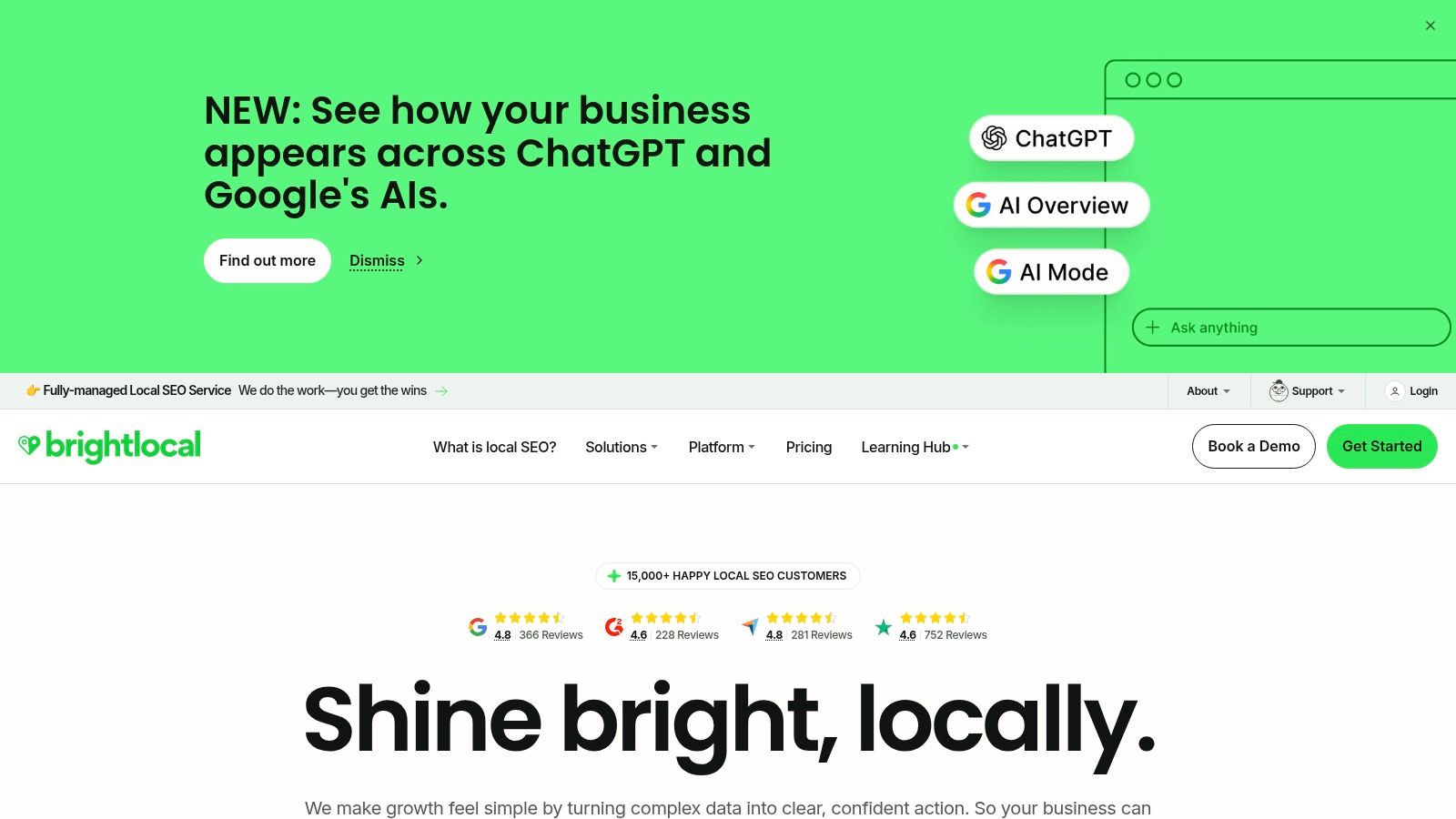
BrightLocal is the strongest starting point when a small business needs one practical local SEO workspace rather than a general-purpose research suite. It brings local audits, Google Business Profile benchmarking, rank tracking, geo-grid maps, listings management, review workflows, and reporting into a single dashboard.
The workflow is action-oriented. A business can begin with a Local Search Audit and GBP audit, inspect visibility across a service area with the Local Search Grid, then work through listings and review tasks without moving between unrelated products. Its Active Sync feature is designed to keep core citation information consistent, while review request workflows can use email or SMS. Review widgets also help bring customer feedback onto the website.
Best fit and coverage gap
BrightLocal suits local businesses, consultants, and agencies that need to monitor several parts of local search without building a complicated stack. Its AI insights and AI visibility tracker can help prioritize actions, but the platform remains more useful for local execution than for deep national keyword discovery or extensive backlink research.
That distinction matters. A plumber, clinic, restaurant, or service-area contractor may get more value from a clear map report and citation workflow than from an enterprise-scale keyword database. An established content team, however, may still need a broader SEO suite alongside it.
Practical rule: Choose BrightLocal when the main question is “What should we fix across our local presence?” rather than “How do we conduct deep competitive research?”
Its entry-level pricing is positioned as transparent and scalable per location, with agency reporting and white-label options available at lower tiers. Review the location limits carefully if you manage multiple branches. To compare citation-focused alternatives, see this guide to citation management software.
2. Semrush Local
Semrush Local makes sense for a business that wants local SEO inside a much larger research ecosystem. Its Local Toolkit adds Google Business Profile automation, review workflows, directory distribution, and map rank tracking to Semrush's established keyword, backlink, site audit, and reporting functions.
The GBP AI Agent is the most notable workflow feature. It can support audits, post creation, automated replies, and routine profile upkeep. Listing distribution extends local business information across major directories, while Map Rank Tracker uses geo-based tracking to show how visibility changes across an area. The broader Semrush platform gives the business a clear upgrade path into competitor research and technical diagnostics.
Best fit and coverage gap
This is a sensible choice for a small marketing team that already needs classic SEO research and doesn't want a separate local platform. It also works for an agency that wants to move a client from local basics into content, backlinks, and site audits without changing ecosystems.
The tradeoff is scope. A single-location business that only needs accurate listings, simple GBP maintenance, and occasional map checks may find the wider platform excessive. Local features are modular, but per-location pricing can become harder to justify as a portfolio grows. Buyers should compare the cost of the base plan, Local Toolkit, map credits, and any usage limits rather than evaluating the headline subscription alone.
Semrush's research depth is useful only when someone can interpret it and act on it. For a small team without SEO experience, the platform can create more data than the business can operationalize.
Read this guide to research competitor keywords if competitive content research is part of the buying decision. Semrush Local is best viewed as a bridge between local operations and full SEO research, not as the cheapest route to basic GBP upkeep.
3. Whitespark
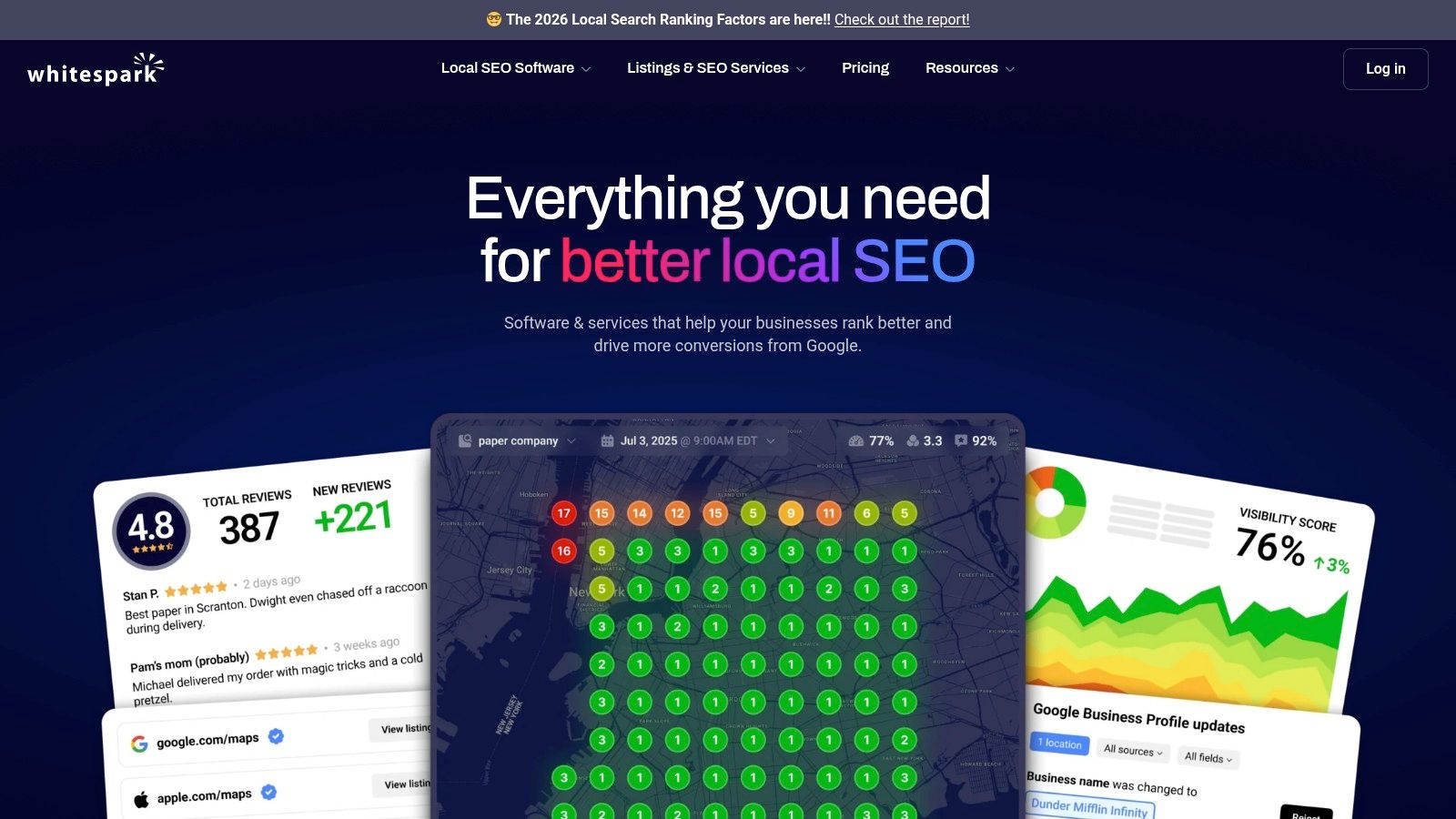
Whitespark takes the opposite approach to an all-in-one suite. It separates local SEO into purpose-built products, including Local Rank Tracker, Local Ranking Grids, Local Citation Finder, a Local Platform for GBP basics, and paid citation services. That unbundled structure can lower waste for a small business with one clearly defined problem.
The Local Rank Tracker supports flexible keyword tiers, while Local Ranking Grids show map-pack performance across precise coordinates. Citation Finder helps identify and monitor business mentions, and the citation audit, cleanup, and building services can be purchased as one-time work rather than as part of a large recurring platform.
Best fit and coverage gap
Whitespark is particularly useful for a consultant, freelancer, or owner who knows which local task needs attention. A business trying to understand why it appears in one neighborhood but not another can use the geo-grid product. A company with inconsistent directory information can focus on citation work without paying for extensive content research.
The limitation is fragmentation. You may need several separate products to reproduce the broader local workflow available in BrightLocal or Semrush Local. That can make reporting and account management less convenient, especially when a small team wants one dashboard for audits, reviews, rankings, and listings.
The pricing model is the attraction. Local Rank Tracker is available across tiers covering 100 to 2,500 location keywords, and the Local Platform is offered at $1 per location, according to the supplied product details on Whitespark. Those figures should still be checked against current terms before purchase.
A specialist tool can be cheaper than an all-in-one platform only when its narrow coverage matches the task you actually need done.
Choose Whitespark when control and modularity matter more than a unified interface. It's less suitable for a business that wants automated review requests, broad content research, or extensive technical auditing in the same subscription.
4. Moz Local
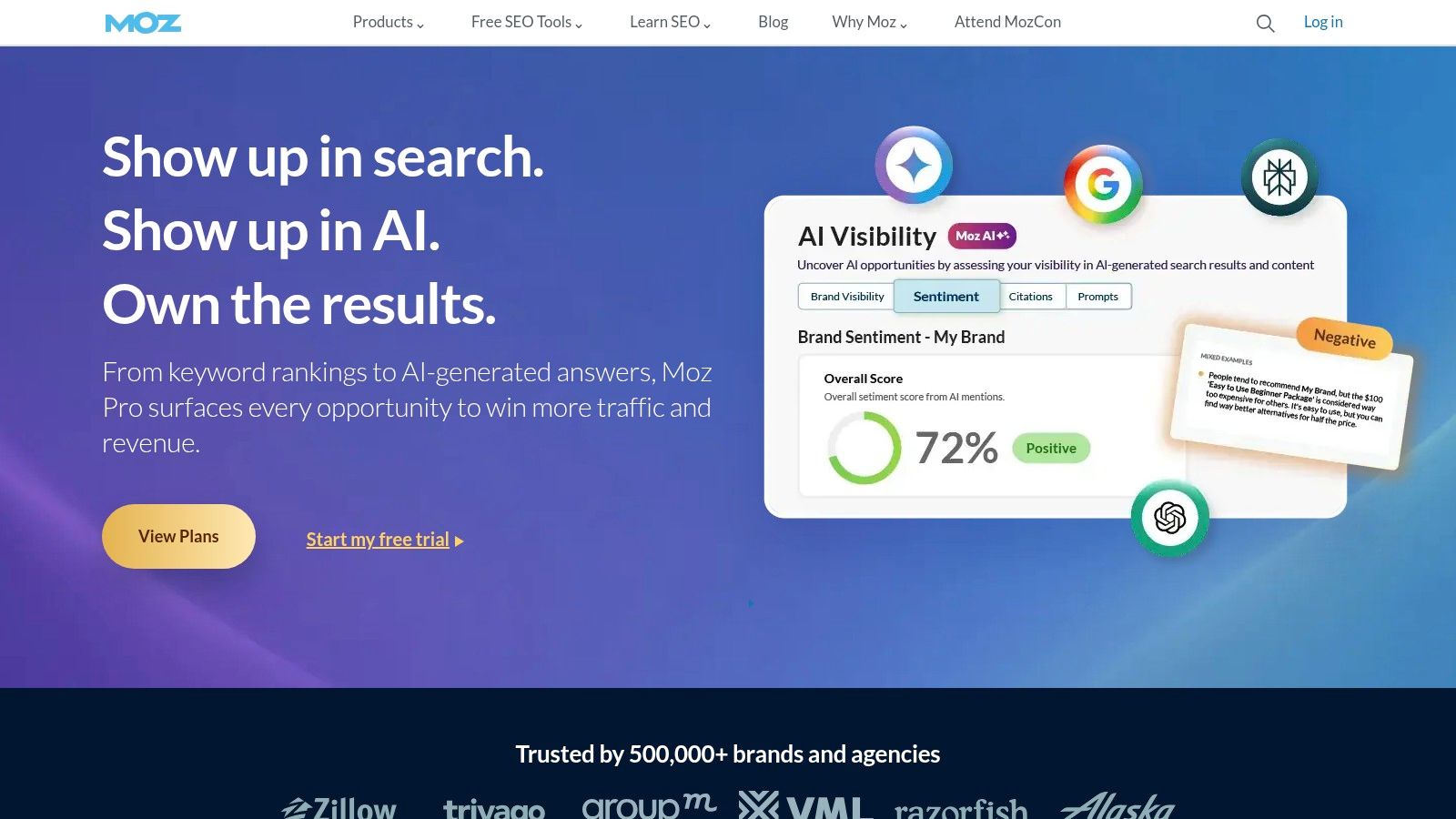
Moz Local is built around a straightforward local data problem, keeping business information accurate and synchronized across directories. Its core listing sync reaches more than 100 directories, and Google Business Profile management sits at the center of the workflow. Higher tiers add review monitoring and social posting, while optional AI features can extend listings and review operations.
For a single-location business, predictable per-location pricing is easier to understand than a large platform with many usage dimensions. A dentist, tradesperson, retailer, or professional office that mainly needs consistent name, address, and phone data may not need a full keyword and backlink suite.
Best fit and coverage gap
Moz Local works best when citation accuracy is the priority. It reduces the operational burden of updating core business details in multiple places, and its local focus keeps the interface more approachable than broad SEO platforms. The tool can also provide a useful foundation before a business adds a dedicated rank tracker or content research system.
Its boundaries are clear. Moz Local doesn't replace a deep site audit, competitor research platform, or full link analysis product. Review monitoring depends on the selected tier, and buyers may need to contact sales or consult current product information to confirm the exact pricing and feature combination.
The per-location model can be attractive for one branch but deserves closer inspection for multi-location businesses. Compare the number of locations, included distribution coverage, review features, and any AI add-ons before calculating the total cost.
For businesses that need more granular map visibility, tracking local rankings with a geo grid is a useful complementary workflow. Moz Local handles information consistency well, but it won't explain every reason a listing ranks differently from a nearby competitor.
5. Local Falcon
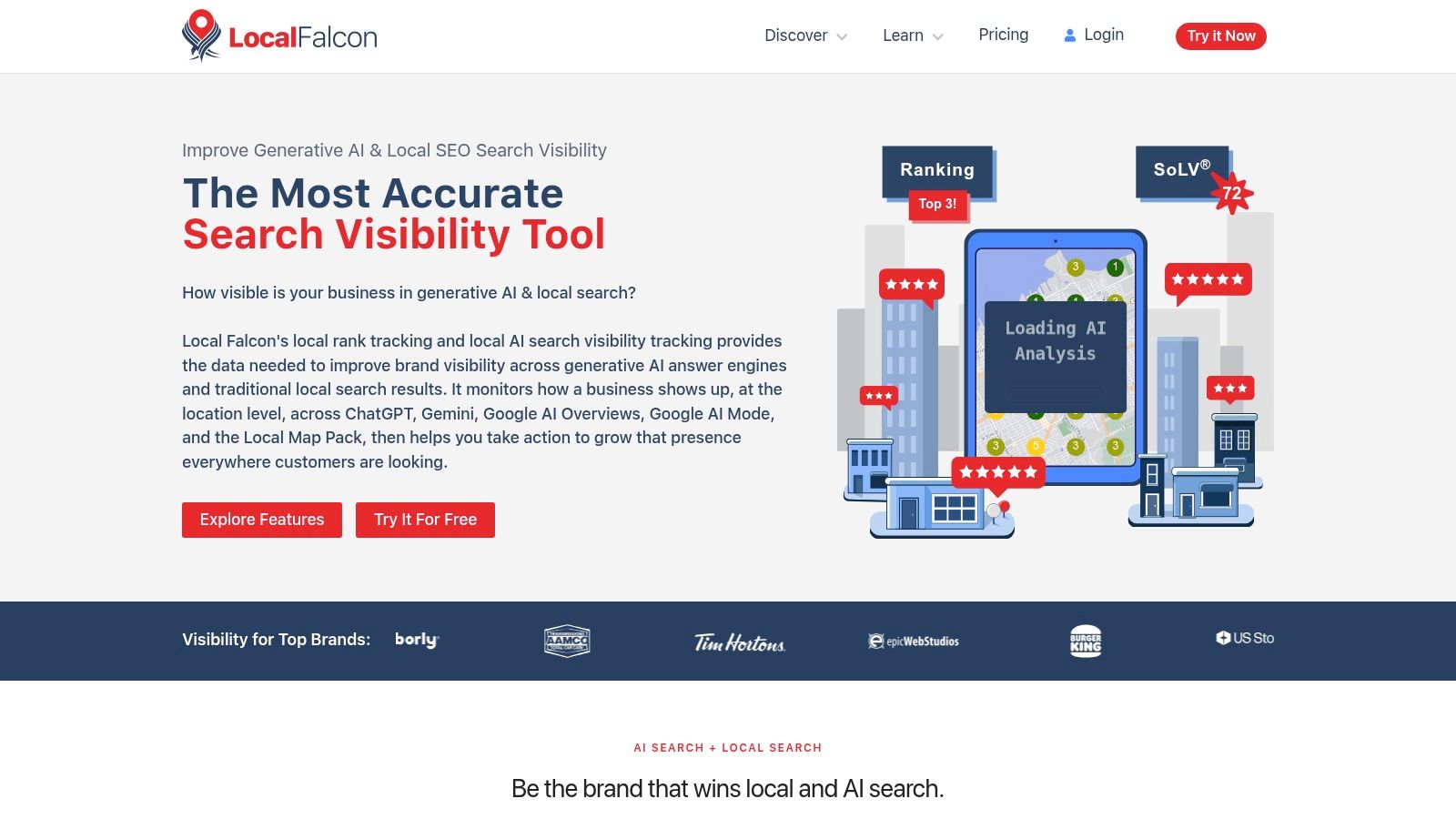
Local Falcon is a focused answer to one question: how visible is a business in Google Maps across its service area? Its geo-grid scans display ranking performance through map pins, giving owners and stakeholders a visual explanation of local reach by neighborhood.
The credit model is central to the buying decision. Plans range from solo use to agency work and allocate different amounts of scan capacity. The platform explains how credits work, which makes it easier to estimate usage before committing. Reports are also simple to share, an important advantage when the person paying for SEO doesn't work in the tool every day.
Best fit and coverage gap
Local Falcon suits a single-location business that already has a listings or GBP process but lacks reliable geographic rank monitoring. It can also help an agency show a client that visibility isn't uniform across a city. A business may rank strongly near its address while appearing much less often farther away, and a grid makes that pattern easier to discuss than a single ranking number.
The platform deliberately doesn't cover citations, content planning, review generation, or broader keyword and backlink research. That's not a flaw if map tracking is the only missing workflow. It becomes a weakness when the owner expects one subscription to diagnose and fix the underlying causes.
Use a Google Business Profile rank checker when comparing this type of tool with broader local platforms. Local Falcon is a measurement layer, not a complete small business SEO system.
6. Localo
Localo is designed for owners and small teams that need a guided GBP improvement process rather than a data-heavy SEO environment. Its audit reduces findings to a single score and a “what to fix first” roadmap, then turns recommendations into practical tasks.
The platform also supports GBP content and post scheduling, rank tracking, and basic review workflows. Its 14-day free trial and support for all languages and alphabets make it easier for a small operator to test the workflow before adopting it, according to the supplied product details on Localo.
Best fit and coverage gap
Localo is a good fit for a freelancer managing local clients, an owner doing SEO without specialist training, or a small team that needs a prioritized to-do list. The prescriptive approach reduces the common problem of opening an audit, seeing many issues, and not knowing which one deserves attention first.
That simplicity also defines the limitation. Localo is primarily a GBP optimization assistant. It doesn't offer the breadth of backlink research, content intelligence, or technical auditing found in Ahrefs or Semrush. A business with a serious content program will need another tool, while a multi-location operator should test how tasks, reporting, and location limits scale.
Its starting price is positioned as low and transparent, with annual discounts available. Confirm the current plan limits before purchasing, especially if you need several profiles, regular rank scans, or agency reporting.
Localo is most valuable when the problem is execution discipline. It gives a small team a sequence of actions instead of another dashboard to interpret.
7. PlePer
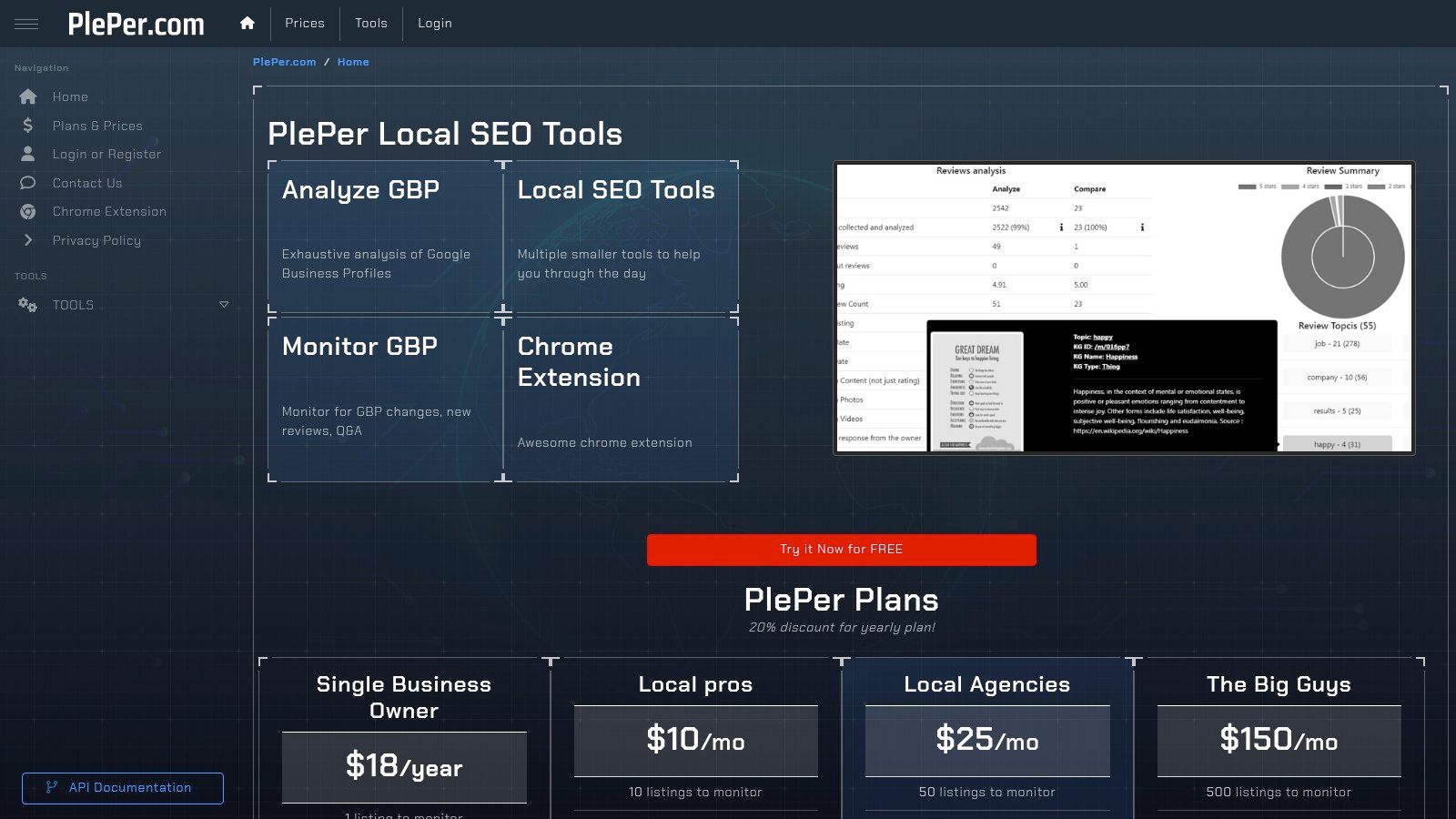
PlePer is a lightweight GBP utility set for businesses and consultants that want profile-specific monitoring without buying a broader SEO suite. It can monitor listings, reviews, and questions and answers, while change alerts help surface edits that deserve attention.
Its research tools are also tightly focused. Category discovery, competitor category analysis, duplicate listing checks, and basic multi-listing oversight can answer questions that general-purpose SEO platforms often bury inside larger workflows. The product scales from one to 500 listings, with consistent feature access across tiers, based on the supplied product details on PlePer.
Best fit and coverage gap
PlePer suits an owner who wants to check whether a GBP has changed, a consultant who needs category research, or a small operation that wants a low-cost monitoring layer beside another SEO platform. Its entry pricing is listed as low as $18 per year for one listing, but buyers should confirm the live offer and included usage before subscribing.
The platform doesn't provide broad keyword research, full site audits, content optimization, or link analysis. That narrow scope is exactly why it can be useful. A company doesn't have to pay for functions it already handles elsewhere, and setup should be lighter than a full local marketing platform.
The main question is whether monitoring is enough. PlePer can identify profile changes, duplicates, and category opportunities, but a business may still need another system for citation distribution, review request campaigns, or geo-grid reporting. Treat it as a GBP utility, not a replacement for the entire local SEO stack.
8. Ahrefs
Ahrefs is the better choice when a small business's local presence is only one part of a larger content and authority strategy. Site Explorer and Keywords Explorer support competitor and keyword research, while Site Audit and Rank Tracker cover technical and performance monitoring. Content Explorer, brand visibility features, and AI visibility tools extend the research workflow beyond standard rankings.
The strongest reason to choose Ahrefs is its backlink and keyword intelligence. A business that publishes guides, compares competitors, or actively pursues links will generally need more than GBP management. Ahrefs can reveal which topics competitors rank for, which pages attract links, and where content gaps may exist.
Best fit and coverage gap
Ahrefs is suitable for an owner with SEO knowledge, a content marketer, or a small agency that can convert research into briefs and page updates. Its free tier, Ahrefs Free, is available for verified site owners, and data connectors support Looker Studio according to the supplied product information on Ahrefs.
Paid plans are premium-priced, so the economics are different from a GBP utility or citation tool. A local business that only needs review monitoring and map visibility may pay for a large amount of unused research capacity. A company competing through service pages, educational content, and digital authority may find that broader coverage more relevant.
Buy Ahrefs for the questions behind organic growth, not simply for a local ranking number.
The setup demand is also higher. Users need to define target topics, interpret competitive data, and decide which opportunities fit the business. Ahrefs can inform a strong content process, but it doesn't replace the people responsible for subject expertise, publishing, and local conversion work.
9. Yoast SEO Premium
Yoast SEO Premium belongs in this list for a different reason. It works inside WordPress and addresses on-page and technical SEO at the point where a business creates and edits pages. Redirect management, multi-keyphrase optimization, internal linking suggestions, orphaned content detection, bulk metadata tools, and AI-assisted title and meta drafting reduce routine publishing friction.
The Local SEO features add location pages, opening hours, store locator functionality, and Maps embedding. That makes the plugin useful for a local WordPress site that needs structured on-site information, even though it doesn't manage off-site listings or citations.
Best fit and coverage gap
Yoast is a strong fit for a WordPress-based local business with an owner, editor, or freelancer who makes regular site changes. The benefit is operational rather than analytical. Instead of exporting recommendations from a separate audit platform, the user can handle many metadata, redirects, internal links, and schema-related tasks within the CMS.
The WordPress restriction is decisive. Shopify, Wix, Webflow, and custom-site owners need another solution. Yoast also won't coordinate review requests, directory distribution, GBP monitoring, or map-grid scans. It should therefore be paired with a listings or local visibility product when those workflows matter.
Premium includes 24/7 support and access to Yoast SEO Academy, according to the supplied product details on Yoast. Check whether the current package includes the local features your site needs, particularly if your business has multiple locations.
Yoast is best understood as the on-site layer of a local stack. It can make WordPress maintenance more consistent, but it can't establish the accuracy of every external business profile.
10. Birdeye
Birdeye is built around reputation, messaging, listings, and customer experience rather than traditional SEO research. Its review management can centralize feedback across more than 200 sites, with AI-assisted responses, review generation campaigns, listings distribution, social publishing, and consolidated messaging, according to the supplied product information on Birdeye.
That makes Birdeye particularly relevant to businesses where reviews and customer communication are central to local growth. A clinic, home services company, dealership, or multi-location brand may need a repeatable process for requesting reviews, monitoring responses, and routing messages more than it needs another keyword database.
Best fit and coverage gap
Birdeye supports both single-location and multi-location operations, but its value increases when review activity and messaging are spread across branches. Centralization can reduce the need for staff to check multiple sites manually, while automated replies and posting support routine reputation work.
The tradeoff is commercial complexity. Pricing is custom-quoted, which makes comparison harder than with transparent per-location tools. The platform can also feel too extensive for a very small single-location business that receives limited review volume and only needs occasional monitoring.
Ask for a quote that separates locations, review campaigns, listings, messaging, and any AI functions. Then compare those costs with the labor currently spent requesting reviews and responding to customers. Birdeye is not a substitute for Ahrefs-style content research or Yoast-style WordPress optimization, but it can be the right operational layer when reputation is the primary local search bottleneck.
Top 10 Small Business SEO Tools Comparison
| Tool | Core focus & key features | Target audience | Unique selling point | Pricing / Value |
|---|---|---|---|---|
| BrightLocal | Local audits, GBP optimization, geo-grid rank tracking, listings sync, reviews, reporting | Small businesses & agencies | End-to-end local dashboard with AI insights and white-label reporting | Transparent, low-entry per-location tiers; scalable |
| Semrush Local (Local Toolkit) | GBP AI agent, listings distribution, map rank tracking, integrates with Semrush research | Businesses wanting local + full SEO suite | Seamless upgrade into Semrush research tools; modular add-on model | Add-on or standalone; per-location costs can add up |
| Whitespark | Local rank tracker, geo-grids, citation finder, paid citation services | Local practitioners & small teams | Purpose-built local tools with per-product pricing | Unbundled, transparent pricing; low-cost entry options |
| Moz Local | Listing sync (100+ dirs), GBP management, review monitoring | Single-location SMBs prioritizing NAP accuracy | Predictable per-location listing focus from a trusted brand | Per-location plans; straightforward but some pricing via sales |
| Local Falcon | Geo-grid scanning with adjustable pin density, map-based reporting | SMBs needing neighborhood/service-area visibility | Visual, shareable map reports and clear credit model | Credit-based plans; competitive single-location entry |
| Localo | Prioritized GBP audit, task roadmap, rank tracking, post scheduling | Owners, freelancers, small teams | Prescriptive, guided workflow for non-experts | Low starting price with annual discounts; 14-day free trial |
| PlePer (GBP Utilities) | GBP monitoring, category discovery, duplicate checks, change alerts | Owners & consultants needing GBP utilities | Very affordable, lightweight GBP-focused toolkit | Extremely low entry (from ≈$18/year for one listing); scales to 500 listings |
| Ahrefs | Keyword & backlink research, site audits, rank tracking, content tools | Content-focused SMBs and agencies | Market-leading backlink and keyword databases | Premium-priced plans; limited free tier for verified sites |
| Yoast SEO Premium (WordPress) | On-page & technical SEO, Local SEO schema, AI meta/title drafting, redirects | WordPress local sites and developers | Integrated WordPress plugin with bundled local features and support | Plugin subscription model; WordPress-only |
| Birdeye | Centralized review management (200+ sites), AI replies, listings, messaging | Single-location to multi-location SMBs and brands | Robust review operations and multi-location messaging at scale | Custom-quoted pricing; can be costly for very small businesses |
Build the Smallest Stack That Solves the Problem
The right choice starts with the missing workflow, not the longest feature list. If local visibility varies by neighborhood, begin with Local Falcon or a platform that includes geo-grid tracking. If the business struggles with inaccurate directory information, compare Moz Local, Whitespark, and BrightLocal. If the team needs a guided GBP plan, Localo may be more practical than a broad research suite. If reviews and customer messages are scattered across locations, Birdeye deserves closer attention.
Next, check operational limits. A low headline price can become less attractive when location counts, scan credits, tracked keywords, review volume, or user seats are restricted. Multi-location businesses should calculate the cost of adding branches before signing up, because a tool that works well for one location may become inefficient as the portfolio expands.
Pricing transparency also changes the buying process. Whitespark, Localo, and several other tools expose clearer entry models, while Birdeye uses custom quotes. Neither approach is automatically better. Transparent pricing makes initial comparison easier, while custom pricing may bundle implementation or operational services that a small team would otherwise need to arrange separately.
Then test the reporting with the person who will act on it. A business owner may understand a map grid or a prioritized task list immediately, but struggle with a dense backlink or technical report. An agency may need white-label reporting and location-level segmentation that a simple owner-focused tool doesn't provide. The best dashboard is the one that leads to a decision, not the one that displays the most metrics.
Use specialized tools together only when their coverage gaps are intentional:
- GBP utilities with research suites: Pair PlePer or Localo with Ahrefs when profile maintenance and broader content research are separate jobs.
- WordPress with listings management: Combine Yoast with Moz Local or BrightLocal when on-site optimization and external citation accuracy need different owners.
- Review operations with local measurement: Add Birdeye to a geo-grid tracker when reputation management and geographic visibility require separate reporting.
- Citation work with content strategy: Use Whitespark for local data cleanup and Semrush or Ahrefs for competitor and topic research.
The SEO software market is expanding, but its buyer needs aren't identical. One outlook values the global category at $3.8 billion in 2025 and projects $8.2 billion by 2034, with SMEs representing 61.3% of the market in that report. Another outlook uses substantially higher market estimates, so buyers should treat market-size projections as directional rather than as a reason to purchase a particular platform. The more useful conclusion is that small businesses are a central audience for affordable, easy-to-implement SEO software, not an afterthought to enterprise products. The market overview provides the supplied context for those projections.
Before you subscribe, write down the task the tool must improve, the person responsible for using it, the locations or profiles involved, and the report that will prove progress. Browse AI Tools for Local SEO to compare focused categories for GBP optimization, citations, reviews, local content, rank tracking, technical SEO, and multi-location operations. Confirm current plans and capabilities directly with each vendor, then choose the smallest stack that your team can use consistently.